
Aperture synthesis 2026-10-18
Aperture synthesis reconstructs the sky's brightness from complex visibilities measured at different interferometric baselines. Each measurement constrains a Fourier transform component of the brightness, rather than supplying a little photograph. Combining many such components can distinguish sources that each individual antenna leaves unresolved. The remarkable economy is that changing separations and the rotation of Earth can provide many measurements with only a few physical antennas.
Martin Ryle's Cambridge group made aperture synthesis a practical method of astronomical imaging at the Mullard Radio Astronomy Observatory. Cambridge's institutional history connects that work with the One-Mile Telescope and its larger successors.[ref]
Mullard Radio Astronomy Observatory at Lord’s Bridge by Cavendish Laboratory, University of Cambridge. Cavendish Laboratory, Mullard Radio Astronomy Observatory at Lord’s Bridge, sections Foundation and early development and A centre for radio interferometry
In his 1974 lecture Radio Telescopes of Large Resolving Power, Martin Ryle recalled the problem of distinguishing weak extragalactic sources and resolving their structure. He explained sequential wavefront sampling using one simultaneously observed element as a wave phase reference, and the saving obtained by letting Earth rotate the apparent baseline.[ref]
Radio Telescopes of Large Resolving Power by Martin Ryle. Ryle (1974), Radio Telescopes of Large Resolving Power, pp. 187–192, Figures 1 and 4
The 1974 Nobel Prize in Physics distinguished Martin Ryle's observations and inventions, especially aperture synthesis, from Antony Hewish's role in discovering pulsars. The latter is a separate astronomical discovery, with its own observational history.[ref]
The Nobel Prize in Physics 1974 by Nobel Prize Outreach. Nobel Prize in Physics 1974, award explanation and equal prize shares
Interplanetary scintillation Created 2026-10-18 Updated 2026-10-20
Interplanetary scintillation is rapid variation in the received strength of a compact astronomical radio source, produced by propagation through fluctuating electron density in the solar wind. Its dependence on source angular size can help distinguish compact sources. It is a propagation effect, distinct from intrinsic periodic emission by a pulsar.
Radio telescope Created 2026-10-18 Updated 2026-10-20
A radio telescope is an astronomical instrument that receives radio waves using an antenna and associated receivers. A single dish measures radiation over its directional sensitivity pattern; separated elements can supply complex visibilities for aperture synthesis.
Radiation-reaction oscillator pole structure Created 2026-10-18 Updated 2026-11-05
For and the convention, the frequency response is . At small nonzero real , its poles areFor positive the slow oscillations decay but the fast mode runs away; for negative the fast mode decays but the slow oscillations grow. Thus no nonzero sign makes all modes stable. A causal initial-value response and a bounded response free of runaways impose different boundary conditions.
For positive , the real-axis frequency response of the radiation-reaction oscillator pole structure excludes future runaway growth but retains an upper-half-plane pole. Closing its inverse Fourier transform upward at gives a nonzero response before the force. The fast pole contributes approximately for negative . A strictly causal retarded prescription instead includes an exponentially growing term for positive and requires a Laplace transform contour. The pre-response is a consequence of imposing boundedness at future infinity, not an unavoidable property of all initial-value solutions of the differential equation.
Order reduction of a radiation-reaction oscillator Created 2026-10-18 Updated 2026-11-05
For , use the zeroth-order equation inside the small third-derivative term, givingFor positive this reduced equation has a stable retarded response with no high-frequency runaway. Its response agrees with the unreduced oscillator to first order at fixed nonresonant frequency. Order reduction deliberately removes the singular fast mode outside the assumed low-frequency regime; it is an approximation rather than an exact alternative boundary condition for the third-order equation.
Point emitter 2026-10-18
An ideal point emitter emits radiant flux from one location. It approximates a physical source when its emitting dimensions are small relative to the distances relevant to the calculation. With isotropy, its radiant intensity is for total radiant flux . An extended source generally requires integrating contributions from different emitting positions.
Replica trick 2026-10-18
For positive , the displayed identity follows by differentiating at zero.
Integer powers of a partition function represent independent copies with the same disorder. Integer moments alone do not justify analytic continuation or interchanging disorder averages and thermodynamic limits.[ref]
Citation Classic commentary on Theory of spin glasses by Sam Edwards. Edwards, 1985 commentary, replica averaging and acknowledged mathematical limitations
Two-spin quenched and annealed free energies 2026-10-18
Choose two Ising spins with Hamiltonian , where independently takes or with equal prior probabilities and . This original finite example has no geometrical frustration and no phase transition. Its four spin assignments give . ThereforeThe concave function puts . For this two-value case the claim is just , obtained by squaring . Thus no formal continuation of replicas is needed to see the distinction.
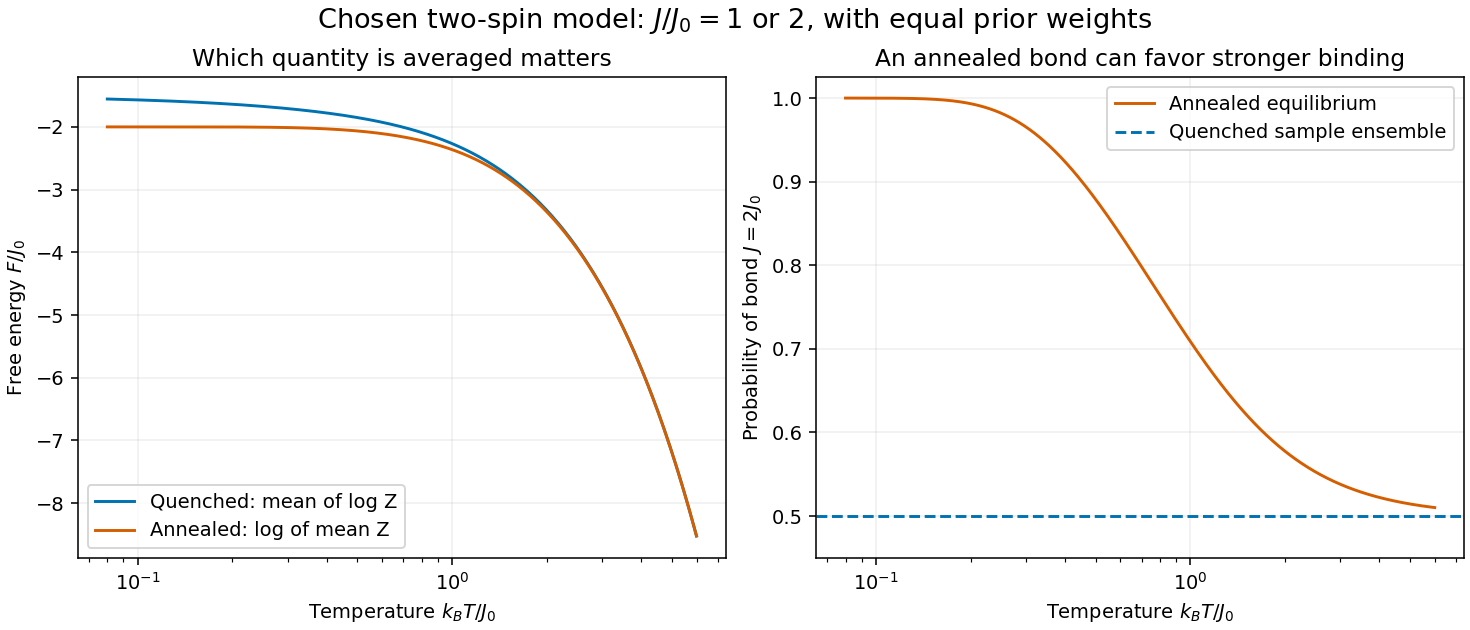

In the annealed disorder ensemble, the stronger bond has probability , approaching one at low temperature. A quenched disorder collection instead retains one half at each coupling. As , and : averaging samples and allowing the material variables to equilibrate describe different physics.
Electromagnetic production and decay of vector quarkonium Created 2026-10-18 Updated 2026-10-25
Single-photon electron-positron annihilation can directly form quarkonium with . A vector S-wave quarkonium can annihilate back through a virtual photon into a charged-lepton pair. At leading nonrelativistic order, its electronic partial decay width is proportional to , where the wavefunction at the origin describes the quark-antiquark annihilation overlap.
Below the threshold for a pair of heavy-light mesons, hadronic decays require annihilation, primarily into three gluons for a color-singlet state. One gluon cannot carry a color-singlet initial state, and two gluons have the wrong charge-conjugation parity. Above the heavy-light pair threshold, a strong interaction can instead separate the heavy quark and antiquark into different mesons after creating a light pair. This can greatly increase the total decay width without comparably changing the short-distance electronic partial width. A specific example is the contrast between the first three Upsilon mesons and the state. Higher radial states can additionally undergo hadronic or radiative transitions to lower quarkonium states.
Quark-model baryon-decuplet construction 2026-10-18
A particularly economical example is the baryon decuplet. Restrict to fully symmetric three-quark flavor states. The nonnegative occupation numbers satisfy , giving possibilities by stars and bars. Their additive labels areThese formulas follow directly from the constituent table. With fixed , there are possible values of , so the weight diagram has rows of four, three, two and one states. Its outer triangle is therefore a consequence of the constituent construction, rather than an arbitrary drawing convention.
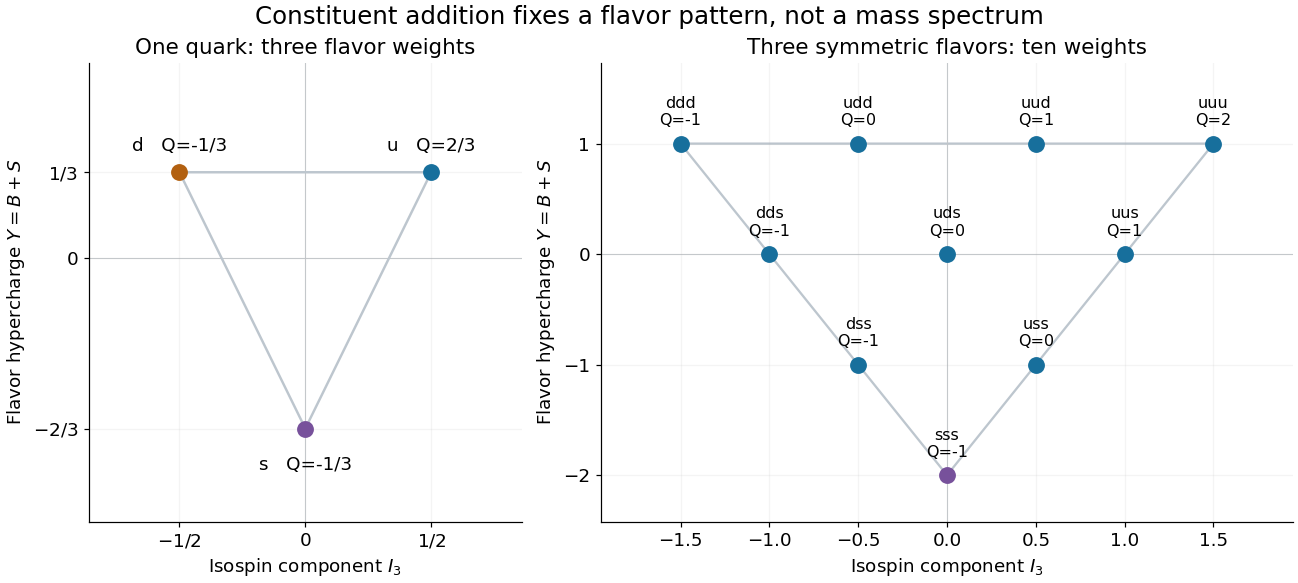

The bottom corner has , hence , and : the Omega baryon position. The top-right corner has and , corresponding to the doubly charged Delta baryon. Every point satisfies the Gell-Mann--Nishijima formula .
The flavor construction is only part of the state. The Pauli constraint on three-quark flavour multiplets also involves spin angular momentum, the spatial wavefunction and color charge. In particular, three identical fermions cannot be assigned a completely symmetric total state merely because the flavor diagram is symmetric. Nor does the same flavor diagram determine the hadron masses: an approximate flavor symmetry can organize a spectrum without making all its members degenerate.
Interband tunnelling 2026-10-18
Quantum tunnelling between different energy bands, including transfer between the valence band and conduction band in a tunnel diode.
Field electron emission Created 2026-10-18 Updated 2026-10-20
Field electron emission releases electrons from matter through electric-field-assisted quantum tunnelling at the surface. The emission mechanism and its rate are distinct from the subsequent acceleration and Larmor formula radiation of an electron already travelling through an approximately uniform electric field.
Second-order optical coherence 2026-10-18
For a source whose counting correlations are stationary, define the dimensionless correlationAssume finite moments and nonzero denominators. The numerator is in normal ordering: two detections remove two photons. The denominator is the product of the two single-count factors, so independent counts have reference value one. This is a diagonal restriction of the four-point second-order field correlation, rather than its complete definition.[ref]
One Hundred Years of Light Quanta by Roy Jay Glauber. 2005 individual Nobel lecture, pp. 87–89, equations (18)–(22); Liceo Galilei Verona mirror
For one selected mode with number operator and , evaluate both detections at the same time. The canonical commutation relation implies , henceThe factorial moment counts ordered pairs of distinct photons. Using would include pairing each photon with itself and would give the wrong coincidence prediction. At this normalized expression is undefined, rather than zero.
In the 2007 cavity quantum electrodynamics experiment of Christine Guerlin and collaborators, including Sébastien Gleyzes, Michel Brune, Jean-Michel Raimond and Serge Haroche, an injected coherent state occupied a 51.1 GHz microwave cavity with niobium-coated mirrors exhibiting superconductivity. Velocity-selected rubidium chemical atoms were prepared as circular Rydberg atoms in levels with principal quantum numbers 50 and 51. Repeated atomic readouts progressively narrowed the inferred photon number to a Fock state; later records revealed jumps. The cavity damping time was . Empty-cavity Ramsey interferometry scans fixed the analysis-phase origin; weak injected fields refined the response calibration. Finite fringe contrast required calibrated likelihoods; photon losses could interrupt convergence.[ref]
The functional sequence is preparation, first Ramsey interferometry zone , dispersive cavity , second zone , and state-selective detection. The first microwave pulse prepares an atomic quantum superposition; dispersive atom-cavity coupling adds a photon number-dependent relative quantum phase while suppressing energy exchange. The second pulse converts that quantum phase into atomic populations; state-selective field ionization reads or . Successive chemical atoms carry the meter records away while the same field remains available.[ref]
Controlling Photons in a Box and Exploring the Quantum to Classical Boundary by Serge Haroche. Controlling Photons in a Box and Exploring the Quantum to Classical Boundary, discussion of Fig. 10 (apparatus) and Fig. 11 (repeated atomic detection)
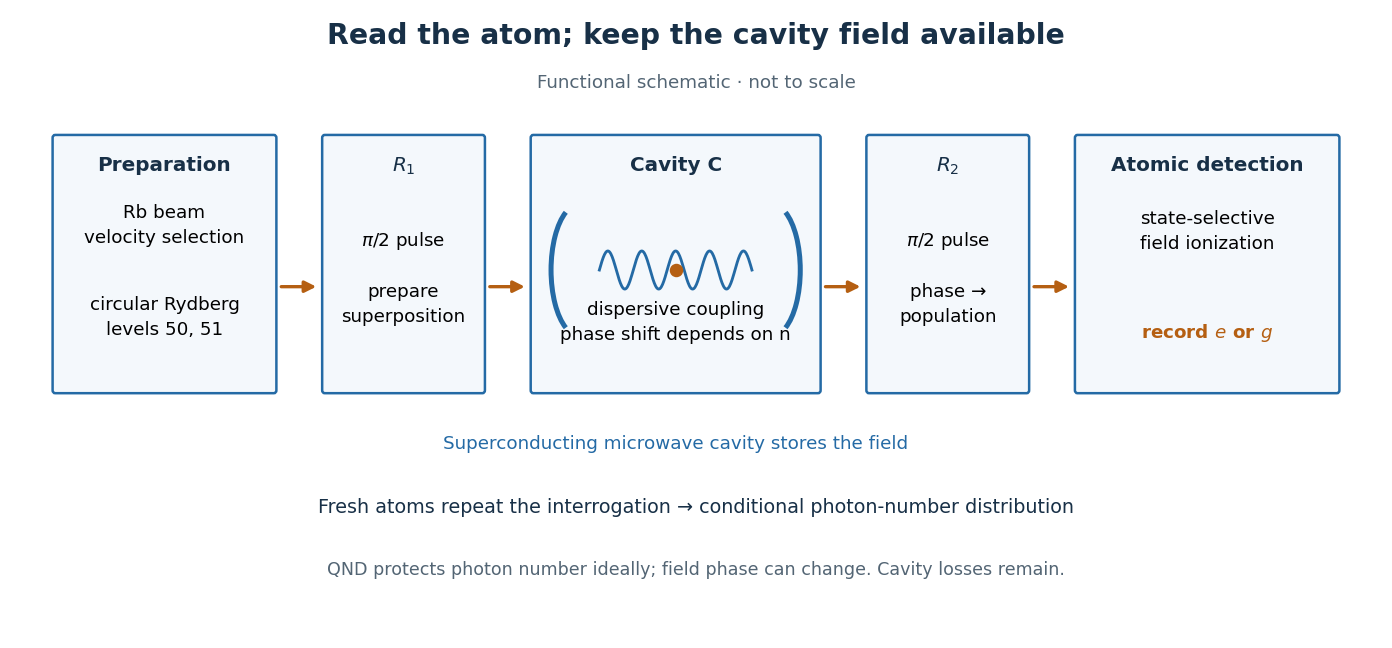

This arrangement makes quantum nondemolition measurement useful for following a field repeatedly and preparing a Fock state by conditioning. The photon number is inferred from a sequence of physical records; it is not a directly visible label attached to a photon. Each atomic probe makes a weak, partial measurement in quantum mechanics of photon number, and the accumulated records can approach a resolved count. A single binary meter need not identify one among many possible Fock states, as perfect discrimination of pure states requires orthogonality.
The achievement depended on complementary ways to organize the same physics. In his Nobel lecture, delivered in 1966 for the 1965 prize, Sin-Itiro Tomonaga described covariant contact transformations and replacing the unobservable bare mass and electric charge by experimental values. He also credited Julian Seymour Schwinger's magnetic-moment work and Richard Feynman's methods for extending the approximation.[ref]
Development of Quantum Electrodynamics: Personal recollections by Sin-Itiro Tomonaga. Development of Quantum Electrodynamics, May 6, 1966; concluding discussion of renormalization and complementary calculations
Richard Feynman's 1965 lecture traced his spacetime and path integral viewpoint and the Feynman diagrams that made perturbation theory easier to organize. He emphasized that the path integral viewpoint helped him find expressions without being essential to every calculation. These accounts support shared credit for workable renormalized QED, not attribution of the whole theory to a single person.[ref]
The Development of the Space-Time View of Quantum Electrodynamics by Richard Feynman. The Development of the Space-Time View of Quantum Electrodynamics, December 11, 1965; paragraphs on manifest covariance, diagrams and the final assessment of path integrals
The first QED radiative correction predicts a positive anomalous magnetic moment. In Julian Seymour Schwinger's 1948 paper On Quantum-Electrodynamics and the Magnetic Moment of the Electron, the extra spin moment is . His uses the unrationalized charge convention; in rationalized natural units the same fine-structure constant is . He explicitly connected the result to mass and charge renormalization.[ref]
https://physics.umd.edu/grt/taj/624c/Schwinger_AnomalousMoment.pdf. p. 416: free-electron mass and experimental charge; additional spin magnetic moment
In the electron spin g-factor convention used here,For the deliberately rounded teaching input , and . The correction is about of the Dirac equation spin moment. These digits describe the stipulated calculation, not the precision of a measured fine-structure constant or a current experimental comparison.
Electron electromagnetic vertex form factors Created 2026-10-18 Updated 2026-10-20
For external electrons on shell, factor out signed electric charge in the parity-preserving interaction vertex:The are Dirac spinors; are gamma matrices. With on-shell renormalization scheme normalization , the Gordon identity gives and .[ref]
QED Vertex Correction (Vadim Kaplunovsky course notes). Eqs. (3), (36)–(38)
This explains a subtlety: the Dirac equation already predicts a spin magnetic dipole moment with . Rewriting its Dirac electromagnetic current with the Gordon identity produces a spin-dependent term even before any loop order correction. measures the additional response after that baseline is included. The limit is taken after extracting its coefficient; setting in the interaction vertex at the outset would hide it. This electromagnetic anomalous magnetic moment is not a failure of gauge invariance of the kind called a quantum anomaly.
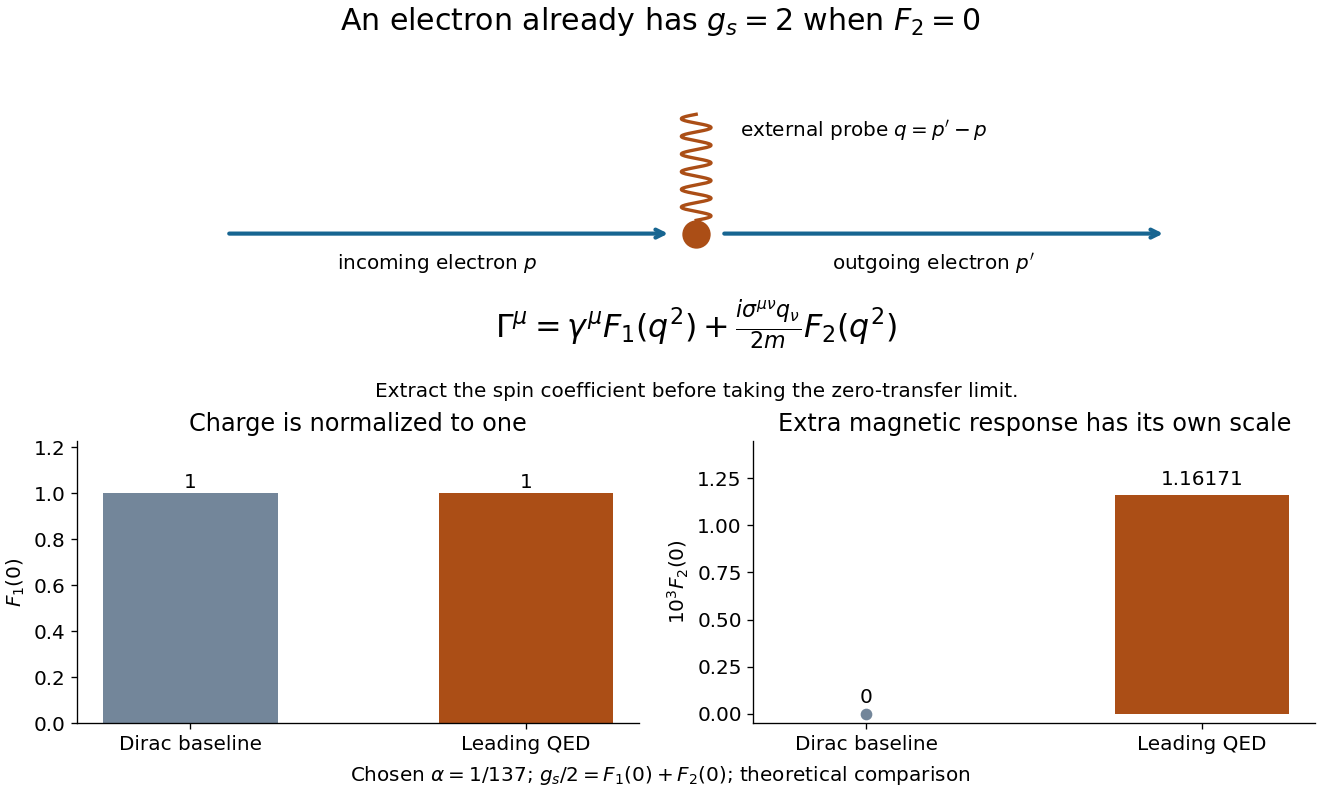
Charge normalization and the additional magnetic response
. Original schematic of the electron electromagnetic vertex form factors. The photon line denotes a weak external probe, not necessarily a real emitted photon. The lower bars use the chosen fine-structure constant : their vertical scales differ so the small remains visible. The Dirac equation baseline is , not zero magnetic dipole moment; the comparison is theoretical, not measured data. Details.
Cavity quantum electrodynamics Created 2026-10-18 Updated 2026-11-05
Cavity quantum electrodynamics studies chemical atoms or related quantum emitters interacting with quantized electromagnetic field modes confined by a cavity. Confinement changes the available mode structure and can strengthen a single excitation's coupling to the emitter. The interaction rate, cavity loss and emitter decoherence determine whether coherent exchange can be resolved.
Near resonance, an chemical atom and mode can exchange excitation; far from resonance, dispersive atom-cavity coupling produces state- and photon-number-dependent shifts. In the microwave photon-box experiments described in the authored lecture, chemical atoms provide repeated nondestructive probes of a long-lived field, allowing photon-number jumps and nonclassical field states to be studied.[ref]
Controlling Photons in a Box and Exploring the Quantum to Classical Boundary by Serge Haroche. Lecture opening and photon-counting discussion: confined microwave field, atom probes and quantum nondemolition measurements
A cavity's presence alone does not establish strong coupling or a particular nonclassical state. Lattice QCD Created 2026-10-18 Updated 2026-11-05
Lattice QCD is a lattice gauge theory formulation of quantum chromodynamics. A Euclidean path integral on a discrete spacetime lattice provides a route to computing hadron observables numerically, particularly when weak-coupling expansions are inadequate. Physical predictions require control of lattice spacing, finite spatial volume and quark-mass effects.
There are unlisted articles, also show them or only show them.