
Doppler-free absorption line model 2026-10-18
Construct an original illustrative spectrum using ordinary frequency detuning . Write the longitudinal Doppler shift in frequency units as , where . Choose a normal distribution with standard deviation and a weak-probe Lorentzian line shape with half width at half maximum :Thus . Choose and natural linewidth , so . The Gaussian-only full width at half maximum is ; the averaged profile also includes the finite Lorentzian line shape width.
Add a deliberately phenomenological Lamb dip:Here is the absorption coefficient normalized to the pump-off line-centre value. The factor is chosen, not inferred from populations or a fit. The dip's assigned full width at half maximum borrows the single-atom power broadening scale purely to illustrate contrast versus width. It is not the preceding overlap integral or a fit to historical spectra. There are no crossover features in this isolated-transition toy spectrum.
For , the subtracted dip has depth and width ; for , depth and width . Its half-depth points are . Measure that width relative to the curved background , not a horizontal line through the total absorption minimum.
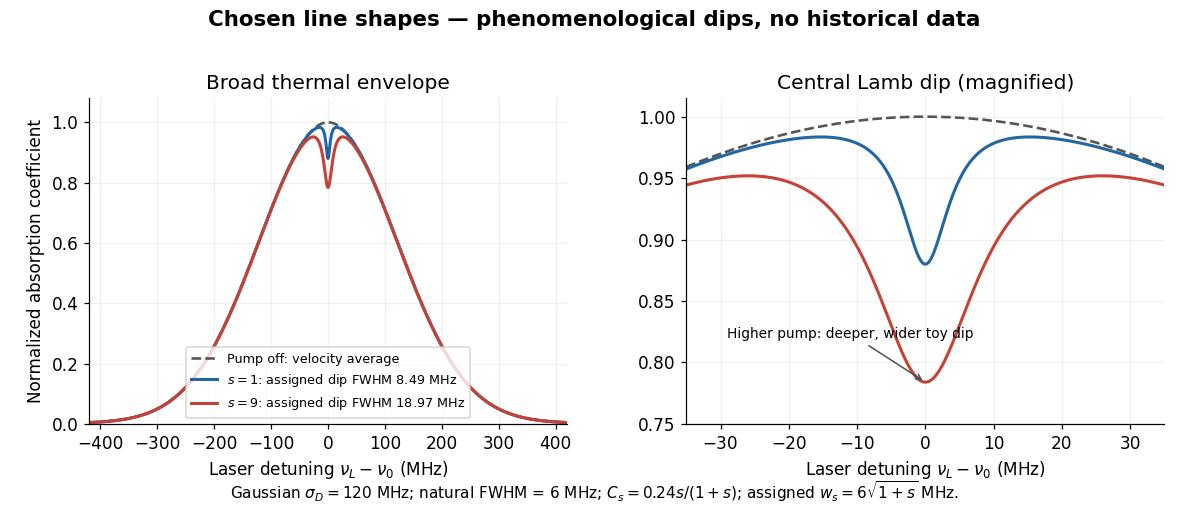
Chosen Doppler envelope and phenomenological Lamb dips
. Original numerical Gaussian velocity average with two explicitly chosen Lorentzian absorption dips. Every numerical setting is illustrative. The right panel magnifies line centre; these curves are not experimental data or fits. Details.
For a chosen cell optical depth , the line-centre pump-off transmission is . At it is . The transmitted probe therefore increases by about percent relative to pump off. Absorption contrast, transmission contrast and spectral width are three different quantities.
Lamb dip 2026-10-18
The narrow reduction in photon absorption near the common resonance of opposed beams. The Doppler-free absorption line model illustrates its sign and contrast; the same feature appears as increased probe transmission.
Two-level saturation population model 2026-10-18
Choose a closed two-level system, equal stimulated absorption and emission strengths, a monochromatic pump, and no extra dephasing. Let be the lower and upper populations, and let spontaneous emission remove upper population at rate . In this convention the natural linewidth is full width at half maximum in angular frequency, its half width at half maximum is , and its full width at half maximum in hertz is . All below are angular detunings.
Let be the on-resonance saturation parameter. An effective stimulated transition rate that reproduces the monochromatic steady response isHere describes each stimulated direction, while describes irreversible spontaneous emission. The rate equation gives the steady populations; it is not a description of transient Rabi oscillations. Setting givesand the population difference relevant to net weak-probe photon absorption isThe pump depletes the lower population by , but reduces the population difference by : stimulated emission contributes as well as missing ground-state absorbers. On resonance, gives , , ; gives , , . As , the two populations approach , rather than producing a population inversion. Far off resonance, and .
For moving atoms use in these pump-prepared populations. A weak counterpropagating probe interrogates them near . A simple population-only approximation to its absorption coefficient averages the weak-probe Lorentzian line shape times over the Maxwell-Boltzmann velocity distribution. It neglects interference between the beams, changes of velocity during illumination, and multilevel optical pumping. Those restrictions matter for real alkali chemical atoms.
Arthur Leonard Schawlow's 1981 lecture describes an external-cell arrangement: a beam splitter makes opposed beams, an optical chopper interrupts the pump, and a lock-in amplifier reads the probe detector with the chopper reference. Pump-on reduces absorption and raises the detector signal; scanning the laser finds the narrow resonance. Its first application used iodine; pressure and laser jitter limited the resolution.[ref]
Spectroscopy in a New Light by Arthur Leonard Schawlow. Schawlow, Spectroscopy in a New Light, pp. 39–40, Fig. 2
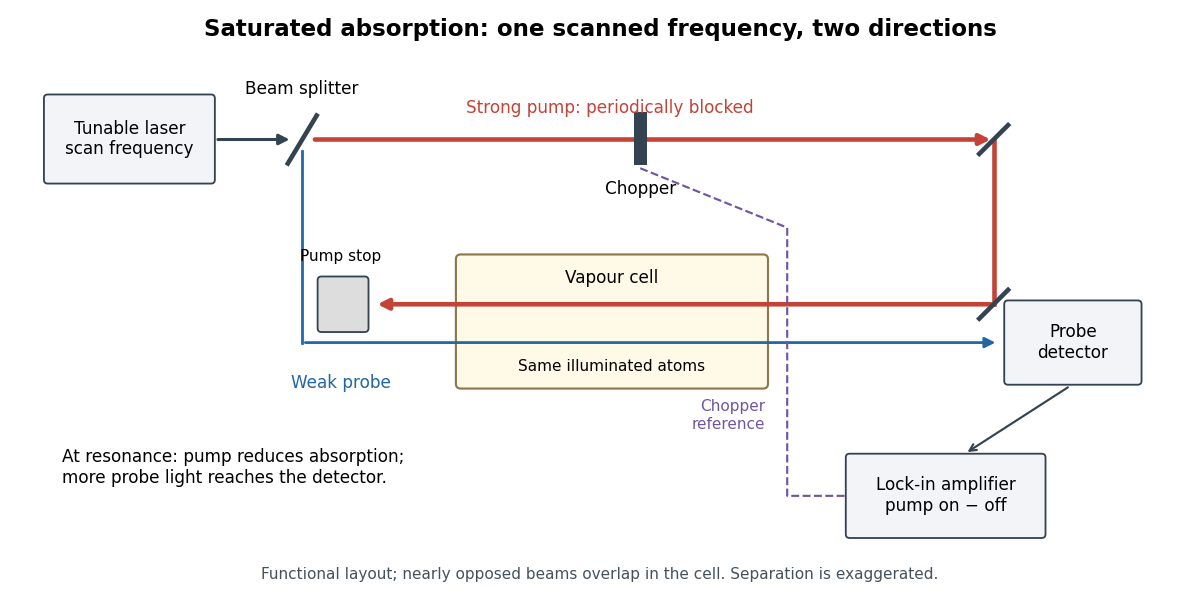
Counterpropagating pump and probe with synchronous transmission readout
. Original functional drawing of the cited external-cell principle. Beam separation is exaggerated; this is not a reconstruction of the pulsed sodium apparatus. Details.
For an original detector model, let be the probe power reaching a photodetector without sample attenuation and let be the sample's probe optical depths. After subtracting a stable detector background, the transmitted powers areA positive synchronous change means less probe photon absorption, provided incident probe power is stable and scattered pump light is excluded. For small optical-depth changes the fractional signal is approximately . A lock-in amplifier's voltage also depends on gain, reference phase and chopping waveform; it is not automatically this dimensionless ratio.
Useful controls are blocking the pump, detuning far from the feature, reversing or adjusting beam alignment, and repeating the scan at several pump light intensities. Frequency calibration, sample pressure, transit through the beams and laser frequency fluctuations must be assessed separately. Nearly opposed beams leave a residual Doppler shift: for wave vectors , the simultaneous-resonance condition gives . Exact opposition removes this transverse sensitivity in the first-order model.
Counterpropagating saturation resonance 2026-10-18
Take a single isolated optical transition of angular frequency . Both beams have laboratory angular frequency , with laser detuning . Let the pump travel along , the probe along , denote an atom's -velocity, and be the approximate vacuum wavenumber; is the speed of light. To first order in , the laser detunings in the atom's frame areThe pump addresses atoms near , while the probe addresses atoms near . For the same transition, simultaneous exact resonance requires both expressions to vanish: adding and subtracting gives and . The selected atoms can still have substantial transverse velocity. Finite natural linewidth admits a narrow interval of longitudinal velocities; a warm gas has not been cooled.
This is velocity selection, not cancellation of each atom's Doppler shift within a single absorption event. Changing laser detuning selects different atoms for ordinary photon absorption, but only near line centre do these two selected classes overlap. Laser cooling instead changes the distribution of the atoms' velocities through repeated momentum transfer.
Klenow fragment Created 2026-10-18 Updated 2026-11-05
The Klenow fragment is a large fragment of Escherichia coli DNA polymerase I that retains DNA polymerization and proofreading exonuclease activities while lacking the intact enzyme’s 5′-to-3′ exonuclease domain. This separation made it useful for extending DNA ends without all the activities of the full enzyme. Engineered exonuclease-deficient variants are different reagents, so a statement about retained proofreading should specify the form being discussed. [ref]
Molecular Biology of the Cell, 4th edition by Bruce Alberts and others. Chapter 8, Manipulating Proteins, DNA, and RNA: DNA polymerases and end labelling
Exponential switch-on of a driven quantum oscillator Created 2026-10-18 Updated 2026-10-20
For on , start in the unforced ground state at . Define and . Time-dependent perturbation theory givesThus the first excited-state probability in the original oscillator basis tends to zero for a rapid turn-on and to for slow turn-on, within the weak-force approximation .
This finite adiabatic limit is not a failure of the adiabatic theorem: the instantaneous ground state is displaced and has a nonzero projection onto the original excited states. In fact a linear force preserves a coherent state, whose exact original-basis displacement at is . It follows either from or from the forced oscillator equations. Consequently the exact original-basis probability is . The instantaneous oscillator basis has displacement , so its mean excitation is instead , which vanishes adiabatically.
Anomalous dispersion Created 2026-10-18 Updated 2026-11-05
Anomalous dispersion is an interval in which the real refractive index decreases with increasing frequency, opposite to normal dispersion. It commonly occurs near a material resonance, where optical absorption also changes rapidly.
The frequency dependence of the complex refractive index determines both propagation phase and attenuation. A rapidly changing real part can give unusual group velocity, but that value alone does not specify the speed of a new signal in an absorbing medium. Measuring transmitted intensity together with phase or deviation across the band is therefore more informative than fitting a real refractive index while ignoring losses.
Normal dispersion Created 2026-10-18 Updated 2026-11-05
In normal dispersion, the refractive index increases with frequency, , equivalently for vacuum wavelength . Transparent regions away from isolated absorption resonances often have this behaviour. Near a resonance the slope can reverse, producing anomalous dispersion accompanied by absorption.
Lens-shaped intersection of two disks Created 2026-10-18 Updated 2026-10-25
For two disks of equal radius whose centres are separated by , their intersection consists of two circular segments. Each segment is a sector of angle minus an isosceles triangle, where . Hence its total area isThe limiting cases are at and at . This geometric region is distinct from an optical lens.
Fourier frequency resolution Created 2026-10-18 Updated 2026-10-20
For equally spaced samples at sampling rate , the discrete Fourier transform has frequency bins spaced by . A rectangular observation window broadens a sinusoid into a sinc function profile whose nearest zeros are from its central frequency. This sets a conventional scale for distinguishing nearby spectral components. It is not a universal lower bound on the uncertainty of frequency estimation for an isolated tone: a specified signal model and noise level can allow precision finer than the bin spacing. Padding with zeros interpolates the spectral display without increasing the observation duration.
Let a bounded connected body consist of two regions with positive constant thermal conductivities . A temperature is harmonic in each region, continuous across their interface, has continuous normal heat flux there, and has prescribed outer Dirichlet boundary conditions. There is at most one sufficiently regular solution.
For the difference of two solutions, apply Green's first identity in each region and multiply by its thermal conductivity. The interface outward normals are opposite, so continuity of and cancels their boundary terms. The outer term vanishes because . Hence the displayed sum of nonnegative Dirichlet energies is zero. The gradient vanishes in both regions; continuity and the outer data then force . The proof also applies to finitely many connected subregions, provided the union is connected and the same transmission conditions hold.
Let and impose zero Dirichlet boundary conditions at . With the convention for the Dirac delta distribution, the Green's function is continuous and its first derivative has jump one. For choose and . Their Wronskian is , soFor , take the continuous limit or use and to obtainThe solution is . These kernels use ordinary measure . The factor comes from the nonconstant Wronskian and must not be discarded by confusing the original operator with its multiplied divergence form .
Bounded exterior disk Green function 2026-10-18
For the exterior of the unit disc in two dimensions, with the sign convention , this is the Dirichlet Green function that vanishes on the circle and is bounded at infinity. The method of images places an opposite logarithmic source at the inverse point . The constant enforces the zero boundary value. The inversion in a circle identity for verifies that condition directly.
The outward normal of the exterior domain is on the unit circle. Its normal derivative gives the positive exterior Poisson kernelFor bounded harmonic functions this kernel integrates boundary data to the interior value. Boundedness at infinity is essential to uniqueness: without it, a multiple of can be added without changing the circle's Dirichlet boundary condition.
Dirichlet Green function inside a sphere 2026-10-18
For the three-dimensional ball , the displayed Dirichlet Green function has convention . Its method of images uses the exterior inverse point . On , the distance identity makes the boundary value zero. The image lies outside the ball and therefore adds no source singularity to the domain. At a central source the weighted image term tends to , giving . Spherical inversion with the required radial weight is the Kelvin transform.
For a three-dimensional slab and source , define image positions and . The displayed method of images series uses convention . Reflection in pairs the plus image with the minus image , while reflection in pairs it with the minus image . Both boundary values therefore vanish. Only lies in the slab. Each bracket is , giving absolute convergence of the paired series away from sources. This selects the usual Dirichlet Green function that decays at large transverse separation.
For and on , with and , the substitution gives . Here and . The displayed Green function vanishes at the endpoints, is continuous at , and its first derivative has jump one, so . It is the usual sine Dirichlet Green function conjugated by the exponential factor. At there is a homogeneous zero mode, so the inverse kernel does not exist without a solvability condition and a normalization.
For in the upper half-space, let be the reflection of the interior source across its boundary plane. The displayed decaying Green function solves with zero Dirichlet boundary condition. The direct term supplies the source; the image source lies outside the domain and its opposite sign makes the two terms cancel on the plane. The minus sign relative to the positive static Yukawa Green function comes from the operator convention. The case is the Coulomb limit. An infinity condition is needed for uniqueness on an unbounded domain.
With the convention , the displayed Dirichlet Green function vanishes on the unit circle. Indeed when . For , the second logarithm corresponds to an opposite image source at , outside the unit disc; it is a harmonic function throughout the interior. At the formula becomes . Its outward normal derivative in the boundary variable is , the Poisson kernel divided by . Green's second identity therefore gives the Poisson integral on the unit disk.
Dirichlet Green kernel for an Euler operator with exponents one and minus four Created 2026-10-18 Updated 2026-10-20
For on , regularity at zero selects the homogeneous solution , while the right Dirichlet boundary condition selects . Their Wronskian is . Thus the displayed Green function, with and , is continuous, has unit first-derivative jump and satisfies . For bounded forcing , is the unique solution continuous at zero with zero endpoint values. The singular homogeneous branch is excluded by that regularity. The kernel uses ordinary source measure , not the measure for the multiplied self-adjoint operator.
There are unlisted articles, also show them or only show them.