
Autocorrelation of a square-integrable function Created 2026-10-18 Updated 2026-10-20
This deterministic, unnormalized cross-correlation of a function with itself exists for every shift when , by the Cauchy-Schwarz inequality. It satisfies and . With Fourier transform convention , its transform is , in the tempered distribution sense when the correlation is not integrable. Fourier inversion at zero gives the Parseval identity, first for Schwartz functions and then by approximation in L2 space. Unlike the normalized statistical autocorrelation, its value at zero is not generally one.
Direct CP violation in two-pion kaon decay 2026-10-18
Direct CP violation concerns the decay transition itself. At leading order, the charged and neutral two-pion decay amplitude ratios separate a common from channel-dependent .[ref]
https://www.nevis.columbia.edu/~haas/documents/physics_nobel_lectures/physics71-80-3.pdf. Cronin, pp.573–574, distinction between epsilon and epsilon-prime
For the corresponding double ratio of partial decay widths,The expansion follows from . A single nonzero long-lived two-pion yield does not isolate : it can already occur with . Thus the 1964 evidence for CP violation must be distinguished from the later experimental establishment of direct CP violation through .
Neutral-kaon two-pion decay time dependence 2026-10-18
For a coherently prepared state proportional to , evolve each component with . The proper time is , and . Since both components reach the same final state, their decay amplitudes add before squaring. Factoring out and a common beam normalization gives the two-pion intensityThe last term is quantum interference. It vanishes upon averaging over an independently random preparation phase, but cannot be discarded from a coherent preparation. Summing the two positive contributions alone would lose the phase-sensitive information.
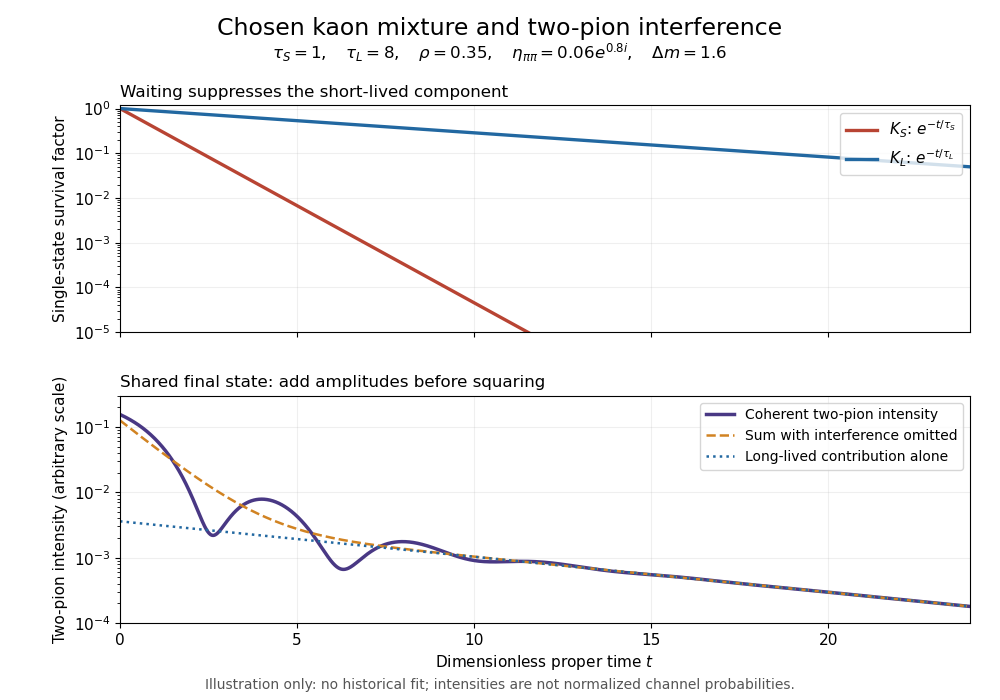

At late proper time, the short-lived contribution and the quantum interference term die away, leaving the long-lived tail . Such a tail is easier to identify after the initially abundant short-lived component has disappeared. The useful experimental balance is between eliminating that component and retaining enough long-lived decays to observe a rare decay channel.
Neutral-kaon CP impurity and two-pion decay 2026-10-18
Use the kaon CP eigenstates convention , matching kaon CP mixing parameter. Then is CP even, while is CP odd. With CPT symmetry and a common small mixing parameter, the physical states can be writtenHere mean short and long mean lifetimes; the kaon CP mixing parameter depends on the flavor-state phase convention. A positive flavor-exchange convention instead makes the symmetric flavor combination CP even, as explained in exchange-positive CP convention for neutral kaon mixing. Mixing these conventions would reverse the interpretation of the written sums.
Why does the two-pion final state test CP symmetry? A spin-zero kaon decaying into two spin-zero pions has relative orbital angular momentum by angular momentum conservation. Two negative intrinsic parities multiply to plus, and . Charge conjugation exchanges and ; the state is even under this exchange. Hence this two-pion state has CP eigenvalue . If a decay transition operator preserves CP symmetry, inserting CP on both sides of changes its sign without changing its value: that decay amplitude must vanish.
Assume for illustration that CP violation occurs only through the state admixture and the decay transition preserves CP symmetry. Put . ThenNeglecting the tiny difference in two-body Lorentz-invariant phase space between the physical masses gives . A branching fraction, however, divides a partial decay width by the total decay width. With , , soFor chosen values and , the branching fraction ratio is , whereas the partial decay width ratio is . This is original arithmetic, not a historical fit. The longer observation time amplifies the integrated fraction relative to the instantaneous partial decay rate.
Neutral kaon regeneration 2026-10-18
Neutral kaon regeneration is the production of a short-lived component when a neutral kaon beam passes through matter. In the phase convention of kaon CP eigenstates, let the forward transmission amplitudes of and be and . Expanding in the kaon CP eigenstates gives the displayed equation. Different forward scattering amplitudes, including absorption, can therefore generate a two-pion signal even with CP symmetry. Ordinary matter is not a CP-symmetric preparation.
Tungsten regeneration calibrated the signal; scanning its position sampled acceptance. Helium regeneration was insufficient, bag walls lay outside acceptance, vertex distributions excluded collimator regeneration, and hydrogen data cross-checked the effect.[ref]
Evidence for the 2π Decay of the K₂⁰ Meson by James H. Christenson and others. p.138, tungsten scan; p.140, helium, walls, vertices and hydrogen controls
These controls are central: the question is whether the long-lived component itself reaches two pions, rather than whether material has prepared a fresh short-lived component. Two-pion kaon event reconstruction 2026-10-18
A two-track invariant mass and a direction test answer different questions. In units , assign each track the pion mass and reconstruct its momentum before magnetic deflection. With and opening angle ,This follows by expanding the squared sum of the two four-momenta. The angle between the reconstructed parent momentum and the neutral particle beam direction satisfiesA fully reconstructed two-body decay channel gives the parent mass and , within experimental resolution. A three-body decay channel with an unseen neutrino generally misses both constraints; an accidental correct invariant mass alone is insufficient. Notice that the track opening angle need not be small even when the parent direction angle vanishes.
James H. Christenson, James Watson Cronin, Val Logsdon Fitch and René Turlay reported the result in 1964. At Brookhaven's AGS, 30 GeV protons struck beryllium; collimators selected a neutral particle beam at 30 degrees. A downstream helium decay volume reduced interactions.[ref]
Evidence for the 2π Decay of the K₂⁰ Meson by James H. Christenson and others. p.138, preparation and helium volume
The flight distance suppressed the short-lived kaon component. Each arm of a two-arm magnetic spectrometer had spark chambers before and after its magnet. Cherenkov detectors and scintillation counters triggered photographic recording in coincidence.[ref]
https://www.nevis.columbia.edu/~haas/documents/physics_nobel_lectures/physics71-80-3.pdf. Fitch, The Discovery of Charge-Conjugation Parity Asymmetry, pp.598–600, apparatus and reconstruction
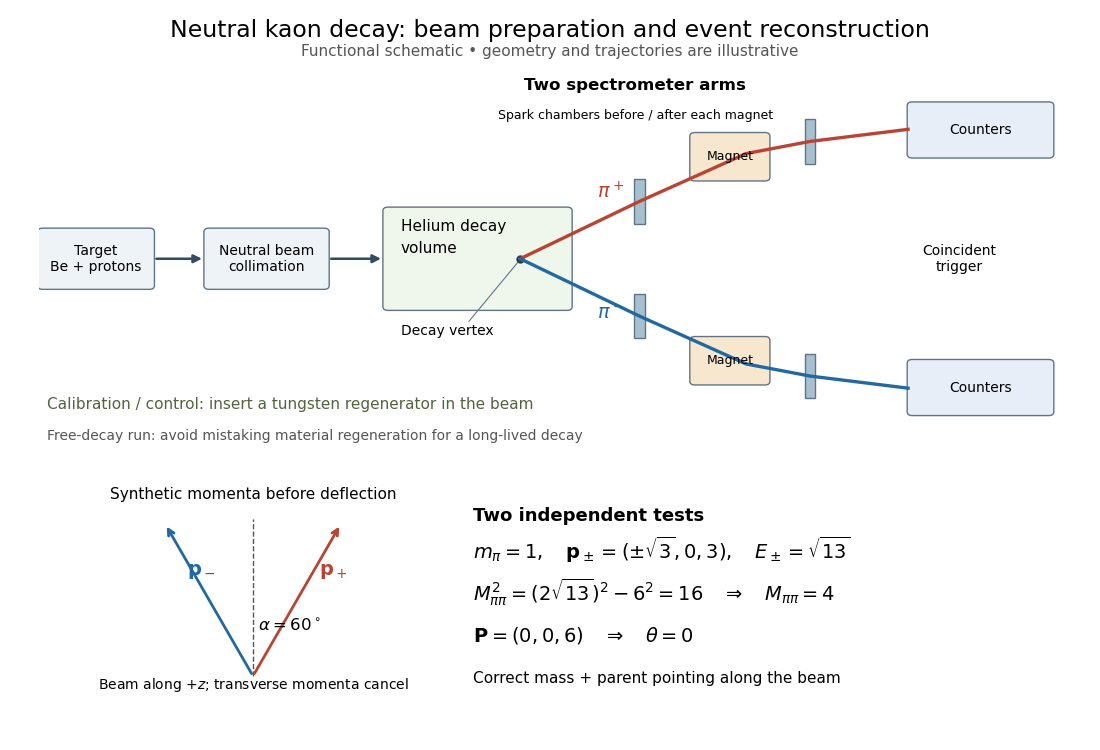

The helium sample yielded signal events; was the ratio to all charged decay channels.[ref]
Evidence for the 2π Decay of the K₂⁰ Meson by James H. Christenson and others. pp.139–140, forward peak and charged-mode ratio
That denominator must be retained when comparing this result with a total branching fraction.The evidence was kinematic. Later regenerated-beam quantum interference established that the short- and long-lived states reached the same two-pion final state, excluding alternatives such as distinct pion-like particles.[ref]
https://www.nevis.columbia.edu/~haas/documents/physics_nobel_lectures/physics71-80-3.pdf. Cronin, CP Symmetry Violation — The Search for Its Origin, pp.570–573, original inference and subsequent interference
The 1964 observation established evidence for CP violation; it did not determine every parameter of the CKM matrix. Inferring time-reversal symmetry violation from CP violation invokes CPT symmetry, rather than a direct comparison of time-reversed transitions in that experiment. Coupled resonant circuit model 2026-10-18
Let two series loops have inductances , capacitances , total electrical resistances , and reciprocal mutual inductance with . For a steady sinusoid of angular frequency , choose complex peak amplitudes with time convention . An ideal source of peak electric potential difference drives loop 1; loop 2 has no independent source. ThenEliminating proves the response formula. Reversing one coil changes the sign of and the relative wave phase, but leaves this amplitude response unchanged. The measured sense ratio is , with included in , not added a second time.
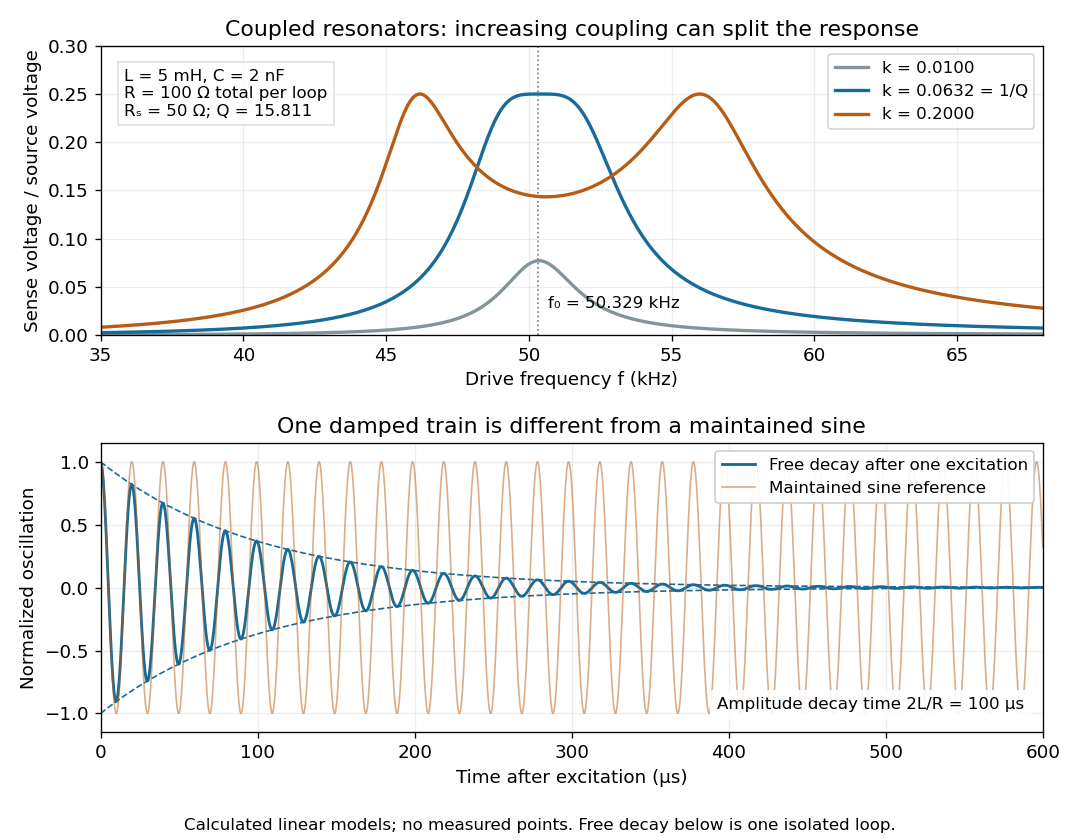

For identical loops at their uncoupled resonant frequency ,Writing makes this . Its derivative has the sign of , so response at this fixed frequency is largest when , equivalently . Too little coupling transfers little excitation; excessive coupling reduces the response at the original centre frequency. This is a fixed-frequency optimum, not a universal optimum over every possible receiver and drive frequency.
For the chosen values, gives . At source peak , the secondary peak electric current is and the sense peak electric potential difference is . The primary peak electric current is also , so source mean power is : each loop dissipates , checking conservation of energy. Here is the equivalent ideal source behind ; a generator's terminal reading must be converted using its measured Thévenin resistance.
In the lossless identical-loop limit, the normal modes have equal or opposite electric currents, making their effective inductances or . ThusAt these are and . Finite electrical resistance broadens and shifts the driven peaks, so the exact response formula, rather than these lossless values, generates the plot. Changing a capacitor moves the uncoupled tuning through : increasing it by lowers by the factor . The model explains why tuning and coupling must be adjusted together; it supplies no transatlantic propagation or detector-threshold prediction.
Coulomb interaction 2026-10-18
Interaction described by the Coulomb potential and its associated Coulomb force.
Coulomb force Created 2026-10-18 Updated 2026-11-05
The Coulomb force is the electrostatic force between electric charges. For point charges in a uniform isotropic medium of permittivity , the force on charge from is , where points from the first charge to the second.
Equal charge signs give repulsion and opposite signs give attraction. The inverse-square dependence allows superposition to construct fields of extended charge distributions. Nearby conductors or spatially varying dielectrics can redistribute charge and alter the field, so the simple uniform-medium pair formula does not automatically solve those boundary problems.
Electric-dipole excitation by a passing ion 2026-10-18
In the straight-trajectory dipole model, retain the Coulomb-coupling convention of . In SI units the coupling denoted here is . First-order time-dependent perturbation theory expresses a transition through the Fourier transform of this pulse at the transition angular frequency.
For positive put . The two Cartesian pulse transforms arewhere is a Modified Bessel function of the second kind. One may derive these from the Fourier transform of , differentiating in its scale and integrating its spatial derivative by parts. For , while , so the transverse impulse gives the probability in the title. If the matrix element vanishes, the smaller longitudinal term can be the leading nonzero contribution.
The conditions include large compared with the atomic extent for the electric-dipole approximation, a small total transition probability for first-order theory, and a collision time short compared with . Large instead gives exponentially suppressed excitation in this model through the large-argument behavior of .
Taylor-Couette flow Created 2026-10-18 Updated 2026-11-05
Taylor-Couette flow is the flow between coaxial rotating cylinders. Its simplest steady homogeneous purely azimuthal viscous state has steady circular Couette profile . Stability of that base state depends on rotation rates, geometry and viscosity; the inviscid Rayleigh centrifugal stability criterion addresses axisymmetric centrifugal disturbances, not every viscous instability.
Microsomal protein import experiment 2026-10-18
In 1975, Günter Blobel and Bernhard Dobberstein combined cell-free translation with dog-pancreas microsomes. Density-gradient centrifugation isolated the membranes; removal of resident ribosomes allowed reconstitution with rabbit-reticulocyte ribosome subunits. Added messenger RNA encoded an immunoglobulin light chain; globin provided a comparison. Products made with or without membranes were challenged with proteases and analyzed by SDS-PAGE and autoradiography. Membranes present during synthesis yielded processed, protected light chain; globin remained susceptible. Adding membranes after precursor synthesis failed to reproduce import. These comparisons support selective passage during synthesis in this preparation.[ref]
The companion paper specifies radioactive amino acid incorporation, ice-cold trypsin plus chymotrypsin treatment, a slab-gel electrophoresis apparatus and dried-gel exposure to X-ray film. Product-size analysis distinguishes a preserved full-size product from residual labeled fragments.[ref]
Transfer of Proteins across Membranes I by Günter Blobel and Bernhard Dobberstein. Methods pp. 837–838: proteolysis, SDS-PAGE and autoradiography; Discussion p. 847
Protection was incomplete. The authors considered leaky vesicles, and warned that heat treatment could damage processing as well as ribosome attachment. Their experiments did not identify SRP or the Sec61 complex. Nor does failure of late membrane addition establish that all organelle protein import must occur during synthesis.[ref]
Transfer of Proteins across Membranes II by Günter Blobel and Bernhard Dobberstein. pp. 858–859: incomplete protection; p. 861: heat-inactivation caveat; p. 862: alternatives for failed processing
Translocon 2026-10-18
A translocon is membrane machinery through which a polypeptide chain crosses or enters a membrane. In endoplasmic reticulum protein targeting, the Sec61 complex supplies the central channel.[ref]
Membrane Protein Insertion at the Endoplasmic Reticulum by Sichen Shao and Ramanujan S. Hegde. Shao and Hegde, 2011; “The Sec61 Translocon”, Figure 4
Signal recognition particle 2026-10-18
The signal recognition particle is an RNA–protein targeting complex linking a ribosome-associated nascent chain to the SRP receptor.[ref]
Membrane Protein Insertion at the Endoplasmic Reticulum by Sichen Shao and Ramanujan S. Hegde. Shao and Hegde, 2011; “Cotranslational Targeting”, Figure 3
Cosmic microwave background quadrupole 2026-10-18
The cosmic microwave background quadrupole is the degree-two spherical harmonic part of the observed cosmic microwave background sky. It has five real coefficients. The axisymmetric example selects only one orientation and shape from this space; is its chosen amplitude, not a normalization for every possible cosmic microwave background quadrupole.
Differential Microwave Radiometer Created 2026-10-18 Updated 2026-11-05
The Differential Microwave Radiometer measured differences in microwave power between pairs of sky directions to map Cosmic microwave background anisotropy. Comparing two directions suppresses a common absolute brightness offset; repeated comparisons during scanning are then combined into a sky map.
The COBE instrument used paired horn antennas at three frequencies, with independent channels that tested detector noise and frequency-dependent galactic foreground contamination. A differencing instrument does not by itself determine the absolute monopole temperature. Its measurement therefore complements the spectrum measured by the Far Infrared Absolute Spectrophotometer.[ref]
Structure in the COBE Differential Microwave Radiometer First-Year Maps by George F. Smoot and others. Instrument design and differential-map construction
Far Infrared Absolute Spectrophotometer Created 2026-10-18 Updated 2026-11-05
The Far Infrared Absolute Spectrophotometer measured the spectrum of the cosmic microwave background by comparing the sky with a calibrated reference. Its differential Fourier transform spectroscopy and blackbody calibration tested whether the radiation followed one Planck function, rather than only measuring differences between sky directions.
The key observable is a spectral residual after fitting a temperature and accounting for instrumental and foreground contributions. A small residual constrains departures from a blackbody spectrum and thus energy exchange in the early universe. This absolute spectral test is distinct from the directional map supplied by the Differential Microwave Radiometer.[ref]
The COBE Far Infrared Absolute Spectrophotometer by NASA LAMBDA. Instrument overview and calibration
Cosecant expansion near zero 2026-10-18
Factor the sine expansion as . To invert the bracket, put and equate coefficients after multiplication. The coefficient gives , while the coefficient gives . Dividing by proves the displayed Laurent series truncation for , . This reciprocal-series calculation is useful when a small sine argument is itself an inverse power of a large variable; multiply the remainder by any outside prefactor when assigning its final order.
The Technische Universität Darmstadt demonstration uses a steel ball launched outward from the centre of a rotating disc. A fixed lecture-room camera records a straight path, while a camera carried above the disc records a curved path. The instructions specify launching toward the fixed camera so that the laboratory motion is clearly visible. The rotating iPod transmits its view wirelessly through Apple TV; two vertical support rods of length are specified for the slow-motion arrangement. The paired video views are the readout: one physical motion is represented in two reference frames.[ref]
Coriolis-Kraft at Technische Universität Darmstadt. Coriolis-Kraft, demonstration M C 13 2: Info; Beschreibung, Hinweis zur Durchführung and Hinweis zum Aufbau
A useful preparation control appears in the Universität Freiburg instructions: with the disc stationary, check that the ball travels radially toward its edge. A camera is mounted on supports attached to the disc; turn the disc by hand as the ball leaves its centre and observe the camera view.[ref]
Kugel auf rotierender Scheibe at Universität Freiburg. Kugel auf rotierender Scheibe: Durchführung, Material, Aufbau and Durchführung
The inference is a dependence of the observed trajectory on the rotating axes; a curved camera trace alone does not isolate the Coriolis force. To compare with the constant-angular velocity free particle in rotating coordinates, measure the disc angular velocity, calibrate lengths in the camera image, and compare launches at rest and with opposite rotation directions. These are checks of the ideal model, not reported measurements from the manuals. A rolling ball can exchange forces with the surface through friction, and hand rotation need not have constant angular velocity; an Euler acceleration then enters too. The ideal free-ball drawing deliberately omits those effects. Neither manual supplies a numerical uncertainty or a precision measurement of the Coriolis acceleration.
There are unlisted articles, also show them or only show them.