
Dirac comb Created 2026-10-18 Updated 2026-10-25
A Dirac comb is a periodic train of Dirac delta distributions. With Fourier transform convention and period ,The identity holds as a tempered distribution. Truncating the real-space train by a finite window convolves the reciprocal train with the transform of that window, broadening its peaks. Convolving the train with one slit's transmission instead multiplies the reciprocal peaks by the slit's field transform, the basic construction of a diffraction grating pattern.
Light-emitting diode Created 2026-10-18 Updated 2026-10-20
A light-emitting diode is a semiconductor diode producing electroluminescence under electric current. Forward bias injects electrons and electron holes; radiative electron-hole recombination emits photons. A double heterostructure uses band offsets to retain both charge carriers in an active layer. A sufficiently thin layer is a quantum well.[ref]
https://journals.aps.org/rmp/pdf/10.1103/RevModPhys.87.1139. §I, p. 1139, Fig. 1; §IV.A, pp. 1143–1144: injection, active layer and quantum-well distinction
The optical and electrical questions are different: photon energy sets a color scale, while light-emitting diode efficiency determines how much supplied energy escapes as light. The blue light-emitting diode made compact white light-emitting diodes and full-color displays practical. A modulated light-emitting diode can also supply the optical signal in a chopped-light lock-in experiment.
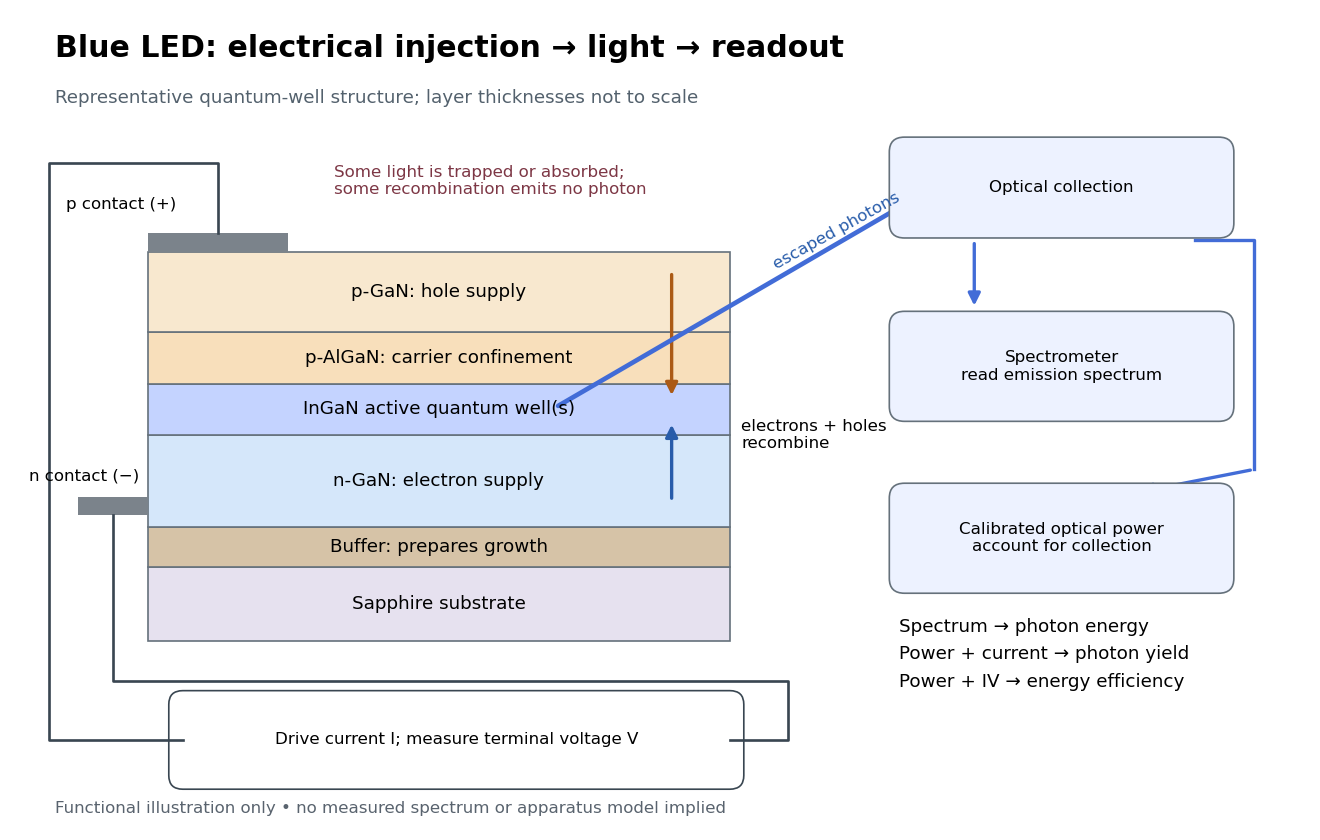
Blue light-emitting diode: carrier injection, emitting structure and optical readout
. Original functional schematic of a representative indium gallium nitride quantum well device on sapphire, not a reconstruction of the 1989 or 1994 devices. Layer thicknesses are schematic. Separate electrical and optical readings determine different properties: terminal electric potential difference and electric current, spectrum, and calibrated escaping optical power. The arrows represent routes through the device rather than a calculated energy band profile. Source. Details.
Rectifier 2026-10-18
Diode characteristic measurement 2026-10-18
The New Jersey Institute of Technology laboratory uses a silicon 1N4148 diode. For its forward current-voltage characteristic, the supply operates in current-source mode; a benchtop voltmeter independently reads the diode electric potential difference. Small electric current steps resolve the steep branch. For reverse measurements, a sensitive ammeter sits in series; the handout suggests a – series resistor. Reversing the applied polarity supplies the comparison. Meter placement must avoid counting the voltmeter's own electric current, and the zero reading may have an offset. The same diode is then measured with an Agilent U2722A source measure unit for graphical comparison.[ref]
Part B Semiconductor Devices: Diodes 1 by New Jersey Institute of Technology. Part B, Experiments with Semiconductor Diodes, items 1 and 2(a): preparation, current control, independent voltage readout, reverse series resistor and same-device comparison
The prescribed analysis uses a logarithmic scale for forward electric current to infer and from the straight region. Large-electric current departures can indicate series electrical resistance. The handout cautions that the accessible range may not determine it precisely; meter loading also matters. This is a measurement procedure, without a published set of device readings.[ref]
Part B Semiconductor Devices: Diodes 1 by New Jersey Institute of Technology. Experiments with Semiconductor Diodes, item 1, parameter extraction and high-current trend-line limitations; Report and Analysis
The reason for the logarithmic scale follows directly from the Shockley diode equation. If and series electrical resistance is negligible,where is a fixed reference electric current making the logarithm dimensionless. The slope is , so extracting needs the junction temperature. Fitting only an appropriate interval matters: a straight-looking subset cannot establish the model at all electric currents.
Diode reverse breakdown 2026-10-18
A sufficiently large reverse electric potential difference can produce a rapidly increasing reverse electric current. Both the ideal diode model and the unextended Shockley diode equation omit this behavior.[ref]
The Junction Diode by W. Marshall Leach, Jr.. The Junction Diode, §1.7, printed p. 17: breakdown after the small reverse-current region
Shockley diode equation 2026-10-18
For a p-n junction at fixed temperature, the Shockley diode equation models its electric current asHere is the diode saturation current, the diode ideality factor, the thermal voltage, the Boltzmann constant, and the elementary charge.[ref]
The Junction Diode by W. Marshall Leach, Jr.. The Junction Diode, §1.2, printed p. 4, equation (1.1) and parameter definitions
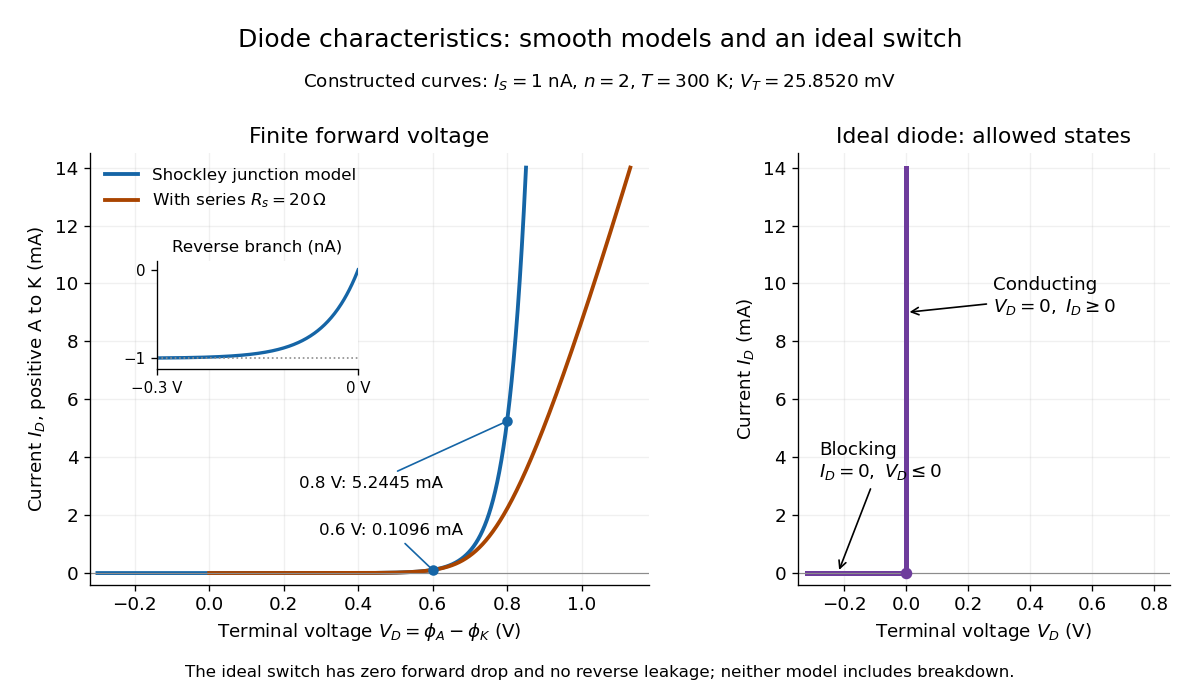
For an original model example, choose , , and . Using and gives . Then gives , whereas gives . These are predictions of the declared model. There is no universal turn-on electric potential difference: solving the Shockley diode equation for the value needed at a chosen electric current givesAt , increasing by multiplies the electric current by approximately . At the same model gives . Its reverse branch approaches ; it cannot describe diode reverse breakdown.
A constructed extension adds internal series electrical resistance to a junction whose electric potential difference is . Applying the Kirchhoff cycle law givesFor and the same , sustaining needs : across the junction plus across its internal electrical resistance. The derivativeshows why the current-voltage characteristic becomes nearly a straight line when the internal series electrical resistance dominates. This is still a fixed-temperature model; self-heating can change , and . Real diodes also have leakage and charge-storage effects omitted here.[ref]
The Junction Diode by W. Marshall Leach, Jr.. The Junction Diode, §§1.3, 1.8 and 1.11: temperature dependence, charge storage and series bulk resistance
Ideal diode model 2026-10-18
The ideal diode model sets the conducting electric potential difference to zero and the blocking electric current to zero. With the stated orientation,[ref]
The Junction Diode by W. Marshall Leach, Jr.. The Junction Diode, §1.12.1, printed p. 30: zero forward voltage and zero reverse current idealization
The surrounding electrical circuit chooses the state and remaining value. The two branches meet at . Their product vanishes, so the ideal diode dissipates no power: .
The ideal diode model omits forward drop, reverse leakage, diode reverse breakdown and switching delay.

Diode cathode 2026-10-18
Diode anode 2026-10-18
The terminal of a diode at which positive forward electric current enters, with the orientation used in the ideal diode model.
Drift-diffusion equation with a potential 2026-10-18
For positive diffusivity , a diffusion equation with potential-driven drift has diffusive flux . On a finite interval with zero flux at both endpoints, the total amount is conserved. The substitution converts the decay eigenvalue problem to the Sturm-Liouville problemThe Rayleigh quotient is . Its zero eigenfunction is constant, giving the stationary solution . This is a spatial Boltzmann distribution; changes relaxation rates but cancels out of the zero-flux equilibrium profile. For a sufficiently regular positive and bounded , the constant eigenfunction is the unique zero mode up to scale.
Robin diffusion with a growing mode 2026-10-18
These Robin boundary conditions give the spatial Sturm-Liouville operator one negative eigenvalue, , with eigenfunction . The other eigenvalues are , with eigenfunctions , ; there is no zero eigenvalue. Hence the diffusion equation has a growing contribution in addition to decaying modes.
There is no contradiction with ordinary diffusive smoothing. The outward normal derivative is at the left endpoint and at the right endpoint, so imposing the same coordinate derivative at both ends does not impose dissipative outward-normal data at both ends. The energy identity is , whose boundary term is here and can supply energy. Orthogonal projection of initial data gives ; it vanishes precisely when the growing mode is absent.
The reflected boundary conditions and have the same spectrum, because reflection reverses the coordinate derivative. Here the growing eigenfunction is and the decaying functions are , givingFor square-integrable initial data , orthogonal projection givesThe norms are and . The spatial Sturm-Liouville problem has no zero eigenvalue and exactly one negative eigenvalue for , namely . The energy boundary term now reads , so the left endpoint can supply energy. The growing mode disappears exactly when .
Squared diffusion-residual action 2026-10-18
For constant , variation of this positive functional gives , or . The diffusion equation gives zero-residual minima, but is only a subset of the stationary equations of the squared functional. Each nonzero spatial Fourier mode has both growing and decaying temporal solutions in the stationary equation. Boundary data decide which stationary paths are admissible. In two spatial dimensions, the bulk action is invariant under the anisotropic scale invariance , , .
A spatially uniform time-dependent reaction coefficient can be removed from a linear diffusion equation by a scalar integrating factor. If and , substitution gives . Initial data and boundary values must also be divided by . A nonzero boundary profile can then be removed by boundary lifting before applying separation of variables. This reduction distinguishes growth of the whole amplitude from decay of the spatial diffusion modes.
Translational diffusion Created 2026-10-18 Updated 2026-11-05
Diffusion of particle position, as distinguished from rotational diffusion of its orientation. Its diffusion coefficient has units of length squared per time.
Resolving power of a diffraction grating Created 2026-10-18 Updated 2026-11-05
For coherently illuminated grating lines used in diffraction order , the Rayleigh criterion yields the displayed ideal resolving power of a diffraction grating. The angular maximum-to-first-zero separation is , while nearby wavelengths are separated by . The order must exist, carry appreciable light intensity and remain free from dominant instrumental broadening. Line count alone therefore does not determine whether a particular instrument resolves a specified doublet.
Pixel sampling of a grating spectrum Created 2026-10-18 Updated 2026-10-20
A normal-incidence diffraction grating of pitch has order at and angular separation . A lens whose axis follows the selected order maps a small angular interval to . Detector pixels substantially smaller than this separation are needed; two pixels per resolution interval correspond to . If instead detector coordinates obey relative to the original axis, the scale is . A numerical pixel limit therefore requires an optical layout and a sampling criterion as well as the resolving power of a diffraction grating.
Landau diamagnetism Created 2026-10-18 Updated 2026-11-05
Landau diamagnetism is the orbital response of mobile electrons to an applied magnetic field, arising from quantization of their transverse motion. For a noninteracting three-dimensional isotropic electron gas with quadratic dispersion, electron spin with and magnetic fields weak enough for the smooth-response limit, its susceptibility is , where is the Pauli paramagnetism susceptibility. Band effective masses, interactions, dimensionality and resolved magnetic quantum oscillations can change this simple relation.
Charge and carrier density of an abrupt p-n junction Created 2026-10-18 Updated 2026-10-20
For a zero-bias abrupt p-n junction, choose the p side at and the n side at . Ionized acceptors and donors remain fixed while mobile electrons and electron holes diffuse and establish a built-in electric field. In the depletion approximation, mobile carriers are neglected on and the net charge density isCharge neutrality gives . The quasi-neutral bulk can have a large mobile carrier density while its net charge density is nearly zero, because fixed dopant charge compensates it. With complete ionization and nondegenerate carriers, equilibrium also gives ; real carrier profiles vary smoothly rather than forming exact step functions at depletion edges.
For a planar abrupt p-n junction with ionized densities , p-side width and n-side width , zero external field requires . Integrating Poisson equation gives , with positive denoting forward bias. Therefore has the displayed value, and . The positive depletion capacitance per area is . It equals when and are signed space charges per area. Differentiating a positive charge magnitude with respect to forward voltage instead gives a negative derivative. The square-root law assumes partially depleted regions, negligible mobile charge and no substantial injected-carrier storage.
Local density of states 2026-10-18
The local density of states resolves the density of states by position as well as energy. With a consistent counting of spin states, its integral over the specimen's volume gives the total density of states, . It describes the spatial distribution of available states, rather than their occupation.
There are unlisted articles, also show them or only show them.