
Extensional strain rate Created 2026-10-18 Updated 2026-11-05
The extensional strain rate is the rate of relative stretching along a specified material direction. If a short material line of length follows a principal stretching direction, is the corresponding eigenvalue of the rate-of-strain tensor. For the planar model in extensional flow, ; the two transverse rates are and zero. For uniaxial extensional flow, each transverse rate is .
Cloud-chamber expansion model 2026-10-18
Consider an illustrative water–air mixture, initially saturated at . Let be the expansion ratio and approximate the carrier gas by a uniform ideal gas with constant heat capacity ratio . Before significant condensation, assume fixed numbers of carrier and vapor molecules, negligible incoming heat, and the reversible adiabatic expansion relation. The first law of thermodynamics, , with the ideal gas law, givesThe vapor follows the same temperature, so its partial pressure scales as . A rapid real piston motion need not be reversible; the formula is an idealized bulk estimate after neglecting flow and losses.
Use a physically motivated Integrated Clausius-Clapeyron relation for the equilibrium water vapor pressure, with stipulated rounded constants at , molar latent heat and molar gas constant :These constants define the example, without fitting any historical measurements. Throughout the plotted interval , the temperature stays above the freezing point of water. InitiallyThus the decrease in vapor pressure initially beats dilution. At , the model gives , , and .
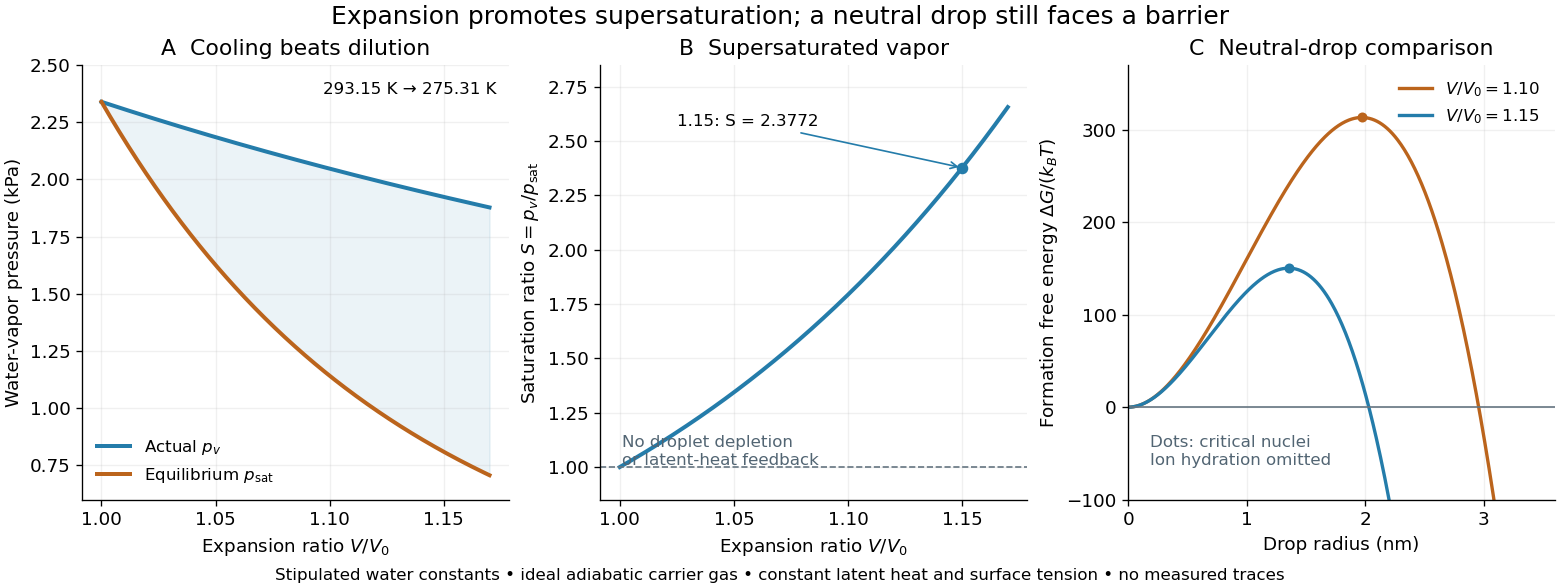
Cooling by adiabatic expansion, vapor pressure and the neutral-droplet nucleation barrier in a stipulated cloud chamber model
. Original calculations, not measured traces. The neutral-droplet model illustrates a barrier; it omits the charged clusters responsible for the detector's ion-assisted response. Details.
Why does not instantly make every molecule a visible drop? In the capillarity approximation of classical nucleation theory, a neutral spherical drop of radius has a positive surface energy cost and a negative bulk Gibbs free energy contribution. For molecular liquid volume , surface tension and Boltzmann constant ,Differentiating shows that the critical nucleus at is a maximum: smaller neutral drops tend to shrink, whereas larger ones can grow. With stipulated , and , the example gives and . A substantial neutral-drop barrier can coexist with supersaturated vapor.
This is deliberately a neutral-drop comparison. An ion changes the cluster free energy through electrical interactions and molecular hydration; the formula does not calculate the ion-assisted nucleation threshold. At nanometre radii, using bulk surface tension is itself approximate. There is no predicted droplet count, growth time or detection efficiency here. Once many drops grow, latent heat release, vapor depletion and heat transfer from the chamber walls invalidate the dry adiabatic expansion trajectory. The example therefore explains the direction of the effect and the need for nucleation, without extrapolating its curves to Wilson's cloud limits.
Wilson cloud-chamber experiment Created 2026-10-18 Updated 2026-10-20
Charles Thomson Rees Wilson's 1927 lecture recalls electron cloud trails produced with X-rays in 1911, then alpha particle trails from a radium-tipped source. The improved 1912 chamber had a wide, shallow space with a suddenly falling floor to limit stirring. A roof–floor clearing electric field removed unwanted ions. Sharp photography required expansion, then the ionizing particle, then illumination.[ref]
On the Cloud Method of Making Visible Ions and the Tracks of Ionizing Particles by Charles Thomson Rees Wilson. Nobel Lectures, Physics 1922–1941; Wilson, 1927 Nobel lecture, pp.199–201, Fig.3: apparatus and operating sequence
The piston mechanism connects the space beneath the moving floor to an evacuated vessel: opening the valve lets the floor drop. Water in a trough supplies the vapor. The Smithsonian's surviving demonstration object is explicitly a 1961 replica of the 1912 apparatus.[ref]
Wilson’s Cloud Chamber, Replica of Cavendish Lab Apparatus by Smithsonian Institution. Smithsonian Institution, Wilson's cloud chamber, replica of Cavendish Lab apparatus, object nmah_700205, “History and basic principle” and “Date made”
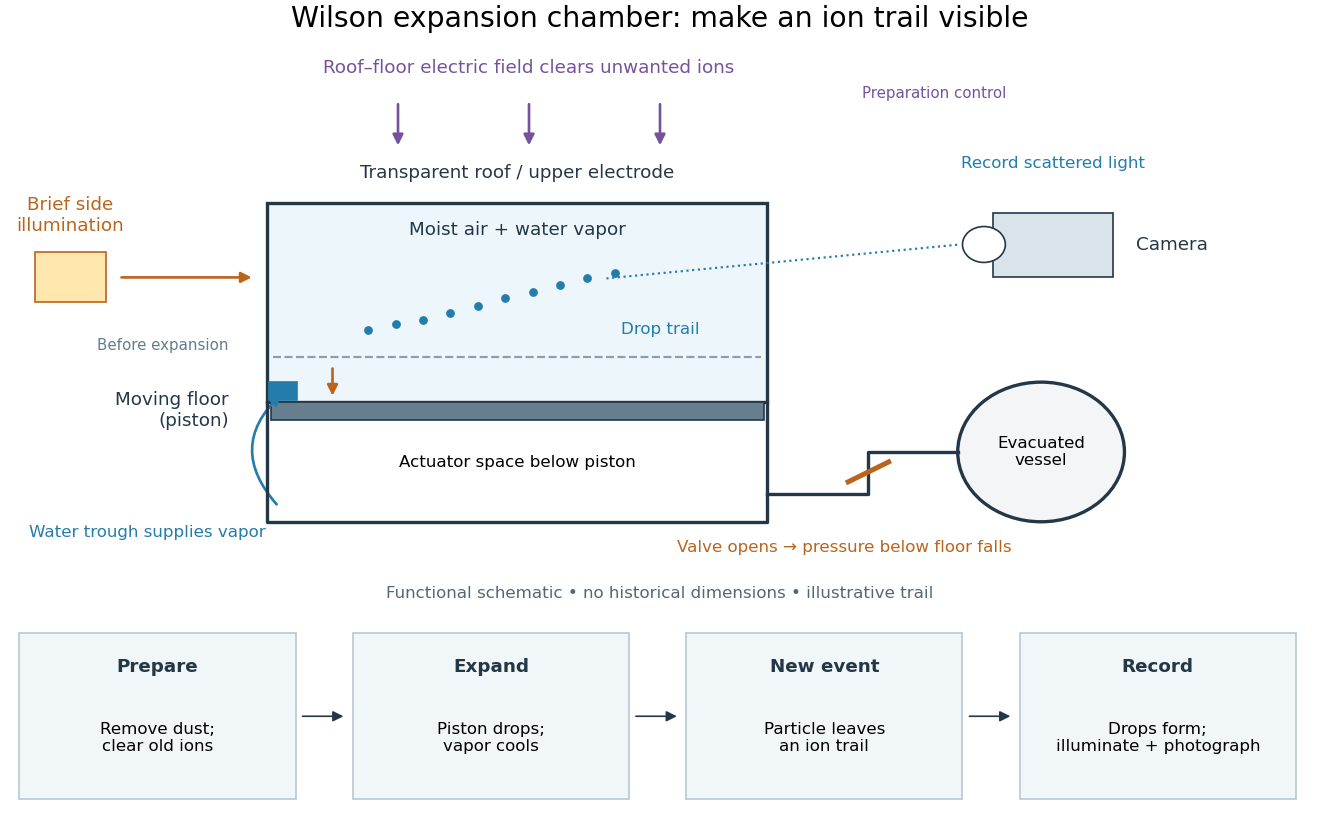

After dust removal, X-rays increased droplet formation above a lower expansion threshold; larger expansions also produced dense background cloud.[ref]
On the Cloud Method of Making Visible Ions and the Tracks of Ionizing Particles by Charles Thomson Rees Wilson. Nobel Lectures, Physics 1922–1941; Wilson, 1927 Nobel lecture, pp.194–197: cloud limits and clearing controls
Triggered cloud chamber 2026-10-18
A triggered cloud chamber expands in response to an event indicated by other detectors, rather than hoping that a particle arrives during a randomly chosen sensitive interval. The ionization trail is produced before expansion. The apparatus must respond while the ions remain sufficiently localized to make a useful photograph.
Biexciton Created 2026-10-18 Updated 2026-10-20
A biexciton is a two-electron, two-electron hole excitation. If and are total excitation energies relative to the empty emitter, the cascade emits photons of energies and . Define its binding energy by . The first cascade photon then has energy . Positive binding shifts that line below the single-exciton line; confinement can also produce negative binding, shifting it above. The cascade does not emit a single photon of twice the exciton energy.
Direct exchange Created 2026-10-18 Updated 2026-11-05
Direct exchange comes from Coulomb matrix elements between overlapping localized electronic orbitals together with the antisymmetry required by the Pauli exclusion principle. It produces a spin-dependent energy without being a classical dipole interaction. Its competition with kinetic processes and orbital occupation helps determine whether neighbouring moments prefer parallel or antiparallel alignment.
Superexchange Created 2026-10-18 Updated 2026-11-05
Superexchange couples localized moments through virtual hopping via intermediate, often nonmagnetic, ligand orbitals. Half-filled orbitals sharing an effective hopping amplitude give an antiferromagnetic scale in the repulsive one-band limit. Ligand geometry, orbital occupation and exchange within intermediate states can change the balance and allow ferromagnetic coupling. Real charge motion can remain gapped while these virtual processes couple an insulating magnet's spins.
Coulomb exchange splitting of two orbitals Created 2026-10-18 Updated 2026-10-20
Let be distinct orthonormal spatial orbitals occupied by two identical spin one-half particles, with a weak repulsive Coulomb interaction. The symmetric and antisymmetric spatial combinations have first-order energy shifts and , where is the direct Coulomb integral andThe Coulomb kernel has positive Fourier transform , so . Fermionic exchange symmetry pairs the symmetric spatial function with the spin-one-half singlet state and the antisymmetric one with the spin-one-half triplet state. For these fixed orbitals the triplet lies lower by when . This does not compare arbitrary singlets and triplets with different orbital occupations; for negligible orbital overlap the splitting can vanish.
Work by Esther Lederberg 2026-10-18
Null effective potential in Schwarzschild spacetime Created 2026-10-18 Updated 2026-10-20
For an equatorial null geodesic in Schwarzschild spacetime, let and be the conserved quantities for an affine parameter . The null metric condition gives . For , the effective potential is zero at the Schwarzschild event horizon, positive outside, and tends to zero at infinity. Its unique exterior maximum is at , with value and second derivative . This maximum gives the unstable photon sphere.
The impact parameter of an incoming ray is for . Capture requires its radial energy to exceed the maximum, namely . At equality the incoming ray approaches the circular orbit asymptotically; it does not cross the horizon. For , the potential is identically zero and the ingoing radial ray is captured.
Entropy of a two-species classical ideal gas 2026-10-18
Two physically distinguishable noninteracting species with fixed particle numbers and the same single-particle partition function have the displayed canonical partition function. If , the leading large-particle-number entropy is . With and , this equals the one-species expression at total number plus . Merely attaching labels to otherwise identical indistinguishable atoms does not justify this mixing term.
Residual entropy Created 2026-10-18 Updated 2026-10-20
Residual entropy is entropy remaining in the zero-temperature limit. An equilibrium ground-state degeneracy gives for the complete system; an extensive residual entropy requires a correspondingly large state count. Frozen configurational disorder can also leave an experimentally inferred residual entropy when a sample fails to equilibrate. The zero-entropy perfect-crystal form of the third law of thermodynamics assumes a unique, fully ordered equilibrium ground state.
Entropy generated by cooling a finite body in a reservoir Created 2026-10-18 Updated 2026-10-20
For a body of constant heat capacity cooling from to a thermal reservoir at , the body's entropy change is , while the reservoir gains . Their sum is nonnegative because for . The logarithmic body contribution is computed along a hypothetical reversible path; the actual finite-temperature-difference heat transfer is irreversible.
Relativistic energy 2026-10-18
For a massive free particle with invariant rest mass , speed , and Lorentz factor , its total energy is . It includes the rest energy and the relativistic kinetic energy . Here is the speed of light. At fixed total energy, a larger speed requires a smaller rest mass.
Energy eigenvector Created 2026-10-18 Updated 2026-11-05
An energy eigenvector is a nonzero vector in the operator domain of a Quantum Hamiltonian satisfying . Normalizing it gives a pure energy eigenstate, for which an ideal energy measurement yields with probability one.
The eigenvector can be multiplied by any nonzero scalar without changing its eigenvalue. Several independent eigenvectors can also share when the energy eigenspace is degenerate. The zero vector belongs to every eigenspace algebraically but represents no physical state and is excluded by the word eigenvector. A free particle plane wave is instead a generalized eigenfunction on unbounded space, since it is not a normalizable vector in the physical Hilbert space.
Range straggling 2026-10-18
Range straggling is the event-to-event spread in particle range for otherwise similar incident particles, caused by fluctuations in their energy loss and transport through matter. It must be distinguished from measurement uncertainty and from the incomplete recording of particles that escape.
Neutron-rich magnesium shell-closure test 2026-10-18
A 2013 RIKEN experiment used a fast calcium beam on beryllium, selected radioactive aluminium and silicon fragments, then struck carbon to produce magnesium isotopes with . Emitted gamma rays supplied excitation energies; comparison across these isotopes supported deformation extending beyond the region toward . This tests the limits of traditional magic numbers, not merely their arithmetic. The inferred shape depends on nuclear-structure interpretation of the energy levels, rather than direct imaging.[ref]
Magic numbers disappear and expand area of nuclear deformation by RIKEN. 20 November 2013, beam preparation, gamma-ray readout and deformation inference
For the rotational elliptic paraboloid above , allow inscribed shapes to touch the boundary. A coaxial cylinder of radius and height obeys . Applying a Lagrange multiplier to gives , hence and .
A centred rectangular parallelepiped with horizontal side lengths and height obeys . The Lagrange multiplier equations for give and , hence . These yield the displayed maximal volumes; both positive stationary shapes are interior optima among the dimension variables, while their degenerate boundary shapes have zero volume. The cylinder's volume is times the box's. If strict containment in the open region is required, these are suprema approached by slightly smaller shapes rather than attained maxima.
Paraboloid sector surface measures 2026-10-18
For and , the curved sector , , has volume beneath it. Its surface area isTo derive this, parametrize the surface by . The upward vector area element is ; its magnitude integrates to the stated surface area. Its integral gives the vector areaIn the shallow limit , the surface area is , approaching the area of its planar sector projection.
Volume and centroid of a parabolic cup Created 2026-10-18 Updated 2026-10-25
The solid , , with , has horizontal slice area . Thus its volume is . For a positive constant mass density, rotational symmetry puts its centre of mass on the vertical axis, andThe curved surface area, excluding the horizontal opening, is . Parametrizing the elliptic paraboloid by gives the area element of a surface , with , proving this last formula. It is also a translated and reflected specialization of paraboloid sector surface measures.
There are unlisted articles, also show them or only show them.