
Rydberg formula Created 2026-10-18 Updated 2026-11-05
The Rydberg formula relates wavelengths of hydrogenic spectral lines to pairs of principal quantum numbers. For hydrogen emission from to , , where includes the electron–proton reduced mass correction to the infinite-nuclear-mass Rydberg constant.
Holding the lower level fixed generates a series: gives the Lyman series and the Balmer series. Higher upper levels accumulate toward a series limit because their binding energies approach zero. For example, gives , whereas the Balmer limit has .
The Bohr model reproduces this gross energy pattern, while a more complete treatment includes fine structure and other corrections. A precise measured line position therefore requires more specification than two principal quantum numbers alone.
For spherical charge density , integrate from zero to to obtain the displayed enclosed charge. Gauss's law then gives , directed inward. Near the origin ; at large radius it approaches the field of charge .
Adding a point nucleus of charge leaves the unperturbed total fieldIt is exponentially small rather than identically zero, because the electron cloud has no compact boundary. This frozen-density field alone does not describe the dominant long-range response to another charge: charge-induced dipole attraction requires allowing the atom to polarize.
Hydrogen spectral series 2026-10-18
A family of hydrogen emission lines terminating at a fixed lower principal quantum number . In the nonrelativistic Bohr model, their inverse wavelengths are for integers . Holding fixed and increasing gives lines approaching the series limit . Reduced mass shifts the Rydberg constant, while additional interactions produce corrections to this gross spectral pattern.
Finite proton-shell correction to hydrogen ground energy Created 2026-10-18 Updated 2026-10-20
Model a proton as a uniformly charged thin spherical shell of radius . Write . The shell theorem gives an electron potential energy inside the shell and outside. Relative to a point Coulomb potential, the perturbation is consequently for and zero otherwise.
For the hydrogen atom ground state, time-independent perturbation theory gives the first-order energy correctionSince , the signed fractional change is . The correction is positive: distributing the positive charge weakens the attraction near the origin and reduces the magnitude of the binding energy. Here is the Bohr radius and is the small-radius approximation.
Work by Hong Kong University of Science and Technology Created 2026-10-18 Updated 2026-11-05
List of historians of physics 2026-10-18
Tissue (biology) Created 2026-10-18 Updated 2026-11-05
A tissue is an organized population of cells together with their associated extracellular material. Cooperation among the components supports a biological function. A tissue differs from an organ, which typically combines several tissue types in a larger spatial arrangement.
Work by Hiroji Yamada 2026-10-18
Hess's law calorimetry experiment 2026-10-18
A practical test compares three transformations involving sodium hydroxide: dissolution of the solid, neutralization of its chemical solution by hydrochloric acid, and reaction of the solid directly with hydrochloric acid. In the ideal compatible-state notation, the hydrogen ion and hydroxide giveThe hydroxide cancels, whereas the newly formed water remains. Sodium and chloride spectator ions must still be included in the full material inventory when matching actual chemical solutions.
The teaching protocol Calorimetry: Heat of Neutralization Reaction & Hess's Law, Procedure A–C, uses nested insulated cups, a cardboard lid and a thermometer. It mixes each of hydrochloric acid and sodium hydroxide chemical solutions; separately it adds solid sodium hydroxide to diluted hydrochloric acid, or to water. It records initial temperatures, stirs, reads temperature every , repeats runs, and extrapolates cooling trends to mixing time. Rapid weighing limits moisture uptake. The Introduction neglects vessel heat capacity and room losses; these are approximations, not a measured calibration. The readout tests whether the inferred enthalpies add, rather than directly measuring a state function.[ref]
Calorimetry: Heat of Neutralization Reaction & Hess's Law, Chemistry 151LL. Introduction; Procedure A.1–8, B.1–5 and C.1–6; Additional Data Treatment: cup approximation, preparation, repeat runs and mixing-time extrapolation
Matching the chemical equations alone is insufficient. The direct-acid recipe uses hydrochloric acid, whereas the solution-mixing recipe uses . The dissolution run also does not automatically reproduce the water inventory of the mixed-solution run. Exact closure requires matching initial and final chemical solution compositions and adding any necessary mixing or dilution enthalpies. Agreement after approximate corrections is a limited test, rather than proof of exact cancellation for those recipes.
To improve the calorimetry, use calorimeter calibration for the participating hardware, and estimate calorimeter heat-loss correction under comparable conditions. With an approximately constant total receiving heat capacity , common initial temperature, constant external pressure, only expansion work, negligible escaping material and negligible bulk kinetic energy and potential energy changes, the balance isHere is the chemical solution mass, its specific heat capacity at constant pressure, the hardware heat capacity, and the signed outward heat loss. Different initial temperatures require separate warming terms. Calorimeter calibration and matching chemical solution compositions address different errors.
For an original constructed model, choose and . Neglect outward heat loss and other corrections. The receiving chemical solution and hardware gain , so . If the completed extent of reaction is for a unit-coefficient chemical equation, the inferred reaction enthalpy per mole of that reaction isThese chosen numbers illustrate the signs and normalization; they are not measured sodium hydroxide data and are independent of the abstract example.
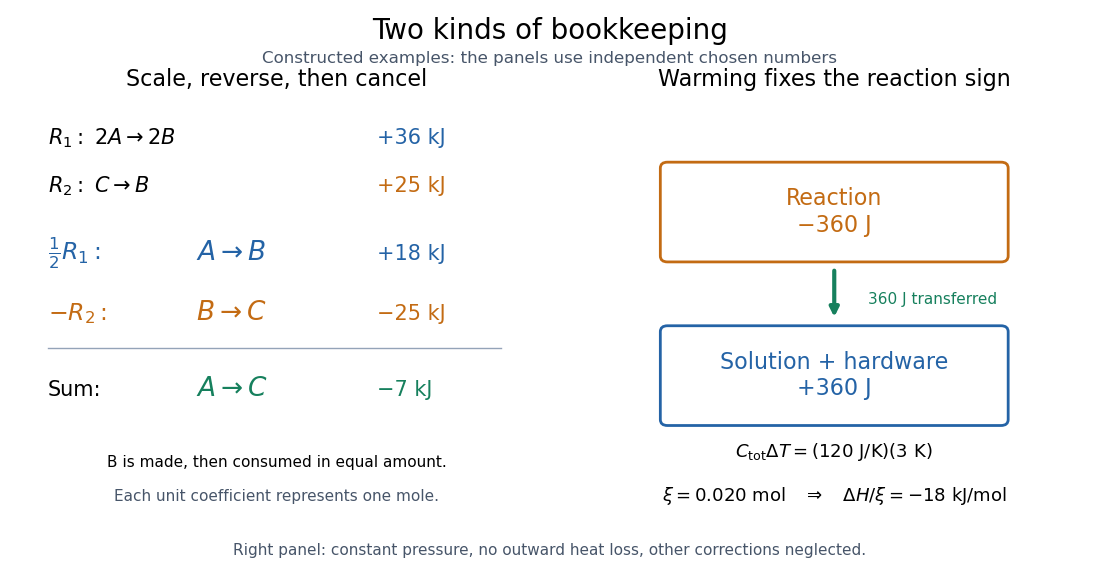
Stoichiometry cancels intermediate states; calorimetry converts warming into signed reaction enthalpy
. Left: original abstract chemical equations use to give and for one mole. Right: an independent chosen heat capacity model gives receiver gain and reaction change . Neither panel reports experimental measurements. Details.
A loss of heat to the room makes the uncorrected warming underestimate the magnitude of a heat-releasing reaction. Incomplete dissolution, incomplete reaction, uncertain amount of substance, or a slow thermometer response can also spoil closure. A useful experimental residual is after all changes have been placed on the same amount and state basis. Compare with the measurement uncertainty, accounting for shared calibration errors; averaging repeated runs reduces scatter without removing a common bias.
Hess's law equation cancellation 2026-10-18
Keep the stoichiometry attached to the enthalpy. Use the same abstract and suppose each of two entries fixes an amount of substance for every species:Here each unit coefficient represents one mole on the common basis. To obtain , halve and reverse . Adding those transformed chemical equations givesThe equal amounts of on opposite sides cancel, leaving . Doubling this final chemical equation would give and ; its change per mole of would remain .
More generally, write each chemical equation as a stoichiometric vector , with negative entries for reactants and positive entries for reaction products. Finding coefficients with also gives , using compatible state and amount conventions. An identical chemical species cancels only with the same thermodynamic phase and composition conditions. A leftover water or dilution step is a real part of the balance.
Enthalpy cycle 2026-10-18
An enthalpy cycle is a collection of compatible thermodynamic processes that returns the entire material inventory to its initial thermodynamic state. Its signed enthalpy changes sum to zero. This supplies a consistency check and lets a missing change be recovered from the others.
Consider three abstract thermodynamic states of the same conserved material inventory at common temperature and pressure. Choose their molar enthalpies, on the same one-mole basis, asThese are constructed values, not material measurements. Endpoint subtraction givesThus : the two-step route and the direct route have the same molar enthalpy change. Closing the route with gives . Shifting every by the same arbitrary reference constant leaves all these differences unchanged.
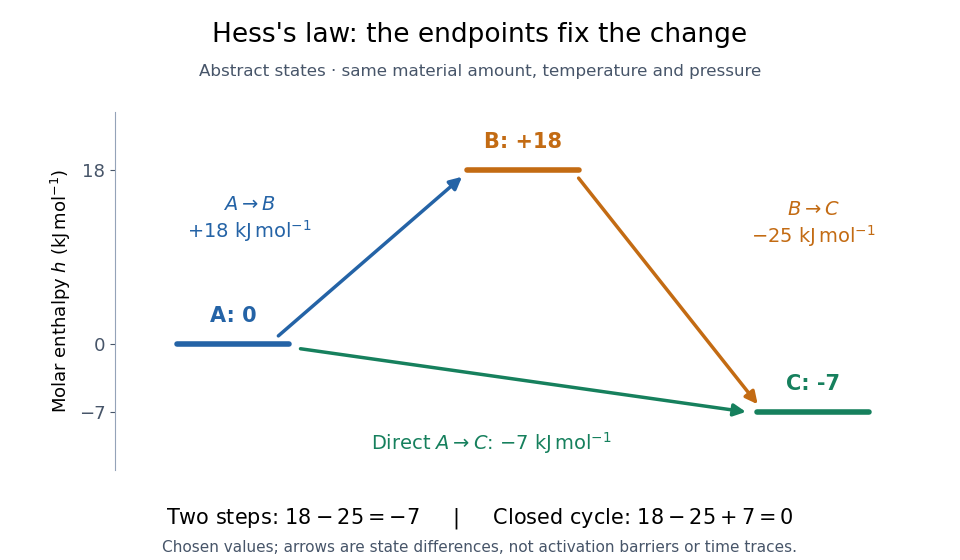

The short proof is cancellation:Adding any finite number of consecutive endpoint differences works the same way. For a closed enthalpy cycle the final cancels the initial . A nonzero experimental residual can therefore expose mismatched states or measurement error; it does not identify which individual input is responsible.
Work by Helen E. Brindley 2026-10-18
Hash table record 2026-10-18
An entry pairing a hash table key with its associated value . In the map interface of hash table, each key equality class has at most one live hash table record.
Hash table key 2026-10-18
The identifier used to select a hash table record. Key equality determines whether two identifiers name the same entry, while a hash function chooses where its lookup begins.
Open addressing 2026-10-18
A hash table collision-handling method storing at most one live record per array slot. A hash function chooses a starting slot, and a probe rule chooses further slots. Unlike separate chaining, records occupy the slots themselves.
Work by Harry C. S. Lam 2026-10-18
Work by Harold G. Smith 2026-10-18
Handbook of Basic Atomic Spectroscopic Data by Jean E. Sansonetti and William C. Martin Atomic Data for Silver (Ag) Created 2026-10-18 Updated 2026-10-20
Work by Hamamatsu Photonics K.K. 2026-10-18
There are unlisted articles, also show them or only show them.