
Metalorganic vapour-phase epitaxy Created 2026-10-18 Updated 2026-11-05
Epitaxial growth using volatile metal-organic precursors delivered in the gas phase. Precursor decomposition and surface incorporation grow a crystalline compound layer or nanostructure; temperature and mass transport influence composition.
Enzyme inhibition initial-rate assay 2026-10-18
The protocol used in the trypsin colorimetric assay requires – inhibition and rejects hazy or yellow BAPNA solution.[ref]
Enzymatic Assay of APROTININ - Sigma Quality Control Test Procedure. A6012, SPBAPN02.001, revised 22 December 1997, p. 3, Notes 1–2: target inhibition range and substrate-solution quality
The trypsin colorimetric assay explains blank subtraction and conversion to a reaction rate using the Beer-Lambert law. This protocol is an activity comparison at one substrate level, not evidence that aprotinin obeys any particular curve above. To test the model, an experimental extension would vary both free inhibitor and free substrate concentrations, estimate early linear reaction rates before appreciable depletion, and fit the whole collection by nonlinear regression. Include a no-inhibitor series and inhibitor-matched blanks: inhibitor-dependent absorbance drift must not be mistaken for changed catalysis.
There is a mathematical reason to collect more than one reaction rate. At with the chosen uninhibited parameters, measuring would imply only . Both and satisfy that observation, although their high- limits differ. A broader substrate range tests which model fits. Even a fitted curve leaves binding geometry unresolved. Check activity recovery after reducing inhibitor concentration separately; the simple equation also ceases to apply when free inhibitor is substantially depleted by binding or inhibitor exchange has not equilibrated during the measured interval.
Reversible enzyme inhibition Created 2026-10-18 Updated 2026-10-20
Construct a minimal model with one substrate and no appreciable accumulated reaction product. Only the enzyme-substrate complex produces product, with catalytic rate constant ; and are inactive. Write and for free molar concentrations, and for total enzyme molar concentration. Assume a suitable quasi-steady-state approximation, rapid inhibitor binding and release relative to turnover, and negligible depletion of free inhibitor. In this construction the population relations areHere is the uninhibited Michaelis constant, and are the inhibition constants for the two indicated binding branches. The symbol denotes a free concentration, not an amount added to the tube. Define . Conservation of enzyme gives an original short derivation:Thus fitting a Michaelis-Menten equation at a fixed would return the apparent parameters“Apparent” means conditional on that inhibitor concentration. The uninhibited Michaelis constant has not been redefined. Dimensional analysis checks the denominator: both and have units of molar concentration; the resulting has units of reaction rate.
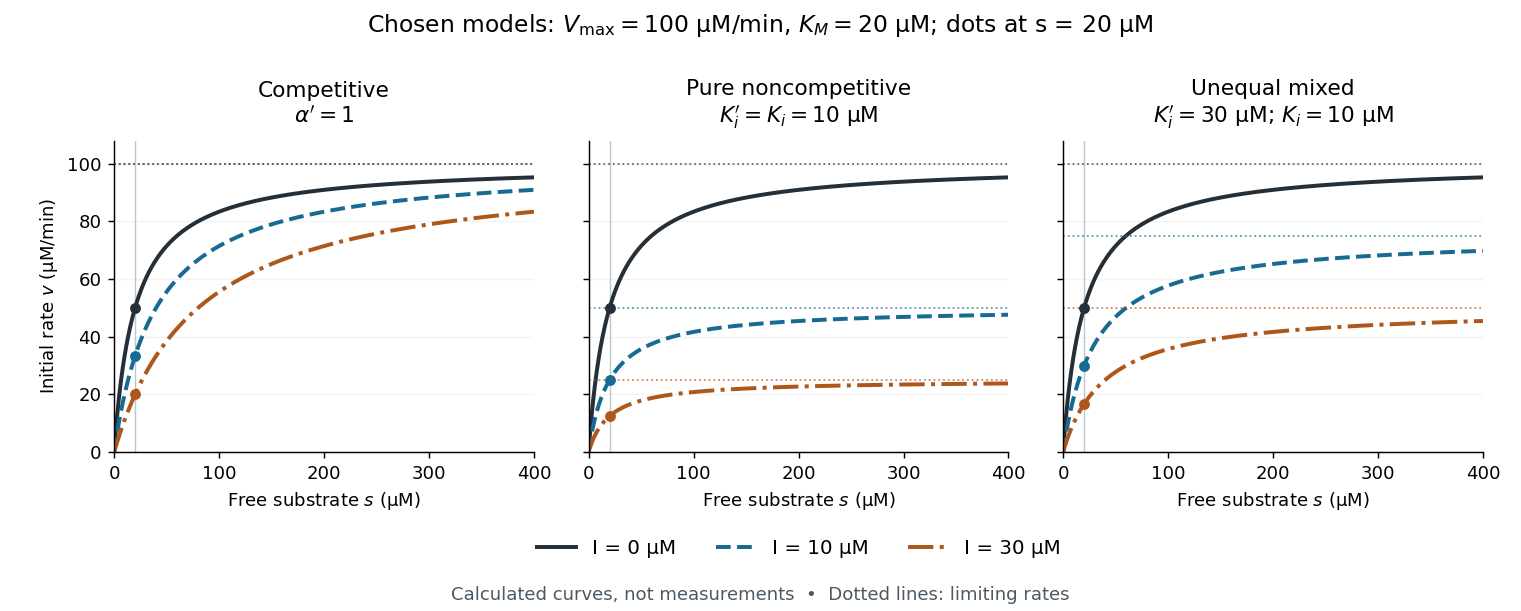

The shared numerical choices make the mechanisms comparable. At and , all three models give . At , the respective reaction rates are , , and ; at they are , , and . These are independently chosen teaching models, not measured inhibition constants for a named enzyme.
List of entomologists 2026-10-18
Endocrinologist Created 2026-10-18 Updated 2026-11-05
An endocrinologist is a physician or researcher specializing in hormones and endocrine disorders. The field relates glandular secretion and feedback to metabolic, developmental and reproductive function. Assessment of a control pathway requires more than naming one hormone.
Electrophoretic mobility 2026-10-18
The electrophoretic mobility is the proportionality coefficient between drift velocity and a weak applied electric field. Its sign specifies motion relative to the field. When only travel distances are used, the mobility magnitude is often intended. For long linear DNA in a weak-field reptation regime, can scale inversely with chain length, whereas free-solution mobility is approximately length-independent. Neither law supplies a universal gel electrophoresis size calibration for arbitrary gel concentration, field strength or molecular topology.
Diffusive broadening of electrophoretic bands Created 2026-10-18 Updated 2026-10-20
A narrow population band undergoing uniform electrophoresis and ordinary diffusion has mean position and variance . This follows from the advection-diffusion equation by changing to the coordinate . For two species with mobility difference , their centre separation is , whereas diffusion widths grow only as . Starting from point-like bands with common diffusion coefficient , a required separation of standard deviations needsA prescribed distance between centres alone is a resolution convention; finite loading widths and other dispersion mechanisms must be included when interpreting actual electrophoresis data.
Unpaired electron Created 2026-10-18 Updated 2026-10-20
Hund's rules Created 2026-10-18 Updated 2026-10-20
Friedrich Hund's rules describe the usual ground-term ordering within an atomic electron configuration in the LS coupling regime. First maximize the total spin subject to the Pauli exclusion principle. Among the terms with that spin, maximize total orbital angular momentum . Within the resulting term, the lowest level has for a less-than-half-filled open subshell and for a more-than-half-filled one. These are ordering rules, not universal replacements for diagonalizing an arbitrary atomic Hamiltonian operator.
For two equivalent electrons, parallel spins give . Their spatial wavefunction must be antisymmetric; the highest allowed orbital projection with parallel spins is , giving . A subshell is less than half filled, so its lowest term symbol is , followed within that term by and . Closed subshells contribute zero total and .
Cathode ray Created 2026-10-18 Updated 2026-10-20
A beam of electrons in a partially evacuated tube, studied in the Thomson charge-to-mass experiment.
Thermionic emission Created 2026-10-18 Updated 2026-10-20
Heating a metal gives some electrons enough energy to escape its surface. A heated diode cathode can therefore supply an electric current across a vacuum gap to a collecting diode anode. This makes temperature a control for the supply of electrons. Conversely, measuring that supply at several temperatures lets us estimate the surface work function: the energy barrier measured from the Fermi level to the nearby vacuum level. A Richardson plot turns the strong exponential function dependence into a slope.
Three questions must be kept separate: how many electrons cross the surface, how many traverse the gap, and how many the collecting diode anode records. The Richardson-Dushman law answers the first under specified surface assumptions. Space charge can obstruct the second, while incomplete collection can alter the third.
Electron gun Created 2026-10-18 Updated 2026-11-05
An electron gun creates, accelerates and shapes a directed electron beam. A source such as a heated cathode supplies electrons, an applied electric potential difference accelerates them toward an anode, and electrodes control the emitted current and beam geometry.
For an electron accelerated from rest through potential difference , the ideal gained kinetic energy is , with the voltage sign chosen to accelerate it. Focusing optics then control beam position and convergence. Source size, energy spread and space charge affect the useful beam; increasing accelerating voltage alone does not guarantee a smaller probe or higher image resolution.
Secondary electron Created 2026-10-18 Updated 2026-11-05
A secondary electron is emitted from a material after excitation by incident radiation or particles, rather than simply being a high-energy primary electron redirected back out. Many detected secondaries have low enough kinetic energy that escape strongly favors regions near a surface.
This makes secondary-electron collection useful for secondary-electron topographic contrast in a scanning electron microscope. Surface angle, local electric fields and collector bias affect the signal as well as emission itself. Backscattered primaries can also excite secondary electrons away from the probe's immediate landing position, so every detected secondary need not originate directly beneath the nominal probe.[ref]
Secondary electron by JEOL Ltd.. Surface-related emission and distinction between secondary-electron generation paths
Backscattered electron Created 2026-10-18 Updated 2026-11-05
A backscattered electron is a primary beam electron redirected out through the incident side of a specimen after scattering. Backscattered signals commonly retain much more of the incident kinetic energy than emitted low-energy secondary electrons.[ref]
In a scanning electron microscope, collecting these electrons can provide backscattered-electron atomic-number contrast, but specimen tilt, collection geometry and crystallographic electron channeling also change brightness. Comparing detector directions or tilting the specimen tests some of those contributions. A bright region is therefore not uniquely a region of greater atomic number.
Electron stopping power Created 2026-10-18 Updated 2026-10-20
The average loss of electron kinetic energy per path length, including collisional and radiative contributions.
Electron scattering Created 2026-10-18 Updated 2026-10-20
Electron mass Created 2026-10-18 Updated 2026-10-20
Electron gas Created 2026-10-18 Updated 2026-10-20
A collection of mobile electrons treated statistically. A dense electron gas in a metal generally requires Fermi-Dirac statistics.
Classical electron radius Created 2026-10-18 Updated 2026-10-20
The classical electron radius is the length scale formed from the elementary charge, vacuum permittivity, electron mass and speed of light. It is not a measured material radius of an electron. In the classical low-energy scattering model it sets the Thomson cross-section, .
Magnetism 2026-10-18
Phenomena involving magnetic fields, including those produced by electric currents and magnetic moments.
A small total magnetic moment can hide extensive magnetic order. Compare three questions: are the individual magnetic moments nonzero, how are their directions correlated, and what is their vector sum? Ferromagnetism, antiferromagnetism, and ferrimagnetism answer the second question differently. The third question alone cannot identify the order.
There are unlisted articles, also show them or only show them.