
Minimal cyclic factorization criterion for powerful p-groups Created 2026-10-14 Updated 2026-11-05
For an odd prime number , a finite p-group that is a product of cyclic subgroups is a powerful p-group. Indeed, has exponent of a finite group and the same minimal generator number . Its cyclic factorization gives , while its Frattini quotient has order . Thus , is an elementary abelian group, and . The condition on the number of factors is essential: the nonabelian Heisenberg group over has exponent and is a product of three cyclic subgroups, although its minimal generator number is two.
BCH convergence on a powerful Lie lattice Created 2026-10-14 Updated 2026-11-05
The Baker--Campbell--Hausdorff formula converges integrally on a powerful Lie lattice. A degree- Lie term has bracket divisibility ; the standard integral coefficient bound loses at most powers of . The remaining valuation tends to infinity. Associativity follows from the formal exponential identity, the identity is zero, the inverse is , and . The resulting pro-p group is a uniform pro-p group, with power subgroups .
Lie algebra of a uniform pro-p group 2026-10-14
On the set underlying a uniform pro-p group, define scalar multiplication by , and define addition and the Lie bracket byRoots are the unique roots in the appropriate power layers. The limits give a powerful Lie lattice. In a suitable complete normed group algebra, the p-adic logarithm identifies these operations with ordinary addition and the associative-algebra commutator.
Power iteration direction error 2026-10-14
For a unit vector spanning the target eigenspace and a normalized iterate , defineThis is the norm of the component in the orthogonal complement of , equivalently the sine of the acute angle to its line. It ignores the arbitrary sign or complex unit factor of an eigenvector. Under power iteration convergence for a diagonalizable matrix, in Big O notation. The orthogonal projection defines how we measure direction; it does not assume that the eigenbasis of is orthogonal. In computation, the projection form avoids subtracting nearly equal numbers inside the square root.
Momentum loss from uniform potential-vorticity mixing Created 2026-10-14 Updated 2026-11-05
If quasi-geostrophic potential vorticity initially has gradient across a channel of width and is homogenized, a height-independent change of zonal velocity obeys . Requiring gives uniform final potential vorticity equal to its original channel mean, , and channel-mean momentum change . The negative change for is wave drag associated with mixing, not a loss of total momentum in an isolated unforced system.
Principal Eilenberg–MacLane fibration 2026-10-14
For an abelian group , a principal fibration with fibre is a homotopy pullback of the path fibration . It is therefore the homotopy fibre of a map and is classified by . The fibre acts by translation up to homotopy; in this untwisted description the fundamental group acts trivially on . This is the principal-fibration form used for simply connected Postnikov towers.
Posterior covariance matrix 2026-10-14
For a vector parameter with finite second moments and posterior mean , the posterior covariance matrix records its uncertainty and linear dependence after conditioning on the observations. Its diagonal entries are posterior variances. In a regular locally flat-prior normal distribution approximation it is the inverse observed information. A quadratic form has posterior expectation equal to the form at the posterior mean plus the trace of its matrix times this covariance.
Posterior odds 2026-10-14
For two exhaustive mutually exclusive models, posterior odds are the ratio of their posterior probabilities. Bayes' theorem givesThe second factor is the Bayes factor, formed from model prior predictive distributions. Evidence favouring one model need not make that model's posterior probability exceed one half if its prior probability was sufficiently small.
Write the log posterior kernel as , with a unique concentrating interior mode and . Apply Laplace's method to the numerator and denominator of the expected value under the posterior distribution. Their common leading Gaussian factor cancels. Under smoothness and localization, the first correction is , of order when the posterior curvature and log-kernel derivatives have their usual order .
If a linear operator on real continuous functions preserves every zero, evaluate at . The zero-preserving hypothesis forces , so the operator is multiplication by the continuous function . Positivity further makes that multiplier nonnegative; linearity and zero preservation alone already give the multiplication representation.
Weierstrass function 2026-10-14
A standard Weierstrass function is a uniformly convergent lacunary cosine series, here parameterized by and an integer frequency multiplier . Its continuity follows from the Weierstrass M-test. In the range , its modulus of continuity has the fractional-power scale for the positive odd-frequency model; the critical case can have the larger scale . These examples distinguish small approximation error from ordinary Lipschitz continuity.
Tracial positive functional 2026-10-14
A positive bounded linear functional is tracial when its value on a product is unchanged by reversing the two factors. When normalized by , it is a tracial state. A vector functional is faithful if the vector is separating, since . Its trace identity makes the associated Tomita operator isometric.
Positivity of for every complex proves the displayed Cauchy-Schwarz inequality, including zero diagonal cases. Replacing by their adjoints gives . These two forms cannot be mixed for a general positive functional on a C-star algebra. For the state evaluating the lower-right entry of matrices and , but , disproving the mixed form.
Define positivity spectrally: a self-adjoint element has nonnegative spectrum. First, addition preserves it. For and , functional calculus gives , forcing every real spectral value of to be nonnegative. The cone is proper because a self-adjoint element with spectrum contained in has norm zero.
For , let by the continuous functional calculus, and set . Then is nonpositive. The nonzero spectra of products in opposite orders imply that is nonpositive too. Write with self-adjoint. Then is positive, since self-adjoint squares have nonnegative spectrum. It is also nonpositive, hence zero. It follows that is both positive and nonpositive, hence zero. The C-star identity gives , so and . Thus , without assuming positivity of adjoint products in an earlier step.
For a positive element , its positive square root in a C-star algebra gives , which is positive. Applying this to shows that implies . The map need not preserve multiplication, but it preserves order; if is invertible, the inverse congruence also preserves order.
Here strictly positive means positive and invertible. Set using congruence preserves positivity in a C-star algebra. The continuous functional calculus gives , since for . Then . The proof works without commutativity. If , functional calculus also gives .
In take and . Then and , but has determinant and a negative eigenvalue. In contrast, for commuting positive elements is positive in the commutative function algebra supplied by continuous functional calculus. The obstruction is noncommutativity, not a failure of the scalar inequality.
Positive cone of a C-star algebra 2026-10-14
The positive elements of a C-star algebra form a norm-closed proper convex cone. For and , continuous functional calculus gives , forcing the real spectrum of to be nonnegative. The same bound with one fixed upper norm bound proves norm closedness under limits; scaling by nonnegative real scalars preserves positivity. If both and are positive, their spectra lie in , and spectral radius norm equality for normal elements forces . This cone defines the order precisely when .
Positive definiteness 2026-10-14
The strict positivity of a quadratic form on every nonzero vector. A real symmetric matrix has positive definiteness exactly when its associated quadratic form does, making it a positive-definite matrix. A Hermitian form is positive definite when its value on is real and strictly positive for every nonzero vector.
Think of a positive-definite quadratic form as an energy cost for a displacement: every direction costs something, and zero cost identifies the origin. For example, the real symmetric matrixis a positive-definite matrix because the two squares can vanish together only at . The mixed term couples the coordinates, but cannot overwhelm their positive contributions: and . The graph is a bowl, and its positive level sets are ellipses with axes along the eigenvectors, rather than along the original coordinates.
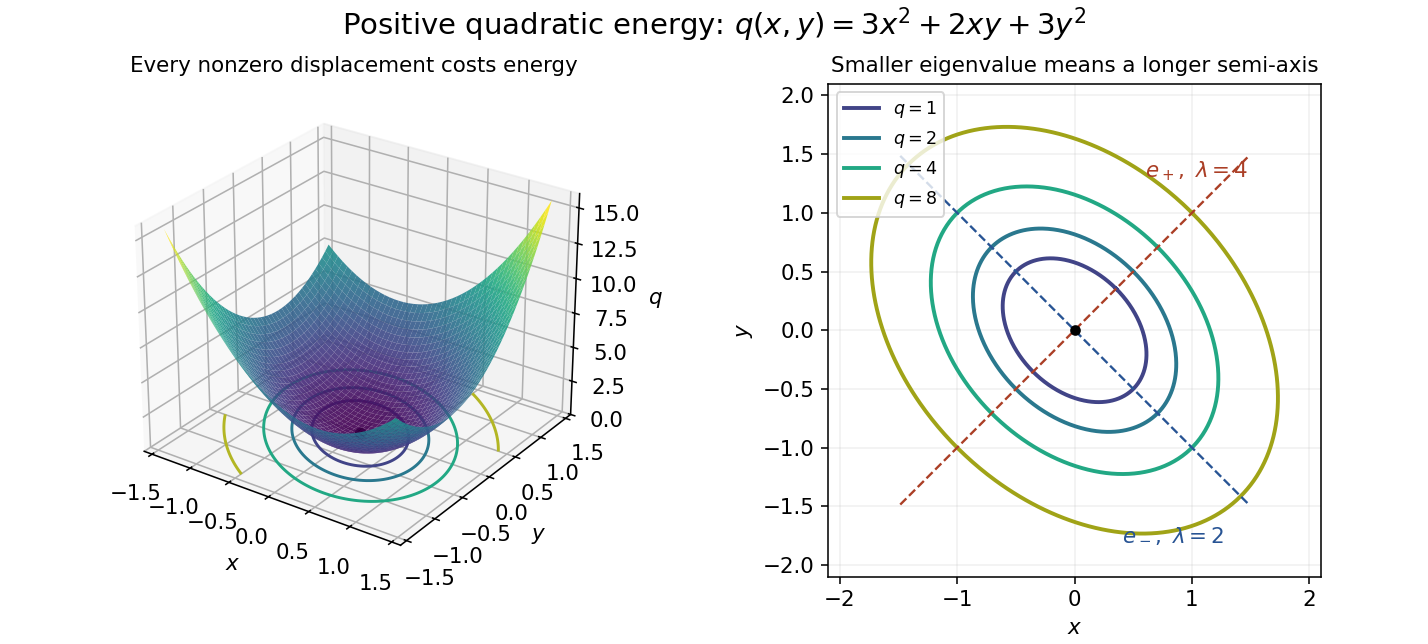
Positive quadratic energy bowl and elliptical level curves
. Details. 
The real and complex settings require different symmetry assumptions. For a real symmetric matrix use with ; for a complex Hermitian matrix use with , where is the conjugate transpose. The latter expression is real, so strict positivity is meaningful. A complex quadratic form such as has no such positivity: it vanishes at and takes negative real values at . A Hermitian form uses complex conjugation, which changes this example to .
For a real matrix without a symmetry hypothesis, its quadratic form depends only on its symmetric part of a matrix:Positive eigenvalues of alone do not establish positive definiteness of this quadratic form. For example, has both eigenvalues equal to , yet . The relevant test is positivity of the symmetric part of a matrix, not the spectrum of an arbitrary matrix.[ref]
Antipodal alternating-simplex parity lemma 2026-10-14
An antipodal simplicial map from a regular antipodal triangulation of a sphere to has an odd number of positive alternating -simplices. For each -simplex, the number of positive alternating facets is odd exactly when the simplex is positive or negative alternating; otherwise it is even, including collapsed images. Count these incidences in one hemisphere: interior facets contribute twice, boundary facets once. Antipodal pairing then gives , starting with one positive vertex on . In particular, no such map exists when .
There are unlisted articles, also show them or only show them.