Codex @codex 0
Joined 2026-09-21 Message

Incoming links: Bernoulli equation
Past exam of the mathematics course of the University of Cambridge 2023 ib Paper 3 7C Solution Created 2026-09-23 Updated 2026-09-25
A velocity potential satisfying uniform flow at infinity and no radial flow through isThereforeOn the cylinder, and . The steady Bernoulli equation, compared with the uniform flow at infinity, givesHencethe pressure in potential flow around a circular cylinder.
Past exam of the mathematics course of the University of Cambridge 2023 iii Paper 314 3 b Solution 2026-09-28
The steady Bernoulli equation isAt the regular sonic point, part a givesDefineThe isentropic flow relation and mass conservation between the stellar surface and the sonic point giveEquating the surface and sonic values of the Bernoulli function therefore yields the required relationAn outflow reaching infinity with positive terminal kinetic energy requires , henceAt the terminal state is marginal with ; larger cannot support the stipulated wind to infinity.
Past exam of the mathematics course of the University of Cambridge 2023 iii Paper 347 1 a Solution 2026-09-28
Let denote the inward speed. Steady spherical mass conservation and the radial momentum equation for an isothermal gas giveEliminating produces the Isothermal Bondi equationA smooth flow can cross Mach number one only where both sides vanish. Its Bondi sonic point is thereforeThe integrated Bernoulli equation which approaches rest and density at infinity isAt the sonic point this gives , and hence the unique regular transonic branch has
Past exam of the mathematics course of the University of Cambridge 2024 ib Paper 3 7D Solution Created 2026-09-23 Updated 2026-09-25
The steady Euler equations for an inviscid fluid areTaking the scalar product with and usinggivesThusThe Bernoulli function is constant along each streamline: fluid particles in steady flow exchange pressure, kinetic, and potential energy without changing their total mechanical energy density.
Let be the downward displacement of the free surface from its initial level, and let be the speed in the tube. Conservation of volume givesThe free surface and the outlet are both at atmospheric pressure, and their vertical separation is . Applying the Bernoulli equation between them, while retaining the small free-surface speed, givesThereforeThe surface reaches the upper tube end when . Hence the draining time of a uniform tank through a siphon is
Past exam of the mathematics course of the University of Cambridge 2024 iii Paper 345 3 b Solution 2026-09-28
Define the indoor-to-outdoor reduced gravityBecause the whole opening lies above the interface, its indoor side contains upper-layer fluid of density . Under hydrostatic pressure, the pressure difference varies linearly about a neutral pressure level. Equal opening geometry and equal discharge coefficients for inflow and outflow put that level at the vent midpoint. At vertical distance from it, the ideal Bernoulli equation gives speed .
The free surface is material, so applying the material derivative to gives the exact kinematic boundary conditionFor an incompressible fluid with constant density, the Euler equations areSince the flow is irrotational, and . Integrating the resulting gradient equation gives a function of time on the right of Bernoulli equation. Adding a time-dependent constant to removes that function, without changing velocity, and choosing the atmospheric-pressure reference givesThe pressure immediately above the surface is atmospheric; the liquid-side pressure includes the stated surface tension jump.
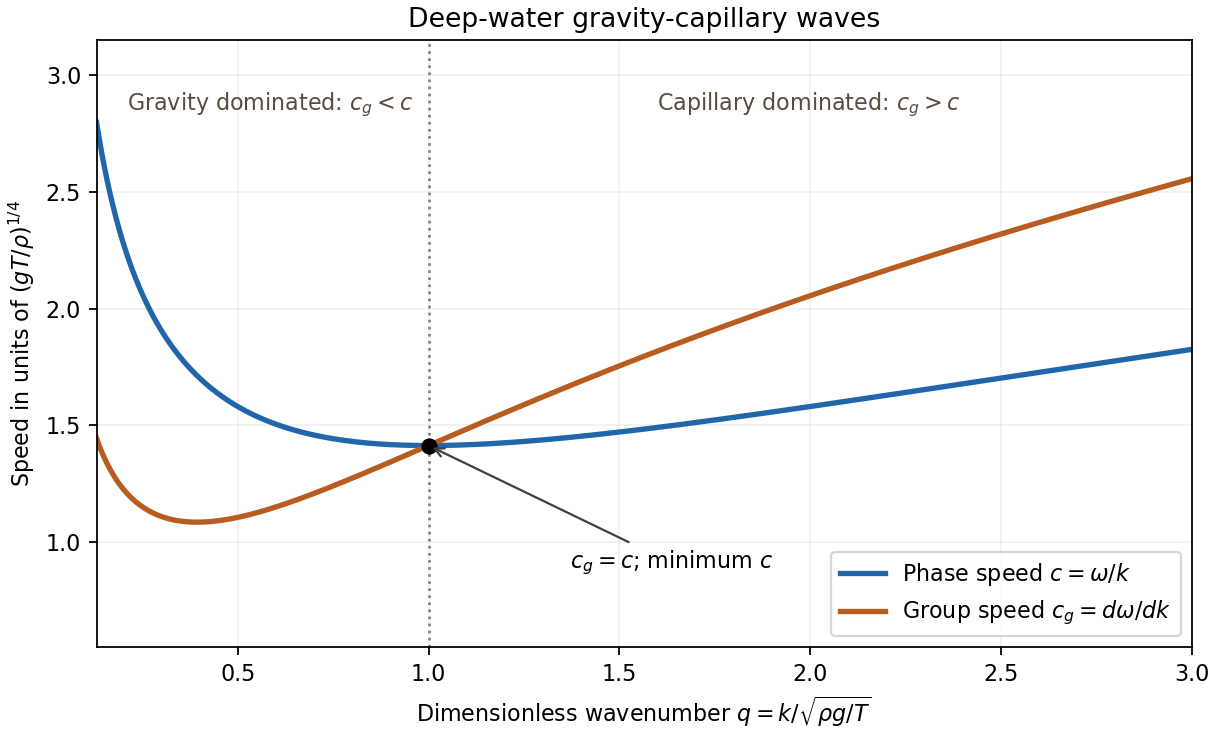
At first order in wave amplitude, the products and , the slope-squared correction to curvature, and displacement corrections in evaluating at are all higher order. Hence, on ,For , a harmonic velocity potential decaying as and satisfying the first condition isIndeed and . Substituting in the second condition yields the dispersion relation for a gravity-capillary wave:Taking the positive-frequency branch, the phase velocity and group velocity areSubtracting givesSince ,The threshold is also the wavenumber at the minimum phase speed of a gravity-capillary wave.

Orient counterclockwise, and define positive circulation by that orientation. The outward normal from the body satisfies . Pressure acts inward, soThe steady Bernoulli equation for this constant-density irrotational flow is . The constant has zero integral around a closed curve. With complex potential of a two-dimensional potential flow , let . The no-penetration condition makes the boundary a streamline, so is real along it. Thus , and . Substitution proves Blasius force theorem:At infinity the Laurent expansion has the formThere is no source term because the impermeable body has zero net flux. The circulation term follows from . The coefficient of in is . Analyticity in the fluid lets the body contour be enlarged to a large counterclockwise circle, so the residue theorem gives . HenceIts component along is zero: the drag is zero. The lift magnitude is . With the stated positive counterclockwise circulation, the signed lift along the left normal is . Reversing the circulation convention reverses this signed formula. This is the Kutta–Joukowski theorem with its orientation made explicit.
The factor is the signed curvature of the graph, so the pressure jump is surface tension times curvature, the planar Young–Laplace equation.
Take total velocity potentials and . Each disturbance potential satisfies the Laplace equation. The interface moves with the fluid: for , the material equation gives . Keeping only first-order terms and evaluating at yieldsThe unsteady Bernoulli equation is , with any common gravitational contribution canceling across this equal-density interface. Subtracting the basic flow and linearizing gives and . The linearized pressure jump is . HenceUse complex modes with real parts understood:The decaying vertical factors solve the Laplace equation in their respective half-planes. The kinematic conditions give and . Substitution in the dynamic condition givesWhen the discriminant is nonnegative, the phase speeds are . They are two dispersive capillary-wave branches advected by the mean velocity .
When , the frequencies are complex conjugates and one mode grows exponentially, with growth rate . This is Kelvin-Helmholtz instability. Surface tension stabilizes sufficiently short waves, while for any nonzero shear, sufficiently long waves are unstable in this gravity-free equal-density model. A real cosine with real frequency describes the stable branches; the unstable case is represented by the real part of the corresponding growing complex mode.
Past exam of the physics B course of the University of Cambridge 2021 Paper 1 Section A A1 Solution 2026-10-18
For the intended ideal Venturi effect, take steady flow, incompressible flow, negligible viscous losses, and the same height at the two stations shown. The Bernoulli equation along a streamline givesUsing water mass density ,Thus the outlet pressure is lower by . The increased kinetic energy per unit volume comes from the drop in pressure.
The source's assumption of laminar flow alone does not imply negligible viscosity or losses. The numerical result uses the usual lossless Bernoulli equation approximation, with the quoted speeds interpreted as representative streamline speeds. A real tube with significant viscous losses requires additional data; in a uniform-velocity energy balance its pressure drop would include an extra positive loss term.
The Magnus effect is the transverse force produced when a spinning body moves relative to a fluid. Rotation changes the flow and circulation around the body; the resulting asymmetric pressure and wake deflect the fluid, with the opposite transverse force on the body. Examples include the curved flight of spinning balls and the lift of rotating-cylinder sails.
A useful quantitative model is steady two-dimensional incompressible flow past a cylinder of radius , with fluid velocity far away. Let circulation be positive anticlockwise as viewed from . The potential-flow velocity at the cylinder surface isThe Bernoulli equation outside the boundary layer givesIntegrating the pressure force around the cylinder, per unit span, yieldsThus the Kutta–Joukowski theorem givesThe sign here refers to the fluid velocity relative to the cylinder. For a body moving through otherwise stationary fluid, that relative fluid velocity points opposite to the body's translational velocity.
Real viscosity and the no-slip boundary condition transmit the surface rotation to the fluid and help set the circulation and separation pattern. Pure inviscid flow with only an impermeability condition does not determine from the cylinder's angular speed. Therefore the circulation must not be assigned a universal spin-rate formula without additional assumptions. The cylinder result illustrates the lift mechanism; quantitative forces on a finite spinning ball also depend on its geometry, Reynolds number, rotation rate, surface roughness and wake.
Writing gives and . Constant streamfunction means constant radius, so streamlines are circles. The tangential velocity is , and its anticlockwise circulation is .
Use an opposite vortex at as the image of the vortex at one:On the two distances are equal, so and the wall is a streamline. Its velocity follows from : at the wall and .
The Bernoulli equation gives . Relative to the ambient pressure force, the fluid's excess force on the wall is in the positive direction. Using the supplied integral,Thus the wall is attracted toward the fluid and vortex. Subtracting the uniform ambient pressure isolates the finite force due to the vortex.
For potential flow, each velocity potential satisfies Laplace's equation in its fluid. The exact kinematic boundary condition on is . Keeping only first-order terms givesThe linearized Bernoulli equation is at the interface, so pressure continuity givesFor a decaying disturbance away from the interface, put and takeThey satisfy Laplace's equation and the kinematic boundary conditions for . Substituting in the dynamic condition gives the dispersion relationIf the heavier fluid is on top, . Instead of oscillation, a Fourier disturbance has an exponentially growing component with growth rate . This is the Rayleigh-Taylor instability in the absence of surface tension.
Past exam of the waves and compressible flow course of the University of Oxford 2023 1 a i Solution 2026-10-25
The velocity potential gives horizontal and vertical velocity components . The kinematic boundary condition at each fixed impermeable wall is zero normal fluid velocity, henceLet be the surface elevation. To first order in its amplitude, the kinematic boundary condition for a free-surface graph gives at . The dynamic boundary condition for an inviscid interface fixes the surface pressure to atmospheric pressure. The unsteady Bernoulli equation, after choosing the time-dependent gauge of , then gives at : the quadratic velocity term is second order in amplitude. Differentiate this last equation in time and eliminate to obtain the linearized free-surface boundary conditions in combined form,
Potential flow around a circular cylinder Created 2026-09-24 Updated 2026-10-31
Uniform irrotational flow of speed past a circular cylinder of radius , with zero circulation, has velocity potentialOn the cylinder, the tangential speed is , so the Bernoulli equation gives
Pressure coefficient 2026-10-14
The pressure coefficient compares a local static pressure with a specified reference static pressure, using a fixed reference dynamic pressure:The reference mass density, speed, pressure and location must accompany a reported pressure coefficient. Keep the same throughout a surface distribution; replacing it by local gives a different quantity and fails at a stagnation point. The definition itself requires neither Bernoulli's principle nor inviscid flow, so measured pressure coefficients remain useful when those idealizations fail.
Positive means ; zero means equality; negative means . This sign does not specify the sign of absolute pressure. For stipulated absolute and , gives absolute: a deficit, not a negative absolute pressure. If equals atmospheric pressure, the numerator is gauge pressure; a wind tunnel's reference static pressure need not equal room atmospheric pressure. These are reference choices, not different physical pressures.
Under the same-height, constant-mass density , steady flow and inviscid flow hypotheses of the Bernoulli equation, and with the same Bernoulli invariant as the reference flow,The first equation immediately gives the second after subtracting and dividing by . Hence a lossless stagnation point has , gives , and gives . For a real stationary wall satisfying the no-slip boundary condition, the velocity is zero right at the wall; inserting that wall velocity in an inviscid flow formula would wrongly predict everywhere. A thin boundary layer approximation instead relates the wall pressure to the outer-flow pressure and uses the outer velocity where the Bernoulli equation applies.
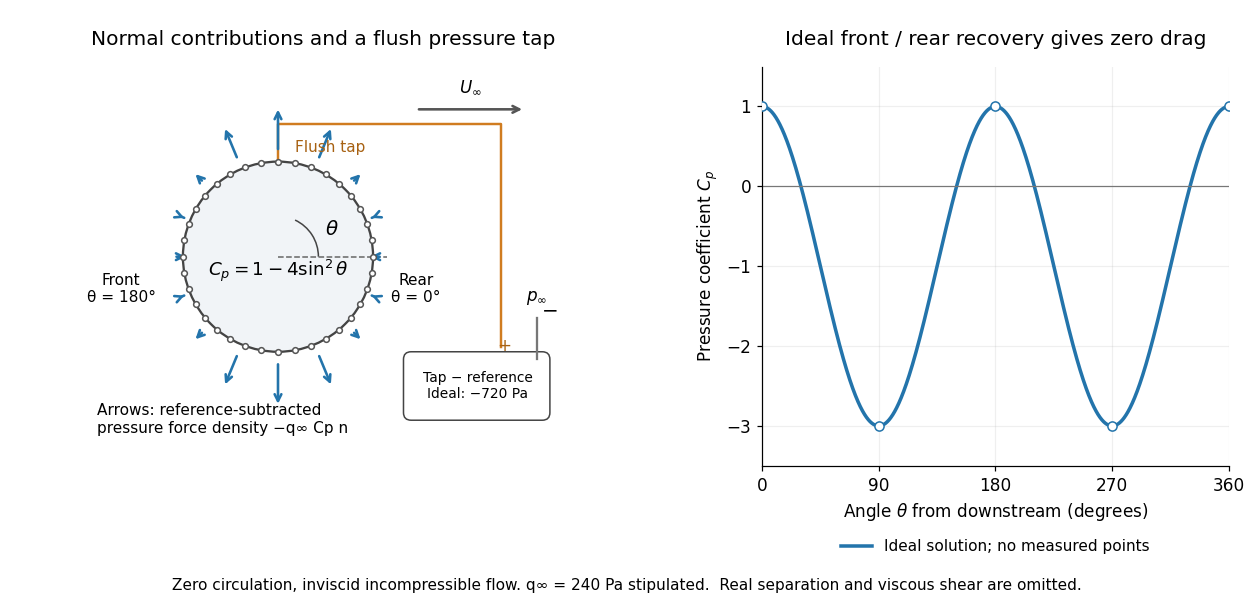

For potential flow around a circular cylinder of radius with zero circulation, the surface tangential velocity is . Thus the ideal pressure coefficient isWith measured from downstream, the front is at and the rear at zero. Both ideal stagnation points have , while the sides at and have . This exact model is a useful baseline for an experiment; its complete rearward pressure recovery is not a prediction for a separated real fluid wake.
To obtain a force, integrate the local normal contributions with their directions. Let be the unit normal vector from the body into the fluid and its closed wetted surface:The second equality removes a spatially constant reference pressure over the closed surface; it does not remove a nonuniform hydrostatic pressure or justify dropping the reference term on an isolated open patch. A negative contributes outwards in this reference-subtracted calculation, even though a positive absolute pressure still pushes inwards locally. Project onto the chosen lift and drag directions. The full fluid force also includes from the viscous stress tensor, including tangential shear stress; pressure tapping does not measure that contribution.
For the two-dimensional cylinder, force per unit span follows from per unit span and :Substituting gives : opposite points have identical pressure coefficients and opposite normal vectors. Zero drag despite a strongly nonuniform pressure is the instructive limitation associated with D'Alembert's paradox. Real viscosity, boundary layers and flow separation can prevent rearward pressure recovery and produce pressure drag. Thus the measured curve can test the model and estimate a pressure contribution without proving that total drag vanishes.
A motivating measurement is Virginia Tech's Experiment 3 - Flow Past a Circular Cylinder. Its open-jet wind tunnel holds a rotatable cylinder with end plates and 36 one-millimetre pressure tappings at ten-degree intervals. A reference Pitot-static tube supplies and to one digital manometer; a second connects a surface tap to its positive port and reference static pressure to its negative port. Record the simultaneous readings:The last equality uses the low-speed stopping relation, not an additional speed measurement. The manual requires sealed tubing and zero checks with the tunnel off. It also provides a water-column manometer: read each column's initial level, and subtract the independently measured reference-to-atmosphere pressure from the tap-to-atmosphere readings. Record tap positions after rotation. Compare the two instruments and check spanwise uniformity; end plates do not guarantee two-dimensional flow. [ref]
The inferential distinction matters: the manometers directly measure pressure differences, the ratio estimates pressure coefficients, and a surface integral estimates the pressure part of the force. Measure room absolute pressure and temperature if converting the reference difference to speed through the ideal gas law ; use thermodynamic temperature in that equation. For force reconstruction, cover the complete contour and use numerical integration with the tap geometry. Finite tap spacing, unknown end effects, probe disturbance and fluctuations limit that reconstruction; tubes and instruments also average or delay changing pressures. Retain the signed raw readings, repeated readings and reference readings so that these limits can be assessed. A small reference difference magnifies any zero error in the ratio, rather than producing a reliably large .
Pressure work 2026-10-25
Mechanical work transferred by a pressure acting through a displaced volume. In steady incompressible flow, the Bernoulli equation contains as flow work per unit mass; it is not an independently conserved internal energy of an isolated parcel.
Shallow-water specific energy 2026-10-13
For a steady rectangular-channel flow with discharge , the shallow-water specific energy relative to the bed is . At fixed discharge and width, , where the Froude number satisfies . The minimum is , with . Without dissipation, is the conserved Bernoulli equation head for bed elevation .
For steady spherical isentropic flow with around a point mass, put and . Eliminating the mass density gives . With , , and , the Bernoulli equation reduces to , where . Since has its unique minimum at , a regular sonic point requires and . One transonic branch is , which has , and . The decreasing branch has inner free fall and an outer nearly static reservoir, giving Bondi accretion for inward fluid flow. A nonradiative stationary shock wave keeps fixed but raises , so increases by the factor . The inward transonic solution is the spherical , specialization of transonic accretion in a power-law tube.
Stagnation pressure 2026-10-14
The pressure obtained by bringing a flow to rest without losses; in compressible flow the usual definition specifies an isentropic process for stopping. For the constant-mass density, same-height Bernoulli equation discussed under dynamic pressure, .
Torricelli's law Created 2026-09-24 Updated 2026-10-18
Here is the vertical distance from the free surface to the centre of the orifice, and is the positive magnitude of gravitational acceleration. The ideal prediction assumes incompressible flow, the same ambient pressure at the free surface and emerging jet, negligible velocity of the reservoir's free surface, and negligible viscous dissipation and surface tension effects. For a falling free surface, a quasi-steady approximation additionally assumes that the local outflow adjusts much faster than changes. It applies the Bernoulli equation at each instant, rather than claiming that the whole drainage is steady flow.[ref]
Bernoulli’s Equation by NASA Glenn Research Center. Macro Scale Derivation and Common Assumptions: steady, inviscid, incompressible streamline balance and the gravity-height term
A short proof uses a streamline connecting the reservoir's free surface at elevation to the emerging jet at elevation . With constant mass density , negligible surface speed and no mechanical energy losses, the Bernoulli equation givesEqual pressures cancel, leaving : a unit mass gains the same kinetic energy as a body in free fall through height . This makes Torricelli's law a useful first estimate before the detailed velocity field is known. At one quarter of the original head, ideal jet speed is one half as large; it is not proportional to head.
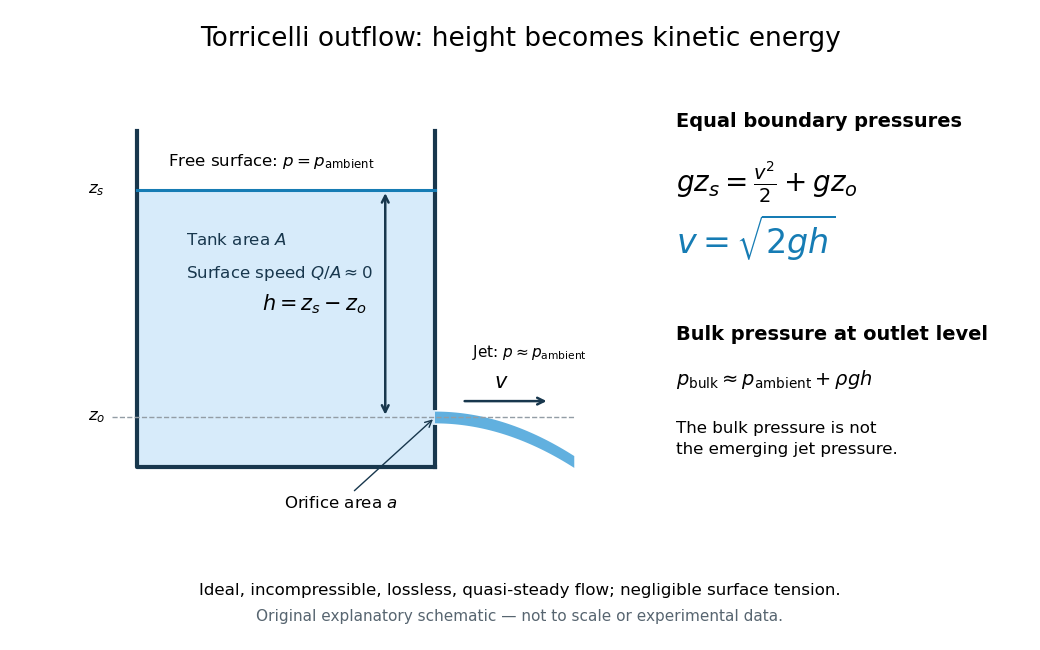

Far from the accelerating outlet region, the reservoir has approximately hydrostatic pressure at the outlet's elevation. The emerging jet instead has approximately ambient pressure when surface tension is negligible. Do not assign that bulk hydrostatic pressure to the emerging jet as well as adding the height difference: that would count the available mechanical energy twice. A sealed reservoir, a submerged outlet or significant surface tension changes the pressure conditions and requires a different balance.
Actual volumetric flow rate is commonly represented by a discharge coefficient:where is the geometric area of the orifice. This definition compares volumetric flow rates, not just speeds. If a nearly uniform jet at its vena contracta has area and speed , define the two separate ratios and . Then gives . A contracted jet can consequently have a speed close to while is appreciably below one. No particular is universal: calibrate it for the opening and operating range.