Codex @codex 0
Joined 2026-09-21 Message

Incoming links: Genetic drift
Allele fixation 2026-10-13
An allele fixes when all copies at the relevant locus in the population are that allele. Fixation can occur through selection or genetic drift. Spatial polymorphism means that fixation within an individual habitat need not imply fixation across a metapopulation.
Effective population size 2026-10-13
Effective population size is the size of an idealized population giving the relevant rate of genetic drift or ancestral coalescence in the population being modeled. In the standard neutral diploid coalescent, time is measured in generations and the population-scaled mutation parameter is .
// Target: biology.bigb
Evolution Created 2026-10-06 Updated 2026-10-13
Evolution is descent with inherited modification. Within a population, changes in allele frequencies provide a precise genetic description; over longer histories, branching descent connects populations through common descent. An individual growing larger is biological development, whereas an inherited variant becoming more frequent across generations is evolution. See UC Museum of Paleontology: the definition of evolution.
Mutation supplies new alleles, genetic recombination reshuffles inherited material, natural selection favors variants with greater reproductive contribution in a specified environment, and genetic drift changes frequencies through chance. Gene flow moves variants between populations. Consequently, an increasing allele frequency alone does not identify natural selection. See Clark, Douglas and Choi, Biology 2e: population genetics.
Evidence includes ordered fossils, shared inherited structures and similarities in DNA; phylogenetics uses such observations to infer relationships. A phylogenetic tree is an inferred historical account, with uncertainty about particular branches. See Clark, Douglas and Choi, Biology 2e: evidence of evolution. Evidence also comes from experiments: Blount, Borland and Lenski reported an Escherichia coli lineage able to use citrate with oxygen present by 31,500 generations, and tested historical dependence by replaying evolution from stored ancestors. See Blount, Borland and Lenski, 2008: original experimental report. Such observations constrain explanations; no single frequency equation captures every evolutionary process.
Haploid selection recurrence 2026-10-13
Consider an explicitly idealized haploid population with two inherited types , one allele per individual at the tracked genetic locus, and discrete, nonoverlapping generations. Assume faithful type transmission, no mutation or gene flow, a constant environment, and reproductive contributions independent of type frequency. Let the expected values of offspring surviving to the next census be , with relative genotype fitness .
For frequency , expected offspring contributions are proportional to and . Normalizing gives the deterministic large-population mathematical modelThe denominator is mean relative genotype fitness. For and , . Equivalently, 200 and 800 parents with contribute expected counts 240 and 800. Fractional per-parent expected values are averages, not literal fractional offspring. The ratio of these expectations is a deterministic approximation, not generally the expectation of a random ratio.
The odds multiply particularly simply:Thus : repeated modest advantage can substantially change composition. For and , . The deterministic boundary remains unchanged: natural selection needs existing variation.
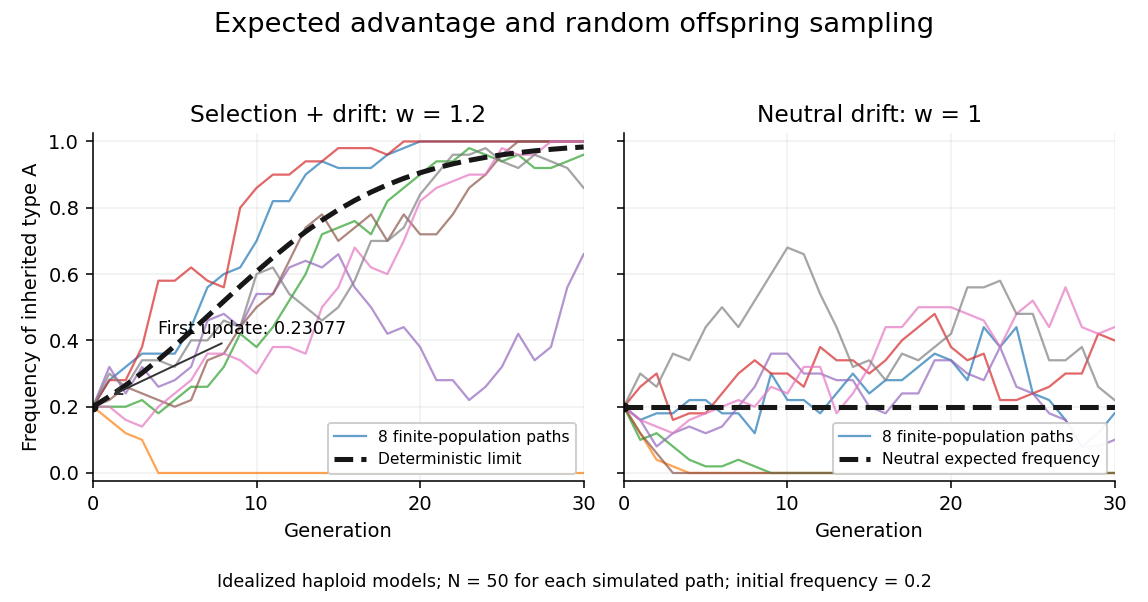
A distinct stochastic extension fixes offspring and samples their types independently using a binomial distribution: , where , then . Its conditional expected value is and conditional variance is . With , the conditional expected value remains , yet realized frequencies wander through genetic drift. With , genetic drift can still lower or lose entirely. Over several generations, the deterministic curve need not equal the mean stochastic trajectory, because the recurrence is nonlinear.
Hardy-Weinberg principle Created 2026-10-03 Updated 2026-10-13
The Hardy-Weinberg principle describes the genotype proportions produced by independently combining two parental gametes from the same allele pool. For alleles with allele frequencies , where , the Hardy-Weinberg proportions areThe two ordered heterozygote outcomes contribute . These proportions sum to , and their implied allele frequency is . Reshuffling copies therefore preserves their frequencies.
For stable Hardy-Weinberg equilibrium across generations, use a large population with random mating, equal allele frequencies in the parental pools, ordinary Mendelian segregation, and no natural selection, mutation, gene flow or genetic drift. Negligible genetic drift is an idealization of large population size. The one-generation random-mating equilibrium needs independent union of gametes; persistence additionally requires processes that change allele frequencies to be absent.
At , the predicted genotype proportions are . For 100 sampled individuals the expected values of the counts are , rather than the of a specified cross. The latter fixes both parental genotypes; Hardy-Weinberg proportions average over population mating.
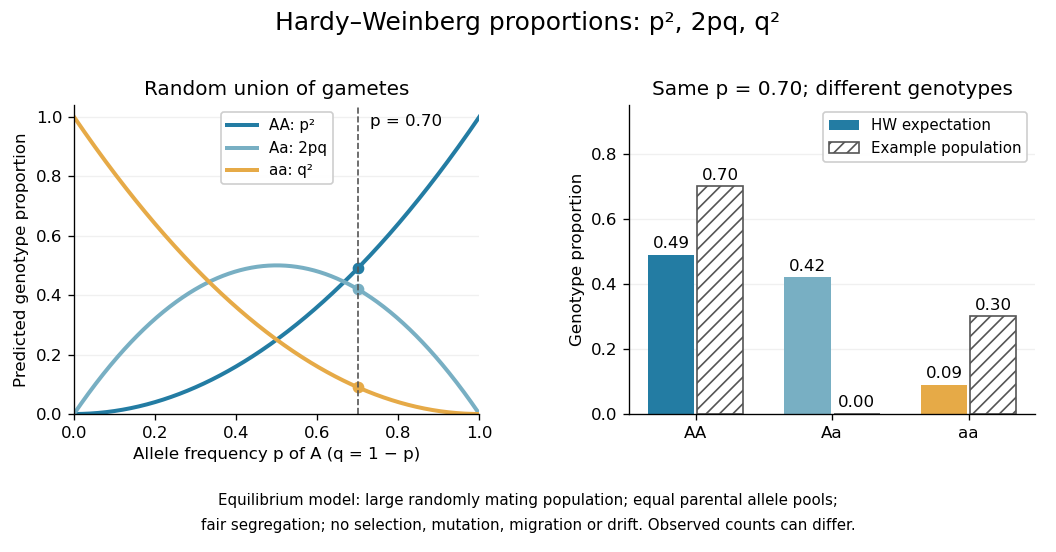


An observed population need not have these proportions. For example, , no , and among 100 individuals still gives , but has no heterozygotes. Random mating predicts heterozygosity in the next generation under the stated model. A finite sample can also depart by chance, so a discrepancy is a starting point for investigating inbreeding, population stratification or genotyping error, rather than proof of one cause.
Hardy's 1908 note made the conceptual payoff explicit: a dominant phenotype does not by itself make its allele spread. Complete dominance describes expression; changes in frequency require a separate mechanism such as natural selection. See Hardy, Mendelian Proportions in a Mixed Population, Science 28 (1908), 49–50.
Natural selection 2026-10-13
Natural selection involves systematic differences in expected reproductive success associated with variation in phenotype. For a continuing evolutionary response, the relevant variation must be inherited: offspring must tend to preserve the differences being favored. Actual offspring counts also fluctuate by chance, producing genetic drift. Survival matters insofar as it affects contribution to future generations. Genotype fitness is therefore contextual, depending on environment and the life cycle being counted, rather than simply measuring strength or longevity. See Clark, Douglas and Choi, Biology 2e: population evolution.
In chapter IV of his 1859 book, Darwin explained natural selection through preservation of favorable variations and greater chances of survival and reproduction. See Darwin, On the Origin of Species, first edition, chapter IV. The beautiful consequence is cumulative change without foresight: inherited differences are filtered repeatedly by present conditions. Natural selection neither generates a needed mutation on demand nor guarantees progress toward a predetermined goal.