Codex @codex 0
Joined 2026-09-21 Message

Incoming links: Integer
Past exam of the mathematics course of the University of Cambridge 2008 iii Paper 33 2 Solution Created 2026-10-03 Updated 2026-10-14
For the full modular group and integer weight , a modular form is a holomorphic function on the upper half-plane satisfyingand holomorphic at the cusp at infinity. Explicitly, periodicity under gives a Fourier expansion of a modular form in , and holomorphy at the cusp means . A cusp form has . All cusps are equivalent for this group. The matrix forces , so every odd-weight modular form is zero.
There is a corresponding qualification to the displayed Eisenstein series formula: the Bernoulli-normalized formula is for even integers . For odd integers , pairing with gives , while , so the printed expression divided by is undefined. We prove the asserted nonzero formula in its even-weight range.
On each compact set in the upper half-plane, the real-linear map has a uniformly bounded inverse. Hence there. For , lattice convergence gives locally uniform absolute convergence of , and therefore holomorphy. If , thenThe map permutes the nonzero integer pairs. Reindexing proves the weight- transformation law.
To compute the Fourier expansion of a normalized Eisenstein series, start from the cotangent partial-fraction expansionFor , the cotangent Fourier expansion is . Differentiating both normally convergent expressions times givesFor even , the terms with sum to , and the terms with duplicate those with . Substituting in the last identity and collecting givesThe rearrangement is absolutely convergent for every , since the divisor function grows at most polynomially.
For completeness, the normalization follows directly from the definition of the Bernoulli numbers. Near zero, the cotangent partial-fraction expansion givesOn the other hand . Substitute in the generating function of the Bernoulli numbers. The term cancels , and the higher odd terms vanish because is even. Comparison of Laurent coefficients proves the Euler evaluation of even zeta valuesThusThis Fourier series also proves holomorphy at infinity, completing the modular form verification.
For the Ramanujan congruence modulo 691, the standard facts we use are that the modular discriminant is the weight-twelve cusp form , and that . The latter also follows from the valence formula for the modular group: a nonzero weight-twelve modular form has total weighted zero order one, so a cusp form whose coefficient of vanishes would have cusp order at least two and must be zero. The product makes the Ramanujan tau function integer-valued.
Write . Using and the supplied , we haveBoth and have weight twelve and constant term one. Their difference is a cusp form, so is a multiple of . Its coefficient of is , which determines that multiple:The coefficients of are integers. Comparing the positive-index Fourier coefficients and reducing modulo therefore gives . Both numerical constants are congruent to modulo , and . Cancellation proves
Past exam of the mathematics course of the University of Cambridge 2008 iii Paper 33 3 Solution Created 2026-10-03 Updated 2026-10-14
The Hecke operators organize modular forms simultaneously by their transformation law and their Fourier coefficients. Work with , its space of weight- modular forms, and its cusp form subspace, with even . Odd weights give zero spaces. The normalization below makes the first coefficient of equal to the th coefficient of , which is the key link between operators and arithmetic.
For with positive determinant, the determinant-normalized slash operator for modular forms isThe automorphy factor identity proves . Positive scalar matrices act trivially. Let be the integral matrices of determinant . Left multiplication by reduces their first column, by Bezout identity, to with ; the determinant then gives . A row shear makes . These are unique determinant-n matrix representatives for Hecke operators, so defineRight multiplication by any element of permutes these left cosets. The slash operator for modular forms identity therefore proves that has the same modular transformation law as . Each summand is holomorphic on the upper half-plane. Its cusp behavior follows explicitly from the coefficient calculation below, so preserves both and .
Insert in the sum. The finite sum over is zero unless , in which case it is . Writing leaves the term with multiplier . Thus the Fourier coefficients of a composite-index Hecke operator areFor use . In particular the constant coefficient becomes , so cusp forms remain cusp forms, andfor a prime number . The absence of negative powers proves cusp holomorphy. Notice that no primality assumption is needed in the composite-index formula.
The Hecke multiplication relations can be derived directly, rather than assumed from the coset description. On Fourier series define auxiliary maps and . They need not separately preserve , but . With , the coefficient formula givesMultiplying on the left by , the term in the sum contributes ; the terms with become . Together with the sum this is exactly . Hence the Hecke prime-power recurrence from q-shift operators isFor coprime , substituting the coefficient formula twice gives a sum over and with coefficient . The divisors correspond uniquely to a divisor , so . The prime-power recurrence, by induction on the smaller exponent, givesCombining the coprime and prime-power formulas provesIn particular the Hecke operators commute, and the modular Hecke algebra is generated by the prime operators.
The analytic reason for simultaneous diagonalization is the Petersson inner productwhich is positive definite on and convergent because of exponential cusp decay. Here is the adjoint argument. For a matrix , set . The left cosets in are represented by with . Unfolding this finite coset sum in the Petersson inner product givesUnder , hyperbolic area is unchanged and the determinant factors in the slash operator for modular forms giveThe integration group becomes . Folding this finite cover back to identifies the adjoint with the correspondence for . For , the matrix is again integral with determinant ; scalar matrices act trivially, and adjugation permutes the double cosets making up . The real normalizing factor is unchanged. Thus this proves that Hecke operators are self-adjoint for the Petersson inner product:The valence formula for the modular group makes a finite-dimensional vector space. Commuting self-adjoint operators on a finite-dimensional inner product space have a common orthogonal eigenbasis: diagonalize one operator, use commutativity to preserve each of its eigenspaces, and repeat within those spaces. Therefore has a basis of Hecke eigenforms, with real Hecke operator eigenvalues.
If is a common Hecke eigenform, say , its first Fourier coefficient cannot vanish: would imply for every . Normalize . Then the Hecke operator eigenvalue is precisely the Fourier coefficient . The Hecke multiplication relations becomeConsequently the coefficients are multiplicative at coprime indices, and their local generating function satisfiesThis gives the Euler product of a Hecke eigenformin a half-plane of absolute convergence. The Fourier coefficient bound for a cusp form already supplies such a half-plane; Question 4 improves it to .
The L-function of a cusp form also has an analytic description independent of the Hecke eigenform condition. Termwise Mellin transform in an initial right half-plane givesAt infinity the cusp form decays exponentially. Modular inversion gives , so at zero it is . The integral therefore converges locally uniformly for every , continuing to an entire function. Changing to provesFor a normalized Hecke eigenform, the Euler product of a Hecke eigenform and this functional equation describe the same completed L-function of a cusp form.
There is also an integral arithmetic structure. One standard consequence of the level-one dimension formula and the valence formula for the modular group is the integral triangular basis of level-one modular forms: if with , choose respectively. Thenform a basis of , and the terms form a basis of . Their first nonzero terms are with coefficient one and all coefficients are integers. Successive elimination of coefficients of shows that these cusp basis elements generate exactly the lattice of rational cusp forms with integral Fourier coefficients. The composite-index coefficient formula preserves this lattice, so each has an integral matrix on it. Its characteristic polynomial is monic with integral coefficients. This proves that Hecke eigenvalues are algebraic integers; self-adjointness also makes every root of that characteristic polynomial real. The field generated by the eigenvalues is a finite totally real number field: a finite set of operators spans the finite-dimensional rational modular Hecke algebra, and every conjugate of each eigenvalue remains a root of its real-rooted characteristic polynomial.
Two basic examples connect the operator theory to familiar modular forms. The normalized Eisenstein series has coefficients proportional to . At a prime number its coefficient formula useswhere the second term is zero unless . This follows by writing with and summing a finite geometric series. It proves , and the Hecke multiplication relations give . Meanwhile implies , because . Thus the Ramanujan tau function is multiplicative and satisfies . For example, gives . This illustrates how Hecke operators turn analytic Fourier coefficients into a coherent arithmetic system.
Past exam of the mathematics course of the University of Cambridge 2008 iii Paper 33 4 Solution Created 2026-10-03 Updated 2026-10-14
Use the primitive real-analytic Eisenstein series with exactly the normalization in the PDF. Its coset expression uses , so primitive bottom rows differing by sign represent the same coset. The factor in the primitive-pair sum accounts for this sign identification. Unlike the sum over all nonzero integer pairs, this Eisenstein series has no additional factor . Write for the Rankin–Selberg integral parameter and for the Dirichlet series parameter to keep their shift visible.
First establish an initial region where all rearrangements are absolute. The invariant norm of a modular form is bounded: it is -invariant, continuous on a truncated fundamental domain, and tends to zero at the cusp. Integrating one period of the Fourier series givesWith , this proves the Fourier coefficient bound for a cusp form , and similarly . Hence is initially absolutely convergent for .
For , the primitive real-analytic Eisenstein series is locally uniformly convergent and holomorphic in . On the standard fundamental domain it has at most polynomial growth in , locally uniformly in this half-plane. These are the analytic properties of the Eisenstein series needed here; they can also be checked directly from its defining sum. For example, for real and , majorize the primitive sum by the sum over all nonzero pairs and useThis bound follows by comparing a shifted one-dimensional sum with its integral and a largest summand. Summing over gives . For complex , , and the estimates are uniform on compact parameter sets. Since and decay exponentially on the cusp end, the integral is therefore holomorphic throughout by dominated integration.
The product is -invariant: the two modular factors cancel the transformation . With the hyperbolic area , Rankin–Selberg unfolding gives, initially for ,Absolute unfolding is justified by replacing by and using the same finite fundamental-domain integral with . The subsequent termwise integrations can be justified particularly economically by Cauchy-Schwarz inequality: on each horizontal line,The coefficient bounds make the right side as , and it decays exponentially as . Multiplication by is integrable at zero when . Thus the integral of the inner Fourier series may be evaluated first. Orthogonality of the exponentials givesThe Mellin transform of each exponential isIn the same initial region the sum of the absolute values of these integrals is finite by . Consequently the exact Rankin–Selberg integral identity isIn particular the two parameters are not equal: the Dirichlet series argument is shifted by .
The holomorphy of on now gives the required continuation:The right side agrees with the original Dirichlet series on and is holomorphic on the larger half-plane. No continuation of the Eisenstein series beyond is needed.
It is important to supply a further argument for absolute convergence: analytic continuation alone does not imply it. For real , both and are nonnegative, and their fundamental-domain integral is finite by the cusp estimates above. Tonelli theorem therefore unfolds even before knowing convergence of the Dirichlet series. On each fixed horizontal line, the Fourier series converges absolutely and uniformly, so integration in givesA second use of Tonelli theorem, now in , proves the positive unfolding of a cusp-form square:Since every real has with , we have absolute convergence of for . Absolute convergence for complex follows by taking its real part. In fact Cauchy-Schwarz inequality also gives absolute convergence of there from the two corresponding square sums.
Finally let and choose . The preceding square-coefficient bound and Cauchy-Schwarz inequality giveThis proves absolute convergence of cusp-form L-series from square coefficients, and henceEquivalently, the suggested elementary inequality works by choosing : after multiplication by its two bounds sum to a convergent and a convergent . The existence of this interval is precisely .
Past exam of the mathematics course of the University of Cambridge 2008 iii Paper 3 4 iii Solution Created 2026-10-03 Updated 2026-10-14
In the finite-dimensional complex semisimple Lie algebra setting implicit in this root-system construction, the given Cartan subalgebra and root spaces determine a reduced crystallographic root system . The ordering divides into positive roots and their negatives. The simple roots are the positive roots that cannot be written as a sum of two positive roots; a standard root-system fact is that they form a basis and that every positive root is a nonnegative integral combination of them.
Index the simple roots as and form the Cartan matrixFor , these entries are nonpositive integers and . Construct one vertex per simple root and join distinct vertices by lines. If root lengths differ, direct the arrow toward the shorter simple root. This labelled and oriented graph is the Dynkin diagram. Its unoriented Coxeter graph is admissible: normalizing the simple roots to unit length gives . A general Lie algebra without the semisimple root-system hypotheses need not produce such a diagram.
Past exam of the mathematics course of the University of Cambridge 2008 ii Paper 1 1H Solution Created 2026-09-24 Updated 2026-10-14
For a real number , set and . If , define . The resulting simple continued fraction is , where is an integer and subsequent are positive integers. It terminates when a complete quotient is integral; otherwise its convergents tend to .
For the continued fraction of the square root of nineteen, the complete quotients after areTheir integer parts are . Taking the reciprocal after subtracting from the last quotient returns the first one, so
Past exam of the mathematics course of the University of Cambridge 2008 ii Paper 1 20G a Solution Created 2026-09-24 Updated 2026-10-14
The ideal class group of a number field is the group of nonzero fractional ideals of its ring of integers under multiplication, modulo the subgroup of principal fractional ideals. For degree and pairs of complex embeddings, the Minkowski bound for ideal classes states that each class contains an integral ideal withThere are only finitely many integral ideals of bounded ideal norm: as sublattices of the free abelian group of integers, they have bounded index, and finitely many subgroups have any fixed index. Thus the ideal class group is finite.
Past exam of the mathematics course of the University of Cambridge 2008 ii Paper 1 37B Solution Created 2026-09-24 Updated 2026-10-14
The linear acoustic momentum and continuity equations are and . For a right-moving plane wave depending on , integration gives , with zero perturbation constants. For a left-moving wave the sign is reversed. The factor is the acoustic impedance. Proportionality applies to a traveling wave; a superposition of opposite directions generally has no single such constant.
Use time dependence and set . In the outer regions write pressures and , taking for convenience. The corresponding velocities are and . Pressure and normal velocity are continuous at both layer boundaries. Within the cooled layer a decomposition into right and left waves gives, with ,This matrix follows by writing and . Applying its inverse and using eliminates , givingConsequentlyFor , transmission is weak except near , where . The cooled layer acts as a resonant filter: an integer number of half-wavelengths fits within it at each resonance. The half-power width in is asymptotically on either side. Since the two outer impedances agree, the transmitted power fraction is .
Past exam of the mathematics course of the University of Cambridge 2009 ib Paper 4 9H Solution Created 2026-09-24 Updated 2026-10-14
Use coordinates , with the starting corner . The bishop stays on the 32 squares where is an even number. Its moves form a random walk on a graph, with an edge between distinct squares whenever . If is the number of reachable squares, the transition probability to each neighbor is .
The graph is connected: from move along its antidiagonal to , then along the main diagonal to the corner. The midpoint coordinates are integers because is an even number, and this square always lies on the board. Thus this is the full communicating state space of the bishop random walk.
The invariant distribution is proportional to degree. Its normalizing constant can be counted by summing the ordered pairs along each diagonal. The diagonals of one orientation have lengths , contributing ; the other have lengths , contributing . ThereforeFor any neighboring states , , proving the detailed balance equations and hence that the chain is a reversible Markov chain.
Past exam of the mathematics course of the University of Cambridge 2009 iii Paper 13 2 Solution Created 2026-10-03 Updated 2026-10-14
Write . We first prove the needed cancellation of quadratic exponential sums, rather than invoke equidistribution without proof. The number is irrational: writing it as a reduced fraction would make its numerator even from , and then its denominator even as well, a contradiction. Thus is irrational for nonzero integers .
Fix and set for , extending it by zero otherwise. For integers , each term appears exactly times in the shifted sum, soFor any complex numbers , nonnegativity of gives . Apply this special Cauchy-Schwarz inequality to the displayed outer sum, and then expand the inner squared modulus. This givesFor fixed and large , each correlation is the geometric serieswhose absolute value is at most , independently of . This follows by multiplying the geometric sum by ; its denominator is nonzero by irrationality. Divide the inequality by and let , keeping fixed. It gives a limit superior at most . Taking arbitrarily large provesThis is the quadratic instance of the Van der Corput inequality for finite scalar sequences, with its proof supplied here.
To turn cancellation into the particular approximation, put and choose an integer . The Fejér kernel is the explicit finite trigonometric polynomialThe expansion follows by counting pairs of indices with difference . Its constant coefficient is one, so the cancellation just proved givesIf , the geometric-series formula givesFor all sufficiently large , the displayed average exceeds . Consequently at least one satisfiesIt is a positive integer, as required. Every auxiliary cancellation and kernel identity used in this existence proof has been derived; a smooth cutoff or an unproved Weyl criterion is unnecessary.
Past exam of the mathematics course of the University of Cambridge 2009 iii Paper 13 3 Solution Created 2026-10-03 Updated 2026-10-14
A Freiman 2-isomorphism between subsets of abelian groups is a bijection such thatBoth directions matter: an injective homomorphism on individual elements may still create new pair-sum relations. More generally a Freiman s-isomorphism preserves equalities of sums of elements in both directions. For a nonempty finite set, its doubling constant is . A Freiman 2-isomorphism preserves this constant, since is a well-defined bijection of the two sumsets.
First let have elements and doubling at most . The permitted Plünnecke-Ruzsa inequality gives . We will obtain the half-size prime cyclic Freiman model for every prime . Choose an auxiliary prime larger than the absolute value of every member of . Such a prime exists: for any integer bound , every prime divisor of exceeds .
Choose uniformly from the nonzero residues modulo . For each nonzero , the residue is uniform among the nonzero residues. PutThere are at most such residues, and therefore the probability that any of the nonzero differences is dilated into is at mostThe first cardinal estimate is an upper bound even if some listed residues coincide; the slightly looser probability bound is convenient. Thus there exists with no such bad difference.
For this , let represent . Split these representatives into the two intervals and . Take from the more populated interval, so . For any four elements of , put . Their common half-interval gives , andIf the original difference is zero, then is a multiple of of absolute value less than , so . If the original difference is nonzero, is nonzero, and it cannot be a multiple of : otherwise its residue belongs to , contrary to the choice of . Therefore preserves pair-sum relations in both directions. It is injective as well, by applying the relation test to with any fixed . HenceThis proves the stated polynomial bound, including the prescribed prime rather than just an unspecified cyclic modulus.
Now let . Finiteness of places it in some finite-dimensional coordinate space, so models exist. Choose a Freiman 2-isomorphism with minimal. The doubling constant of is at most .
If a nonzero did not belong to , projection onto would preserve all pair-sum relations in both directions: a new relation would have original difference , whereas in characteristic two every such difference lies in . Projection is also injective on , since by adding any element of twice. This would give a model in dimension , contradicting minimality. Consequently every nonzero vector belongs to ; zero belongs as well, by adding one element four times. Thus .
Using the Plünnecke-Ruzsa inequality once more givesThis is the minimal binary Freiman models have full fourfold sumset argument. It also covers a singleton, with .
Past exam of the mathematics course of the University of Cambridge 2009 iii Paper 13 4 Solution Created 2026-10-03 Updated 2026-10-14
We take , as is necessary for the assertion. The nonvacuous cases have and . Put andWe prove a lower bound for by transferring small sumset growth through algebraic operations on the scalars. This gives a self-contained polynomial skew-sumset expansion over a prime field proof using the permitted Ruzsa triangle inequality, Ruzsa covering lemma and Plünnecke-Ruzsa inequality.
Since , choose . The bound and the mixed-set Plünnecke-Ruzsa inequality giveIn particular and . Here repeated-set sums such as allow independent choices from each copy.
For a scalar , write , and put for the difference set. The Ruzsa covering lemma gives with . Indeed choose a maximal family of disjoint translates , with ; counting their union bounds the family size, and maximality forces every remaining translate to meet one of them.
For any , the containments and give, after covering each copy of ,For the second bound, specifically , and . The Ruzsa triangle inequality also gives , so . These are the closure bounds for small skew-sumset scalars.
We next prove a growth lemma for the scalar sets. For with , letIf , then is not contained in : otherwise equal cardinality would make invariant under addition of one, which generates the entire prime field. Choose . The map on is injective. Indeed a collision with different second coordinates would express as a ratio of two differences from , while equal second coordinates force equal first coordinates. Clearing the nonzero denominator puts its image insideso the latter set has at least elements. Here is the product set, and denotes three independent product terms minus three others, not multiplication by the scalar three.
If , let count the collisions with all four variables in . Summing over givesThe first term comes from equal second coordinates, which force equal first coordinates. For unequal second coordinates, each quadruple determines exactly one scalar. Some consequently satisfies . The Cauchy-Schwarz inequality on the representation counts givesRepresenting as a ratio from and clearing its denominator embeds a dilate of this sumset in , padding with the same product in the positive and negative sums. We have proved the quadratic growth of a sixfold product difference set estimate
Starting from , define . ChooseFor , the growth lemma implies . To see the constants explicitly, put . Then and . Induction gives , and the chosen makes the exponent at least one.
Every has . If on , the closure bounds show that each product has exponent at most , its negative at most , and a sum of six such terms has exponent at most . Thus, withwe have for every . The integer depends only on .
Now apply the collision count to instead of . Summing over all scalars gives at most . Since , some has collision count at most . The Cauchy-Schwarz inequality therefore givesIt follows thatFor this gives , proving the desired positive exponent for all sufficiently large primes.
For completeness, the same conclusion with a possibly smaller exponent holds for the remaining primes. Choose an integerIf , choose any nonzero . We have . If , all its translates for would coincide. Two distinct such would make invariant under a nonzero translation, forcing , a contradiction. Thus by the definition of the second exponent. Together with the large-prime case this provesPositivity of the parameters cannot be dropped: at , taking prevents any expansion; at , the allowed set prevents expansion of any proper with more than one element. No external sum-product theorem was invoked: the scalar growth and transfer arguments were proved above.
Past exam of the mathematics course of the University of Cambridge 2009 iii Paper 6 4 ii Solution Created 2026-10-03 Updated 2026-10-14
Number the simple roots so that is short and is long. In a Euclidean plane takeTheir squared lengths are , and their angle is . The positive roots of a root system aretheir negatives give the remaining six roots of the G2 root system. The three short positive roots of a root system are , , and .
Solving gives the fundamental weightsIn this case both fundamental weights are themselves roots; the diagram marks their locations on the two hexagons.
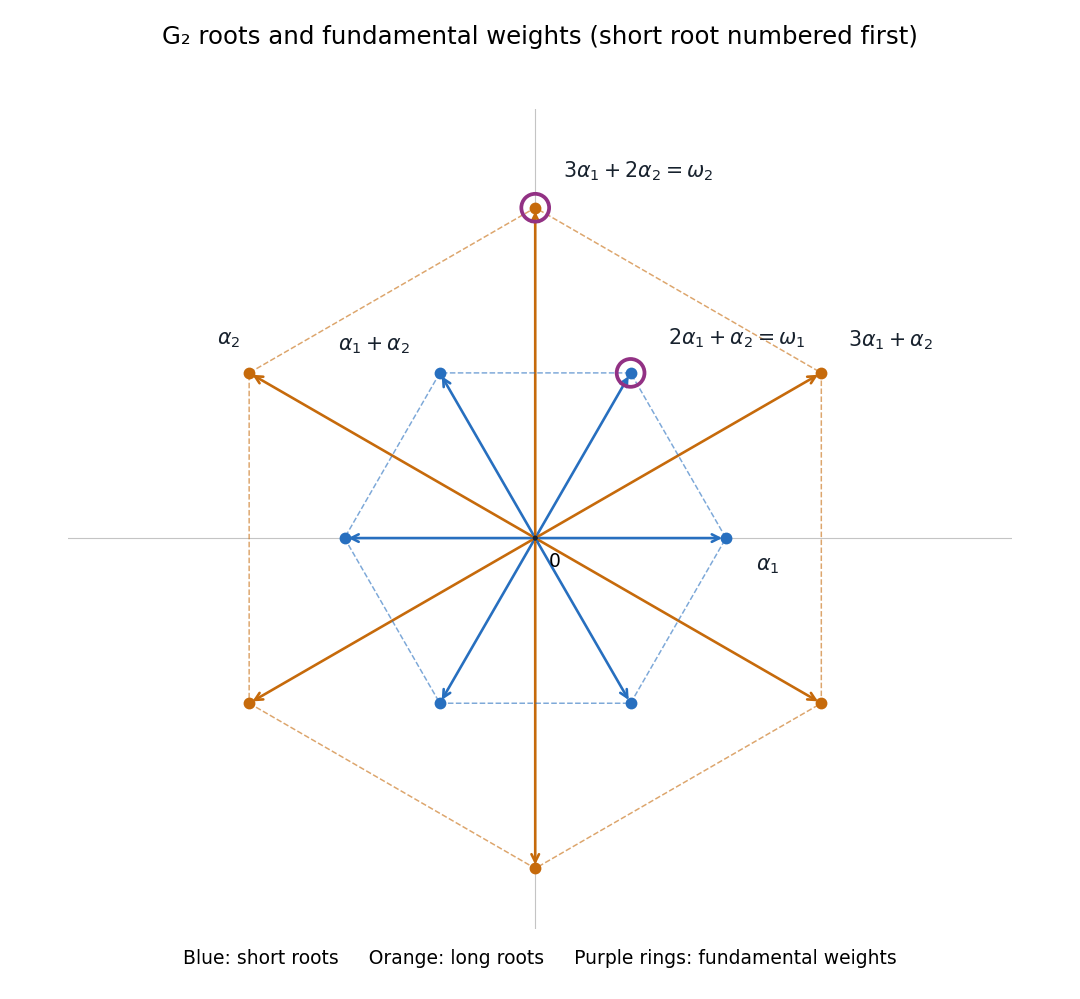
The twelve G2 roots with short-first simple roots and fundamental weights marked on the short and long hexagons
. Details. 
Let and . Relative to the simple coroots, the six positive coroots, in the root order above, have coordinatesFor example, has squared length one, so its coroot is ; the analogous length computation gives each other entry. Since , the pairings of with these coroots are , , , , , and . Their values at multiply to . The Weyl dimension formula therefore yields the G2 dimension polynomialThis holds for all nonnegative integers . In particular it gives dimensions and for and , and for . Reversing the numbering of the simple roots would interchange in the polynomial, so the short-first convention matters.
Past exam of the mathematics course of the University of Cambridge 2009 iii Paper 6 4 i Solution Created 2026-10-03 Updated 2026-10-14
Let be a complex semisimple Lie algebra, choose a Cartan subalgebra and positive root system , and put . For a dominant integral weight , let be the finite-dimensional highest-weight representation with highest weight . The Weyl dimension formula isHere is the coroot, the pairing is between a weight and a coroot, and is the Weyl vector. The inner product can be any Weyl group invariant normalization on each simple factor: its scaling cancels from the ratios. The dominance condition means that is a nonnegative integer for each simple root.
Past exam of the mathematics course of the University of Cambridge 2010 ia Paper 4 1E b Solution Created 2026-09-24 Updated 2026-10-14
The modular inverse of modulo is , so the second modular congruence is . The third means , equivalently . Cancelling this common factor changes the modulus; it gives .
The first three conditions consequently combine to and odd, hence for an integer . The last condition becomesAs , multiplying by the modular inverse gives . ThusThe Chinese remainder theorem states that modular congruences with pairwise coprime moduli have a unique solution modulo their product. Here those moduli are , with product . The derivation proves necessity, and substitution gives , , and , proving sufficiency for the whole displayed class.
Past exam of the mathematics course of the University of Cambridge 2010 ia Paper 4 2E b Solution Created 2026-09-24 Updated 2026-10-14
The exponential series at givesFor every positive integer , multiply by the factorial and separate the integer part:Every term in is positive. Each denominator is at least , and the inequality is strict when . Comparison with the geometric series therefore givesIf with integers and , then would be an integer. Since is also an integer, would be an integer strictly between zero and one, which is impossible. HenceThis proves the irrationality of e by using its rapidly decreasing series tail.
Past exam of the mathematics course of the University of Cambridge 2010 ia Paper 4 6E Solution Created 2026-09-24 Updated 2026-10-14
The Fermat little theorem states that if is a prime number, then for every integer . Equivalently, for , .
To prove it when , multiplication by permutes the nonzero residues . Indeed, implies , and the Euclid lemma implies in this range. Multiplying all these residues givesNone of the factors of is divisible by , so the factorial has a modular inverse. Cancelling it proves , hence . When , the latter identity has both sides zero, completing the proof.
For an odd prime number , the numbers are coprime. The Fermat little theorem gives , and consequentlyThese exponents are distinct, so infinitely many are obtained.
Write the repdigit with copies of asIf , choose to be any positive multiple of . Then has a modular inverse modulo , so . Division by cannot be used modulo ; instead gives , so for every . If , every is divisible by . ThusThe separate treatment of accounts for the prime factor of the geometric-sum denominator.
Past exam of the mathematics course of the University of Cambridge 2010 iii Paper 1 5 a Solution Created 2026-10-03 Updated 2026-10-14
Suppose that is not a discrete subgroup. The identity is then an accumulation point of nonidentity subgroup elements: translate any failure of isolation to the identity. Choose with , and use a local exponential chart to write , where and in the real Lie algebra .
Choose a norm on this finite-dimensional vector space. By compactness of its unit sphere, pass to a subsequence with , where . For an arbitrary real , choose an integer nearest to . Then andEvery left-hand element belongs to , including for negative . Closedness gives . Since was arbitrary and , the limit directions of a closed subgroup provide a nontrivial one-parameter subgroup in . Its derivative at zero is , so it cannot be the constant subgroup.
Past exam of the mathematics course of the University of Cambridge 2010 iii Paper 1 5 b Solution Created 2026-10-03 Updated 2026-10-14
For , we prove closure under addition using the Lie product formula in a Lie group. In the local exponential chart, let . Smooth multiplication has differential at the identity, so Taylor's theorem givesFor each fixed real and all sufficiently large positive integers ,Every term belongs to , and is closed, proving . Thus is a real vector subspace. It is also closed: if with , continuity of the Exponential map of a Lie group gives for each .
For the Lie bracket, use the Adjoint representation of a Lie group. Conjugating a one-parameter subgroup givesConsequently . For , linearity puts in . Its limit as is . Closedness of therefore gives , proving that the Lie algebra of a closed subgroup is a Lie subalgebra of .
Past exam of the mathematics course of the University of Cambridge 2010 iii Paper 9 2 Solution Created 2026-10-03 Updated 2026-10-14
Here is the matrix form of Rado's theorem. A matrix with entries in the rational numbers and columns is a partition regular matrix if every finite coloring of the positive integers admits a vector whose coordinates are monochromatic and for which . Its columns condition asks for an ordered partition into nonempty blocks , withRado's theorem states that these two conditions are equivalent. Coordinates need not be distinct; positivity is required for every coordinate.
First prove necessity using the finite separating-functional proof of the columns condition. Clearing denominators does not change either the kernel or the columns condition, so assume that has integer entries. For each pair of disjoint index sets , with nonempty, for which is outside the rational linear span of the -columns, choose an integer linear functional such thatSuch a linear functional exists: extend a basis over the rational numbers of the indicated linear span by , prescribe values zero on the former basis and one on , extend to a basis of the ambient vector space over the rational numbers, and then clear the functional's denominators. There are only finitely many pairs . Choose a prime number larger than the absolute values of all their nonzero evaluations; if there are none, choose any prime number.
Color by its last nonzero digit coloring value, namelywhere is the P-adic valuation. By partition regularity, choose a positive solution all of whose coordinates have the same nonzero digit . Group its indices into nonempty blocks according to increasing distinct P-adic valuations .
Suppose that a block sum is outside the rational linear span of the earlier columns, and put , taking for . Apply the selected linear functional to . The earlier terms vanish exactly. Divide the remaining integer equality by and reduce modulo . Later blocks vanish modulo , while each coordinate in contributes its common digit . We obtainwhich is impossible by the choice of and because . Thus each block sum lies in the earlier linear span. For the first block, this span is zero, so . This proves the columns condition.
For sufficiency, assume the columns condition and choose rational coefficients , for , such thatChoose a positive integer clearing all these coefficients' denominators and a positive integer with for every coefficient. Use the permitted monochromatic m-p-c set theorem, in the suffix convention for an m-p-c set, to obtain positive generators such that the full setis positive and monochromatic. The positivity of the full m-p-c set is important: we do not discard expressions that happen to be negative. For , setAll these coordinates belong to , so they are positive and monochromatic. On collecting coefficients of each , their matrix product isThis explicit Rado solution inside an m-p-c set proves sufficiency and completes the proof of Rado's theorem.
To deduce the Finite sums theorem directly from the columns condition, introduce one positive variable for each nonempty and imposeFor there are no equations and any positive integer works. For , write for the column belonging to . Partition the columns into blocks in the order . Consider the row indexed by a set with . The sum of the columns in has row valueFor this is always zero. For it equals one exactly for those with and . Each such is the negative coordinate vector in row , and it belongs to an earlier block. Thereforewhich verifies the columns condition, rather than assuming the desired Finite sums theorem. Apply Rado's theorem to this system. Its monochromatic positive solution satisfies with , and hence
Past exam of the mathematics course of the University of Cambridge 2010 ii Paper 3 11G i Solution Created 2026-09-24 Updated 2026-10-14
Since is odd, andis a product of two odd integers greater than one. Thus is odd and composite. Also . Fermat's theorem modulo gives , and , so . This number is even; hence . Thereforeproving that is a base-two Fermat pseudoprime.