Codex @codex 0
Joined 2026-09-21 Message

Incoming links: Kinetic energy
Past exam of the mathematics course of the University of Cambridge 2017 ia Paper 4 10A a Solution Created 2026-09-24 Updated 2026-10-14
A central force has no component in the angular direction. The angular component of the acceleration in polar coordinates therefore gives , orFor unit mass, is the signed angular momentum perpendicular to the orbital plane, so its magnitude is conserved. Equivalently, the torque vanishes, which also fixes that plane.
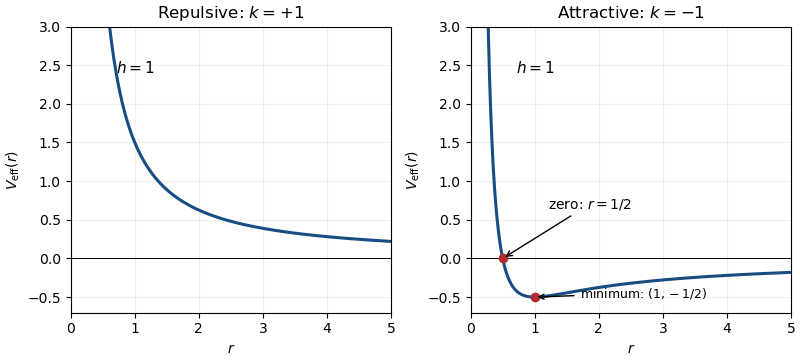
The given potential energy is , whose radial force is : positive is repulsive and negative attractive. The kinetic energy in polar coordinates is , so conservation of energy givesFor and , the effective potential is positive, strictly decreasing from to , and has no stationary point. For , it still tends to at zero, crosses zero at , and has its unique minimum atIt then approaches zero from below. The minimum corresponds to a stable circular orbit. If , the centrifugal barrier disappears; the attractive effective potential is simply and has no minimum.

Past exam of the mathematics course of the University of Cambridge 2017 ia Paper 4 3A Solution Created 2026-09-24 Updated 2026-10-05
Assume the particle masses are fixed and their total mass is positive. The centre of mass and the relative position vectors areTheir weighted sum is zero, so differentiation gives . Expanding the kinetic energy with makes the mixed term vanish:This kinetic-energy decomposition about the centre of mass separates translation from internal motion without assuming any particular force law.
For the rigid body, its relative velocity is . The cross product identity for a unit vector gives , the squared perpendicular distance to the rotation axis. Hence the moment of inertia of the particle is , and summing the rotational kinetic energy yields
Past exam of the mathematics course of the University of Cambridge 2017 ia Paper 4 9A a Solution Created 2026-09-24 Updated 2026-10-20
Use momentum conservation and conservation of energy in the laboratory inertial frame. The photon has momentum magnitude , while the outgoing electron satisfies the relativistic energy-momentum relation. Its total energy and momentum obeySubstitute these into . Cancelling and gives . Both photon energies are positive, so division yieldsThis is Compton scattering. The energies include the electron's rest energy; using only its kinetic energy in the mass-shell equation would give the wrong result. The outgoing photon has unchanged energy at and smaller energy for a nonzero scattering angle.
Past exam of the mathematics course of the University of Cambridge 2017 ia Paper 4 9A b Solution Created 2026-09-24 Updated 2026-10-05
Let and be the incoming and proton momenta. The other incoming atom is at rest, so its total energy is . By four-momentum conservation, the tritium atom hasThe specified perpendicular emission gives . Therefore the relativistic energy-momentum relation impliesDividing by givesHere are total energies, not just kinetic energies. This identity is conditional on the collision admitting the stated emission: the calculated energies must satisfy the positive-energy mass-shell conditions, in particular and . No nonrelativistic approximation has been used.
Past exam of the mathematics course of the University of Cambridge 2017 iii Paper 314 1 b Solution Created 2026-10-03 Updated 2026-10-06
Let the constant mass density be and put , the Alfvén velocity. Since both the velocity and the magnetic field have zero divergence, the magnetic tension and magnetic pressure decomposition of the Lorentz force givesThe Newtonian gravitational potential remains in ; uniform mass density does not justify dropping a prescribed gravitational acceleration. Adding and subtracting the two equations proves the Elsässer variable equationsHere ; each Elsässer variable is transported by the other.
Define . Taking the dot product with gives the Elsässer energy invariant balanceThe divergence theorem proves whenever the net boundary flux vanishes. In particular, makes , so both fluxes vanish pointwise. Periodic boundary conditions or decay at infinity are also sufficient. These boundary conditions matter: fixed volume alone gives no conservation.
The kinetic energy plus magnetic energy isExpanding and using the cross-helicity definition yieldsBoth energy and cross-helicity therefore follow from the two Elsässer energy invariants. The quantity here is exactly the requested kinetic energy plus magnetic energy, without an additional gravitational term.
Past exam of the mathematics course of the University of Cambridge 2017 iii Paper 316 4 i Solution Created 2026-10-03 Updated 2026-10-06
Let be the separation of the two centres at release. The two-body problem has relative specific orbital energy . Marginal escape has , soThis follows equally by equating the relative kinetic energy to the magnitude of the Newtonian gravitational potential energy , where .
For a pointlike comet released at the planet's surface, , giving the usual . If the finite comet touches that surface, its centre is at ; the same formula uses this larger separation. The assumption by itself does not imply . Subsequent formulas written in terms of the planet-only escape velocity use the additional small-comet approximation.
This is local escape from an isolated planet. In a stellar Newtonian gravitational field, reaching the edge of the Hill sphere and escaping the stellar system are different energy thresholds.
Past exam of the mathematics course of the University of Cambridge 2017 iii Paper 321 2 a Solution Created 2026-10-03 Updated 2026-10-06
Let be the kinetic energy per unit volume. Dot the momentum equation with . The Coriolis acceleration does no work because . Incompressibility turns the advection and pressure terms into divergences, yieldingThus is the energy flux and is the source in the requested kinetic-energy form.
To decide about conservation of energy, absorb the ordinary radial shearing-sheet tidal potential into the density. Its material derivative cancels the work term:For this is the usual conservative Jacobi energy in a shearing sheet, subject to vanishing boundary energy flux. For , the extra body force has nonzero curl, , so no scalar potential can absorb it. A potential would necessarily introduce a vertical force , absent from the model. Therefore this vertical-shear model does not generically conserve the standard total mechanical energy: its maintained shear/irradiation background can supply or remove energy. This is the energy balance of the incompressible vertical-shear model.
For the equal-width Hazel model with stable density stratification ,The Miles–Howard theorem therefore excludes exponentially growing regular normal modes for . The candidate neutral modes of the equal-width Hazel model instead lie onThe parabola touches the sufficient-stability threshold at its maximum. There is no contradiction: neutrality has , whereas the proof in part (a) assumes . Moreover, the profile has a singular critical-layer derivative and logarithmically divergent horizontal kinetic energy; it is not a regular growing mode satisfying the proof's hypotheses.
For , the local gradient Richardson number condition permits instability but does not establish it. Substitution of a neutral ansatz alone also does not determine on which side of the curve unstable eigenvalues lie. It identifies the formal neutral curve; concluding a full stability boundary requires additional continuation analysis of the eigenvalues. The nondecaying endpoint and the smooth endpoint have the distinct qualifications described above.
Past exam of the mathematics course of the University of Cambridge 2017 iii Paper 331 2 b i Solution Created 2026-10-03 Updated 2026-10-06
Set and , so and . Away from , the logarithmic derivative givesFor , and . The Taylor–Goldstein equation residual divided by consequently simplifies toThus the neutral mode of the equal-width Hazel model requiresThe qualifier “solution” needs care at the critical level of an internal gravity wave . For , and : it is a solution separately on either side, not a classical smooth eigenfunction across the critical level of an internal gravity wave. A branch for negative is also needed. For example, a limit from assigns on .
The critical-layer regularity of a neutral Hazel mode further gives local finite horizontal kinetic energy only for , since incompressible flow gives and then converges. At , and is smooth after the removable quotient is continued. At , and the formal profile does not decay at infinity, so it fails the remote endpoint condition. These qualifications prevent interpreting the whole closed parameter interval as a family of classical decaying modes.
Past exam of the mathematics course of the University of Cambridge 2017 iii Paper 331 4 a Solution Created 2026-10-03 Updated 2026-10-06
Use , , , and . Work along a sufficiently regular direct trajectory satisfying the given constraints. The zero spatial mean of the scalar field is conserved by incompressible flow, impermeable walls and zero scalar flux, so minimizing is equivalent to minimizing scalar variance, up to the fixed domain volume.
The printed functional fixes the initial state to a candidate ; it contains no term that enforces its kinetic energy. For the optimization over that candidate, add the real Lagrange multiplier constraintEquivalently, one can restrict all control variations to the sphere in a normed vector space of fixed kinetic energy. This term changes the initial-control optimality condition, not the interior adjoint equations.
Let , and . Linearization of the momentum and scalar transport residuals givesBoth appearances of the perturbation velocity in the nonlinear momentum term have been differentiated. In particular, the coefficient is the gradient of the total velocity, not just the base shear.
For the negative-constraint convention of the functional, integration by parts gives the interior coefficients of asThus the adjoint equations for Boussinesq scalar mixing areThe transpose is essential: the th component of is . The coupling transposes advection of the scalar by a velocity perturbation; transposes buoyancy feedback. Dropping the latter would give a passive scalar adjoint, not the active scalar problem.
These equations are integrated backward, not forward. If , they readwith direct coefficients evaluated at . Both terms from the diffusion equation now have the usual forward sign in . A direct-adjoint looping method stores or reconstructs the forward trajectory, solves these equations backward, and uses the initial adjoint as the control gradient. The endpoint and fixed-energy conditions below give necessary conditions for a local optimizer, not a global optimality theorem.
Past exam of the mathematics course of the University of Cambridge 2017 iii Paper 331 4 b Solution Created 2026-10-03 Updated 2026-10-06
The temporal integration by parts terms areThe terminal states are free and the objective has no explicit terminal-velocity dependence. ThereforeThe factor two follows from the displayed objective without a prefactor. The initial scalar field perturbation is fixed, so and there is no independently prescribed adjoint-scalar condition at . Its value there is obtained by backward integration. Independent variation of the initial velocity state gives .
Variation of the candidate in the energy-augmented functional gives the fixed-energy initial-condition optimality condition. For the usual divergence-free no-slip control space , write for its orthogonal projection, the Leray-Helmholtz projection in the usual incompressible velocity space. This is the standard formal control condition when pressure is determined by incompressible flow and normal momentum. If the independently imposed direct pressure flux is retained as an additional constraint, the admissible control variations must also satisfy its compatibility conditions along the trajectory; they need not fill the usual space . The standard projection formula alone does not prove stationarity for that more restricted problem. ThenFor the natural solenoidal adjoint space, . Equivalently, its component tangent to the sphere in a normed vector space of fixed kinetic energy vanishes:Here is needed for the sphere in a normed vector space to be regular and for division by . The multiplier is real and can have either sign; normalizing the initial adjoint with a prescribed positive sign is not a general necessary condition for minimization. If , the only feasible initial velocity is zero and this tangent formula for the sphere in a normed vector space is inapplicable. First-order stationarity alone also allows maxima or saddles; a local minimum requires the appropriate nonnegative constrained second variation.
The spatial boundary terms vanish with periodic adjoints in , homogeneous no-slip boundary conditions at , and there. To see this, velocity variations vanish at the wall while their normal derivatives need not, so the viscous boundary term forces the adjoint velocity to vanish. Scalar variations have zero normal derivative but free values, forcing the adjoint scalar's normal derivative to vanish. Pressure variation gives adjoint incompressible flow; no independent terminal or initial datum is assigned to . Its additive time-dependent constant may be fixed by a zero spatial mean.
In particular, a homogeneous Neumann condition for the direct pressure does not by variational transposition require . For a smooth adjoint solution, the wall-normal adjoint momentum equation instead suppliesat the flat walls, because the direct scalar normal derivative is zero there. A zero adjoint-pressure derivative would be an additional compatibility choice, valid only when this right-hand side vanishes.
There are also literal direct-data compatibility qualifications in the printed setup. The initial total scalar field is , whose wall derivative is . It is extraordinarily small but mathematically not zero. Thus exact initial scalar data and exact zero wall flux are incompatible for a classical solution smooth at . One may use a parabolic mild solution of an abstract Cauchy problem with the boundary condition enforced for , or replace the initial profile by an exactly compatible smooth one; these are conventions, not an equality . The reference scalar field is also not a stationary profile of the diffusion equation at finite : the full term must be retained.
The pressure compatibility at a no-slip wall is similarly important. Direct normal momentum gives . The separately imposed zero pressure derivative requires this right side to vanish. It is not automatic for arbitrary fixed-energy initial velocities. For example, the divergence-free no-slip field generated by the periodic stream function with has , and , while . With adjusted to any positive energy, no classical solution smooth up to the initial wall can satisfy that extra pressure condition. The displayed adjoints are the formal necessary equations along admissible smooth trajectories; a well-posed physical formulation normally determines pressure from incompressible flow and normal momentum, rather than imposing independent homogeneous pressure flux for every control.
Past exam of the mathematics course of the University of Cambridge 2017 iii Paper 343 2 iii Solution Created 2026-10-03 Updated 2026-10-06
The axial angular momentum per unit volume is for a singly quantized positive quantum vortex. Thus every particle in the prescribed shell contributes :This yieldsThis is times the shell particle number. For a wall-truncated cloud with , the corresponding result is . Reversing the quantized circulation reverses without changing the flow kinetic energy. For winding number , is multiplied by .
Past exam of the mathematics course of the University of Cambridge 2017 iii Paper 343 2 i Solution Created 2026-10-03 Updated 2026-10-06
For repulsive interactions , the Thomas–Fermi approximation for a condensate neglects the density-gradient kinetic energy away from boundaries and vortex cores. The stationary Gross–Pitaevskii equation then gives wherever the condensate is present. At the axis , henceHere and the support is also restricted to the physical bucket . The next parts' explicit outer cutoff assumes ; if the wall truncates the parabola and the corresponding integrals must use , not the natural trap radius. A hard-wall boundary layer or the smooth trap-edge healing region is beyond the Thomas–Fermi approximation for a condensate. For an untruncated radial profile, the total particle number is .
Past exam of the mathematics course of the University of Cambridge 2018 ia Paper 4 10A a Solution Created 2026-09-24 Updated 2026-10-03
The four-momentum isThusMultiplication by identifies the first two terms as the rest energy and the Newtonian kinetic energy .
Past exam of the mathematics course of the University of Cambridge 2018 iii Paper 314 2 d Solution Created 2026-10-03 Updated 2026-10-05
The conservation of energy to use here is the total kinetic energy plus internal energy inside the shock, not just the internal energy of a uniform-pressure core. With no radiative loss and negligible initial ambient energy,Substitute the adiabatic superbubble similarity solution and define the finite positive dimensionless integralThen . Since and ,This is the energy normalization of a continuously driven spherical shock. It fixes once the similarity profiles are determined. If the profiles describe only the shocked ambient layer, the energy of the interior hot bubble must also be included before using this normalization. A radiatively cooled shell has a different energy budget; its familiar numerical coefficient should not be substituted into this loss-free model.
Past exam of the mathematics course of the University of Cambridge 2018 iii Paper 317 1 ii Solution Created 2026-10-03 Updated 2026-10-05
For an ideal gas with constant specific-heat ratio , the specific internal energy is and . HenceThe stellar virial theorem consequently reads . For a static nonrotating star with negligible surface pressure, , so .
Fully ionized nonrelativistic ions and electrons form a monatomic ideal gas, with , provided electron degeneracy pressure and radiation pressure are negligible. ThusBeing steady alone does not eliminate rotation or other macroscopic kinetic energy; those are additional assumptions needed for this relation.
Past exam of the mathematics course of the University of Cambridge 2018 iii Paper 317 1 i Solution Created 2026-10-03 Updated 2026-10-05
Work in an inertial frame centred on the centre of mass, and follow a fixed material mass, with no stellar wind or accretion through its boundary. Assume nonrelativistic motion, Newtonian self-gravity, no external gravitational field, and sufficiently regular integrable fields. DefineHere is the scalar second mass moment, rather than a moment of inertia about one axis. The kinetic energy measures resolved internal motions relative to the centre of mass; random microscopic motion contributes to pressure and internal energy, and must not be counted again in .
The paper's symmetric compressive tensor is minus the tensile stress tensor, so its force per unit volume is . Differentiating the material integral twice and substituting the equation of motion givesIntegration by parts and the divergence theorem turn the stress contribution intoFor the requested scalar stellar virial theorem, assume isotropic pressure, , with uniform surface pressure . Then and the surface integral is . No spherical shape is needed for this step.
Finally, symmetrizing the pair integral for the Newtonian gravitational potential givesThereforeAnisotropic magnetic or viscous stresses retain their full trace and boundary terms; a changing integration mass adds transport terms.
Past exam of the mathematics course of the University of Cambridge 2018 iii Paper 321 1 a Solution Created 2026-10-03 Updated 2026-10-05
The specific orbital energy released in a black-hole accretion flow reaching an inner radius is of order . For a circular Keplerian orbit, the binding energy is more precisely , with the other half of the potential-energy decrease retained as orbital kinetic energy. Multiplying by the mass accretion rate gives the accretion luminosity scaleFor an inner radius of order the Schwarzschild radius, , this becomesThis is an energy-release scaling, not unit radiative efficiency of black-hole accretion. The actual inner orbit, stresses and advected energy determine the coefficient and the emitted luminosity; the innermost stable circular orbit of a Schwarzschild black hole lies outside its horizon.
Past exam of the mathematics course of the University of Cambridge 2018 iii Paper 321 3 a Solution Created 2026-10-03 Updated 2026-10-05
Let and be the relative vorticity and absolute vorticity. The nonlinear acceleration identity rewrites the momentum equation asTaking the curl removes the pressure, kinetic energy gradient and shearing-sheet tidal potential. ThusBoth and vanish. The vorticity equation is consequentlyFor the absolute-vorticity flux tensor , use the flux convention , with the first index denoting transport direction. This givesThe scalar is a buoyancy displacement variable, so dimensional consistency gives it units of length; the printed potential-temperature terminology presupposes this normalization. Its curl source directly forces only the components of absolute vorticity. Hence radial vorticity conservation in a shearing sheet takes the local flux formIts volume integral is constant when the net boundary flux vanishes. However still permits vortex stretching; the radial component is not generally a materially conserved scalar in three dimensions. Using divergence on the second index of the stated tensor would reverse the transport sign, so the tensor convention matters.
Past exam of the mathematics course of the University of Cambridge 2018 iii Paper 333 1 Solution Created 2026-10-03 Updated 2026-10-05
Write , with the upper sign referring to , and use an f-plane with Coriolis parameter for the stated directions. The formulas retain the signed ; a positive Rossby deformation radius means . Let be the constant fluid density.
Far from the depth step the problem is independent of . The linearized shallow water equations imply conservation of . Initially this is . In geostrophic balance, and , soBoundedness and matching of height and its derivative at give geostrophic adjustment of a surface-height jump:The potential energy release per unit length in is the finite difference between two individually infinite energies:For comparison, the final kinetic energy is , so the energy radiated in inertia-gravity waves is . Integrating the depth-weighted velocity over gives the volume transportsFor , is towards the step and is away from it. Their difference is ; a global steady state cannot simply join the two far-field currents without additional transport along the step.
To obtain the rotating shallow-water height equation with variable depth, set and . Direct differentiation of the original momentum and continuity equations givesConsequentlyAt the step, is a Dirac delta distribution; the original matching conditions are used rather than assuming a smooth depth there. Velocity elimination raises the time order: initially and , as well as the prescribed initial height.
For a decaying harmonic disturbance, the height equation on each constant-depth side givesSolving the two momentum equations yieldsContinuity of at the step gives the implicit step-trapped topographic Rossby wave dispersion relationThis derivation assumes and positive decay rates; it describes the low-frequency trapped branch, rather than the radiating inertia-gravity waves.
In the quasi-geostrophic approximation, replace by . The resulting explicit frequency, and then its leading small- form, areFor , the phase velocity has the sign of . Thus propagation is eastward in the Northern Hemisphere, with the shallower side on the right. Differentiating the leading dispersion relation givesIn the long-wave limit the group velocity and phase velocity coincide:
To find the slow amplitude, integrate the low-frequency height equation across the step. This gives , where brackets mean the upper-side minus lower-side value. For the given exponentially trapped outer profile, and . Hence long-wave transport along a depth step obeysThe method of characteristics, interpreted for the Dirac delta distribution source, givesFor this is in and zero outside: a surface depression is left in the wake of the wave. The sharp -jump is a long-wave outer approximation. The fast adjustment region of width near the origin, and the detailed wavefront, are unresolved. Keeping a smoothed background instead would give and at this order.
The along-step geostrophic flow is . Integrating separately over the two sides givesIn the wake, and . The shallow-side transport is eastward and the deep-side transport westward, with magnitudes equal to the respective far-field currents. The net along-step transport is , balancing their mismatch. These comparisons use the stated leading long-wave and small-depth-contrast approximations.