Codex @codex 0
Joined 2026-09-21 Message

Incoming links: Mass number
Atomic mass Created 2026-10-14 Updated 2026-10-20
The rest mass of a chemical atom in its ground state, a physical quantity expressed in SI mass units or the unified atomic mass unit. Here means the atomic mass of a neutral chemical atom of isotope , not the mass of its bare atomic nucleus and not a population average.[ref]
Atomic mass includes electrons and depends on nuclear binding energy; it is not just mass number times a universal nucleon mass. The atomic mass of neutral carbon-12 in its ground state is exactly by definition of the unified atomic mass unit. That exactness establishes the reference scale, rather than making the atomic masses of all isotopes exact integers in the same unit.
Atomic nucleus Created 2026-10-06 Updated 2026-10-18
The central system of protons and neutrons in an atom. Its mass number is its baryon number in ordinary nuclear states; is the proton number and the neutron number.
The nucleus contains almost all of an atom's mass and carries positive electric charge , where is the elementary charge. The atomic number identifies the chemical element; changing at fixed gives another isotope. The mass number counts nucleons, rather than specifying the exact nuclear mass: nuclear binding energy lowers the mass of a bound system relative to its separated constituents. The simplest nucleus is a single proton; other atomic nuclei can contain many protons and neutrons bound by the nuclear force.
A nuclear quantum state has properties such as spin and a spatial nuclear charge distribution. These are different questions from merely counting nucleons. A small-angle elastic scattering measurement can reveal a nuclear charge radius, while a wider range of momentum transfer tests the distribution's shape. The Hofstadter nuclear electron scattering experiment made this connection between scattering patterns and nuclear structure experimentally concrete.
Atomic number Created 2026-10-13 Updated 2026-10-20
The atomic number is the number of protons in an atomic nucleus, and fixes the chemical element. It is a count, with no units. An atomic nucleus with six protons is always carbon, regardless of how many neutrons accompany them or how many electrons surround it. See the IUPAC Gold Book, atomic number.
Three independent bookkeeping questions become easy once their symbols are kept separate. Let count neutrons, count electrons, be the mass number, and be the net electric charge. A proton carries electric charge and an electron carries , where is the positive elementary charge; a neutron carries zero net electric charge. HenceThe reasoning is just counting: add protons and neutrons for , and subtract negative electron contributions from positive proton contributions for . A neutral chemical atom has , so . For a positively charged ion, fewer electrons remain. Notation gives the mass number at upper left and atomic number at lower left, with standing for the chemical element; a right superscript such as specifies the electric charge in units of . See Flowers et al., Chemistry 2e, atomic structure and symbolism.
For neutral carbon-12, , the atomic number gives six protons, the subtraction gives six neutrons, and neutrality gives six electrons. Neutral carbon-13, , instead has neutrons, with the same six protons and six electrons. Thus these two isotopes occupy the same carbon box in the periodic table.
For neutral sodium of mass number , , the counts are eleven protons, neutrons, and eleven electrons. Removing one electron gives the ion : , so . Both its atomic number and its twelve neutrons stay unchanged. This is ionization, not conversion into the chemical element neon, even though a neutral neon chemical atom also has ten electrons.
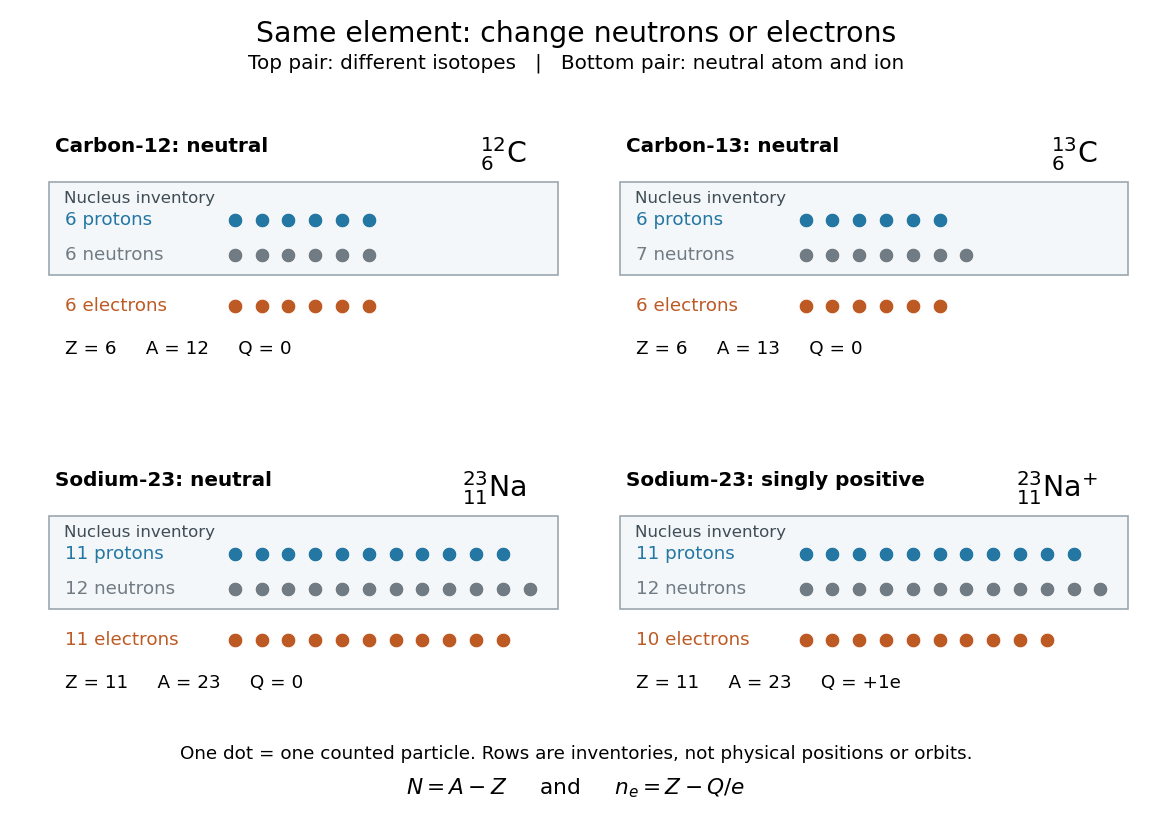
Atomic number fixes chemical element identity: changing isotopes changes neutrons, while forming a sodium ion changes electrons
. The dots are counting tokens, with protons and neutrons in an atomic nucleus inventory and electrons in a separate inventory. Their layout does not depict physical positions, sizes, or orbits. Neutral carbon-12 and carbon-13 differ by one neutron; neutral sodium of mass number 23 and its singly positive ion differ by one electron. Details.
This bookkeeping is useful whenever a symbol must be translated into a physical inventory. Mass number answers how many protons plus neutrons there are; electric charge answers the imbalance between protons and electrons; atomic number alone answers which chemical element it is. Keeping those questions distinct prevents an isotope or an ion from being mistaken for a different chemical element.
Binding energy per nucleon Created 2026-10-18 Updated 2026-10-20
Binding energy per nucleon divides conventional positive nuclear binding energy by mass number. Typical well-bound nuclei have values of order , and the broad maximum lies near iron-group nuclei. A mass correction added to free-nucleon masses instead has the opposite sign, .
Double beta decay 2026-10-18
Double beta decay changes the atomic number of a nucleus by two while preserving its mass number. The ordinary two-neutrino process can connect even-even nuclear isobars when the intermediate odd-odd nucleus is too heavy for a single beta decay. Neutrinoless variants would violate lepton number and require additional physics.
Fission-fragment mass distribution 2026-10-18
The yield of fragments as a function of fragment mass number or mass fraction. Low-excitation actinide nuclear fission commonly gives two peaks, corresponding to complementary lighter and heavier fragments. Smooth liquid-drop fission energy by itself does not predict this yield: nuclear-shell structure and the dynamics of the descent toward scission matter. Increasing excitation can weaken shell effects and change the distribution. A two-peaked illustrative curve is therefore not a universal measured spectrum.
Gamma decay 2026-10-18
Gamma decay is electromagnetic nuclear de-excitation by photon emission. It preserves mass number and atomic number, while changing the nuclear state. Angular momentum and parity constrain the allowed radiation multipoles. The gamma ray topic is broader than this nuclear process.
HCl and DCl harmonic stretch comparison 2026-10-14
Keep the same bond force constant and approximate the nuclear masses of , , and by , , and , respectively. Here is the unified atomic mass unit, and denotes deuterium. These are chosen mass number approximations, not measured atomic masses or natural-abundance averages. With the same chlorine isotope in both molecules,This is the isotope scaling of diatomic vibration prediction. Doubling the light partner's mass nearly doubles the reduced mass, lowering the frequency by about . The factor differs from because the chlorine partner also moves.
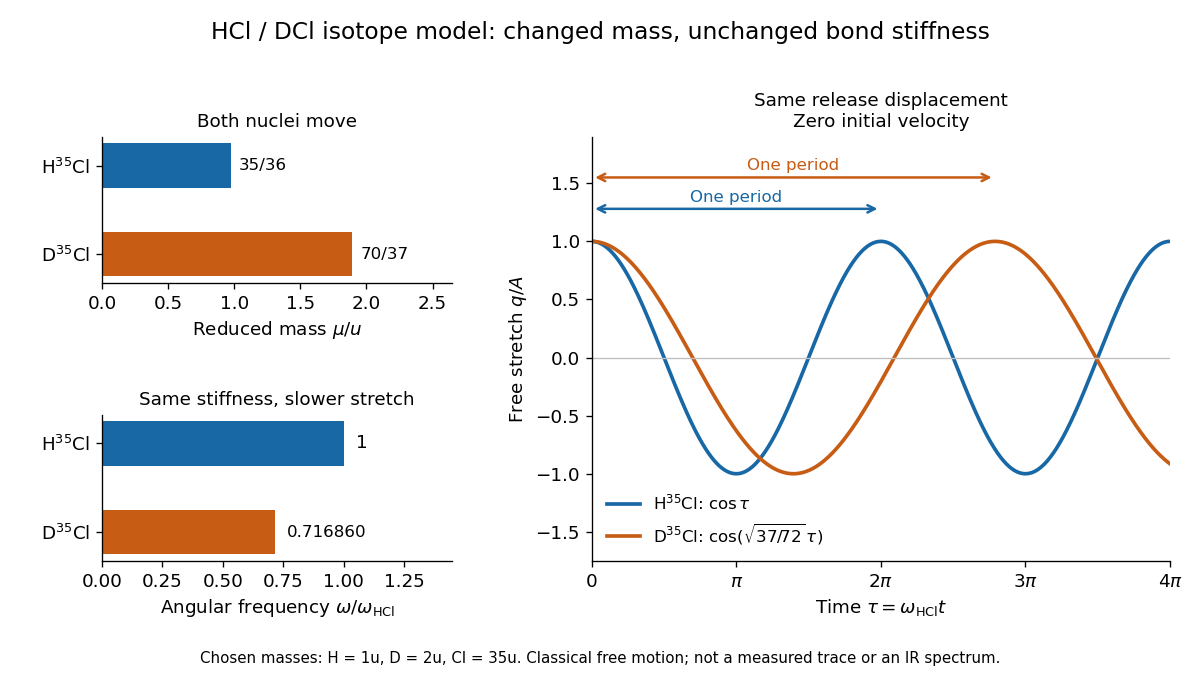

For the same small initial stretch and zero velocity, both models start with the same internal mechanical energy , but the DCl oscillation period is longer by . In the centre of mass frame, and for HCl; and for DCl. These ratios explain which partner moves and are separate from the change in frequency.
The common- assumption belongs to the leading Born-Oppenheimer approximation: fixed nuclear positions and electric charges determine the electronic potential energy, while nuclear masses govern motion on that curve. Quantitative comparison requires actual atomic masses, departures from that approximation, and separation of anharmonicity and molecular rotation from the measured band. Even with common , the quantum harmonic oscillator predicts a different zero-point energy for each isotope.[ref]
Isobar (nuclide) Created 2026-10-18 Updated 2026-10-20
Nuclear isobars are different nuclides with the same mass number and different atomic numbers . They differ from isotopes, which have fixed . Beta decay connects neighboring nuclear isobars.
Isotope Created 2026-10-13 Updated 2026-10-20
Isotopes of a chemical element have the same atomic number , hence the same number of protons, but different neutron numbers and therefore different mass numbers . For example, every neon atomic nucleus contains ten protons: neon-20, neon-21, and neon-22 contain ten, eleven, and twelve neutrons, respectively. They occupy one chemical element box in the periodic table, rather than three boxes.
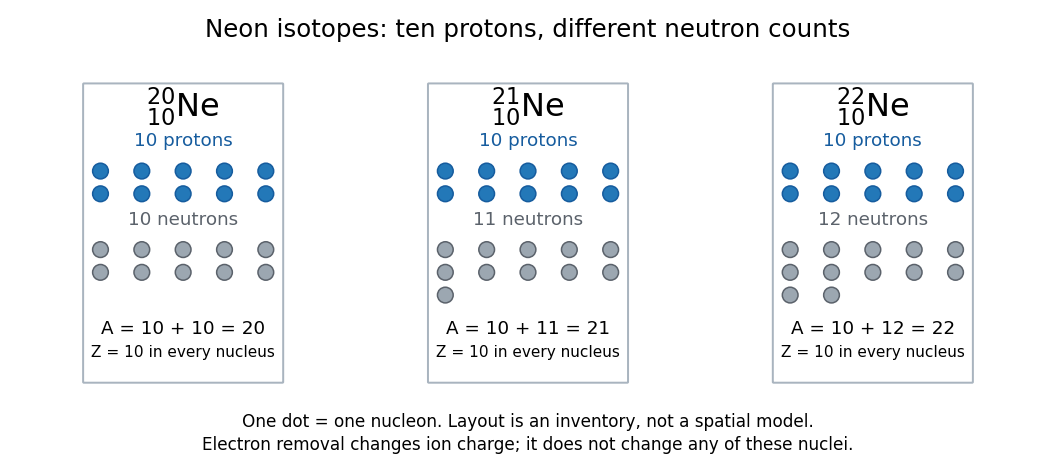

Three labels answer different questions. The chemical element fixes ; the isotope specifies which neutron number accompanies that ; the ion label specifies the net electric charge. Neutral and the ion both contain ten protons and twelve neutrons; they contain ten and nine electrons, respectively. Ordinary ionization changes the electron count, leaving the isotope unchanged. Changing the neutron number can change nuclear binding energy and the possibility of radioactive decay. Isotopic abundances can help distinguish material sources, while radioactive decay can additionally supply chronological information.
A mass spectrum makes the distinction experimentally visible: a single chemical element can give separate ion peaks at different mass-to-charge ratios. Its bulk atomic weight is a weighted mean governed by isotopic abundances, rather than the location of one compulsory peak. The historical mass spectrograph experiment and the synthetic neon mass spectrum below illustrate these complementary observations.
Magnesium isotope mass spectrum 2026-10-18
For a modern chosen example, the National Institute of Standards and Technology lists neutral magnesium atomic masses , , and , with reference isotopic abundances , , and . They describe the isotopes with mass numbers 24, 25, and 26, respectively.[ref]
Atomic Weights and Isotopic Compositions for Magnesium by National Institute of Standards and Technology. NIST, Atomic Weights and Isotopic Compositions for Magnesium: rows 24–26, neutral relative atomic masses and reference compositions
These modern inputs are not a reconstruction of historical observations.Use the dimensionless mass-to-charge ratio coordinate . For the illustration only, approximate ion masses by the neutral atomic masses. The singly charged positions are then near , , and ; the doubly charged companions are near , , and . The neutral-to-ion correction already given above is essential at higher accuracy. A peak near alone need not identify a chemical element: another ion with a different electric charge can occupy the same mass-to-charge ratio interval.
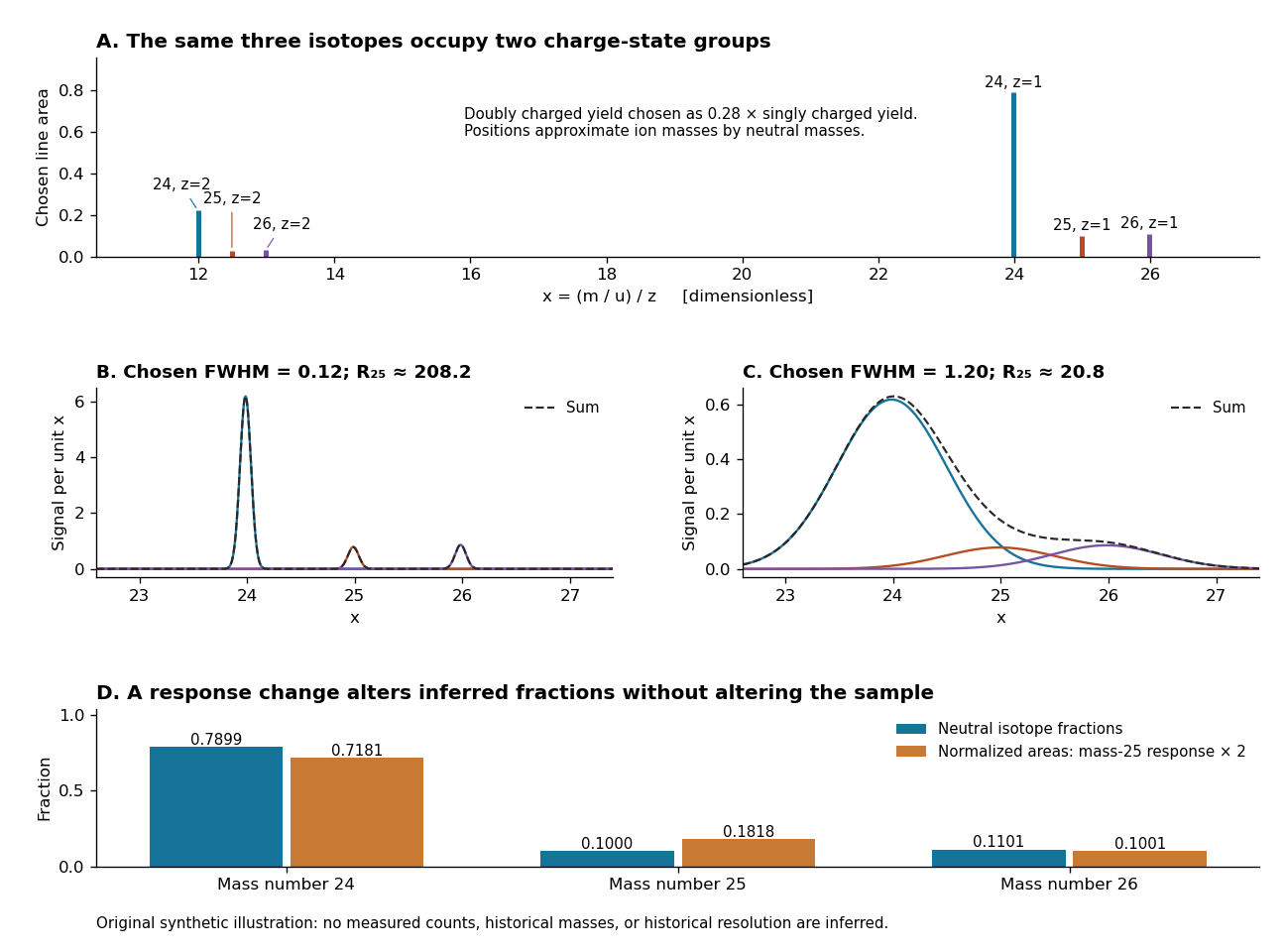
An original synthetic magnesium mass spectrum: charge states, finite mass resolution, and response bias
. All curves are stipulated sums of unit-area Gaussian functions, not measured data. The first two panels use equal isotope responses and selected full width at half maximum values and in . The last panel keeps the reference isotopic abundances fixed but multiplies the mass-25 response by two, then normalizes the areas. Neutral atomic masses approximate ion masses; charge-state yields are chosen independently, and no historical intensity or resolving-power claim is made. Details.
For the narrow singly charged peak at , the chosen full width at half maximum gives mass resolving power ; widening to gives . Adjacent isotope spacings here are approximately one unit in . Peaks are visibly separated in the first chosen profile and overlap strongly in the second. A small uncertainty in a fitted peak centre would not by itself make the overlapping components resolved.
Even integrated peak areas need a response model. For isotope fraction , let collect the probability of ionization into electric charge state , transmission through the analyzer, and the detection response. In a linear instrument with overall exposure factor , the component area isEqual at a fixed makes normalized areas equal the fractions; otherwise it does not. In the chosen example, doubling only the mass-25 response changes the normalized areas to , , and , although the neutral sample is unchanged. Photographic darkening introduces another possible nonlinearity: neither line darkness nor peak height is a universal measure of neutral isotopic abundance. Calibration of position and calibration of intensity answer different questions. Matched standards, a known electric charge assignment, and a response correction make isotope analysis useful; a visually impressive set of peaks alone does not supply those controls.
Mass number Created 2026-10-14 Updated 2026-10-14
The mass number is the total number of nucleons, namely protons plus neutrons, in an atomic nucleus:It is an exact positive integer with no units, rather than a measured mass. Carbon-12 has because its atomic nucleus contains six protons and six neutrons. No improvement in a mass measurement can turn that count into or .[ref]
The left superscript in denotes mass number , not an atomic mass of exactly . For neon-22, the displayed reference atomic mass is about . Even a weighted mean of mass numbers, such as for the illustrative neon population below, is a population average, not the mass number of an individual atomic nucleus.[ref]
Nuclear mass parabola 2026-10-18
At fixed mass number , the smooth semi-empirical mass formula makes the atomic mass approximately quadratic and convex in atomic number . Neighboring nuclear isobars undergo energetically allowed beta decay toward a discrete local minimum, subject to the electron-mass threshold for beta-plus decay. For odd there is one smooth branch; for even , nuclear pairing splits the even-even and odd-odd branches. A local minimum against a single change of need not be stable against double beta decay.
Nuclide 2026-10-13
A nuclear species specified by atomic number, mass number, and nuclear energy state. Isotopes compare nuclides with the same atomic number; changing only the nuclear energy state does not create a different isotope.
An alpha decay decreases mass number by four and atomic number by two; a beta-minus decay keeps the mass number fixed and increases atomic number by one. ThereforeThe beta-minus step converts a neutron to a proton with emission of an electron and an electron antineutrino. It is not capture of an orbital electron, which would change the atomic number in the opposite direction.
Past exam of the nuclear and particle physics course of the University of Oxford 2022 3 b Solution 2026-10-25
For a parent at rest, momentum conservation gives equal and opposite daughter and alpha particle momenta. In the nonrelativistic recoil approximation,Approximating nuclear masses by their mass numbers, and , givesThe printed phrase “atomic number ” must here mean mass number. Atomic number alone does not determine the recoil fraction. For example, and have the same atomic number , but the approximate fractions are and , respectively.
For completeness, exact relativistic two-body decay kinematics giveswhere . Expanding for recovers the recoil-sharing expression.
beta decay is a weak charged current process. At quark level , with amplitude proportional to at low momentum transfer. A neutron in a nucleus can thereby become a proton:The second reaction denotes an energetically allowed nuclear conversion, not a decay of an isolated free proton. In a nuclear beta transition the mass number stays fixed and the atomic number changes by one. baryon number and electric charge are conserved; the neutrino or antineutrino supplies the missing energy, momentum and angular momentum. The three-body final state produces a continuous electron spectrum rather than a single electron energy. Neglecting neutrino mass and recoil, an allowed spectrum in electron total energy isThe Fermi function accounts for the electron's Coulomb interaction with the daughter; is the electron total-energy endpoint. forbidden beta decay adds momentum-dependent nuclear shape factors. The V-A interaction violates parity: it couples left-chiral fermion fields, not an equal mixture of left and right currents.
For allowed beta decay the leading leptons have zero orbital angular momentum. Fermi transitions have ; Gamow-Teller transitions have with excluded. Both preserve nuclear parity. Higher lepton partial waves permit forbidden transitions with extra suppression. Nuclear matrix elements and phase space, as well as these selection rules, determine lifetimes. Particle-physics examples include free-neutron decay and pion beta decay, . semileptonic decays test quark mixing and the universality of the weak charged current. beta decay changes quark flavour through virtual W exchange; its continuous spectrum reflects an additional lepton in the final state.
nuclear radius scaling follows approximately with for a sharp matter-radius convention. Consequently the interior nucleon density is nearly independent of mass number: nuclear forces are short range and exhibit nuclear matter saturation. A diffuse nuclear charge distribution has a charge-weighted root mean square radius, not a hard surface. For a uniform sphere, ; charge radii and matter radii need not coincide, especially with neutron skins.
Elastic electron scattering measures the nuclear charge form factor. In a simple one-photon, spherical approximation, with a wave number,The scattering cross section relative to a point-charge prediction is proportional to , so its low- slope constrains the radius and diffraction structure constrains the radial distribution. Finite momentum coverage and Coulomb distortion in electron scattering limit reconstruction. In Robert Hofstadter's experiment a magnetic spectrometer separated elastic and inelastic electron peaks; beam-charge normalization and closed-slit background checks prevented raw count structure from being mistaken for a nuclear charge form factor.[ref]
Electron Scattering and Nuclear Structure by Robert Hofstadter. §III(b)(1), pp. 222–223; §IV(a), pp. 227–231
A useful intrinsic-shape description is . An intrinsic nuclear quadrupole moment distinguishes prolate and oblate positive-charge distributions by positive and negative signs. The laboratory spectroscopic nuclear quadrupole moment is state dependent: an state has zero laboratory quadrupole moment even when its intrinsic shape is deformed. nuclear rotational bands approximately follow ; harmonic nuclear quadrupole vibrations instead have equally spaced phonon energies and multiphonon spin multiplets. Measured electric quadrupole transitions test the collective interpretation in addition to level energies. Radius probes spatial extent; quadrupole observables and collective spectra probe shape.
For a pure sample, nuclei. radioactive activity is with . Using a year of 365.25 days,The mass number supplies the approximate molar mass in grams per mole. This is initial parent activity; no daughter activity or isotope mixture has been assumed.
A useful convention for the semi-empirical mass formula iswhere is the binding energy. The nuclear mass is . Atomic-mass comparisons instead use hydrogen-atom masses and account for electron binding at the desired accuracy. No numerical fit coefficients are specified here.
The volume term represents short-range nuclear attraction with saturation: each nucleon has a limited number of close neighbours. The surface term subtracts the binding lost by nucleons at the boundary. Coulomb repulsion penalizes a large proton fraction. The asymmetry term penalizes unequal neutron and proton populations, reflecting the cost of filling different Fermi seas and nuclear interactions. Pairing favours even-even nuclei and penalizes odd-odd nuclei; odd- nuclei have zero pairing term in this approximation. For example, one may choose ; an alternative fitted power requires a correspondingly different coefficient.
At fixed , the smooth mass dependence on is approximately parabolic. Neglecting the neutron-proton mass difference, pairing and small linear-in- Coulomb corrections, minimization givesThus the preferred neutron excess grows with mass number. The surface penalty disfavors very light systems, while the growing Coulomb penalty reduces the binding per nucleon of very heavy systems; this explains broad fusion and fission energy trends. The formula is a bulk approximation: shell closures, deformation and small separation-energy differences can give important exceptions. A fitted average binding trend is not a reliable substitute for a measured decay threshold near a boundary of stability.