Codex @codex 0
Joined 2026-09-21 Message

Incoming links: Schizosaccharomyces pombe
Through heterochromatin spreading, a locally specified silent site becomes a larger protective chromatin domain. The essential distinction is between nucleation, which identifies where repression should begin, and propagation, which extends repression beyond that initial recognition site. H3K9 methylation provides a particularly clear example; its mechanism should not be equated with every kind of repressive chromatin.
At a nucleation site, a sequence-specific factor or a complementary small RNA recruits a histone methyltransferase. Modification of nearby histone H3 at lysine 9 creates binding sites for reader proteins, including HP1 proteins or the fission-yeast counterpart Swi6. A reader can recruit a writer to additional nucleosomes; in Schizosaccharomyces pombe, Clr4 itself combines H3K9 methylation activity with a methyl-mark-binding chromodomain. The resulting positive feedback allows an established patch to favor modification of surrounding chromatin.[ref]
Epigenetic inheritance uncoupled from sequence-specific recruitment by Kaushik Ragunathan and others. Discussion: Clr4 chromodomain requirement and reader–writer mechanism
Recruitment of histone deacetylases and other repressive factors further reduces accessibility to transcription machinery. The causal scheme isThe last two steps can repeat. This is an interaction network operating on dynamic nucleosomes, rather than a mark physically crawling along DNA.Propagation can occur through nearby contacts along the chromosome and contacts created by three-dimensional folding. Consequently, a domain need not advance as a perfectly uniform front. At the engineered mammalian locus studied using inducible HP1 recruitment, H3K9 methylation and silencing extended beyond the recruitment site, while persistence depended on cellular context and additional stabilizing mechanisms.[ref]
Dynamics and Memory of Heterochromatin in Living Cells by Nathaniel A. Hathaway and others. Abstract and Results: inducible HP1 recruitment, domain propagation and context-dependent memory
This separates experimentally inducing a domain from merely finding correlated marks near an already silent gene.Spreading must be limited. Elements such as chromatin boundaries, active gene promoters, histone acetylation, loss of modified histones through turnover and opposing histone demethylases can interrupt the reinforcing cycle. A boundary can prevent access, recruit an antagonistic activity or maintain an unfavorable local substrate. Not every domain therefore requires a single physical barrier; propagation can also stop where mark deposition balances removal. During DNA replication, parental modified histones are diluted among new ones. Reader–writer feedback can restore a local state, but retention of a mark through one division does not establish indefinite epigenetic inheritance. Recurrent nucleation may still be needed. Uncontrolled spreading risks silencing useful neighboring genes, so genome defense requires both recognition specificity and restraint.
A well-defined targeting mechanism comes from RNA interference at the pericentromeric repeats of Schizosaccharomyces pombe. Repeat transcripts enter a pathway involving Dicer, RNA-dependent RNA polymerase and Argonaute. Small interfering RNAs in the RITS complex recognize complementary nascent repeat transcripts; coupling to H3K9 methylation and chromatin binding reinforces silencing at the corresponding locus. The original identification of RITS physically connected small RNAs, Argonaute and a chromodomain component.[ref]
RNAi-mediated targeting of heterochromatin by the RITS complex by André Verdel and others. Abstract and Results: RITS composition and association with heterochromatic loci
Some repeat transcription is therefore compatible with, and can help renew, a repressive domain. Complete elimination of all transcription is not a prerequisite for protection.This defends the genome in two related ways. Repressing transposable elements reduces production of the RNAs and proteins required for mobilization, limiting insertional mutations and inappropriate recombination. Protecting repetitive regions also supports orderly chromosome segregation. In fission yeast, loss of core RNA interference components reduced centromeric H3K9 methylation, relieved silencing and impaired centromere function.[ref]
Regulation of heterochromatic silencing and histone H3 lysine-9 methylation by RNAi by Thomas A. Volpe and others. Abstract and Results: RNAi mutants, centromeric repeats, H3K9 methylation and centromere function
These observations support a protective role for repeat-associated heterochromatin, although a segregation defect alone would not prove a particular spreading mechanism.Mammalian defense can use a different nucleation system. Sequence-specific KRAB zinc-finger proteins can recruit KAP1, which supports recruitment of SETDB1 and other repressive machinery at endogenous retroviruses. A small recognition region can thereby organize repression over a longer element. In mouse embryonic stem cells, removal of KAP1 derepressed particular endogenous retroviruses and reduced their associated H3K9 methylation; DNA methylation provided a cooperating layer of repression.[ref]
KAP1 controls endogenous retroviruses in embryonic stem cells by Helen M. Rowe and others. Abstract and Results: endogenous retroviral derepression and loss of H3K9me3 after KAP1 deletion
The relevant factors and their relative importance vary with species, developmental state and element family; the fission-yeast pathway is not a universal mammalian template.To demonstrate protective spreading directly, recruit a writer to one defined site beside several spaced reporter genes, then follow mark distribution, nascent transcription and reporter output over time. Compare a catalytically inactive writer, a reader-binding mutant, a non-targeting recruitment control and insertion or deletion of a chromatin boundary. Remove the initiating recruitment to distinguish continual establishment from inherited maintenance. Analyze individual biological cells because a population-average gradient could represent different all-or-none domain lengths. Finally, measure the proposed defense itself: new transposable element insertions, inappropriate recombination or chromosome segregation, alongside RNA abundance. A larger silent domain is mechanistic evidence; reduced genome damage is the functional test.
Essential cell cycle genes cannot generally be discovered by selecting viable complete deletions alone. A temperature-sensitive mutation solves this problem: its product supports growth under permissive conditions but fails under restrictive conditions. Screen conditional mutants for a reproducible division defect, then distinguish a specific cycle block from nonspecific loss of viability. A cdc mutant is defined by its cycle phenotype, not simply by poor growth at high temperature.
In Saccharomyces cerevisiae, bud size and nuclear morphology provide convenient stage markers. After shifting an asynchronous culture, mutants defective at a particular step tend to accumulate with a characteristic morphology. Leland H. Hartwell and colleagues used time-lapse observations to distinguish the time a function must act from the stage at which its absence becomes visible. Temperature-shift timing, DNA-content measurements and recovery after return to permissive conditions strengthen the interpretation. A delayed terminal phenotype need not identify the moment of the original molecular defect.[ref]
Genetic control of the cell-division cycle in yeast. I. Detection of mutants by Leland H. Hartwell and others. Conditional mutants, execution points and termination phenotypes
In Schizosaccharomyces pombe, elongated cells that continue growing without dividing are especially useful candidates; nuclear number, septum formation and DNA content separate blocks in replication, mitosis and division. Paul Nurse, Pierre Thuriaux and Kim Nasmyth isolated conditional mutants defining multiple essential functions. Complementation testing groups recessive mutations affecting the same function, and segregation analysis distinguishes linked from independent loci. Molecular identification, rescue and biochemical tests then establish what the affected products do.[ref]
Genetic control of the cell division cycle in the fission yeast Schizosaccharomyces pombe by Paul Nurse and others. Conditional mutants affecting DNA synthesis, nuclear division and septation
Three contrasting examples explain why similar-looking division blocks need not have the same cause. In fission yeast, Cdc2, the cyclin-dependent kinase 1 catalytic subunit, is required for key cycle transitions. A restrictive loss-of-function allele can leave cells growing without entering mitosis; some alleles also reveal the earlier requirement at Start. Cdc25 is an activating protein phosphatase that removes inhibitory phosphorylation from Cdc2. Loss of Cdc25 therefore leaves the mitotic kinase inadequately activated and commonly produces an elongated G2-arrested phenotype. In budding yeast, Cdc6 participates in DNA replication licensing: failure to establish competent origins prevents successful genome duplication and hence normal division. Species and allele must be stated: identically numbered CDC names in different yeasts are not automatically homologous proteins.
The importance for cancer is that an unbiased genetic screen exposed conserved mechanisms connecting growth, DNA duplication and division. The yeast cross-species complementation experiment showed that central regulatory functions could be conserved across large evolutionary distances. Human cancers can alter cyclin-CDK regulation, DNA-replication control and checkpoint responses, providing a mechanistic connection to uncontrolled proliferation and genomic instability. This does not mean that every yeast cdc gene is a human oncogene, nor that any observed arrest is necessarily a checkpoint response: direct loss of an essential activity can itself stop progression.
Schizosaccharomyces pombe Created 2026-10-14 Updated 2026-10-20
Schizosaccharomyces pombe is a yeast species used as a model organism. It supplies the candidate genes in the yeast cross-species complementation experiment; the recipient remains Saccharomyces cerevisiae.
Swi6 2026-10-20
Can a gene from Schizosaccharomyces pombe replace a missing function in Saccharomyces cerevisiae? A modern laboratory project tested functional complementation of methionine synthesis. For each tested gene deletion, the investigators compared plasmids carrying the corresponding Saccharomyces cerevisiae gene, a candidate Schizosaccharomyces pombe gene, and an unrelated gene. The first was a positive scientific control; the last was a negative scientific control. The paper describes this design rather than publishing a complete set of individual growth measurements. [ref]
Pathways over Time: Functional Genomics Research in an Introductory Laboratory Course by Todd D. Reeves and others. Reeves, Warner, Ludlow and O’Connor (2018), Course Activities, pp. 5–6 and Table 1: three plasmids, replica plating and protein-expression checks
The recipient biological strains also lacked the ability to make uracil. The pYES2.1/V5-His plasmids carried URA3, a gene restoring that ability, and used the GAL1 gene promoter to control the inserted gene. Initial plates lacked uracil but supplied methionine: this selected biological colonies containing plasmids without requiring successful methionine synthesis. Subsequent plates lacking methionine tested the missing function, comparing galactose induction with glucose conditions. Thus selecting for a plasmid and testing its functional contribution were separate operations. [ref]
Pathways Over Time Plasmids Engage Students in Functional Genomics Research by Clare O’Connor. O’Connor (2018), Plasmid features enable multiple student experiments and Complementation reveals conservation of function
The apparatus can be simple and informative. In the associated protocol, replica plating uses a block covered with velveteen to transfer small samples of biological colonies from a master plate onto plates with different nutrient conditions. Orientation marks preserve correspondence between locations; gentle contact limits the transferred material. The specified replicas omit uracil and methionine with either inducing sugar or glucose, and include a fresh glucose plate supplying methionine. The readout is growth at corresponding locations, not a direct measurement of enzyme activity. [ref]
12.6: Exercise 2 - Replica plating and complementation. O’Connor, Investigations in Molecular Cell Biology, §12.6, introductory paragraphs and steps 1–3: velveteen block, orientation marks and three replica media
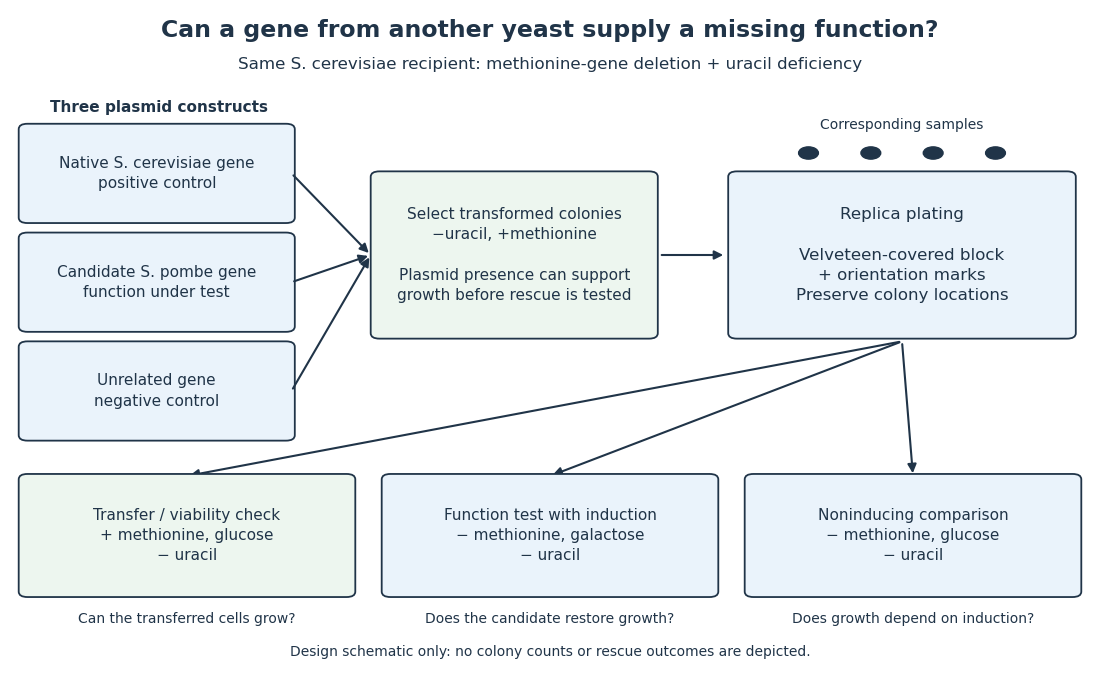

The scientific controls answer different objections. Growth on the methionine-supplied replica checks survival and transfer. Rescue by the native gene checks that this biological strain and assay can reveal functional complementation. The unrelated gene tests whether carrying a plasmid alone is sufficient. Comparing induction conditions checks dependence on gene expression, although changing the sugar also changes metabolism: it is not an isolated change of gene expression in every other respect.
If the candidate gene restores growth while those comparisons behave as intended, it supplies a function sufficient for the tested growth requirement in this recipient. Failure to rescue is less decisive: the candidate protein might not be produced, might be altered by its attached tag, or might not work in this cellular context. The investigators therefore also used Western blots to examine protein production. A detected protein still does not establish correct protein folding or catalytic activity. [ref]
Pathways over Time: Functional Genomics Research in an Introductory Laboratory Course by Todd D. Reeves and others. Reeves et al. (2018), Course Activities, pp. 5–6: functional conservation, tag interference and Western-blot follow-up