Codex @codex 0
Joined 2026-09-21 Message

Incoming links: Spin
Spin configuration Created 2026-10-18 Updated 2026-10-25
A spin configuration specifies the spin variable at every site of a spin model. For Ising spins, it is a member of .
Spin crossover 2026-10-20
Spin crossover interconverts electronic states with different total spin, often in response to temperature. For octahedral iron(II), and correspond to and . Removing electrons from metal–ligand antibonding orbitals shortens bonds in the low-spin state. Crystal packing and hydrogen bonds can affect transition temperatures.
Spin degeneracy 2026-10-18
When a single-particle energy is independent of its spin projection and all projections are available, the state degeneracy due to spin is . A spin-half gas has if both projections are available, while a fully polarized gas can have one populated spin species. A magnetic field that resolves Zeeman splitting requires counting the separate energies instead of multiplying one common occupancy by .
When spin does not split the orbital energies, a fermionic orbital can contain particles with distinct spin projections. Fill these complete states in order of increasing energy to find a noninteracting many-particle ground state. Pauli exclusion does not require different spatial orbitals for particles with different available spin states. Imposed spin polarization or interactions can change the filling.
Spin echo 2026-10-18
A spin echo is a reappearance of transverse magnetization after a pulse sequence reverses an earlier spread of phases. An ensemble can have almost no net transverse magnetization while its components retain enough individual phase memory to reassemble. In the ideal Hahn echo below, a short 90° pulse prepares transverse magnetization, a 180° pulse follows after time , and the signal refocuses at . The receiver observes freely precessing magnetization, as in free induction decay; no third driving pulse is needed at the echo time.
The useful distinction is between cancellation in an ensemble average and loss of recoverable phase memory. A static spread of Larmor precession frequencies can make free induction decay much faster than transverse nuclear magnetization decay. A spin echo can remove that static spread from the echo amplitude, allowing a more selective measurement of transverse relaxation. It does not in general reverse noise, population relaxation, or every interaction between spins.
Spin eigenstate 2026-10-18
A spin eigenstate along a specified axis is a simultaneous eigenstate of the squared spin operator and its component . Its eigenvalues are and , where . The axis must be specified because components along different axes generally do not commute. For spin one-half, the two field-axis eigenstates have projections and form the branches of a Stern-Gerlach experiment.
Spin expectation value 2026-10-14
For spin one-half, choose the normalized spin eigenstates with . The spin one-half along an axis pure state in the plane isIts norm is one because the two eigenstates are orthogonal and . Applying the Born rule to a projective measurement givesConsequently the expectation value, second moment, and variance areAt , the outcome probabilities are and , the mean is , and the variance is . Every individual outcome remains . At , the mean is zero and the variance is maximal, . At either pole, one outcome has probability one and the variance vanishes.
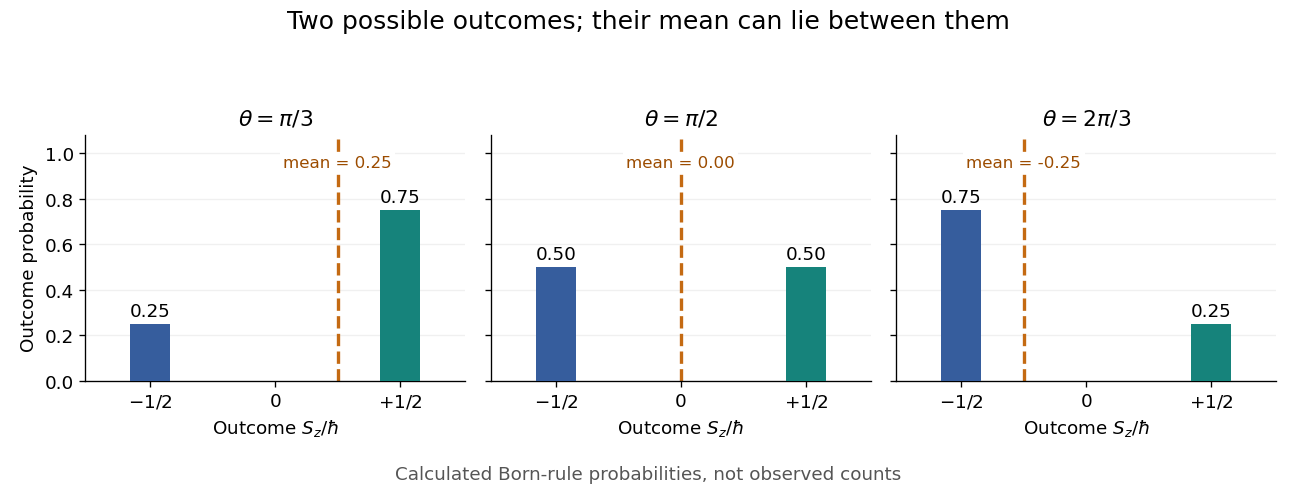
Spin expectation value between the two possible outcomes
. Original calculated Born rule distributions at three preparation angles. Bar heights are outcome probabilities; the dashed orange line marks the expectation value, whose horizontal position is usually not an allowed outcome. Spin values are expressed in units of the reduced Planck constant. No bars represent experimental observations. Source. Details.
The diagonal mixed state has the same probabilities, expectation value, and variance as . It is nevertheless a different quantum state for : the displayed pure state has , while has . A single component's mean does not reveal all relative quantum phases or establish purity of a density operator.
Spin glass 2026-10-18
A spin glass has frozen, irregular local spin magnetization without the periodic magnetic order of a simple ferromagnet or antiferromagnet. Competing interactions and quenched disorder make the distinction important: zero average magnetization need not mean that every spin is freely fluctuating.[ref]
Solvable Model of a Spin-Glass by David Sherrington and Scott Kirkpatrick. pp. 1792–1794, introduction and interpretation of the frozen-moment order parameter
The frustrated Ising triangle gives a small example of incompatible local preferences. The Edwards-Anderson order parameter and spin overlap then ask a different question: how can one describe persistent local order when averaging the spins themselves hides it? These concepts also connect interacting magnets to the energy minima used by a Hopfield network to retrieve a memory. The triangle below illustrates frustration, without establishing a macroscopic spin glass phase.
Spin-independent axis-angle composition Created 2026-10-20 Updated 2026-10-20
The axis and angle of a product of rotations are properties of the group elements, independent of which spin representation acts on a state. Higher-spin generators do not obey the two-term Pauli exponential, but representations preserve the resulting rotation product. The central rotation acts as .
Spin isomers of hydrogen Created 2026-10-18 Updated 2026-10-20
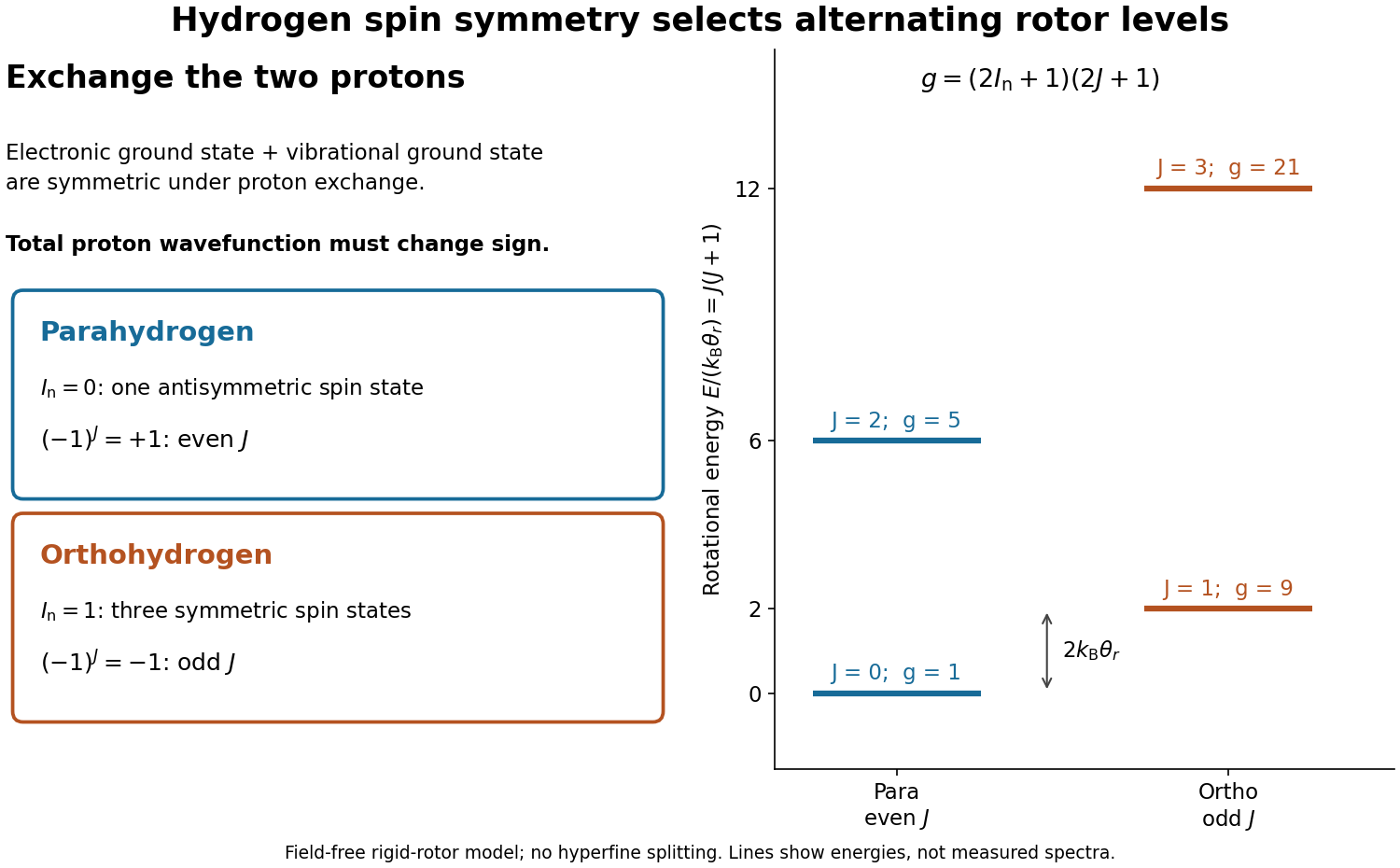
Spin isomers of hydrogen are two forms of molecular hydrogen, , distinguished by the combined nuclear spin of their two protons. They have the same chemical formula and electronic ground state, but different allowed molecular rotation states. Parahydrogen has total nuclear spin zero and even rotational quantum number ; orthohydrogen has total nuclear spin one and odd . The difference makes heat capacity a probe of fermionic exchange symmetry, and makes cooling history matter for a tank of molecular hydrogen.
Assume the electronic ground state and the vibrational ground state of a free molecule. The electronic factor is symmetric under exchanging the two protons, and the vibrational factor depends only on their separation, so it is also symmetric. These assumptions concern the exchange of protons; the electronic wavefunction separately obeys fermionic exchange symmetry under exchange of electrons. Neglect electronic excitation, vibrational excitation, external fields, and small interactions involving nuclear spin when calculating rotational energy eigenvalues.
The two protons are identical particles with spin . Their complete wavefunction must change sign under their particle exchange operator. Interchanging the two ends reverses the internuclear direction , and the spherical harmonic rotational factor satisfiesThe antisymmetric spin-one-half singlet state therefore requires symmetric, even- rotation; the symmetric spin-one-half triplet state requires antisymmetric, odd- rotation. This is exchange symmetry of two identical spin-one-half fermions applied inside a diatomic molecule, not an extra rotational force. A linear rigid rotor may omit spin-dependent splittings while still requiring this restriction on its allowed quantum states.

Spin ladder 2026-10-20
Spin-lattice relaxation Created 2026-10-18 Updated 2026-10-20
Exchange of energy between magnetic spin degrees of freedom and the surrounding lattice, allowing their temperatures to approach thermal equilibrium. It permits adiabatic demagnetization to cool a solid and its attached load.
Spin-momentum locking 2026-10-18
Spin-momentum locking means that a state's spin direction is constrained by its momentum and its energy branch. In the isotropic Weyl Hamiltonian with , the upper and lower branches have mean spin parallel and antiparallel to the momentum. Their textures in an equatorial momentum plane are radial outwards and inwards. Other Hamiltonians can lock spin transverse to momentum, so radial locking is an example rather than the general definition. In an effective model one must check whether its Pauli matrices represent physical spin or pseudospin before interpreting the texture as a measured spin.
Spin-one-half quadratic anisotropy is constant Created 2026-10-20 Updated 2026-10-20
For spin one-half, the Pauli representation makes every diagonal quadratic component a multiple of the identity. Thus cannot split the doublet or cause spin reversal. This conclusion is special to this quadratic Hamiltonian and does not exclude linear Zeeman dynamics.
Spin orbital Created 2026-10-14 Updated 2026-10-20
When spatial and spin factors separate, a spin orbital combines a spatial orbital with a normalized spin state . For an electron, choose spin one-half along an axis with . The two spin orbitals and are orthogonal even though their spatial orbital is identical, since their inner product contains . When spatial and spin variables do not separate, the complete one-particle state is instead a multicomponent wavefunction ; exclusion still applies to that complete quantum state.
Spin-orbit g-factor ratio from two P states 2026-10-18
An original reduced model makes the cancellation explicit. Assume LS coupling, neglect nuclear spin, and write the electronic magnetic dipole moment as . For , , the projection used to derive the Landé g-factor givesThese coefficients follow by substituting or into the angular-momentum projection formula; neither level measures pure spin alone. In a weak uniform magnetic field, adjacent electronic projections have spacing when . ThereforeThe common magnetic field and Bohr magneton cancel. The ratio determines , not without further knowledge of . For , it gives . Small departures from are magnified differently from small departures of from ; the two fractional changes should not be identified.
With the stipulated inputs , and , the two electronic frequencies are and . Their ratio is approximately , and inversion recovers . These are ideal electronic lines, not historical gallium data. Nuclear spin, mixing between levels and other deviations from LS coupling require a more complete model in an actual atom.
Spin-orbit interaction Created 2026-10-18 Updated 2026-10-20
The spin-orbit interaction couples orbital angular momentum to spin. In chemical atoms it helps determine fine structure and the coupling scale that separates weak-field Zeeman splitting from the Paschen-Back effect.
For the interaction built from the total two-electron spin and orbital angular momentum, set . The spin-dot-product eigenvalue identity then gives the shift in the title. In the first excited two-electron oscillator manifold, the singlet has and zero shift with multiplicity three. The triplet has , with shifts and multiplicities .
The multiplicities sum to twelve, and their weighted shift sums to zero. The specified interaction preserves both and ; it is distinct from summing separate single-electron spin-orbit interactions. Its shifts are exact within this model's invariant oscillator manifold, with weak coupling ensuring the original level ordering remains useful.
Spin polarization 2026-10-18
For a spin-one-half ensemble, spin polarization measures unequal occupation or coherent alignment of spin states. A spin-dependent energy splitting does not alone determine the ensemble's response: occupation, temperature and spin relaxation matter. A spin polarization is distinct from a net change of charge density and from the optical polarization of waves.
Spin qubit in a gated quantum dot 2026-10-20
A single confined electron's two spin states form a qubit when initialization, coherent rotations and measurement are controlled. Local driving rotates one spin; gate-controlled exchange can entangle neighboring dot spins. Spin-to-charge conversion permits electrical readout. Observing charge blockade alone does not demonstrate coherent qubit operation.