Codex @codex 0
Joined 2026-09-21 Message

Incoming links: Spontaneous symmetry breaking
Past exam of the mathematics course of the University of Cambridge 2025 iii Paper 303 3 b i Solution Created 2026-09-24 Updated 2026-09-25
For and , minimizing the -invariant potential givesThe free energy has the full symmetry, but choosing one point on this sphere leaves only the rotations fixing that point. This is spontaneous symmetry breaking, . The tangent directions along the sphere cost no potential energy and are the massless Goldstone modes predicted by the Goldstone theorem.
Past exam of the mathematics course of the University of Cambridge 2025 iii Paper 337 1 a Solution Created 2026-09-24 Updated 2026-09-25
A nonrelativistic Landau-Ginzburg theory for a complex order parameter with global symmetry isIn the broken phase , write . The first term isup to the sign convention for the phase. Thus the momentum conjugate to is : this is number-phase conjugacy. Canonical quantization gives the corresponding local commutator, while the spatial integral relates the global phase to total particle number.
Consequently a state with a sharply selected phase, as used to describe spontaneous symmetry breaking, cannot be an eigenstate of particle number. It is a coherent superposition of charge sectors with number fluctuations. Conversely, an exact finite-volume number eigenstate has no definite phase; the phase-selected broken-symmetry states emerge in the thermodynamic limit.
Past exam of the mathematics course of the University of Cambridge 2026 iii Paper 305 1 Solution Created 2026-09-24 Updated 2026-09-25
A global symmetry is spontaneously broken when it preserves the action but does not preserve a chosen ground state. If is broken to the stabilizer , the degenerate vacua form a vacuum manifold . The Goldstone theorem states that a relativistic theory has one massless scalar mode for each broken continuous internal generator, so the standard counting gives Goldstone bosons.
Past exam of the mathematics course of the University of Cambridge 2026 iii Paper 337 2 a ii Solution Created 2026-09-24 Updated 2026-09-25
As , the Matsubara sum becomes . Put and . The factors of cancel from both sides, leavingUsing four-dimensional spherical coordinates,At the onset of spontaneous symmetry breaking, the symmetric-phase gap closes. ThusFor the constraint is instead satisfied by an ordered condensate; a positive symmetric gap exists for .
A topological defect can remain after spontaneous symmetry breaking when the field cannot be continuously put into the vacuum everywhere. If the vacuum manifold is , its topology classifies possible obstructions. Causally separated regions can settle into different local order-parameter configurations; joining them during a phase transition can trap defects. This is a formation mechanism, not an assertion that every transition creates every possible defect.
In three spatial dimensions the homotopy classification of cosmological defects gives areDisconnected vacua can meet across a wall; winding around a line can obstruct filling its core; a sphere around a point can carry monopole charge. Textures differ from permanent localized cores: they can collapse and unwind when the field leaves the vacuum manifold. Local gauge and global symmetry breaking also differ in their long-range fields and radiation. The original cosmological analysis connects vacuum topology with domain and string formation and their subsequent evolution.[ref]
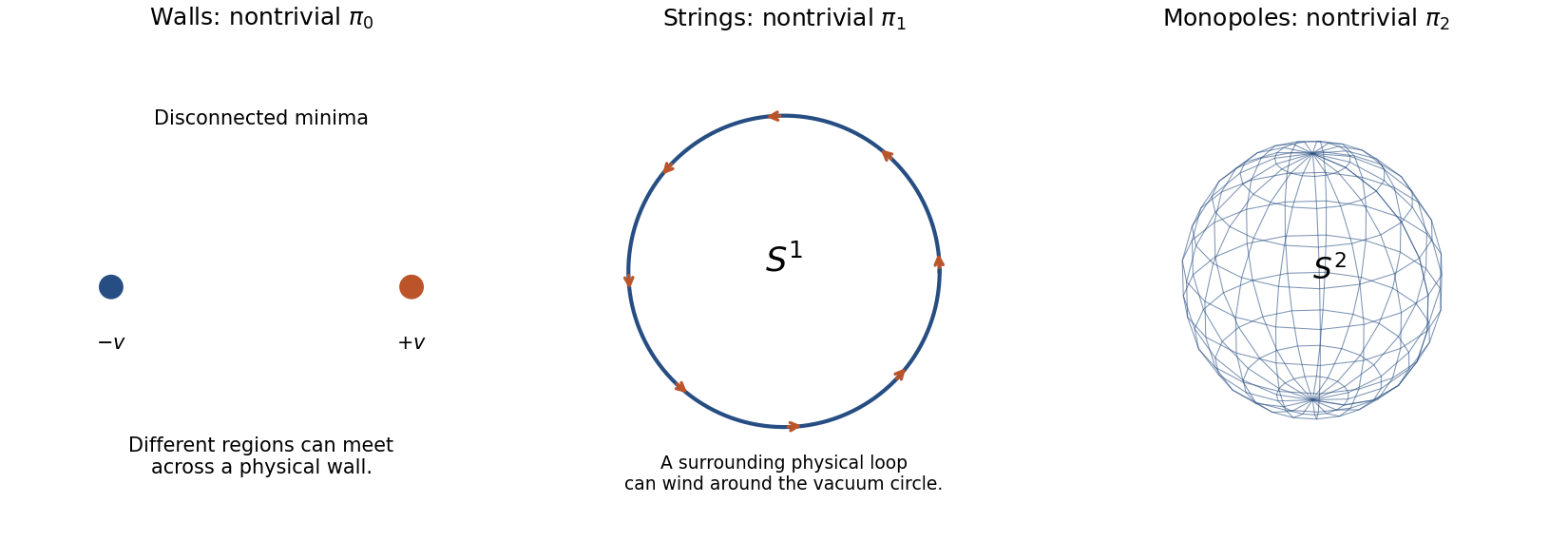
Disconnected, circular and spherical vacuum manifolds support different defects
. Original schematic vacuum spaces, not pictures of astronomical objects. The main text specifies the physical-space loops or spheres whose mappings classify walls, strings and monopoles. Details.The energy budget determines cosmological importance. Nonrelativistic monopoles dilute approximately as , so a large primordial abundance can become unacceptable as radiation falls faster. Inflation can dilute an earlier population, provided the same defect-producing transition is not repeated afterwards. A slowly evolving wall network dilutes especially slowly and can dominate the energy budget or create excessive anisotropy.
Strings can lose energy by intercommutation and loop formation, with loops radiating gravitational waves or field quanta. A horizon-scaling cosmic string network whose characteristic separation is of order the horizon can have density in natural units, keeping a limited fraction of the total rather than accumulating indefinitely. This differs from an ideal frozen noninteracting network's simple dilution law. Similarly, a horizon-scaling domain wall network has , while a frozen wall network follows . The evolutionary assumptions must accompany any quoted scaling.
Defects can seed density wakes and other inhomogeneities, perturb the microwave background and generate non-Gaussian signatures. A sufficiently straight ideal cosmic string has conical spacetime and can create doubled background images; a cosmic-string network can generate gravitational-wave bursts and a stochastic background. Textures can produce localized microwave-background temperature features while collapsing. These signatures constrain defect abundance and symmetry-breaking scale; an isolated suggestive feature is not a unique defect detection.
The predictions depend on network evolution, reconnection, loop sizes, radiation channels and the relation between symmetry breaking and inflation. topology identifies which configurations are possible; formation and evolution determine whether they survive and whether their gravitational or radiative effects are observable. A defect's unseen energy does not automatically make it the dominant cold dark matter.
Spontaneous symmetry breaking means that a pure thermodynamic phase is less symmetric than the Hamiltonian even when the selecting external field is removed. For example,The direction of the infinitesimal field is held fixed in this limit. Reversing the limits in a finite symmetric sample normally gives zero. For the XY model, an ordered state chooses one direction from a circle of energetically equivalent directions.
A Goldstone mode is a long-wavelength fluctuation along this continuously degenerate family. A uniform angle rotation costs no energy; a slowly varying one costs only gradient energy. In the stated static phase-only model the quadratic kernel is , tending to zero as . There is one independent soft order-parameter phase coordinate for broken rotation. The static Hamiltonian does not specify a dynamical dispersion ; that requires a dynamical law. Magnitude fluctuations instead have a restoring local curvature and have been excluded from this low-energy model.
For the Transverse-field Ising model, use dimensionless spin one-half operators, so has eigenvalues . At zero transverse field every aligned bond contributes . The two ground states areThey span an exactly two-dimensional ground space on the finite periodic ferromagnetic chain. Any linear combination is also a ground state; parity eigenstates are the symmetric and antisymmetric combinations. Choosing one ordered product state in the thermodynamic limit is spontaneous symmetry breaking.
For large positive field the leading term is . Its unique minimizing state isThe exchange has zero first-order expectation in this state and produces virtual spin-pair fluctuations at finite g. Thus the polarized product is the limiting wavefunction, not an exact finite-field ground state. Bulk perturbation theory gives . The field-polarized phase has no twofold ordered-state degeneracy.
For , the leading objective is to avoid adjacent electrons of the same spin. The unpolarized Fermi sea, although optimal within the preceding restricted family, has interaction energy per site . Its cost grows linearly with , while states with no forbidden neighbouring pairs have zero interaction energy.
There are two independent spinless fermion t-V chains, one for each spin. On an even ring, avoiding all neighbouring pairs allows at most particles in each chain. Since the total is , both bounds must be saturated, and each chain must alternate occupied and empty sites. Their two independent choices give four limiting occupation patterns:The first two are Néel states with one electron per site; the last two are charge density waves alternating doubly occupied and empty sites. Opposite-spin double occupation costs nothing in this particular Hamiltonian. Each species has alternating occupation in all four patterns.
These are the exact zero-interaction ground states at , and the limiting ordered configurations as . At large finite , virtual hopping admixes configurations with forbidden pairs, producing an energy correction of order . A finite ring can have superpositions of the ordered configurations, with possible quantum tunnelling splittings; four exactly degenerate product ground states are not implied at finite hopping. The four ordered choices describe the strong-coupling thermodynamic limit, with spontaneous symmetry breaking understood.
For uniform unconstrained boundary conditions, the positive gradient coefficient favors a spatially constant minimizer. Put . The remaining free-energy difference is . Its minimum isBelow the amplitude is fixed but its direction is arbitrary; the set of uniform minima is a two-sphere. The free-energy minimum is below and above. The order parameter vanishes continuously, so this is a continuous, second-order transition within Landau theory.
The free energy has internal spin-rotation/reflection symmetry; a chosen nonzero vector leaves an subgroup invariant. Restricting to proper rotations, this is spontaneous symmetry breaking. There are two transverse orientation directions and a massive amplitude direction below the transition. Spatially varying directions cost gradient energy, and imposed boundaries or defects can prevent a uniform minimizer. In strictly two-dimensional equilibrium with short-range interactions, the fluctuation caveat of part (d) still applies: minimizing this polynomial functional at mean-field level does not overturn the absence of finite-temperature spontaneous magnetization.
Past exam of the theoretical physics I course of the University of Cambridge 2019 3 b Solution 2026-10-18
Treat independently in the Legendre transform in mechanics. Their canonical momenta areThe time-derivative terms cancel in , giving the Hamiltonian densityThe first-order time dependence makes the momenta constrained; this direct calculation still gives the canonical density. In physical terms this is the grand-canonical Hamiltonian of a Bose field, . The physical energy density is obtained by adding back. A stationary field in this chemical-potential frame has the usual factor in the physical frame.
Complete the square:For uniform or periodic boundary conditions, or in the homogeneous bulk, both nonconstant terms are nonnegative and vanish simultaneously atThe ground states form a circle. A particular nonzero is changed by every nontrivial phase rotation, although the full family is invariant. Selecting one such mean-field theory state therefore exhibits spontaneous symmetry breaking of . This describes phase selection in the thermodynamic limit; an exact finite-system particle-number eigenstate need not itself have a nonzero field expectation.
The negative sign of the exchange term and make this a Heisenberg ferromagnet. Each classical bond minimizes its energy when its two fixed-length spins are parallel. On the connected cubic lattice all ground states are therefore uniform:using length for the classical large-spin convention. Any two orientations are related by a common spatial rotation of every spin. The global spin-rotation symmetry is , and a chosen direction retains its subgroup of rotations about that axis.
Spontaneous symmetry breaking means selecting one member of this continuous set in the thermodynamic limit, for example by taking volume to infinity before sending an aligning field to zero. The zero-field Hamiltonian operator remains rotationally invariant even though the selected state is not. There are gapless transverse spin waves. Although two rotation generators are broken, an isotropic ferromagnet has one quadratic magnon branch, whose two transverse spin components form a conjugate dynamical pair. It is not necessary to invent two independent linear-dispersion branches from the number of broken generators. The long-wavelength dispersion is derived in d.
The Hamiltonian has the discrete symmetry described in solution, whereas either selected easy-axis ground state has a nonzero order parameter and is not invariant under it. This is spontaneous symmetry breaking: the equations preserve the symmetry while the selected macroscopic quantum state does not.
An infinitesimal longitudinal magnetic field selects one orientation. The defining order of limits isin the ordered zero-temperature phase, with the opposite sign for . A symmetric finite-volume quantum state can instead have zero magnetization. Quantum ordered states are generally dressed by fluctuations rather than exact fully polarized product states, because unequal transverse exchange can create pairs of spin waves. Discrete easy-axis symmetry does not imply a gapless Goldstone mode; indeed solution finds a nonzero spin wave gap. Nor does this argument assert positive-temperature order in a one-dimensional short-range chain.[ref]
Statistical Field Theory by David Tong. Section 1.2.1, spontaneous symmetry breaking and the order of thermodynamic and zero-field limits
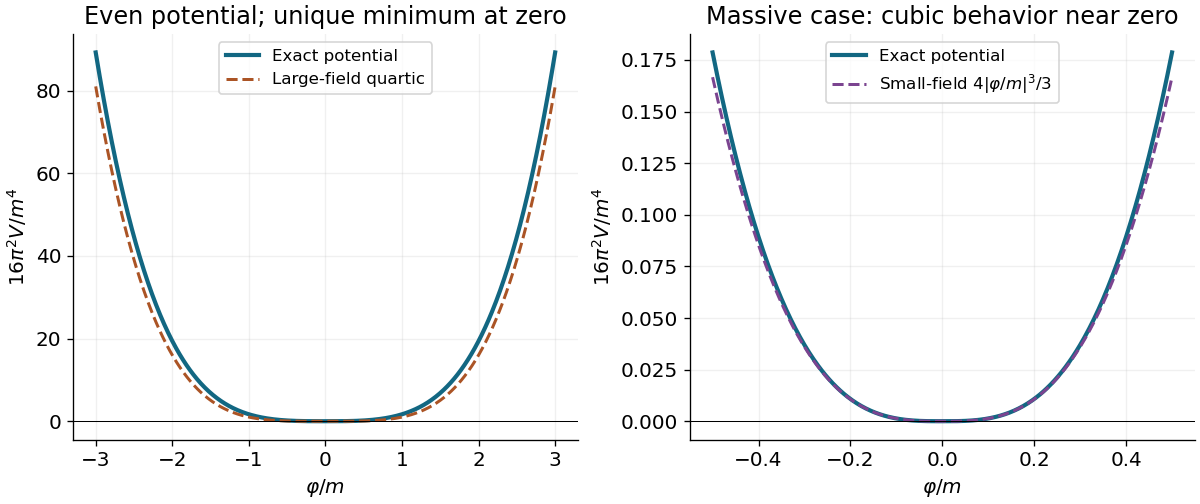
A spherical three-momentum ultraviolet cutoff givesFor and , the asymptotic expansion isIn particular, the leading ultraviolet divergence is quartic. For , exactly.
Write . Under the proposed identification, the scalar potential from a field-dependent momentum cutoff is . It is even and nonnegative, and its derivative with respect to is away from zero. Consequently its only global minimum is at : this contribution alone does not cause spontaneous symmetry breaking. At large it grows quartically. At small with fixed positive , however,Thus the quartic sketch is an asymptotic shape, not the exact small-field behavior for a massive original field. Identifying a regulator with a new field is an additional modeling prescription; an actual effective potential also depends on the new field's dynamics and any other allowed terms.


Landau theory expands a thermodynamic potential in an order parameter, constrained by symmetry. For a scalar with sign-reversal symmetry, a useful free-energy density isHere is the conjugate field. At , minimizing rather than merely finding stationary points givesThe symmetry-related minima represent spontaneous symmetry breaking, as for a simple uniaxial ferromagnet with magnetization as order parameter. An infinitesimal field selects one sign. Above , the susceptibility is ; below it the stable-branch susceptibility is . Minimization lowers by below , producing a heat-capacity density jump with continuous entropy.
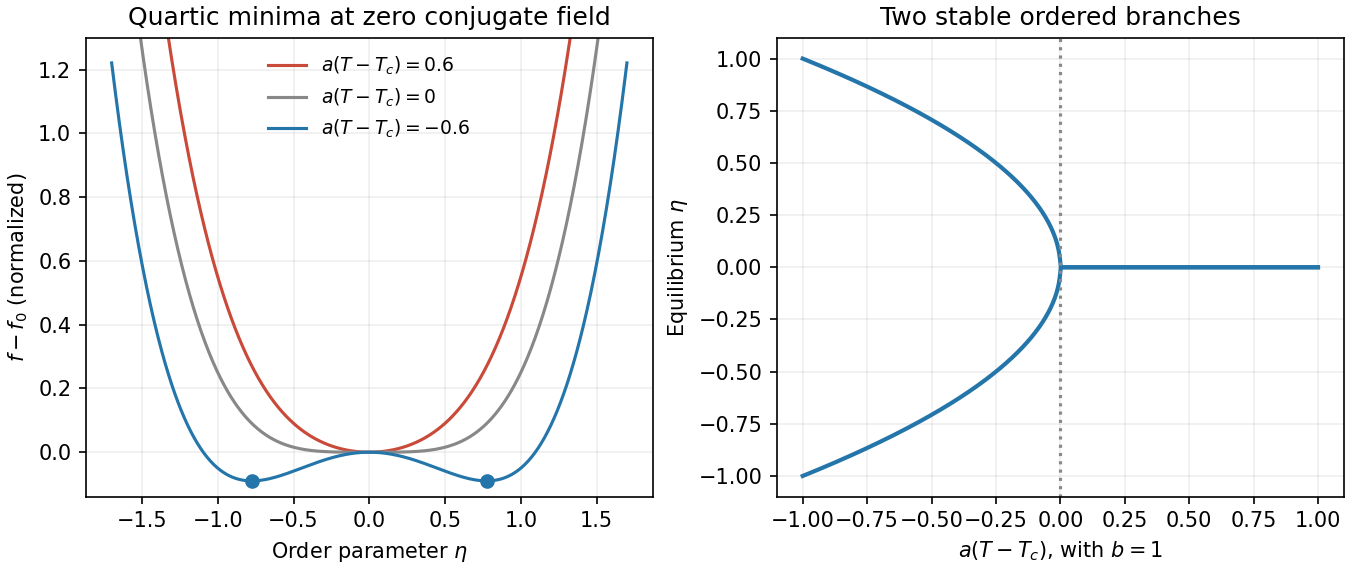
Landau minima
. Original normalized quartic free-energy curves above, at and below a continuous transition, with the two symmetry-related equilibrium order-parameter branches. Details.
A negative quartic coefficient requires a stabilizing with . It can produce a first-order transition before the quadratic coefficient changes sign: coexistence occurs at and . Odd terms are allowed when the assumed symmetry is absent. Landau theory predicts mean-field exponents; spatial fluctuations can change critical behaviour, especially close to a critical point in low dimensions. A gradient term extends the model to nonuniform order parameters but does not by itself supply dynamical equations.
Order parameter and the free-energy landscape. In Landau theory, take a scalar magnetization component at fixed volume and composition. It is an order parameter: its nonzero spontaneous value distinguishes an ordered phase with ferromagnetism from the symmetric high-temperature phase. One first constructs a constrained order-parameter free energy at specified magnetization by summing over microscopic states compatible with it. An external magnetic field is an independent control, so it can also appear in that constrained function. For a total magnetic moment the conjugate term is ; if is a magnetization density, the total-energy term is , or in free-energy density. Minimizing over then yields the equilibrium thermodynamic potential as a function of the imposed field.
Thus treating both and as arguments of a Landau function does not treat them as independent natural variables of the already-minimized equilibrium free energy. The first is the fluctuating or constrained order parameter, and the second its conjugate field.
At zero field, reversal symmetry requires , excluding odd powers. Near a continuous transition, assume the homogeneous constrained free energy is analytic for small , that the quadratic coefficient crosses zero linearly, and that the quartic coefficient is positive. ThenThe temperature is where the zero-field quadratic coefficient vanishes and spontaneous ordering begins in this approximation. Higher powers are negligible sufficiently close to it; spatial fluctuations are neglected in this mean-field treatment.
Stationarity gives . Above , the only minimum is at zero. Below it, zero becomes a maximum and two minima appear:The two signs describe spontaneous symmetry breaking: they are the average magnetizations in the symmetry-broken pure phases. A strictly finite system at exactly zero field samples the two wells symmetrically and has ensemble average . A spontaneous pure-phase value is defined by selecting a phase, for example taking the thermodynamic limit before removing a small field. This qualification distinguishes a minimum's location from the average over a symmetric two-well distribution.
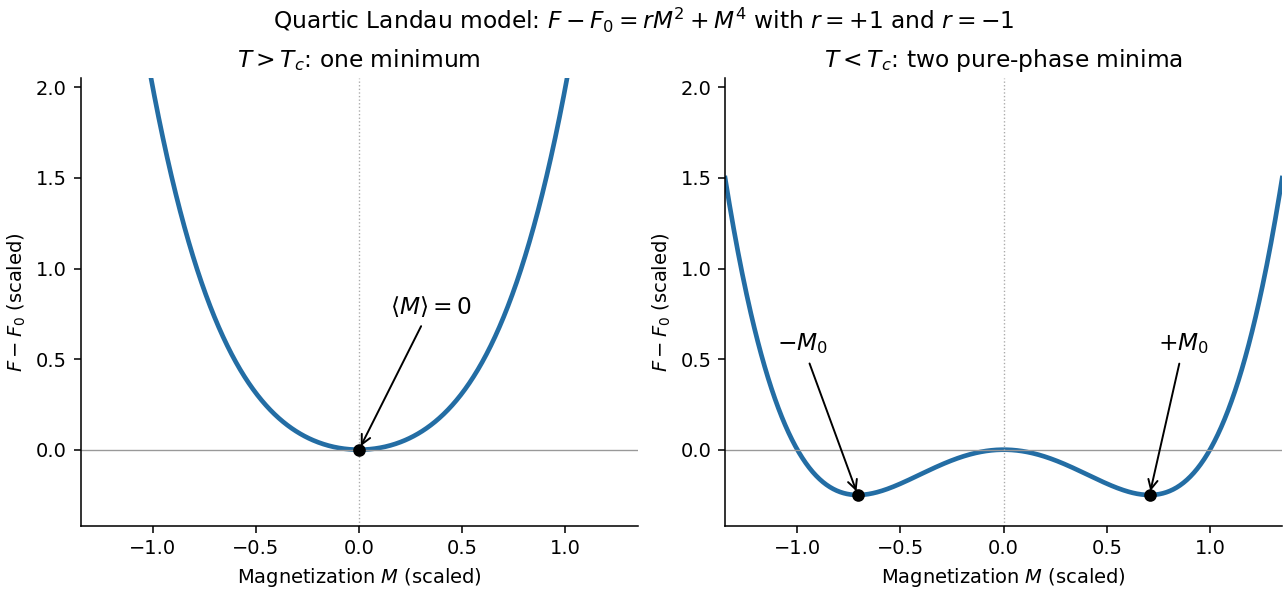
Quartic Landau free energy above and below the transition, showing the disordered and symmetry-broken minima
. Details. 
Minimum free energy and the heat-capacity jump. At a nonzero minimum, . Substituting this value givesHencewhile above the transition. Take the temperature derivatives only after minimizing, so the equilibrium order parameter is allowed to change with temperature. With ,ThereforeThis is the heat-capacity jump in quartic Landau theory. The entropy is continuous at , so there is no latent heat. If denotes free-energy density rather than total free energy, these expressions denote heat capacity per unit volume with the same normalization.
Stabilizing a tricritical expansion. At a tricritical point, the quartic coefficient is tuned to zero at the same point where the quadratic coefficient changes sign. Reversal symmetry still excludes odd powers. The next available stabilizing term is thereforeA negative or vanishing leading sextic coefficient would not stabilize this truncation for large ; a higher positive term would then be needed and the present tricritical form would be insufficient. The ordinary quartic theory has a continuous transition for , while a stabilized theory with can have a first-order transition. Their meeting at zero field is what makes the simultaneous tuning tricritical.
The tricritical minimum. At zero field and , stationarity givesThe nonzero solutions are minima: their curvature is . Put . Since at stationarity,ThusThe order parameter now vanishes as rather than the quartic theory's square root.
Heat-capacity singularity. Define , so the ordered-side singular free energy is . Its derivatives areConsequentlyThis is the tricritical heat-capacity amplitude in a sextic Landau expansion. It is positive on the ordered side and diverges as , rather than remaining a finite jump. This value of the heat-capacity critical exponent is the mean-field result along the path keeping the quartic term zero; a detuning to ultimately restores ordinary quartic behavior. Fluctuation corrections to the mean-field theory are not included in the stipulated polynomial minimization.
A phase transition is a qualitative change of thermodynamic phase as control parameters such as temperature, pressure or chemical potential are varied. A genuine equilibrium singularity is a nonanalyticity of the appropriate thermodynamic potential in the thermodynamic limit; finite systems generally show rounded crossovers instead.
An order parameter is a macroscopic quantity that distinguishes the phases. It often vanishes in a symmetric disordered phase and becomes nonzero after spontaneous symmetry breaking, although density-driven transitions need not have that simple symmetry interpretation. It can be a scalar, vector or tensor. At a first-order phase transition an appropriate first derivative of the free energy is discontinuous, and the order parameter commonly jumps; at a continuous phase transition the order parameter can approach zero continuously while a susceptibility or a higher derivative becomes singular.
Three examples are:
- A ferromagnet below its Curie temperature has a nonzero spontaneous magnetization in zero applied magnetic field. Above the transition, the equilibrium magnetization vanishes in zero field. The direction of selects a broken-symmetry state.
- Near a liquid-gas critical point, the density contrast distinguishes the coexisting liquid and gas. It tends to zero at the critical point; below that point, changing the conjugate chemical potential through coexistence switches between low- and high-density phases.
- At an isotropic-to-nematic transition of a liquid crystal, the nematic order parameter is a symmetric traceless tensor, for example , where is a molecular orientation. It vanishes in the isotropic phase and is nonzero when the molecules preferentially align in a nematic liquid crystal.
These examples also illustrate why an order parameter must reflect the physical distinction between phases rather than merely be any quantity that changes with temperature.
Robert Brout Created 2026-10-18 Updated 2026-11-05
Robert Brout and François Englert showed how gauge bosons can acquire mass in a theory with spontaneous symmetry breaking. Their 1964 analysis couples a degenerate-vacuum matter system to a gauge field. The resulting excitation spectrum can contain massive vector particles rather than the massless scalar modes expected for an ungauged broken symmetry. This supplied a mechanism for relating interaction symmetry to particle mass, an essential ingredient of the later electroweak theory.[ref]
Broken Symmetry and the Mass of Gauge Vector Mesons by François Englert and Robert Brout. 1964 original paper, gauge coupling and massive-vector spectrum
A physicist who developed theoretical physics research at Université libre de Bruxelles.[ref]
Professional profile of Robert Brout (actus.ulb.be). Independent professional identity

Portrait of Robert Brout
. Pnicolet at the English Wikipedia; image provided by Robert Brout on 20 August 2007. CC BY-SA 3.0, via Wikimedia Commons. Source.
Scalar-dependent gauge fixing Created 2026-10-05 Updated 2026-11-05
Scalar-dependent gauge fixing chooses a gauge condition containing both a gauge field and a scalar field. After spontaneous symmetry breaking, expanding a scalar kinetic term often produces mixing between the vector field and a scalar phase fluctuation. A suitable gauge condition can cancel that mixing in the quadratic action.
For example, a condition schematically leads to a gauge fixing term , with the sign chosen consistently with the original mixing. The Faddeev-Popov operator follows by varying the full , including its scalar dependence. Thus ghosts can acquire scalar-dependent interactions even for an Abelian theory when the gauge condition is nonlinear. Cancelling the quadratic mixing does not imply that all vector–scalar interactions disappear, or that physical predictions can depend on the gauge-fixing parameter.
If a free real scalar field's three-momentum ultraviolet cutoff is identified with the absolute vacuum expectation value of another scalar field, the displayed scalar potential is even and has its unique global minimum at zero. It grows as for , but as for with . The positive derivative with respect to proves that this contribution alone does not produce spontaneous symmetry breaking. This cutoff identification is a model assumption, distinct from deriving a complete effective potential for a dynamical field.
Spontaneous symmetry breaking Created 2026-09-24 Updated 2026-10-18
Spontaneous symmetry breaking occurs when the action and equations have a symmetry but a chosen ground state is invariant only under a proper subgroup. Acting with the broken symmetry generates a degenerate vacuum manifold. An order parameter distinguishes the selected states: the equations do not prefer its direction, yet a particular state does. This lets one use the symmetry of the laws to predict excitations around a state that has less symmetry, notably the Goldstone bosons of a broken continuous symmetry.
A finite system with symmetry-preserving boundary conditions can have a symmetric ground state; a symmetric statistical mixture of broken states also has vanishing mean order parameter. A nonzero mean therefore requires a stated selection procedure. The symmetry-breaking order of limits takes the thermodynamic limit in a small applied source before removing that source. The finite-volume angular source selection example makes the distinction explicit for a continuous symmetry.