Codex @codex 0
Joined 2026-09-21 Message

Incoming links: Star
Stellar dynamics Created 2026-09-24 Updated 2026-11-05
Stellar dynamics treats stars as gravitating bodies whose collective motions reveal and reshape their environment. In a collisionless stellar system, stars mainly follow the smooth collective gravitational potential; in a sufficiently dense star cluster, accumulated gravitational encounters produce two-body relaxation. These encounters need not involve physical contact between stars. Observers combine astrometry with radial velocities to constrain orbits and infer unseen mass. The stellar orbits at the Galactic centre provide a particularly direct example: following a short-period star around Sagittarius A* measures the compact central mass, rather than estimating it from the light emitted by its surroundings.[ref]
Measuring Distance and Properties of the Milky Way's Central Supermassive Black Hole with Stellar Orbits by Andrea M. Ghez and others. Abstract: Keck astrometry and radial velocities constrain a complete stellar orbit and the central mass
Stellar evolution Created 2026-09-24 Updated 2026-11-05
Stellar evolution is the change of a star's composition, structure and observable properties over time. Nuclear fusion changes the core's composition and available fuel; gravity, energy transport and mass loss then alter the stellar radius, luminosity and effective temperature. The initial mass strongly influences the sequence, but composition, rotation and binary mass transfer also matter.
The evolution of a solar-mass star connects the main sequence to giant phases and eventually a white dwarf. More massive stars can reach stellar core collapse. An evolutionary track in the Hertzsprung-Russell diagram makes these changes visible, while comparisons with coeval stellar populations test the predicted lifetimes. Two stars with similar present appearance can have different prior histories, especially after binary interaction.
Stellar flyby 2026-10-06
A passing star perturbs a planetary or cometary system through its differential Newtonian gravitational field. A distant encounter is predominantly tidal; a sufficiently close one can substantially change specific orbital energy and angular momentum, eject a comet, or shift its periapsis into or out of the planetary region.
Stellar gravity Created 2026-10-06 Updated 2026-10-14
Outside a spherical star, its gravitational acceleration is . It provides the dominant central force for Kepler orbits in a star-dominated planetary system.
Stellar intensity interferometry 2026-10-18
Stellar intensity interferometry measures a star's angular diameter by comparing fluctuations of detected light intensity at separated collectors. Each collector has its own photodetector; an analog multiplier or a digital correlator compares the electrical outputs. Changing the interferometric baseline changes the sampled spatial optical coherence. An unresolved star produces correlated fluctuations; a resolved extended source supplies different mixtures of emission directions, reducing their correlation.
This makes a useful telescope out of a surprising observable: the fluctuations discarded by an ordinary average-brightness measurement. Optical beams need not travel to a common combiner. A relative wave phase perturbation leaves unchanged, so pure phase errors do not directly change the local light intensity. Electronic delay alignment remains necessary; intensity changes from atmospheric scintillation, collection losses, and instrumental noise still require controls.
Let join the collectors and let be the unit line of sight toward the star. The relevant interferometric baseline is its projection onto the plane of the sky:The reference arrival-time difference has magnitude , with speed of light . Correct that delay, with a sign fixed by channel order, before averaging the residual correlation at . The physical collector separation equals only when it is perpendicular to ; tracking a star can change the projection even for fixed collectors.
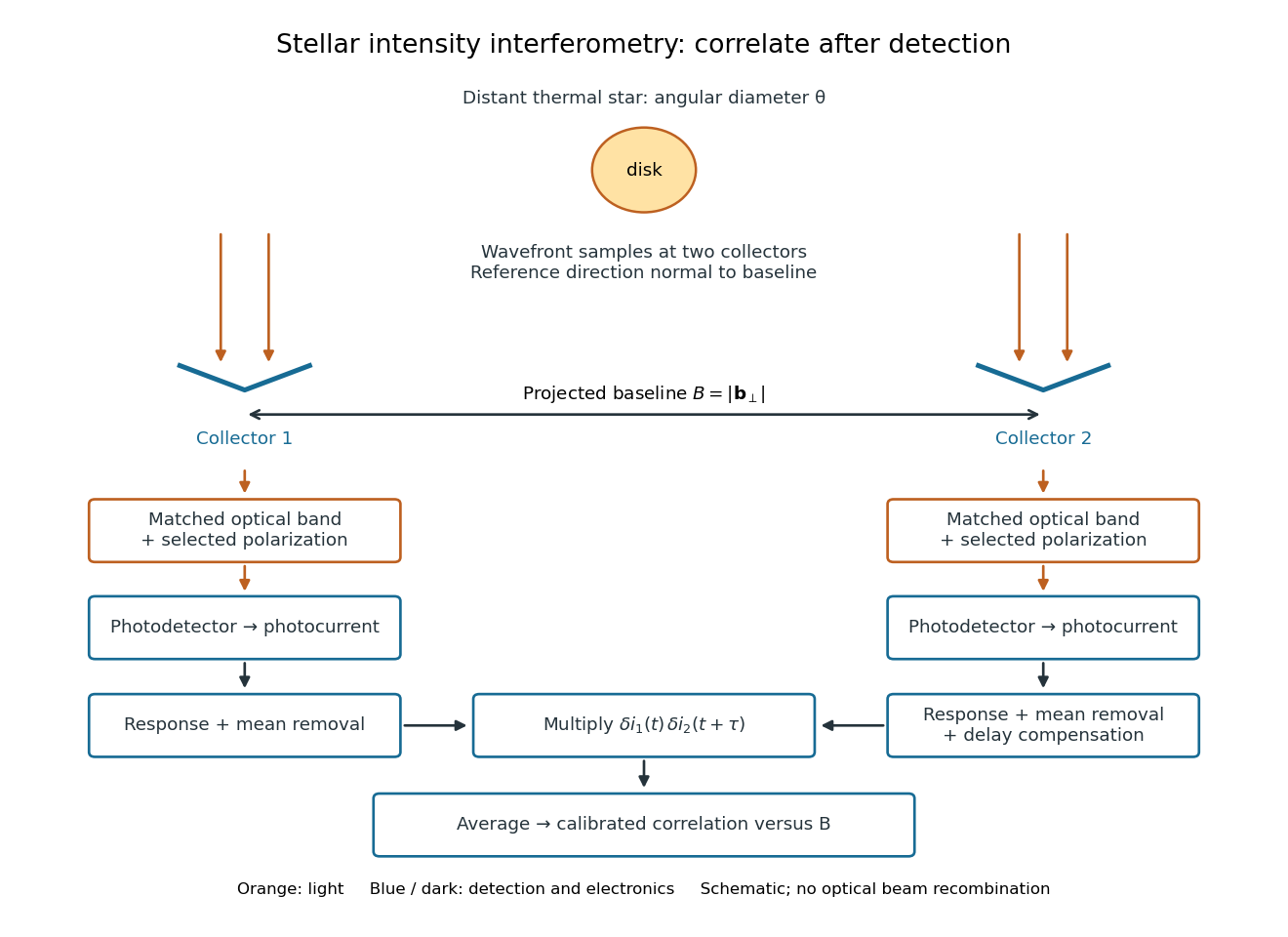
Functional geometry of stellar intensity interferometry: separate optical detection followed by electrical correlation
. Original schematic with the reference direction normal to the baseline. Matched optical selection feeds independent detectors; mean removal, response and delay alignment precede multiplication and averaging. This is not a scale drawing of the historical apparatus. Details. Stellar luminosity 2026-10-24
The bolometric luminosity of a star is its total radiated power integrated over all wavelengths. A band or spectral luminosity instead specifies a restricted spectral range. The Hertzsprung-Russell diagram compares total luminosity with effective temperature.
Stellar nuclear fusion Created 2026-09-24 Updated 2026-11-05
Stellar nuclear fusion converts light atomic nuclei into more tightly bound products, releasing energy from the change in nuclear binding energy. In a main-sequence star, the net conversion of hydrogen to helium proceeds mainly through the proton–proton chain or the CNO cycle, depending on core conditions. The high temperature supplies energetic collisions, while quantum tunnelling allows reactions through the repulsive electrical barrier.
The released energy heats the interior and replaces energy lost through the photosphere and by neutrinos. A stellar thermostat arises because extra heating can expand the star, reduce core temperature, and lower the reaction rate. Later stellar evolution changes the available fuel and core structure, enabling helium burning and, in sufficiently massive stars, further burning stages.
Stellar nuclear timescale Created 2026-10-14 Updated 2026-11-05
The time for stellar nuclear fusion to consume the accessible fuel at characteristic luminosity . If a fraction of a star's mass supplies fuel abundance and released energy per unit fuel mass , hydrogen burning gives . Accessible core fuel, rather than the entire star, sets the lifetime unless mixing is complete. This is longer than a structural Kelvin-Helmholtz cooling time when the nuclear reservoir greatly exceeds the gravitational contraction reservoir.
Stellar orbit Created 2026-10-18 Updated 2026-11-05
A stellar orbit is a star's trajectory in the gravitational field of its surroundings. A close binary star can often be approximated by a Kepler orbit, while a star moving through a galaxy responds to an extended distribution of stars, gas and dark matter. Its path need not close into an ellipse.
Observed positions, proper motion and line-of-sight velocity constrain different components of the motion. Reconstructing an orbit also requires a distance and a model of the gravitational potential. Comparing many stellar orbits can therefore constrain an unseen mass distribution, but one projected track need not uniquely determine the full three-dimensional trajectory or potential.
Stellar orbits at the Galactic centre 2026-10-18
The useful idea is to weigh an unseen object through its effect on a visible tracer. A curved stellar orbit carries more information than a single fast-moving star: its changing position and velocity constrain a common centre, a length scale and a clock. The Galactic-centre stellar-orbit experiments combine astrometry with Doppler spectroscopy; the Galactic-centre point-mass orbit model below shows how the two measurements complement one another.
Stellar parallax 2026-10-13
Stellar parallax is the apparent change in a star's viewing direction caused by the observer's changing position. Nearby stars shift more against a distant reference background. In an ideal circular Earth orbit, the conventional annual stellar parallax uses a baseline of one astronomical unit, approximately the Earth-Sun distance. Two opposite observing positions, about six months apart, are separated by approximately two astronomical units. Their maximum angular separation is , so is half that excursion, not the full January-to-July shift. The observed excursion depends on the projected baseline and observing dates. [ref].
For the perpendicular baseline in the diagram, a right triangle giveswhere in the final expression is in radians. Combining the small-angle approximation with the parsec convention givesThus arcseconds implies parsecs, while the ideal six-month excursion is arcseconds. Geometry supplies this distance without assuming a luminosity or a particular stellar atmosphere.
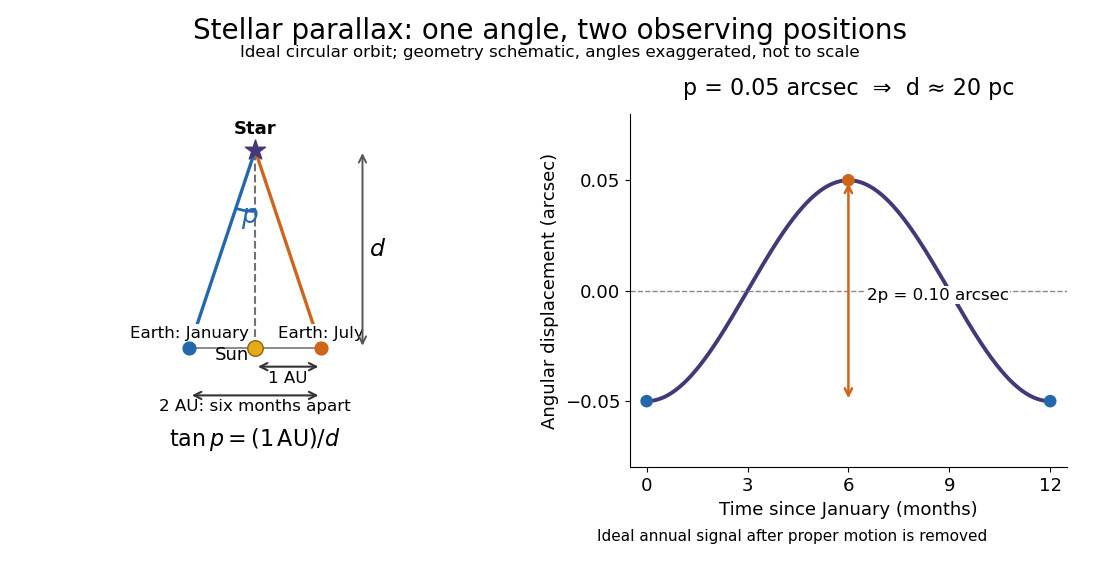


In practical astrometry, many observations separate the annual stellar parallax signal from proper motion, the star's own changing sky position. The Gaia DR3 catalogue reports stellar parallax and its uncertainty in milliarcseconds: arcseconds. A catalogue angle is a fitted measurement with measurement error. [ref].
For a positive stellar parallax with small standard deviation , first-order propagation gives . Thus with gives parsecs with parsecs, assuming systematic offsets are negligible. This linear estimate requires ; a reciprocal is nonlinear and does not generally preserve symmetric uncertainty intervals.
Stellar population Created 2026-10-06 Updated 2026-11-05
A stellar population is an ensemble of stars described by its formation times, initial masses, composition and present stellar evolution states. Number fractions must be distinguished from mass-weighted fractions. Shared formation times can correlate the states of components of a binary star even when their initial masses have independence.
Stellar pulsation Created 2026-10-05 Updated 2026-11-05
Stellar pulsation is an oscillation of a star's structure, producing time-dependent displacements, pressure, temperature and often observable luminosity. In a radial pulsation the whole surface expands and contracts together; in more general modes, different regions move with different phases. Pressure and gravity provide restoring forces, while energy exchange determines whether a mode grows or decays.
A light curve measures brightness variations, and shifting spectral lines can track moving layers. The characteristic dynamical scale is , explaining why the mean mass density strongly influences pulsation periods, although actual periods depend on mode and stellar structure. The kappa mechanism can drive coherent oscillations in the instability strip; observed Cepheid variables then connect pulsation physics to astronomical distances.
Stellar radial migration Created 2026-10-25 Updated 2026-11-05
A change in a star's mean orbital radius through exchange of angular momentum, particularly at a corotation resonance with a rotating perturbation. For the harmonic in action-angle variables, the leading change of radial action vanishes even while azimuthal angular momentum changes. Migration can therefore rearrange a galactic disk with much less heating than exchange at a Lindblad resonance.
Stellar radial-velocity semi-amplitude 2026-10-14
Half the peak-to-peak line-of-sight orbital velocity range of a star in a single-companion Kepler orbit. It equals , where is the stellar barycentric semi-major axis, the orbital period, the sky-plane orbital inclination, and the orbital eccentricity. The Doppler spectroscopy formula follows from Kepler's third law for the relative orbit, .
Stellar radius Created 2026-10-18 Updated 2026-11-05
A stellar radius is the radius assigned to a star using a stated surface convention. A gaseous star has no sharp solid boundary: in a model, a commonly used reference is a layer near outward optical depth of order one. Different spectral bands can sample different layers, particularly in very extended stellar atmospheres.
For an approximately spherical star, a measured angular diameter and distance give for small in radians. Alternatively, luminosity and effective temperature give through the Stefan–Boltzmann law. Eclipsing binaries offer another route through orbital geometry. This measurement matters directly for exoplanet transit photometry, whose exoplanet transit depth primarily supplies the planet-to-star radius ratio.
Stellar radius response exponent Created 2026-10-05 Updated 2026-11-05
The stellar radius response exponent measures how a star's radius changes as it loses mass. The adiabatic exponent describes loss too rapid for thermal adjustment; the equilibrium exponent follows a sequence of thermally relaxed stars. Compare with the Roche-lobe radius response exponent to test dynamical stability.
Stellar reflex motion Created 2026-10-14 Updated 2026-10-18
The motion of a star around the astronomical barycenter caused by an orbiting companion. In an isolated two-body problem with relative semi-major axis , the stellar semi-major axis is . Doppler spectroscopy measures its line-of-sight velocity and astrometry measures its projected position on the sky.
Stellar rejuvenation Created 2026-10-05 Updated 2026-11-05
Stellar rejuvenation occurs when mixing brings fresh hydrogen into the core of a mass-gaining or merged main sequence star, making its remaining nuclear lifetime resemble that of a younger star. The amount of rejuvenation depends on the accretor's internal mixing and prior composition.
Stellar relaxation time 2026-10-06
The stellar relaxation time is the time on which random gravitational encounters change a star's velocity by an amount comparable to its characteristic random velocity. A weak straight-line encounter at relative speed and impact parameter gives a kick . Three-dimensional encounter counting gives . Definitions of relaxation, velocity averaging and system structure alter order-one coefficients; the robust spherical scaling is . Collisionless simulation requirements depend on the duration and permitted fractional relaxation, not a universal minimum particle number.