Use angular size under a collinear relativistic boost. For a small distant source, the two angular diameters have ratio , where is the relative rapidity. Thus , and the relative velocity satisfies
The speed is therefore . The observers are momentarily coincident, so this is relativistic aberration, rather than a difference in their distance from the planet. The observer moving faster towards the planet measures the smaller angular diameter under the source-direction aberration convention.
The signed rapidity corresponding to velocity is
Equivalently , , and . Thus the Lorentz boost from part (i) becomes
Multiplying two such matrices gives diagonal entries and off-diagonal entries , by the addition identities for hyperbolic functions. Hence
The resulting rapidity is . In velocity variables this is the relativistic velocity-addition formula .
For , each adjacent pair of walkways has relative rapidity . There are such steps between and , so the equal-rapidity chain of collinear Lorentz boosts has total rapidity . Thus the actual velocity is
It is strictly below the speed of light for every finite . Adding the adjacent velocities as ordinary numbers ignores the relativistic velocity-addition formula.
For large , the Taylor series of the inverse hyperbolic tangent gives
Consequently
More precisely, , so the limit is approached from above. The case would prescribe an adjacent relative velocity equal to the speed of light; it does not define an admissible walkway inertial frame.
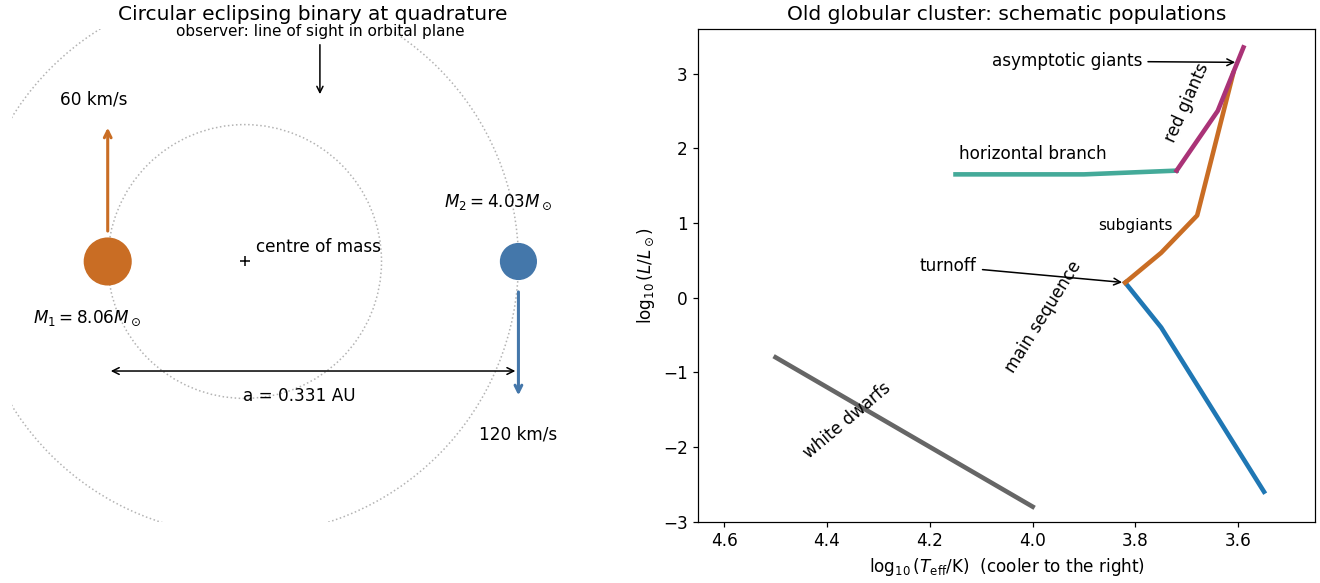
Assume a circular orbit and an orbital inclination , as appropriate for a simple eclipsing binary estimate. At quadrature the two radial velocities are opposite and equal to the orbital speeds. The more massive component has the smaller amplitude. With the centre of mass as origin,
Thus , and Kepler's third law gives
The orbital plane contains the observer's line of sight; at quadrature the two velocities point towards and away from that observer, as labelled in the original schematic below. For an elliptic orbit, the measured amplitudes instead give ; the numerical answer requires the circular assumption.
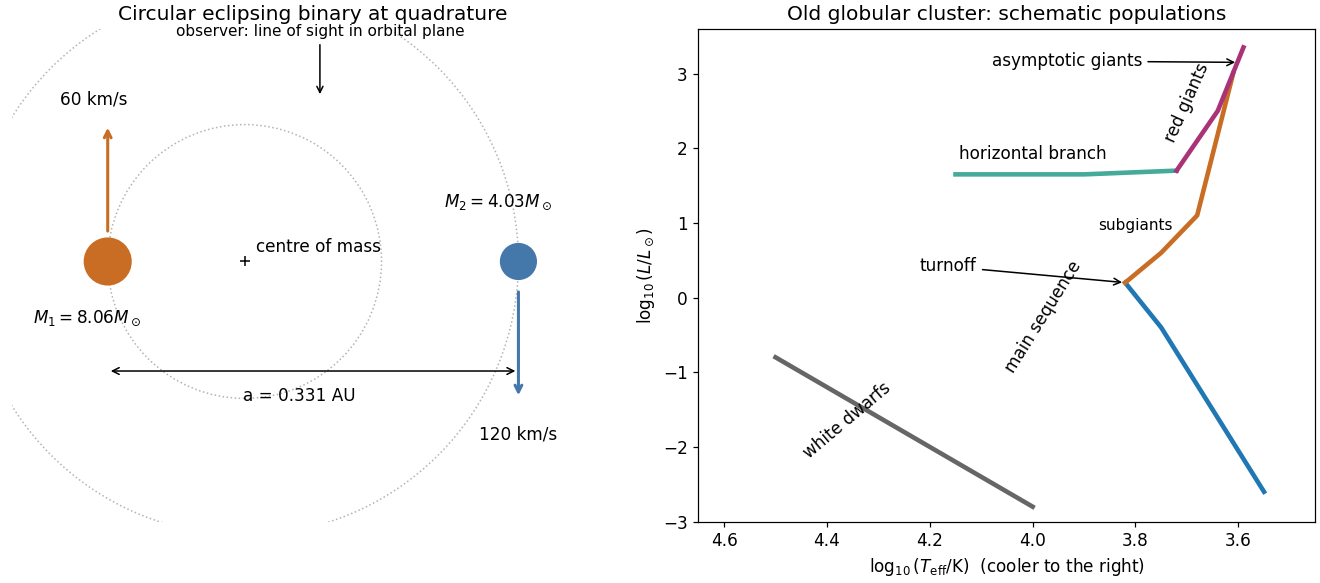
Figure 1.
Binary geometry and an old globular-cluster Hertzsprung-Russell diagram; both panels are schematic
. Details.
Take a stationary initial electron of mass , a photon incident along , and a nonrelativistic recoil velocity of magnitude . Choose above for the scattered photon and below for the electron. Conservation of momentum gives
The electron's unchanged rest energy cancels in conservation of energy, leaving
Equivalently use and . The nonrelativistic limit requires , and treating the electron as free requires its binding energy to be negligible on the scale of the collision.
Start with a fast massive projectile following an approximately straight path. Its time-dependent electric field perturbs bound absorber electrons. At large impact parameter, treating the perturbation to first order and summing excitation and ionization transition probabilities gives an energy transfer weighted by the absorber's oscillator strengths. The oscillator-strength sum rule reduces the leading coefficient to the number of target electrons, while their logarithmically weighted excitation energies define .
The classical impulse picture explains the logarithm: a transverse impulse scales as , so transferred energy scales as ; multiplying by the number of encountered electrons in gives . Quantum scattering replaces ad hoc short- and long-distance cutoffs by recoil kinematics and bound-state excitation. Relativistic projectile kinematics supplies and the term. Summation over many independent encounters gives the mean stopping power, rather than the energy-loss straggling of individual tracks.
The leading approximation assumes , a sufficiently fast projectile for perturbation theory, a largely fixed projectile charge, and weak correlations between collisions. At low velocity, electron binding, charge exchange and nuclear stopping become important; at high velocity, polarization screens distant interactions and gives the density correction. The projectile's bremsstrahlung is suppressed by its large mass and is excluded from the collision stopping power.
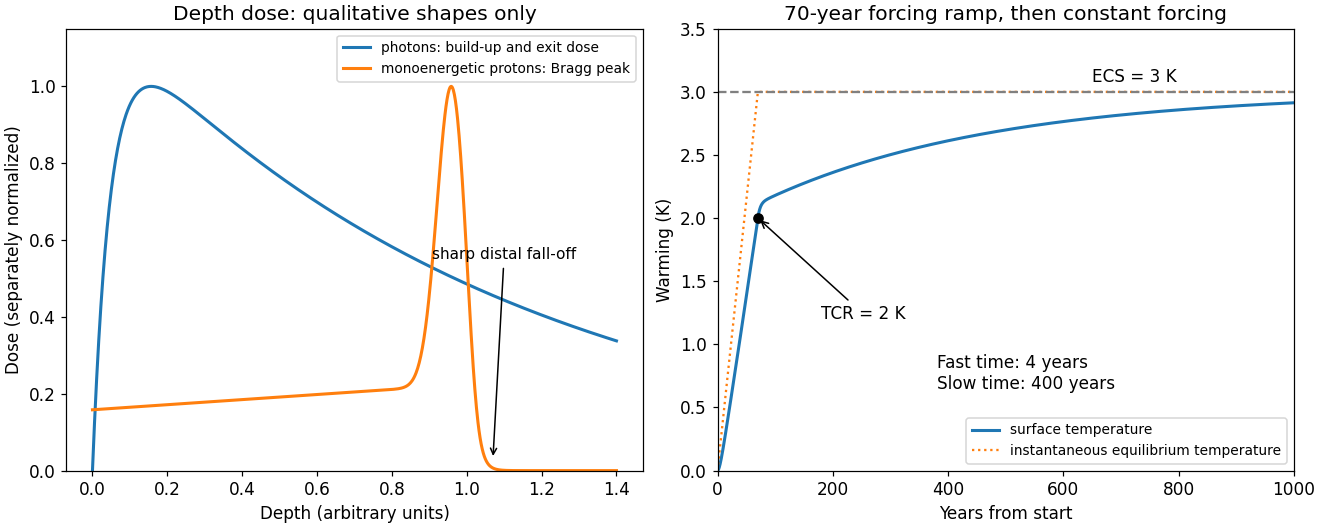
The dominant factor raises the energy loss as a charged projectile slows, while the logarithm moderates that rise. This produces a Bragg peak close to the end of its particle range. At still lower velocity, changing effective charge, shell effects and nuclear stopping invalidate extrapolation of the elementary Bethe stopping formula to zero energy. A finite initial energy gives a finite continuous-slowing-down range,
A higher initial energy increases the particle range; greater electron density increases stopping power per unit length. Absorber and also affect the depth. Multiple Coulomb scattering, energy-loss straggling, nuclear reactions and the incident energy spread broaden the measured peak and distal fall-off; nuclear secondaries can produce a small tail. Superposing many incident energies makes a spread-out Bragg peak for an extended target. The schematic curve below illustrates shapes only and is not patient radiation dosimetry.
Figure 1.
Qualitative depth-dose curves and a two-timescale climate response; depth is in arbitrary units
. Details.
Assume a circular orbit and an orbital inclination , as appropriate for a simple eclipsing binary estimate. At quadrature the two radial velocities are opposite and equal to the orbital speeds. The more massive component has the smaller amplitude. With the centre of mass as origin,
Thus , and Kepler's third law gives
The orbital plane contains the observer's line of sight; at quadrature the two velocities point towards and away from that observer, as labelled in the original schematic below. For an elliptic orbit, the measured amplitudes instead give ; the numerical answer requires the circular assumption.
Figure 1.
Binary geometry and an old globular-cluster Hertzsprung-Russell diagram; both panels are schematic
. Details.
Put and . Then
The second row is the original damped harmonic oscillator equation and the first row defines the auxiliary velocity. This converts a second-order ordinary differential equation into two first-order equations without changing the required two initial values.
Suppress primes on the angular velocity while retaining rotating components. The canonical momentum is . Varying with respect to position and applying the Euler-Lagrange equations gives
The terms are the physical force, the velocity-dependent Coriolis force, the outward centrifugal force, and the Euler force caused by changing angular velocity. The common origin is inertial; an accelerating origin would introduce another translational apparent force.
At latitude , the Earth's angular velocity in east–north–up coordinates is . Assume a small horizontal patch, constant , negligible vertical velocity, and a vertical constraint balancing effective gravity. Absorb the steady centrifugal force into that effective gravity. With and physical horizontal force per unit mass , the Coriolis force gives
Large-scale atmospheric and oceanic flows deflect to their right in the northern hemisphere and left in the southern hemisphere; their balance with a horizontal pressure gradient produces geostrophic flow. A Foucault pendulum has an oscillation plane that precesses relative to the ground at angular rate . Both effects vanish at the equator within this horizontal approximation.
Let be the particle number density, the conservative potential energy and the applied force. In the overdamped regime a viscous drag coefficient gives drift velocity . Combining this drift with Fick's first law gives the number flux
At thermal equilibrium, the Boltzmann distribution is , so . Setting its net flux to zero yields
This is the Einstein diffusion relation. The derivation assumes a dilute equilibrium suspension, uniform temperature, linear drift response and a well-defined long-time diffusion coefficient. With a nonzero conservative force, the full transport equation includes drift; the force-free equation in the next section describes spreading without that drift.
Relativistic radiation is concentrated into an angle of order around the instantaneous velocity. The emission direction sweeps past a tangent observer over an orbital interval of order . Since the charge moves toward the observer, arrival times are compressed by an additional factor of order , giving the spectral scale .
The conventional numerical factor follows from the radiation Fourier phase. Near the tangent direction, circular motion gives
With , this becomes . The resulting Airy-type integrals are expressible through modified Bessel functions with tangent-plane argument . The standard angle-integrated synchrotron radiation spectrum has shape
It therefore identifies
The beaming argument supplies the physical scaling; the spectral integral fixes the conventional factor . Critical energy is a broad spectral scale, not a hard photon-energy cutoff.[ref]
Newton's first law says that a body retains uniform rectilinear motion, including rest as the zero-velocity case, unless impressed forces change that motion. Its physical content includes the existence of a common class of inertial frames: free bodies do not each require an unrelated frame chosen just to straighten their own trajectory. Uniformity refers to the inertial time parameter, and straightness to the spatial structure of those frames. Everyday slowing under friction is compatible with this claim because it involves an interaction, not an exception to inertia.
Newton's second law relates the impressed resultant force to change of momentum. In modern continuous-force notation,
so for constant mass it becomes . An impulsive version is . The change is directed along the impressed resultant, not necessarily along the body's current velocity. The original wording concerns change of quantity of motion; the differential equation is its modern continuous-time formulation.[ref]
These are substantive physical claims only when mass, interactions and the inertial structure are constrained independently. If “force” merely abbreviates whatever equals in any arbitrarily chosen coordinates, the second law by itself predicts nothing. Actual applications combine the law with independently testable interaction laws, vector addition of forces, initial conditions and a specification of the inertial frames.
Showing that acceleration is unchanged by a uniform boost is necessary, but it is not enough to establish the Galilean covariance of Newton's second law. One must specify how time, positions, masses, forces and any background physical systems transform, and show that the actual force laws retain their form.
For a constant spatial rotation , boost velocity and translations, write
Differentiation gives and . Assuming invariant inertial mass,
Consequently the equation has the same form if the resultant physical force satisfies . For a pure boost, this reduces to . More explicitly, if a force is represented by a function of positions, velocities and other physical data, those arguments and data must transform so that its primed value is times the old value. It is this condition on the complete dynamical model, not the typography of , that establishes covariance.
An instantaneous inverse-square interaction depending on the separation of two particles passes this test: their common boost cancels from the separation, and a rotation rotates the force vector. A resistance law also passes when the medium's velocity transforms with the body. In contrast, keeping in every boosted frame while silently resetting the same medium to rest changes the physical problem. That model has not been shown covariant by noting .
Likewise, the full Maxwell equations are not made Galilean covariant merely because some equation of particle motion is written as force equals mass times acceleration. The covariance of a framework has to be checked together with its interaction laws. Newton's own Corollary V expresses the corresponding equivalence of uniformly translating, nonrotating systems for the mechanics under consideration.[ref]
Eclipses justify an approximately edge-on orbit, and equal velocity amplitudes imply equal masses. The relative speed is 200 km s, so m, or . Substitution in the binary period law gives , hence . Inclination corrections scale the dynamical masses as if exact edge-on viewing is relaxed.
Homogeneity makes the inertial transformation linear. Align origins at , let the second origin have velocity , and impose isotropy and reciprocity. Then , , . If the same limiting signal speed has trajectories in both systems, substituting these two trajectories fixes . Requiring the inverse to have the same form with fixes . Continuity at rest selects the positive square root:
Light enters this derivation through the empirical/in-principle operational identification of the invariant speed and Einstein synchronization. Group, homogeneity and isotropy arguments can instead derive a family with a universal parameter , and . They do not by themselves determine whether or a positive finite value. Empirical light propagation or other relativistic dynamics identifies for our world. Consequently a derivation need not assume light as its first premise, but it must acquire the physical invariant-speed structure somewhere rather than extract it from linearity alone.[ref]
In this argument, homogeneity, isotropy, equivalence of inertial frames and the existence/identification of an invariant speed are physical structural posits. Coordinate origins, axis orientation and clock-unit choices are conventions. Einstein synchronization stipulates equal one-way signal times for outward and return paths; the empirical two-way light behavior and material-clock comparisons are not made true merely by that stipulation. Other synchronization coordinates can describe the same operational observations with a different displayed one-way light speed and transformed formula. Distinguishing those choices from the physical invariant structure is essential to the derivation.
Bohmian mechanics retains definite particle positions and deterministic trajectories, which makes it resemble classical mechanics at one level. But the guiding dynamics depends on a wavefunction obeying the Schrödinger equation, with velocity schematically . For many particles this wavefunction is defined on configuration space and can be entangled. The velocity of one particle can consequently depend on the configuration of distant particles. Classical-looking trajectories therefore do not entail classical locality or separability.
Writing also yields a Hamilton-Jacobi-like equation with quantum potential . The quantum potential is not generally a sum of ordinary pair potentials in three-space; its configuration dependence carries the nonclassical correlations. A stationary real bound-state wavefunction can give a stationary particle configuration, unlike the orbit one might infer from a classical Coulomb picture. Measurement outcomes are contextual: the actual apparatus interaction helps determine which position record is produced.
With the quantum-equilibrium distribution , the guidance and wave equations preserve that distribution and reproduce the usual quantum statistics. Determinism alone does not establish that distribution; equilibrium or typicality is an additional explanatory component. The theory also leaves philosophical choices about whether the wavefunction is a physical field, a law-like object or part of a broader ontology.
The significant departure is therefore not simply replacing chance by hidden classical motion. It is the entangled guiding structure, nonlocal dependence and contextual relation between measurements and properties. The retained particles make the account continuous with some classical intuitions, while its actual law and ontology depart substantially from classical many-body mechanics.[ref][ref]
For a measurement specifically, the apparatus configuration occupies one region associated with a record. The guidance law evolves that actual configuration into one branch of the entangled system-apparatus wavefunction; disjoint unoccupied branches do not contain the actual pointer. In quantum equilibrium the distribution of those occupied outcome regions is the Born distribution. Thus the account supplies a definite record without requiring stochastic wavefunction collapse, while paying the costs of added configuration ontology, nonlocal guidance and a justified equilibrium measure.
The floor contributes gravitational potential . Neglecting vertical velocity as specified, for the nonrotating cup orientation the Lagrangian is
For general , replace the velocity components by and . The potential remains the same because the paraboloid is axisymmetric.
For , and . The equations are , . For ,
At resonance the forced terms are and . Constants depend on the marble's initial position and velocity. A general cup orientation is obtained by multiplying the vector solution by ; the physical inertial solution is unchanged by relabeling the cup axes. Resonant growth eventually invalidates the small-horizontal-motion/neglected-vertical-speed approximation.