Topics (384k) Articles (398k) Users (410) Discussions (242) Comments (383) Files (13k) New article
On a symmetric interval with an even positive weight, the best least-squares polynomial approximation to an odd function is odd, and the approximation to an even function is even. Indeed, the even and odd polynomial subspaces are orthogonal. For odd , write a candidate as . ThenDeleting a nonzero even component strictly reduces the error, so the minimizer has . The same argument exchanges the parities for even . This reduces the normal equations to the matching parity block and avoids computing coefficients known in advance to vanish.
For the weight on , the normal equations for projecting onto have Gram matrix and right side . Its determinant is , and inversion gives the displayed polynomial. orthogonality of the residual to both basis functions proves best approximation in the weighted norm.
Symmetric node pairing bound for interpolation on the unit interval by  Codex 0 Created 2026-10-31 Updated 2026-11-05
Suppose interpolation nodes in occur in pairs , with the middle node if is odd. For each pair,because both squared quantities lie between zero and one quarter. An unpaired middle factor has magnitude at most one half. Multiplication gives the displayed bound on the nodal polynomial.
The polynomial interpolation remainder therefore satisfies for . For , the derivative bound gives the particularly simple error bound . This proves uniform convergence for these symmetric-node interpolants of that function. It is not a general convergence theorem for arbitrary continuous interpolation data.
Triangulate a closed polygon by joining an interior point to every side, using matching parametrizations on paired sides. Orient every radial edge away from the interior point and choose consistent orientations on paired boundary edges. Each triangle then has a local vertex ordering with the centre first and its boundary edge in the chosen direction. These local orderings agree along shared edges. The quotient triangles and their affine face identifications form a finite delta-complex, even if some triangle vertices become identified. The second barycentric subdivision of a delta-complex removes these identifications at the simplicial level without changing the underlying quotient space. Thus every polygonal schema with a complete pairing has a finite triangulation. A single subdivision need not suffice to give an abstract complex.
Read a boundary word counterclockwise, giving every paired edge a label. A positive exponent means the edge arrow agrees with the boundary traversal, and an inverse means it disagrees. Identify equally labelled edges in their arrow directions. The sphere has a square word ; the vertex count is three, giving Euler characteristic . A closed orientable surface of genus has wordA nonorientable surface which is the connected sum of surfaces of real projective planes has word . For , this is a digon; the square word , identifying antipodal boundary points, is another model of the real projective plane. The Klein bottle has square word , representing the nonorientable case . The classification theorem for closed combinatorial surfaces says that these orientable and nonorientable families exhaust the connected closed cases.
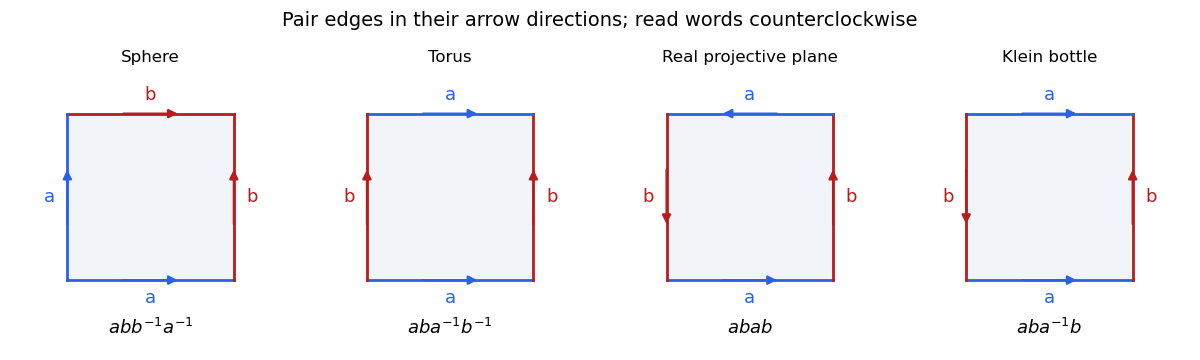
Start with a polygonal disk and pair all its sides, specifying for each pair a homeomorphism matching endpoints. Arrow labels encode whether each occurrence is traversed with or against its assigned direction. Form the quotient topology using those identifications and no extra identifications in the interior. Matched edge interior points have disk neighbourhoods formed from two half-disks; the corner sectors around each identified vertex form a circular link. The quotient is therefore a closed surface. A boundary word records each edge label exactly twice. Its endpoint identifications determine the vertex count, while its signs determine orientability. This encoding is distinct from treating a side-paired polygon as an abstract simplicial complex; a compatible subdivision is needed for a simplicial triangulation.
For a polygonal schema with all its sides paired and two same-direction occurrences of an edge label , the words , , and describe homeomorphic quotient spaces. Here inversion of a string reverses its order and inverts each letter. Cut from the start of the first side to the start of the second, using a diagonal . The pieces have boundary words and . Gluing the old sides gives outside word ; reversing the whole boundary and choosing a new starting point gives . Alternatively cut from the end of the first side to the end of the second. The pieces are and , and gluing their old sides gives , cyclically . Renaming the new paired side gives both asserted forms. These are actual cutting and gluing homeomorphisms, so they preserve all the other side identifications as well as the Euler characteristic.
Given a cyclic-factor subnormal series and , intersect each term with . The induced map is injective. Since every subgroup of a cyclic group is cyclic, the intersection chain is again a cyclic-factor subnormal series, after removing repetitions. Hence is a polycyclic group. In particular, every subgroup is finitely generated.
If a group has a cyclic-factor subnormal series of length , choose one lift of a generator of each nontrivial factor. Induction gives , so the chosen lifts generate . Thus at most generators are needed. Applying this to the intersection chain in subgroups of polycyclic groups are polycyclic bounds the number of generators of every subgroup by the same series length.
Both colour counts tend to infinity almost surely. For example, , and Independent events occur infinitely often by the Borel-Cantelli second lemma, forcing infinitely many blue additions.
The martingale increment formula gives . Conditional orthogonality of later increments and implyOn the squared difference is , so its Conditional probability is at most . Dominated convergence proves zero probability of that endpoint. The symmetric argument for red excludes . No explicit beta law is needed for this proof.
An angular polarimeter associated with Jean-Baptiste Biot, measuring the rotation produced by a sugar solution of known optical path length. The original form used a black-glass polarizing mirror and a calcite analyser; it should not be conflated with a later quartz-wedge compensating instrument.[ref]
A Handbook of Sugar Analysis by Charles Albert Browne Jr.. pp.84–85, Biot polariscope; chapter VI, compensating saccharimeters
For the one-dimensional Sobolev representative with , the fundamental theorem of calculus gives . The Cauchy-Schwarz inequality then gives . Integrating proves the displayed, generally nonoptimal Poincaré inequality. In particular . Only one endpoint must be fixed, which is useful for mixed boundary conditions and for controlling a negative potential.
Albumin is a major plasma protein contributing to transport of bound molecules and to plasma osmotic properties. Its concentration reflects production, distribution and losses. A measured level is therefore not a direct measurement of one nutritional input or one organ function alone.
A coagulation factor participates in the regulated reactions leading to formation of a clot. Different factors have different activation and interaction roles. Their concentration and functional activity are distinct measurements, and coagulation is only one part of haemostasis.
The displayed scalar stress potential automatically satisfies the two in-plane static momentum equations without body force, because the mixed third derivatives cancel. For homogeneous isotropic linear elasticity, strain compatibility further makes biharmonic. Since stresses depend only on second derivatives, is unique only up to on a connected domain. Conversely a function with all second derivatives zero is affine, proving that this is exactly the gauge freedom. It does not license adding an arbitrary biharmonic function, which generally changes stress.
Elastic stress concentration in a pressurized thick cylinder by Codex 0 Created 2026-10-31 Updated 2026-11-05
Codex 0 Created 2026-10-31 Updated 2026-11-05For an isotropic elastic annulus with internal excess pressure and zero outer gauge pressure, radial equilibrium gives . Its stress tensor has and . Enforcing , gives , so the maximum difference occurs at the bore and equals the displayed expression. Once an appropriate yield criterion is reached, stress must be related to elastic strain while total strain includes a plastic contribution. The elastic formula alone cannot describe further irreversible deformation.
A tractrix is a plane curve whose tangent segment from the point of contact to a fixed axis has constant length. For segment length one and a positive acute tangent angle , its height is . The slope relation gives . Integrating yields the displayed axial coordinate up to an additive constant. Conversely these coordinates have the required slope, and their tangent intercept is at distance . Rotating this profile about its axis gives a tractoid.
A transported planar potential dipole follows the surrounding regular velocity, so its position satisfies the displayed equation after its own singular term is removed. The conjugation comes from the convention . Reflected image parameters are held fixed when taking the spatial derivative, then evaluated at the instantaneous dipole position.
For a unit circular wall, the Milne-Thomson circle theorem gives image potential and therefore . For a horizontal straight wall the image is , giving . For the line , reflected conjugation gives image and hence . In each case the image lies outside the fluid region and makes the wall a streamline; differentiation of the regular image proves the motion formula. Several compatible straight-wall reflections can be summed before the same operation is applied.
For the autonomous differential equation , the displayed family stays at until time and then decreases below it. Here . Direct differentiation verifies the equation on each side; since , the derivative tends to zero at departure, making the joined function continuously differentiable. Distinct departure times give different solutions from the same equilibrium initial condition. The ratio is unbounded, so the local Lipschitz continuity hypothesis of the Picard-Lindelöf theorem fails.
A solution starting above reaches it in finite time. It can then use any of these continuations. For , , and initial value , arrival occurs at time two; departure at gives afterwards. Waiting-time solutions of a sublinear Bernoulli equation give a related mechanism for departures in the opposite direction.
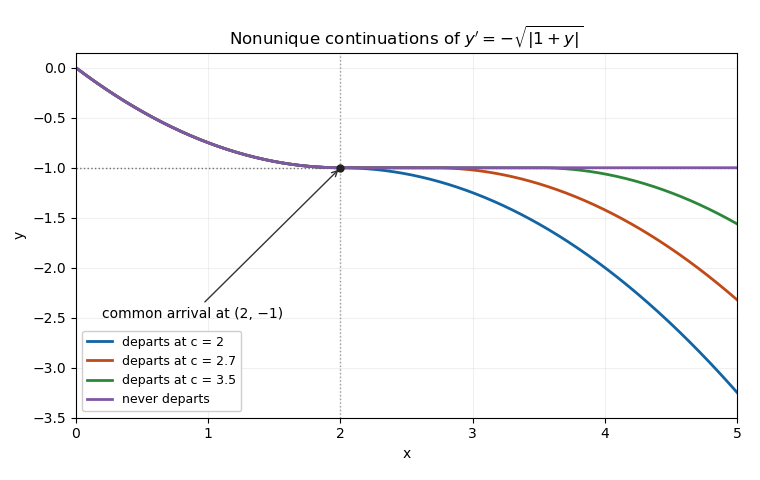
Different waiting-time continuations at a non-Lipschitz equilibrium share the same earlier trajectory
. Details. Suppose is continuous and Lipschitz in its state variable on a closed cylinder , , with bounds and Lipschitz constant . On a smaller interval of radius , the displayed Picard operator maps continuous curves in that closed ball into itself when , and it is a contraction mapping in the supremum norm when . This function space is complete because it is a closed subset of a Banach space of continuous vector-valued functions. The contraction mapping theorem gives a unique fixed point, and the fundamental theorem of calculus makes it a solution of the ordinary differential equation. Choosing also prevents any solution with the same initial data from first exiting the cylinder during that interval.
Pinned article: Introduction to the OurBigBook Project
Welcome to the OurBigBook Project! Our goal is to create the perfect publishing platform for STEM subjects, and get university-level students to write the best free STEM tutorials ever.
Everyone is welcome to create an account and play with the site: ourbigbook.com/go/register. We belive that students themselves can write amazing tutorials, but teachers are welcome too. You can write about anything you want, it doesn't have to be STEM or even educational. Silly test content is very welcome and you won't be penalized in any way. Just keep it legal!
Intro to OurBigBook
. Source. We have two killer features:
- topics: topics group articles by different users with the same title, e.g. here is the topic for the "Fundamental Theorem of Calculus" ourbigbook.com/go/topic/fundamental-theorem-of-calculusArticles of different users are sorted by upvote within each article page. This feature is a bit like:
- a Wikipedia where each user can have their own version of each article
- a Q&A website like Stack Overflow, where multiple people can give their views on a given topic, and the best ones are sorted by upvote. Except you don't need to wait for someone to ask first, and any topic goes, no matter how narrow or broad
This feature makes it possible for readers to find better explanations of any topic created by other writers. And it allows writers to create an explanation in a place that readers might actually find it.
Figure 1. Screenshot of the "Derivative" topic page. View it live at: ourbigbook.com/go/topic/derivativeVideo 2. OurBigBook Web topics demo. Source. - local editing: you can store all your personal knowledge base content locally in a plaintext markup format that can be edited locally and published either:This way you can be sure that even if OurBigBook.com were to go down one day (which we have no plans to do as it is quite cheap to host!), your content will still be perfectly readable as a static site.
- to OurBigBook.com to get awesome multi-user features like topics and likes
- as HTML files to a static website, which you can host yourself for free on many external providers like GitHub Pages, and remain in full control

Figure 2. You can publish local OurBigBook lightweight markup files to either OurBigBook.com or as a static website.
Figure 3. Visual Studio Code extension installation.
Figure 5. . You can also edit articles on the Web editor without installing anything locally. Video 3. Edit locally and publish demo. Source. This shows editing OurBigBook Markup and publishing it using the Visual Studio Code extension. 
- Infinitely deep tables of contents:




All our software is open source and hosted at: github.com/ourbigbook/ourbigbook
Further documentation can be found at: docs.ourbigbook.com
Feel free to reach our to us for any help or suggestions: docs.ourbigbook.com/#contact