The pulse energy shape factor is the dimensionless ratiowhere is laser pulse energy, is background-subtracted peak power and is a stated pulse duration. It belongs to the chosen profile and width convention. Here denotes the power full width at half maximum, the convention explicitly used by the primary source documentation.[ref]
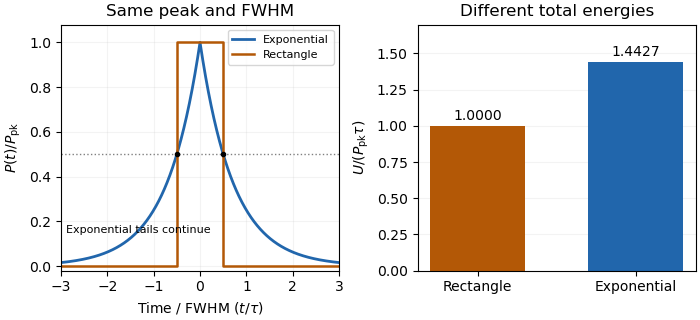
An original counterexample compares a rectangular pulse with a bilateral exponential pulse. Give both the same and power FWHM . The rectangle is nonzero over a width , so and . Forthe half-maximum points are again , but integration of the two tails gives and .
With and , the energies are and . The same measured peak and FWHM therefore leave a 44.3 percent difference in this example. This nonuniqueness of pulse energy at fixed peak power and FWHM is a profile ambiguity, not an instrument-unit conversion.

Articles by others on the same topic
There are currently no matching articles.