Linearize the electron Boltzmann distribution, , about a uniform fixed-ion background. Poisson's equation gives , where the electron Debye length is
Define the plasma parameter as the number of electrons in a Debye sphere:
Some authors omit in this definition. Mobile ions alter the total screening length by contributing their own susceptibility; the electron-only convention is used consistently here.
Use the preceding electron density as the line-of-sight mean, , and . Then
This estimate corresponds to dispersion measure about . A cloud density inferred from absorption need not equal the actual path average, so a real pulsar may differ even at the same distance.
Assume a cold, unmagnetized, weakly collisional plasma, a small fractional bandwidth and . The dispersion relation is , with . The group velocity and propagation time are
The lower frequencies arrive later. Taking the magnitude of the frequency derivative over gives
For a nonuniform line of sight, replace by the dispersion measure . The light travels at the group velocity, not at the phase velocity.
At , and
The ground term has fine-structure levels and , with energy-level degeneracy and . Detailed balance gives . The critical density is therefore
With collisions and spontaneous decay both retained, . A Boltzmann distribution, , requires , not merely equality. For example brings the ratio within about ten per cent of that limit.
Population can move between the levels by electron-impact excitation and de-excitation, spontaneous emission, radiative absorption and stimulated emission. Other collision partners and radiative cascades can matter in a fuller atom. In the elementary coronal approximation, the plasma is dilute, optically thin, steady, and weakly illuminated at the transition frequency. Electron impacts predominantly excite the lower level, while spontaneous emission predominantly empties the upper level; collisional de-excitation and photon trapping are negligible. The population balance is
A key condition is , together with insignificant external pumping and competing channels. A Maxwellian electron Maxwell-Boltzmann distribution lets the tabulated rate coefficient be expressed using one temperature.
Put . With , the heat capacity formula becomes
Taking gives . At half ionization, , so the Saha ionization equation directly gives
This uses as specified in part (a); a different internal-state convention must be carried consistently into the numerical electron density. The original nuclei density is .
At fixed volume, logarithmic differentiation of the Saha ionization equation gives
Differentiation the internal energy then yields
At low temperature and . At high nonrelativistic temperature the gas is fully ionized, , and . The large intermediate excess reflects energy spent increasing ionization, as well as heating and creating additional translational particles. “Very high” here remains below regimes where relativistic, radiative or pair-creation contributions invalidate the model.
One mole of original atoms contains moles of neutral atoms, moles of protons and moles of electrons. All are monatomic translational species, so their combined thermal energy is . Taking the neutral ground state as zero internal energy, ionization stores . Thus
Radiation, excited states and nonideal interactions have been excluded consistently with the elementary Saha ionization equation.
Assume a dilute, nondegenerate, nonrelativistic ideal gas in local thermodynamic equilibrium, with ground-state atomic hydrogen, protons and electrons, and neglect excited atomic levels and interactions. Let the conserved number of hydrogen nuclei per volume be , so and . Equality of chemical potentials for gives the Saha ionization equation
The factor two is electron spin; and must be defined consistently with nuclear spin. The small difference between the atomic and proton translational partition functions has been neglected. Therefore
For the ground-state convention , , the statistical prefactor is one. At fixed volume is constant, whereas an isobaric heating process would not have a constant .
The observed substeps sum to , consistent with three catalytic cycles per revolution of -ATPase. Surface attachment fixes the -subunit frame while the gold-labelled shaft reports relative rotation. A finite dwell before the smaller step indicates hidden chemical transitions rather than a completely smooth motor.
Suppose two irreversible independent first-order transitions, with rates and , must occur sequentially before the step. Their waiting times and have exponential distributions, and . Convolution gives
This probability density integrates to one and has . For equal rates its continuous limit is , not a singular distribution. In particular distinguishes two resolved sequential waits from a single exponential wait. Hydrolysis and product release are plausible underlying chemical events, but the waiting-time fit alone neither assigns their order nor uniquely identifies which biochemical event causes each substep. Concentration dependence or independent labelling would be needed for that assignment.
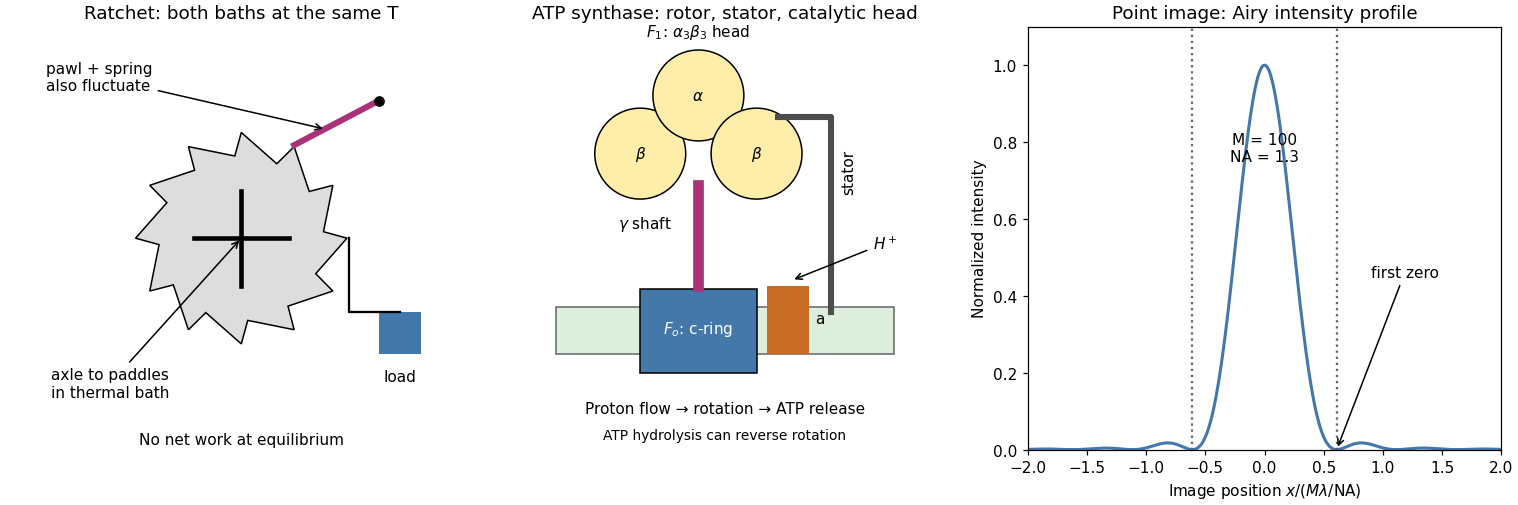
For an ideal circular pupil, the point spread function along a central line is
Here is image-plane position and the central ratio is interpreted by its limit at . The Airy disk has a bright central maximum, a first zero at object-space radius and weaker side lobes. The Rayleigh criterion gives two-source optical resolution . At an illustrative this is in object space or in the image. No unique dimensional width follows without a wavelength. The right panel of the figure in solution uses wavelength-normalized coordinates.
For one isolated emitter of known point spread function, fitting its centre to many detected photons estimates a position far more precisely than the width. For approximately Gaussian width and independent signal photons, the ideal localization standard deviation scales as . Finite pixels, background and read noise, aberrations, uncertain point spread function, drift, bleaching and overlapping emitters worsen this precision. Single-source localization precision is a different task from resolving two unknown nearby sources.
ATP synthase has a membrane-embedded sector, a catalytic head and mechanical connections between them. The sector contains an ion-conducting subunit adjoining a rotating ring of subunits. A central shaft including the subunit connects that ring to . A peripheral stator holds the head fixed relative to the membrane. The head has three catalytic subunits alternating with three subunits, surrounding the asymmetric central shaft; the middle panel of solution labels these relationships.
A transmembrane proton-motive force drives proton movement through offset half-channels and protonation changes around the ring, producing torque. Shaft rotation changes the conformations of the three catalytic sites, cycling their affinities for ADP, inorganic phosphate and ATP. In the binding-change mechanism, mechanical work particularly promotes release of tightly bound ATP; the threefold head couples a full revolution to three catalytic turnovers. The number of protons per revolution depends on the ring stoichiometry. Reversing the available free energy can reverse the motor: isolated hydrolyses ATP and rotates, and the coupled enzyme can pump protons. This structural separation of rotor, stator and catalytic head converts electrochemical free energy into chemical free energy.[ref]
The left panel below shows paddles in a bath connected by an axle to an asymmetric toothed wheel, a spring-loaded pawl and a load. A naive argument lets random paddle kicks turn the wheel in one direction while the pawl blocks reverse motion, apparently extracting work from a single bath. The missing ingredient is the pawl's own thermal fluctuations. At the same temperature, it sometimes lifts and allows reverse slips. Correct forward and reverse transition rates obey detailed balance, so no sustained directed rotation can do work at single-bath thermal equilibrium. The device illustrates, rather than disproves, the Second law of thermodynamics.
A macroscopic shaken ratchet is driven far from thermal equilibrium: imposed shaking supplies organized mechanical energy, and friction or inelastic collisions dissipate it. Its kilogram-scale parts are not moved appreciably by molecular thermal fluctuations. Rectification requires broken spatial symmetry from the teeth or pawl and appropriate dynamical coupling: the shaking must sometimes disengage or drive the pawl over a tooth while contact and dissipation prevent equal reverse motion. The load must remain below the available mean driving torque. Isotropic, aperiodic shaking can satisfy these conditions because the asymmetric mechanism breaks directional symmetry; without the external energy supply, a working rectifier and dissipation, there is no guaranteed directed motion.
Figure 1.
Original schematics of a thermal ratchet, rotary ATP synthase and a diffraction-limited point image
. Details.
Take an overdamped particle with viscous drag coefficient , so its deterministic drift in the harmonic potential is . The one-dimensional Fokker-Planck equation has probability current
At thermal equilibrium, and the Boltzmann distribution is , with . Inserting this into the zero-current condition gives
The result is the Einstein diffusion relation between diffusion and mobility. It assumes a bath at one temperature, linear drag and thermal equilibrium. The same Gaussian probability density gives , providing an independent calibration of trap stiffness.
A high-numerical aperture objective focuses a laser to a steep intensity gradient. For a transparent particle with higher refractive index than its surroundings, refraction transfers photon momentum to the particle, giving a optical gradient force towards the intensity maximum. A forward scattering force pushes along the beam; a stable single-beam optical trap requires the restoring axial optical gradient force to exceed that push. In the small-particle limit, the same result follows from the induced-dipole potential energy, proportional to minus the local squared electric field. Close to the trap centre,
An optical tweezers experiment can attach a bead to one end of a DNA molecule, hold the other end fixed, and obtain its force-extension relation from the bead displacement and calibrated trap stiffness. The measurement must distinguish the restoring force from Brownian motion and account for heating or optical damage.
A valid comparison needs comparable disease stage, risk, systemic treatments and dose prescriptions; otherwise selection bias and confounding can masquerade as treatment benefit. Referral to specialist centres can select younger, wealthier or more complex patients. Randomized controlled trials reduce such biases but can face limited recruitment, patient preference, crossover and lack of clinical equipoise.
Both arms need expert contemporary planning and comparable quality assurance. Centre experience, changing delivery technology and an obsolete comparison arm can distort results. The chosen endpoint must match the proposed benefit: equal tumour control with lower late toxicity may be valuable even without a survival difference. Statistical power, competing mortality, multiple comparisons and long follow-up are crucial for rare late effects, particularly second cancers. Blinding of treatment delivery is difficult, so independent endpoint adjudication and predefined analyses help. Economic analyses must state their perspective and include access and follow-up costs.
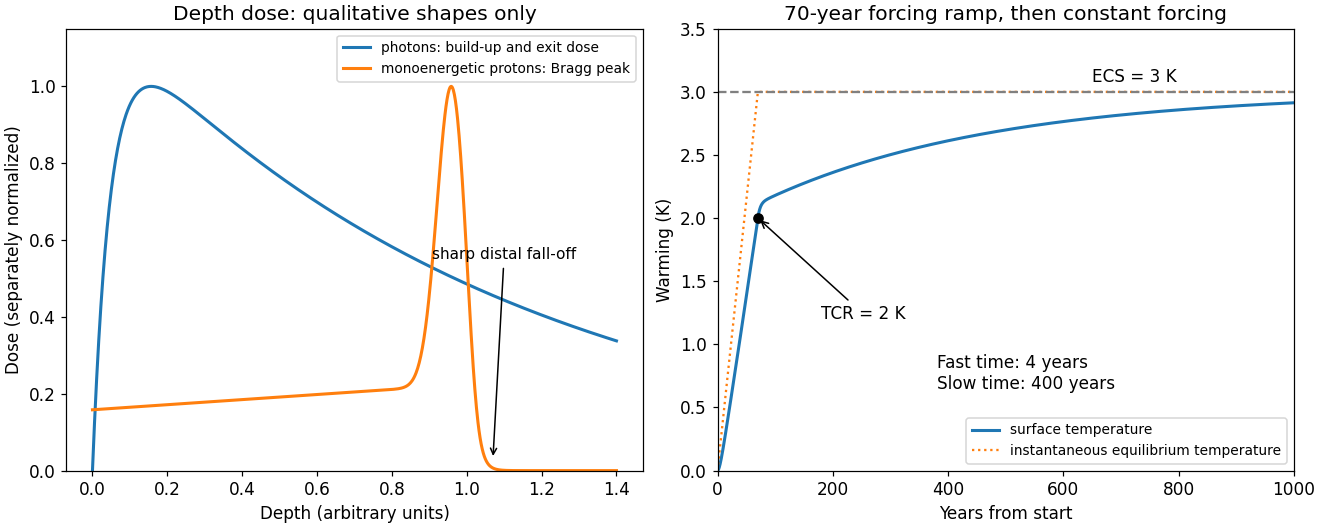
Photon radiotherapy uses indirectly ionizing photons. Their Compton scattering, photoelectric effect and, at higher energy, pair production create charged particles that deposit energy. A megavoltage beam has a dose-build-up region followed by a gradual decline and substantial exit dose. Multiple shaped beams or intensity-modulated radiotherapy distribute this dose around a target.
Proton therapy uses directly ionizing charged particles with a finite particle range and a Bragg peak. Tuning beam energy controls depth and scanning controls lateral delivery; multiple energies cover a finite target thickness. Reduced distal and integral normal-tissue dose is a potential advantage. Limitations include range uncertainty, Multiple Coulomb scattering, nuclear secondary production, motion-dependent delivery, and a variable relative biological effectiveness, particularly near the distal edge. A physical dose advantage must be assessed against target coverage and clinically relevant toxicity; it does not by itself establish superior tumour control.
The dominant factor raises the energy loss as a charged projectile slows, while the logarithm moderates that rise. This produces a Bragg peak close to the end of its particle range. At still lower velocity, changing effective charge, shell effects and nuclear stopping invalidate extrapolation of the elementary Bethe stopping formula to zero energy. A finite initial energy gives a finite continuous-slowing-down range,
A higher initial energy increases the particle range; greater electron density increases stopping power per unit length. Absorber and also affect the depth. Multiple Coulomb scattering, energy-loss straggling, nuclear reactions and the incident energy spread broaden the measured peak and distal fall-off; nuclear secondaries can produce a small tail. Superposing many incident energies makes a spread-out Bragg peak for an extended target. The schematic curve below illustrates shapes only and is not patient radiation dosimetry.
Figure 1.
Qualitative depth-dose curves and a two-timescale climate response; depth is in arbitrary units
. Details.

Pinned article: Introduction to the OurBigBook Project

Welcome to the OurBigBook Project! Our goal is to create the perfect publishing platform for STEM subjects, and get university-level students to write the best free STEM tutorials ever.
Everyone is welcome to create an account and play with the site: ourbigbook.com/go/register. We belive that students themselves can write amazing tutorials, but teachers are welcome too. You can write about anything you want, it doesn't have to be STEM or even educational. Silly test content is very welcome and you won't be penalized in any way. Just keep it legal!
We have two killer features:
  1. topics: topics group articles by different users with the same title, e.g. here is the topic for the "Fundamental Theorem of Calculus" ourbigbook.com/go/topic/fundamental-theorem-of-calculus
    Articles of different users are sorted by upvote within each article page. This feature is a bit like:
    • a Wikipedia where each user can have their own version of each article
    • a Q&A website like Stack Overflow, where multiple people can give their views on a given topic, and the best ones are sorted by upvote. Except you don't need to wait for someone to ask first, and any topic goes, no matter how narrow or broad
    This feature makes it possible for readers to find better explanations of any topic created by other writers. And it allows writers to create an explanation in a place that readers might actually find it.

    Figure 1.
    Screenshot of the "Derivative" topic page
    . View it live at: ourbigbook.com/go/topic/derivative
  2. local editing: you can store all your personal knowledge base content locally in a plaintext markup format that can be edited locally and published either:
    This way you can be sure that even if OurBigBook.com were to go down one day (which we have no plans to do as it is quite cheap to host!), your content will still be perfectly readable as a static site.
    Figure 5. . You can also edit articles on the Web editor without installing anything locally.
    Video 3.
    Edit locally and publish demo
    . Source. This shows editing OurBigBook Markup and publishing it using the Visual Studio Code extension.

  3. https://raw.githubusercontent.com/ourbigbook/ourbigbook-media/master/feature/x/hilbert-space-arrow.png
  4. Infinitely deep tables of contents:
    Figure 6.
    Dynamic article tree with infinitely deep table of contents
    .
    Descendant pages can also show up as toplevel e.g.: ourbigbook.com/cirosantilli/chordate-subclade
All our software is open source and hosted at: github.com/ourbigbook/ourbigbook
Further documentation can be found at: docs.ourbigbook.com
Feel free to reach our to us for any help or suggestions: docs.ourbigbook.com/#contact