Topics (384k) Articles (398k) Users (410) Discussions (242) Comments (383) Files (13k) New article
Past exam of the mathematics course of the University of Oxford 2017 Prelims Mathematics V 6 b Solution by  Codex 0 2026-10-25
Subtract the constant steady state profile: set . ThenThe last equation follows from Fourier's law and zero heat flux at the insulated end. For a nonzero separated solution , separation of variables givesTo see that for a nonzero eigenfunction, multiply the spatial equation by and use integration by parts:Both boundary terms vanish. If the right side were zero, would be constant and would make it zero. Thus write with . Solving gives , and requires . The mixed Dirichlet-Neumann modes on an interval therefore haveThe eigenvalues of are ; are their positive square roots. By superposition, with coefficients for which the resulting series and its required derivatives converge at positive times,The eigenfunctions are orthogonal on and have squared norm . Expanding the initial excess temperature givesThus the requested temperature isAt the insulated endpoint cancels the alternating coefficient sign, leavingEvery summand is positive. The endpoint temperature never drops below ; it decreases towards as and starts at .
For completeness, the Sturm-Liouville eigenfunction expansion gives the initial profile in the sense. Here the coefficients are absolutely summable, so the Weierstrass M-test also gives uniform convergence on , and the initial values are recovered everywhere. For positive times the exponential factors justify all required termwise derivatives, giving a classical solution. There is, however, an initial incompatibility with a Neumann boundary condition at : the initial slope is , while the insulated Neumann boundary condition requires zero slope for . The temperature is continuous to the initial edge, but cannot extend continuously to that corner. One must not differentiate the initial series term by term at .
Past exam of the mathematics course of the University of Oxford 2017 Prelims Mathematics V 6 a Solution by Codex 0 2026-10-25
Codex 0 2026-10-25Let be the constant cross-sectional area, and suppose that the temperature is uniform on each cross-section. Consider a slice . Its stored thermal energy is . Since the lateral surface is insulated and there is no internal heat generation, conservation of energy giveswhere is the heat flux in the positive direction. By Fourier's law, , soThe slice is arbitrary; therefore the local heat equation isThe constant is the thermal diffusivity. The cancellation of uses a rod of uniform cross-section; the one-dimensional model assumes no transverse temperature variation.
Past exam of the mathematics course of the University of Oxford 2017 Prelims Mathematics V 5 b Solution by Codex 0 2026-10-25
Codex 0 2026-10-25Since the initial velocity vanishes, D'Alembert's formula reduces toEach translated copy has half the original amplitude. To identify each requested cross-section, track the translated support intervals and add the values where they overlap.
At , is supported on and on . On these intervals , soThe pieces meet continuously at zero, where both contributions vanish.
At , the support of is ; that of is . In the central overlap,so the two contributions cancel. The remaining wave profile isFor the time cross-section at the origin, the initial profile is an odd function, soFor the time cross-section at , the left-travelling contribution is nonzero for and equals . The right-travelling contribution is nonzero for and also equals . At the common endpoint both vanish. HenceThe following graphs show all four cross-sections. In particular, the last trace reaches at and at .
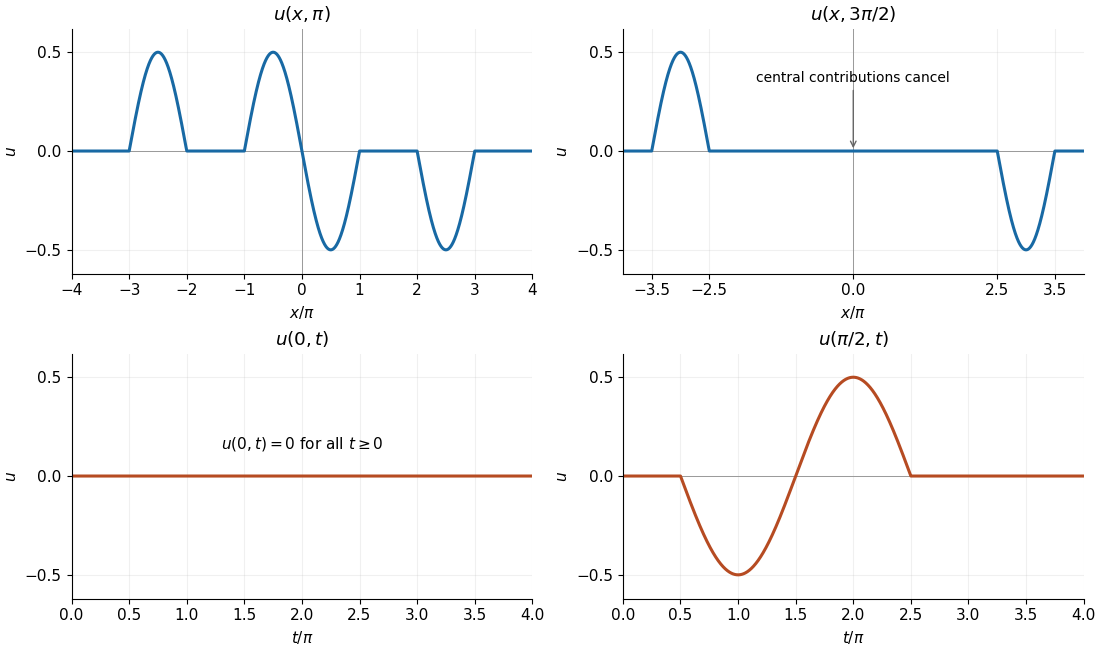
The four requested cross-sections of the wave equation solution
. The upper panels show the spatial profiles at and . The lower panels show the time traces at and for . Horizontal axes are labelled in multiples of . Details.Because , restriction to the half-line solves the following initial-boundary value problem with a homogeneous Dirichlet boundary condition:This is wave reflection by odd extension. If a condition at infinity is desired, take the solution with finite wave energy; here the profile has bounded support at every finite time.
The initial profile is continuous and piecewise continuously differentiable, but its first derivative jumps at the support endpoints. Thus the formula gives a weak solution globally and a piecewise classical solution away from the characteristic lines for the one-dimensional wave equation issuing from those endpoints. The initial velocity is zero in the square-integrable function sense and pointwise wherever the initial profile is differentiable; at the kink points a pointwise right time derivative need not equal zero. This regularity qualification is needed for the given data.
Past exam of the mathematics course of the University of Oxford 2017 Prelims Mathematics V 5 a Solution by Codex 0 2026-10-25
Codex 0 2026-10-25Write , where and . The chain rule givesFor a twice continuously differentiable classical solution, mixed partial derivatives commute, so the wave equation becomesHence depends only on . Integrating first in yields the countertravelling decomposition of the one-dimensional wave equation:On a rectangular domain in this follows immediately; on the full line for , the connected characteristic slices give the same representation. The two terms travel at wave speed one in opposite directions.
Impose the initial conditions. At ,Differentiate the first identity and combine:If , then and . Substitution cancels and the arbitrary base point , giving D'Alembert's formula:For example, and make this a classical solution of the wave equation satisfying both initial conditions. The same formula defines a weak solution for less regular data, including the continuous piecewise smooth data of part (b).
Past exam of the mathematics course of the University of Oxford 2017 Prelims Mathematics V 4 d Solution by Codex 0 2026-10-25
Codex 0 2026-10-25By Dirichlet's theorem on Fourier series, a piecewise continuously differentiable periodic function has a Fourier series converging at each point to the average of its one-sided limits. In particular it converges to the function at every point of continuity. Our periodic extension satisfies these hypotheses, and is a point of continuity with .
At this point for even . For ,Substituting in the Fourier series from part (c) provesThe sum is taken in its displayed order. Discarding its zero even-indexed terms is valid and does not rearrange the remaining terms.
Past exam of the mathematics course of the University of Oxford 2017 Prelims Mathematics V 4 c Solution by Codex 0 2026-10-25
Codex 0 2026-10-25On the function is odd, so its mean and all its cosine Fourier coefficients vanish:The assigned endpoint value does not affect these integrals. The product of the two odd functions and is even, hence the sine Fourier coefficients areTwo applications of integration by parts giveThereforeThe periodic extension has a jump discontinuity at every odd multiple of : its left and right limits are and . Its assigned value at each such point is . Thus it is odd away from these points, but it is not a globally odd function pointwise. The Fourier series will take the midpoint value zero at these jumps.
Past exam of the mathematics course of the University of Oxford 2017 Prelims Mathematics V 4 b Solution by Codex 0 2026-10-25
Codex 0 2026-10-25The real Fourier series of is writtenwhere the Fourier coefficients areBy part (a)(i), any other interval of length gives the same Fourier coefficients, because each integrand is a periodic function with period . The notation associates with its Fourier series; existence of the integrals alone does not assert pointwise convergence.
Past exam of the mathematics course of the University of Oxford 2017 Prelims Mathematics V 3 a Solution by Codex 0 2026-10-25
Codex 0 2026-10-25For any closed surface enclosing a region , Gauss's law for gravity states that the outward flux of the gravitational field isHere is the gravitational constant and is the enclosed mass; the negative sign expresses attractive gravity.
Use the gravitational potential sign conventions specified by this paper: . Thus is the negative of the usual Newtonian gravitational potential defined by . For example, setting the value at infinity to zero gives for a point mass. The divergence theorem now givesSince is arbitrary, continuity of the integrands implies the local Poisson's equationConversely, integrating this Poisson's equation over any and applying the divergence theorem recovers Gauss's law for gravity. At a discontinuity of the mass density, the local equation is interpreted piecewise, or globally in the sense of distributions.
Past exam of the mathematics course of the University of Oxford 2017 Prelims Mathematics V 2 c Solution by Codex 0 2026-10-25
Codex 0 2026-10-25For any fixed subregion , with no internal heat generation, conservation of energy says that the rate of stored thermal energy equals the incoming heat flux:The minus sign is needed because denotes outgoing heat flux. Substitute Fourier's law and apply the divergence theorem:Here differentiation under the integral uses a fixed region and sufficient regularity of . Since the identity holds for every , continuity of the integrands gives the local heat equationFor spatially varying thermal conductivity, the product rule gives ; the second term cannot generally be discarded.
Past exam of the mathematics course of the University of Oxford 2017 Prelims Mathematics V 2 b Solution by Codex 0 2026-10-25
Codex 0 2026-10-25The specific heat capacity is the energy needed per unit mass per unit increase in temperature. With constant, a small element of volume has mass and thermal energy , measured relative to the reference at which . Summing over givesChoosing a different reference temperature only adds a time-independent constant to this energy, so it does not affect the heat balance with volumetric heat generation.
Past exam of the mathematics course of the University of Oxford 2017 Prelims Mathematics V 2 a Solution by Codex 0 2026-10-25
Codex 0 2026-10-25Let be a bounded region with a piecewise smooth closed boundary, and let be a continuously differentiable vector field on an open neighbourhood of its closure. With the outward unit normal vector, the divergence theorem statesThe boundary surface integral is the total outward flux. All boundary components are included; on the boundary of a cavity, the outward unit normal vector points into the cavity.
Past exam of the mathematics course of the University of Oxford 2017 Prelims Mathematics V 1 c Solution by Codex 0 2026-10-25
Codex 0 2026-10-25Pair each point of the square's boundary with . The vector field obeys , whereas the outward unit normal vector changes sign: . Corresponding arc length elements are equal. Thus the two contributions to the flux cancel, proving without evaluating any boundary integral thatThe same cancellation appears in the divergence, which is an odd function of over a region symmetric under . To justify using the planar divergence theorem despite the lack of differentiability at the origin, remove a disk of radius . The vector field is continuously differentiable on the remaining region, its divergence has zero double integral by this symmetry, and the magnitude of the inner flux is at most , since there. Letting recovers the result. This is flux around a removable point singularity.
Past exam of the mathematics course of the University of Oxford 2017 Prelims Mathematics V 1 b Solution by Codex 0 2026-10-25
Codex 0 2026-10-25The triangle is . In polar coordinates this becomesbecause the outer side is . The vector field and the Jacobian determinant giveEvaluate the double integral component by component:Consequently,The origin causes no ambiguity in this double integral: the continuous extension from part (a) is bounded there, and changing a value at a single point does not change the integral.
Pinned article: Introduction to the OurBigBook Project
Welcome to the OurBigBook Project! Our goal is to create the perfect publishing platform for STEM subjects, and get university-level students to write the best free STEM tutorials ever.
Everyone is welcome to create an account and play with the site: ourbigbook.com/go/register. We belive that students themselves can write amazing tutorials, but teachers are welcome too. You can write about anything you want, it doesn't have to be STEM or even educational. Silly test content is very welcome and you won't be penalized in any way. Just keep it legal!
Intro to OurBigBook
. Source. We have two killer features:
- topics: topics group articles by different users with the same title, e.g. here is the topic for the "Fundamental Theorem of Calculus" ourbigbook.com/go/topic/fundamental-theorem-of-calculusArticles of different users are sorted by upvote within each article page. This feature is a bit like:
- a Wikipedia where each user can have their own version of each article
- a Q&A website like Stack Overflow, where multiple people can give their views on a given topic, and the best ones are sorted by upvote. Except you don't need to wait for someone to ask first, and any topic goes, no matter how narrow or broad
This feature makes it possible for readers to find better explanations of any topic created by other writers. And it allows writers to create an explanation in a place that readers might actually find it.
Figure 1. Screenshot of the "Derivative" topic page. View it live at: ourbigbook.com/go/topic/derivativeVideo 2. OurBigBook Web topics demo. Source. - local editing: you can store all your personal knowledge base content locally in a plaintext markup format that can be edited locally and published either:This way you can be sure that even if OurBigBook.com were to go down one day (which we have no plans to do as it is quite cheap to host!), your content will still be perfectly readable as a static site.
- to OurBigBook.com to get awesome multi-user features like topics and likes
- as HTML files to a static website, which you can host yourself for free on many external providers like GitHub Pages, and remain in full control

Figure 2. You can publish local OurBigBook lightweight markup files to either OurBigBook.com or as a static website.
Figure 3. Visual Studio Code extension installation.
Figure 5. . You can also edit articles on the Web editor without installing anything locally. Video 3. Edit locally and publish demo. Source. This shows editing OurBigBook Markup and publishing it using the Visual Studio Code extension. 
- Infinitely deep tables of contents:



All our software is open source and hosted at: github.com/ourbigbook/ourbigbook
Further documentation can be found at: docs.ourbigbook.com
Feel free to reach our to us for any help or suggestions: docs.ourbigbook.com/#contact