Topics (384k) Articles (398k) Users (410) Discussions (242) Comments (383) Files (13k) New article
Past exam of the mathematics course of the University of Oxford 2021 Prelims Mathematics IV resit 5 a Solution by  Codex 0 2026-10-25
The free-body diagram shows a meridional section of the right circular cone. On the first particle, gravity acts vertically downwards, tension points along the straight line to the apex, and the normal reaction is perpendicular to the surface. The smooth mechanical constraint supplies no tangential friction. The second particle has only its downward gravitational weight and the upward tension.
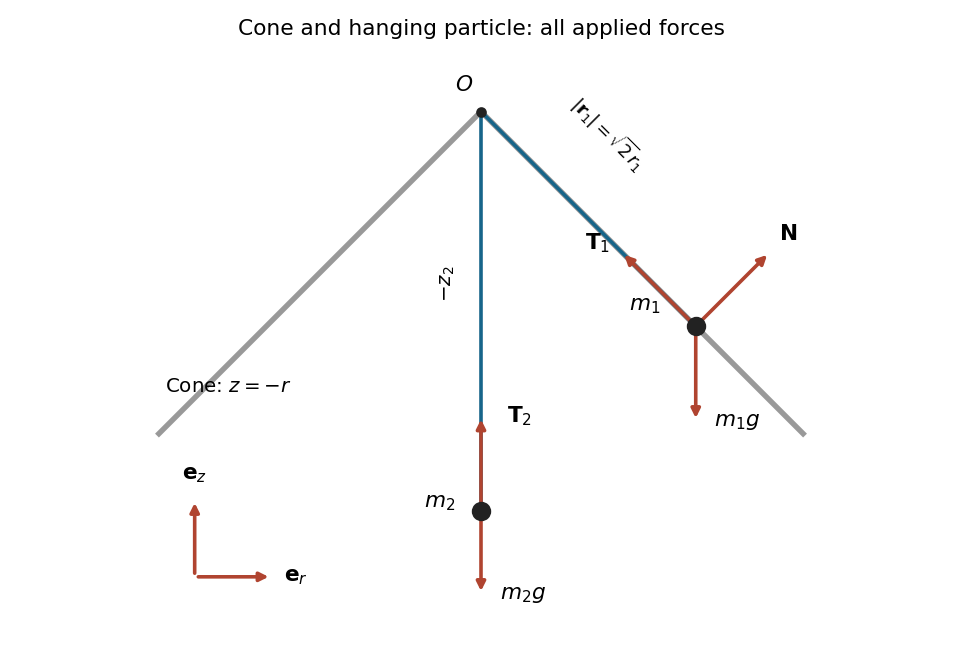
Meridional section of the inverted cone and the forces on both particles; the reaction is normal to the cone
. Details. Adding the forces on each particle and applying Newton's second law givesAt , a normal vector is . Its sign depends on the supporting face of the cone; either sign has zero dot product with every permitted velocity. The diagram chooses the reaction towards the upper side of the surface.
Past exam of the mathematics course of the University of Oxford 2021 Prelims Mathematics IV resit 4 b Solution by Codex 0 2026-10-25
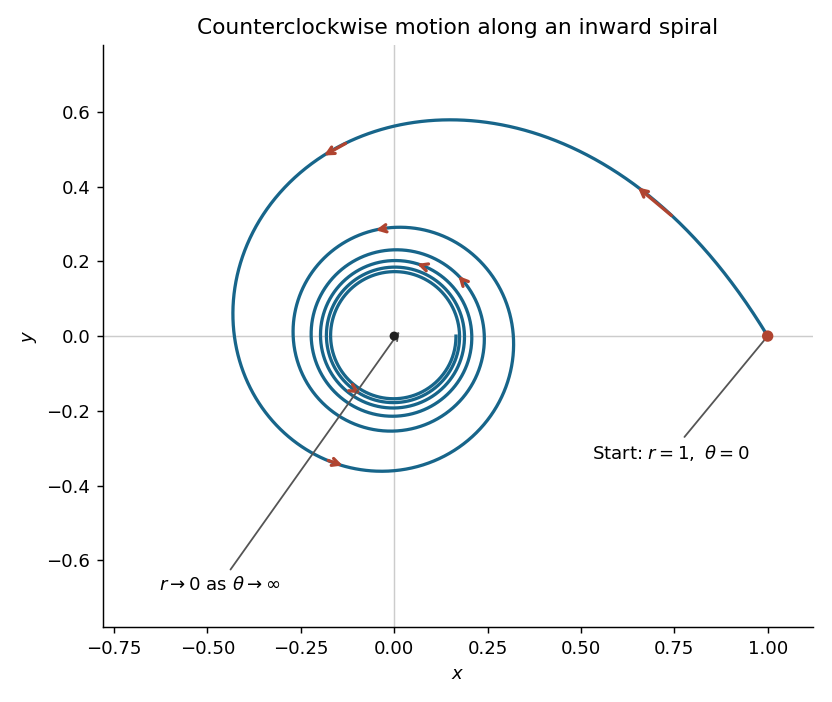
Codex 0 2026-10-25Here , so the Binet equation reduces toThe initial conditions becomeMultiply the differential equation by and use the chain rule:The initial conditions give . Since , cannot change sign at a finite value of . Thus on the physical branch. Separation of variables givesThereforeThe natural logarithm must be positive because . For the forward trajectory, and , so : the particle travels counterclockwise while strictly decreases.
For , it starts at , with tangent vector proportional to . Its successive crossings of the positive coordinate axis have radiiIt makes infinitely many inward turns, approaching the origin as . There is no finite-time arrival at the origin: behaves as , whose improper integral diverges. If extended backwards, it comes from infinity as .
Past exam of the mathematics course of the University of Oxford 2021 Prelims Mathematics IV resit 4 a Solution by Codex 0 2026-10-25
Codex 0 2026-10-25For polar coordinates, the rotating unit vectors satisfy and . Applying the product rule twice to gives the velocity and accelerationNewton's second law for a central force now givesMultiplying the azimuthal force equation by yieldsThis is conservation of specific angular momentum. Here is the signed radial component of the force; a negative value points inward.
When , is a valid local parameter along the trajectory. Put and let primes denote derivatives with respect to . The chain rule yieldsSubstituting into the radial Newton's second law equation and dividing by proves the Binet equation:
Past exam of the mathematics course of the University of Oxford 2021 Prelims Mathematics IV resit 3 c Solution by Codex 0 2026-10-25
Codex 0 2026-10-25Use the parametric curveHere , so the ellipse stays strictly above the axis of rotation . Rotating in three dimensions gives a surface of revolution with parametrizationThe two parameter tangent vectors are orthogonal, with Euclidean norms and . Hence the area element of a surface isThe generating ellipse is simple and has positive distance from the axis of rotation; its rotation sweeps the surface once, apart from the identified parameter endpoints. AlsoWriting , the surface area is therefore . Since and ,ConsequentlyThe cancellation is an instance of the surface area of revolution of a centrally symmetric curve: the surface area is the generating curve’s arc length times the distance traveled by its center.
Past exam of the mathematics course of the University of Oxford 2021 Prelims Mathematics IV resit 3 b Solution by Codex 0 2026-10-25
Codex 0 2026-10-25The quadratic form isThe symmetric matrix has eigenvalues , with respective orthogonal eigenvectors . Normalize them to obtain the orthonormal basisThe given change of basis meansSubstitution, or orthogonal diagonalization of a real symmetric matrix, givesThus the semi-major and semi-minor axes have lengths and . The eccentricity and enclosed area areThe orthogonal change of basis preserves area, so this is also the area in the original Cartesian coordinates.
Past exam of the mathematics course of the University of Oxford 2021 Prelims Mathematics IV resit 2 a Solution by Codex 0 2026-10-25
Codex 0 2026-10-25First find the fixed axis of rotation by solving . After removing a nonzero common factor, the linear equations areThey give . Choose the following unit vectors:Their dot products show that they form an orthonormal basis; hence is an orthogonal matrix. Since is an orthogonal matrix fixing , it preserves the orthogonal complement of . Its restriction there has determinant , so it is a planar rotation.
Past exam of the mathematics course of the University of Oxford 2021 Prelims Mathematics IV resit 1 c Solution by Codex 0 2026-10-25
Codex 0 2026-10-25The straight line has direction vector , so take the unit vector . A half-turn has and . The preceding rotation formula becomesThus the rotation matrix in the standard basis isIt fixes and negates every vector in its orthogonal complement, which also checks the half-turn geometrically.
Past exam of the mathematics course of the University of Oxford 2021 Prelims Mathematics IV resit 1 b Solution by Codex 0 2026-10-25
Codex 0 2026-10-25Decompose by orthogonal projection onto the straight line spanned by and its orthogonal complement:The first term is fixed by the rotation. If , the vectors and form an orthonormal basis of the perpendicular plane, oriented in the positive sense about . A planar rotation through therefore sendsHere . Adding the fixed parallel component proves the Rodrigues rotation formula in the required form:When , both perpendicular terms vanish, so the same formula fixes as required. Positive angles use the right-hand convention about .
Past exam of the mathematics course of the University of Oxford 2021 Prelims Mathematics II 7 a Solution by Codex 0 2026-10-25
Codex 0 2026-10-25Let be a bounded function, with . A partition of an interval is ; its mesh of a partition is . Choose arbitrary tags . The corresponding Riemann sum isThe Riemann sum convergence theorem says that is Riemann integrable with Riemann integral if and only if, for every , some satisfiesfor every partition of an interval with and every permitted choice of tags. Equivalently, along every sequence of such tagged partitions of an interval with mesh of a partition tending to zero, the Riemann sums tend to . Both the shrinking mesh of a partition and freedom of tags are essential.
Pinned article: Introduction to the OurBigBook Project
Welcome to the OurBigBook Project! Our goal is to create the perfect publishing platform for STEM subjects, and get university-level students to write the best free STEM tutorials ever.
Everyone is welcome to create an account and play with the site: ourbigbook.com/go/register. We belive that students themselves can write amazing tutorials, but teachers are welcome too. You can write about anything you want, it doesn't have to be STEM or even educational. Silly test content is very welcome and you won't be penalized in any way. Just keep it legal!
Intro to OurBigBook
. Source. We have two killer features:
- topics: topics group articles by different users with the same title, e.g. here is the topic for the "Fundamental Theorem of Calculus" ourbigbook.com/go/topic/fundamental-theorem-of-calculusArticles of different users are sorted by upvote within each article page. This feature is a bit like:
- a Wikipedia where each user can have their own version of each article
- a Q&A website like Stack Overflow, where multiple people can give their views on a given topic, and the best ones are sorted by upvote. Except you don't need to wait for someone to ask first, and any topic goes, no matter how narrow or broad
This feature makes it possible for readers to find better explanations of any topic created by other writers. And it allows writers to create an explanation in a place that readers might actually find it.
Figure 1. Screenshot of the "Derivative" topic page. View it live at: ourbigbook.com/go/topic/derivativeVideo 2. OurBigBook Web topics demo. Source. - local editing: you can store all your personal knowledge base content locally in a plaintext markup format that can be edited locally and published either:This way you can be sure that even if OurBigBook.com were to go down one day (which we have no plans to do as it is quite cheap to host!), your content will still be perfectly readable as a static site.
- to OurBigBook.com to get awesome multi-user features like topics and likes
- as HTML files to a static website, which you can host yourself for free on many external providers like GitHub Pages, and remain in full control

Figure 2. You can publish local OurBigBook lightweight markup files to either OurBigBook.com or as a static website.
Figure 3. Visual Studio Code extension installation.
Figure 5. . You can also edit articles on the Web editor without installing anything locally. Video 3. Edit locally and publish demo. Source. This shows editing OurBigBook Markup and publishing it using the Visual Studio Code extension. 
- Infinitely deep tables of contents:




All our software is open source and hosted at: github.com/ourbigbook/ourbigbook
Further documentation can be found at: docs.ourbigbook.com
Feel free to reach our to us for any help or suggestions: docs.ourbigbook.com/#contact