Topics (384k) Articles (398k) Users (410) Discussions (242) Comments (383) Files (13k) New article

An etalon round-trip phase is the phase accumulated by a circulating optical field after one complete internal round trip, relative to its earlier passage. At normal incidence through a uniform plate of thickness ,where the last terms are the phases of the two internal amplitude-reflection coefficients. Propagation and reflection both contribute; a coating phase is not automatically zero.
The resonance condition follows from a field sum. If , with , successive transmitted paths contain factors . Their geometric series has denominator . Its squared magnitude containsFor slowly varying amplitudes, transmission peaks occur near . The primary manufacturer tutorial describes the resulting etalon transmission peaks and distinguishes their spacing from their width.[ref]
A constant phase offset shifts resonance positions without changing the local slope. In an original model with constant round-trip delay , adding reflection phase shifts a given resonance by approximately . The free spectral range remains in this constant-slope model.
Frequency-dependent phase has a different effect. Differentiating with respect to angular frequency givesThe last two terms form an etalon coating group delay. A stipulated propagation contribution plus coating contribution gives local resonance spacing about , rather than 50 GHz. These are illustrative phase functions, not measured coating specifications.
Use a continuous branch of wave phase when differentiating: jumps of in a wrapped display are not physical delay spikes. The etalon delay inferred from free spectral range article derives the interval relation between phase slope and adjacent resonances. Finite pulse bandwidth, angular spread and frequency-dependent reflection amplitudes determine how closely the simple resonance model describes an actual optical pulse.
The name Golay code refers to closely related exceptional linear codes. The binary Golay code has parameters : length twenty-three, dimension twelve over , and minimum distance seven. Adding an overall parity coordinate gives the extended binary Golay code . There is also a ternary code, whose extension has parameters ; specifying the alphabet and extension avoids ambiguity.[ref]
Golay codes in the Error Correction Zoo. Binary and ternary Golay code entries, parameters and perfect-code properties
The binary length-twenty-three code corrects three errors. A radius-three Hamming ball contains words. Its disjoint decoding balls therefore cover all received words exactly: this is a perfect code. The extended code has a larger minimum distance, but its radius-three balls do not fill the entire larger word space. These arithmetic properties explain why the codes are useful beyond their historical names.
The radial radiant-energy density of a Gaussian beam gives energy per increment of radius, rather than per unit surface area. For local radiant exposure and encircled radiant energy of a Gaussian beam ,Its units are , while has units . The primary Gaussian profile uses as the irradiance radius.[ref]
For an original narrow-annulus comparison, take and . The central disk from zero to receives about . The annulus from to receives about . Both span the same radial width, but the outer annulus has much more area. Equal radial width is not equal receiving area.
The shell density is maximal at and vanishes at , despite the local exposure being largest on axis. Dividing by gives a probability density function over nonnegative radius: it is a Rayleigh distribution with scale . This is an energy-weighted mathematical representation, not an additional photon-counting assumption. Differences between successive centred-aperture energy measurements estimate shell energies; dividing by their radial separation approximates when that separation is sufficiently small.
The area-equivalent lumen diameter is the diameter of a circle having the same area as a measured lumen. For positive area ,It converts an area observation into a length scale without asserting that the actual lumen is circular. The definition applies to an irregular outline as well as to an ideal geometric shape.
For an ellipse with full principal diameters , area is , soAn original ellipse with diameters and has area and area-equivalent diameter . The arithmetic mean of its two diameters is , which would define a circle of larger area.
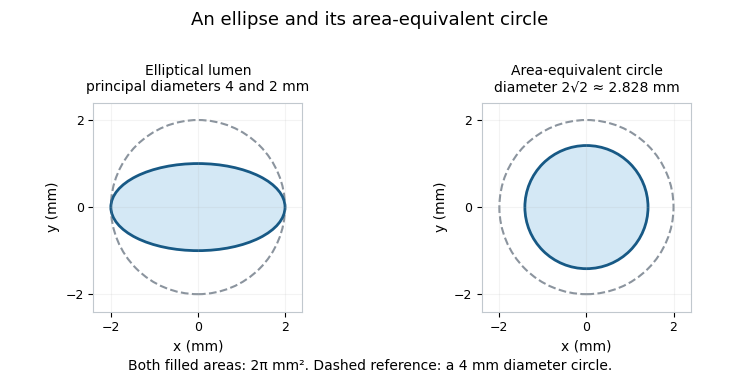
Using an equivalent diameter in a circular area-ratio formula is valid by construction:Using an arbitrary single projected width instead is not. Eccentric lumen stenosis can show different widths in different views while retaining the same area. Primary selective coronary arteriography used serial and cine recording to observe the contrast-filled arterial route; interpreting such images still requires the chosen projection and reconstruction model.[ref]
Selective Coronary Arteriography: Part I: A Percutaneous Transfemoral Technic by Melvin P. Judkins. Material and Technic, serial/cine recording
The equivalent diameter also differs from hydraulic diameter, , which includes wetted perimeter . Two equal-area outlines can have different perimeters and flow resistance. An area-equivalent circle is therefore not automatically an equivalent flow model.
For small area uncertainty, differentiation gives . A relative standard uncertainty in area gives approximately in the derived diameter if other inputs are fixed. This propagates area uncertainty; it does not correct an incorrectly segmented outline or a mismatched reference region.
Unwinding a failed character-device registration releases resources acquired before an initialization failure while preserving the lifetime of anything that concurrent users can still access. In Linux, reserving device numbers, publishing the character-device object and creating userspace-visible names are distinct steps. The cleanup path must know which steps actually succeeded.
Consider an original abstract initialization sequence: reserve a number range, initialize a character-device object, publish it, then finish a later setup step. The following table tracks successful acquisitions; it is not a complete driver implementation.
| State reached | Range reserved? | Character device live? | Required response to a later failure |
|---|---|---|---|
| Before reservation succeeds | No | No | Do not release a range that was not acquired. |
| Reservation succeeded, publication not reached | Yes | No | Release that reserved range and other private resources already acquired. |
| Publication succeeded | Yes | Yes | Stop new access, unwind the reservation, and preserve storage needed by existing users. |
alloc_chrdev_region reserves a range and reports failure through its return value. cdev_init initializes the object with its operations; cdev_add publishes it and makes it live immediately. unregister_chrdev_region releases a successful number reservation. Pair each release with the acquisition that actually succeeded, using the same first number and count.[ref]Character-device number registration in the Linux kernel documentation. Char devices, alloc_chrdev_region, cdev_init, cdev_add and unregister_chrdev_region
For a concrete bookkeeping example, suppose a successful reservation contains four interfaces starting at returned pair . Failure before publication requires releasing that four-number range. Releasing only three leaves part of the reservation behind; releasing a guessed starting major or an unacquired range is a different error. The returned major from dynamic character-device number allocation must be retained rather than reconstructed from a pathname.
Publication changes the lifetime problem.
cdev_del prevents new opens, but existing open file descriptors can still invoke their file operations. Therefore removing the device from lookup is not a proof that its backing state can immediately be freed. Character-device lifetime after deletion must account for the references and callbacks already in progress.[ref]Character-device number registration in the Linux kernel documentation. Char devices, cdev_del lifetime note
The combined
cdev_device_add helper has an especially important failure contract: callers must assume userspace could open the device and call operations even if the helper returns failure. A blanket error handler that immediately frees all backing state would violate that contract.[ref]Character-device number registration in the Linux kernel documentation. Char devices, cdev_device_add note
Design ownership and reference handling around the documented publication boundary, then release each owned resource once. The general lesson is that reverse acquisition order must be combined with concurrency-aware lifetime management.The dual projective plane of for a three-dimensional vector space is . A nonzero linear functional defines a line in the original plane, and scalar multiples define the same line. Thus points of the dual plane parametrize lines of the original plane.
In coordinates, the original line corresponds to the dual point . The incidence equation is symmetric between a point coordinate triple and a line coefficient triple. For example, all original lines through have , and their dual points form a line in the dual plane.
Projective duality interchanges collinear original points with concurrent dual lines and vice versa. An identification of the plane with its dual needs additional data, such as a nondegenerate bilinear form; the canonical construction is the dual space, not a preferred coordinate identification.
For a real dual pair and , the polar set isThe same absolute-value definition applies to a complex pairing. It collects the linear measurements uniformly bounded by one on . Reversing the roles of defines the bipolar.
A polar is convex, balanced and closed in the topology of pointwise convergence on , since it is an intersection of inverse images of closed scalar unit disks under linear evaluations. Inclusion reverses: implies .
In with the usual dot pairing, the polar of is , because the maximum of on that square is . In a normed space paired with its continuous dual, the polar of the primal closed unit ball is exactly the dual closed unit ball by the definition of the operator norm.
Wake-plane dependence of a downwash measurement means that a measured downward velocity depends on where the observation plane lies relative to the lifting wing and its evolving wake. The induced velocity entering a wing-section force calculation is not generally equal to a downstream probe reading. Classical lifting-line theory explicitly adjusts local incidence using the induced flow at the lifting line, under assumptions such as steady flow, incompressible flow and a nearly planar high-aspect-ratio wing.[ref]
Prandtl's Lifting Line Introduction (16.100) by MIT OpenCourseWare. printed pp. 1–3, assumptions, induced angle and circulation equation
An original straight-filament model isolates one reason for the difference. Consider a vortex filament of circulation magnitude starting at streamwise coordinate zero and extending downstream forever. At a point with streamwise coordinate and perpendicular distance , its induced azimuthal speed isThe integral follows by differentiating . At , only one half of the corresponding infinite straight filament contributes; far downstream, the local filament extends far in both axial directions relative to .
For two straight trailing filaments at transverse positions with opposite circulation signs chosen to induce downward flow between them, their midpoint contributions add:With stipulated and , this trailing-filament contribution is at , at , and approaches . This is an idealized geometry calculation, not a measured wake or a universal factor-of-two correction for every wing.
The model omits finite vortex cores, the bound-vortex contribution away from the lifting line, the complete distributed vortex sheet, wake deformation and wake contraction in a downwash survey. Each can change the spatial transfer. In particular, a wing-plane value and a far-wake value must be connected using the same load and wake model before using one to infer the other.
In the small-angle lifting-line model, the wing-plane induced-drag calculation weights downwash by the circulation or local lift. Its source derivation integrates the local induced contribution along the wing.[ref]
Force Calculations for Lifting Line (16.100) by MIT OpenCourseWare. printed pp. 1–2, local lift, induced angle and induced-drag integration
Substituting an arbitrary downstream speed into that expression can misestimate drag even if the speed measurement itself is accurate.A proposed survey measures velocity components at several downstream stations with the same probe calibration and freestream reference, covering both vortex cores and the intervening region. Record the wing loading, probe orientation and cross-plane coordinates, and track how vortex separation and circulation estimates change. A centerline reading alone does not recover the whole momentum field. Matching an axial trend tests the proposed transfer model only over the surveyed region; it does not establish that a rolled-up real wake remains a pair of straight mathematical filaments.
Incongruent dissolution occurs when a solid releases its constituents into solution in proportions different from its bulk stoichiometry. Preferential release of one constituent, or dissolution accompanied by formation of a secondary solid, can both produce this behaviour.
For a nominal solid , congruent release would give dissolved amounts in the ratio if no other sinks intervene. An outlet ratio different from therefore motivates checking for selective leaching, precipitation, adsorption and surface alteration. It does not alone prove which step controls the rate. Distinguishing these processes matters when using a single-pass flow-through leach test to infer long-term durability from measured solution concentrations.
A separation layer is a specialized layer of cells at a controlled opening site in a plant. In the Arabidopsis thaliana fruit, the separation layer lies at the margin between the valves and central replum, within the dehiscence zone. Loss of adhesion between its cells allows the valves to detach during fruit dehiscence. The adjacent layer reinforced with lignin has a different mechanical role; the separation layer is not the whole dehiscence zone.[ref]
An INDEHISCENT-Controlled Auxin Response Specifies the Separation Layer in Early Arabidopsis Fruit by Kasper van Gelderen and others. Introduction, p. 857; valve-margin anatomy and cell separation
A useful developmental experiment compares normal fruits with mutants of the INDEHISCENT regulatory gene. A 2016 study found an early defect in the cell divisions that normally establish the dehiscence zone, alongside altered auxin response. Tissue-targeted changes in auxin transport also prevented normal opening.[ref]
An INDEHISCENT-Controlled Auxin Response Specifies the Separation Layer in Early Arabidopsis Fruit by Kasper van Gelderen and others. Abstract; ind-mutant early cell-division defect and transport perturbations during stages 14–16
The experiment connects local cell identity and hormone response to a later mechanical outcome.Timing matters. An early auxin response and a later local auxin minimum describe different developmental stages, not contradictory recipes for one unchanging tissue. Similarly, an accidental tear can release seeds without establishing that a normal separation layer formed. Comparing local anatomy, developmental stage and the eventual opening site distinguishes a specified release layer from simple damage.
A drift residual after current-source swapping remains when the current ratio changes between the two source assignments. The geometric mean cancellation in current-source swapping in a resistance ratio measurement is exact for a fixed multiplicative mismatch; it does not make a time-varying mismatch constant.
Let the true resistance ratio remain fixed. At the two acquisition times , write . With opposite source assignments,For , the logarithmic error is . A full-interval bound therefore givesFor an original example, a logarithmic source-ratio drift of over a acquisition separation produces . This is a underestimate for that drift direction. Shortening the separation reduces this particular residual, provided both readings still follow electrical settling.
A useful original logarithmic variant of an ABBA measurement sequence uses source-assignment signs at equally spaced times . The four readings obey . Combining them as givesBoth the constant and linear logarithmic drift terms cancel because the signed time sums vanish. Unequal timing, nonlinear drift and a changing sensor resistance can leave residuals. If itself varies, the combination includes its geometric average over the acquisitions rather than automatically recovering a single-time value.
The primary RTD guide establishes source interchange in its three-wire circuit; its topology-specific arithmetic averaging is distinct from the separate-branch logarithmic model above.[ref]
A Basic Guide to RTD Measurements by Joseph Wu. §1.4.2, printed p. 6, Figure 1-6 and equations (9)–(12)
A proposed bench test imposes a slow controlled source-ratio variation, timestamps the readings, and compares a two-reading swap with the balanced four-reading sequence while using stable sensing resistors.A current-sign certificate from sensor delay is a bound proving that load electric current keeps one specified sign throughout a future switching interval, despite measurement error and the age of the reading. It supplies a condition under which a direction-dependent correction in current-polarity dead-time compensation can use its assumed current path. Manufacturer switching diagrams show why current direction matters: inductive current can continue through body diodes during nonoverlap.[ref]
Suppose a sensor reports for sampling time , with . The command begins at and the affected interval ends at . Assume throughout . Integrating the derivative bound givesThus certifies positive current throughout the interval; certifies negative current. The strict inequalities exclude a possible zero at the limiting time. A failed certificate does not prove a sign change; it means the stated information does not rule one out.
For an original numerical example, let , , sample age and . Then . A reading has a certified minimum of . If the sample could be another older because of timestamp uncertainty, use that oldest possible time: the bound becomes . Ignoring acquisition-to-controller delay would overstate the available margin.
A current-sign certificate for an averaged sensor sample must model the averaging aperture too. Suppose the sensor returns the uniform average over , plus error at most . For a future time ,The interval certificate therefore uses . With and the preceding delay and switching interval measured from , . The same reading is no longer sufficient. The half-aperture term is justified here by a uniform averaging model; a different filter needs its own response model.
The slew bound must apply during switching, not only to the slow visible current envelope. For an ideal inductor of inductance , , so an independently justified bound on its terminal electric potential difference gives . A smaller slope measured in a quiet part of the cycle need not bound a subsequent rail-clamped interval.
Several consistent measurements can be combined. If each provides an enclosure of the current over the entire target interval, intersect those enclosures. For example, and imply the tighter , certifying positive current. An empty intersection flags inconsistent measurements or assumptions; it is not an especially strong certificate.
A proposed bench validation timestamps the sensing aperture, controller decision and actual gate transitions, while an independent current record checks the asserted error and derivative bounds. Repeat near current zeros and across the intended load range. This distinguishes a deterministic enclosure from a standard uncertainty or confidence interval and tests the complete timing chain needed by current-sign uncertainty in dead-time compensation.
CSS scroll padding defines inward offsets from a CSS scrollport to establish an optimal viewing region. In a snap container that region is the CSS snapport, used to align CSS scroll snap areas. The
scroll-padding shorthand sets its sides, while individual longhands can control one side.[ref]CSS Scroll Snap Module Level 1 by World Wide Web Consortium. §4.2, scroll-padding and optimal viewing region
For an own example, take a -by- CSS pixel scrollport and set
scroll-padding: 10%;. Percentages resolve against the corresponding scrollport dimension: left and right are pixels each, top and bottom each. In physical coordinates the optimal region iswith dimensions by . The declaration gives the same percentage on each side, not the same absolute number of pixels.[ref]An explicit
scroll-padding-top: 50px can reserve room in the preferred viewing region when an overlay obscures the top of a scrolling panel. This does not itself create the overlay or change the content's normal layout. It tells scrolling operations where a useful visible alignment should lie.The initial value
auto leaves the offset to the user agent. The pinned specification says it should generally resolve to zero, while allowing heuristics that choose a nonzero value in appropriate cases. Code that needs the example's explicit geometry should therefore state its offsets instead of silently treating every automatic value as zero.[ref]CSS Scroll Snap Module Level 1 by World Wide Web Consortium. §4.2, auto and heuristic example
These offsets do not clip the excluded strip, resize the scrollport, change the CSS scroll origin or redefine the CSS initial scroll position. They affect the optimal region for operations such as targeting, focusing and paging; the property applies to scroll containers even when they are not snap containers.[ref]
CSS Scroll Snap Module Level 1 by World Wide Web Consortium. §4.2, applicability and effects on scrolling versus layout/visibility
CSS scroll margin describes outsets on the target side, whereas CSS scroll padding describes insets on the container side. Using both requires aligning the resulting two regions rather than adding ordinary box-model padding to the element and assuming it has the same effect.
CSS scroll margin supplies outsets around an element's transformed border bounds to define its CSS scroll snap area. The
scroll-margin shorthand assigns top, right, bottom and left values using the usual one-to-four-value ordering. In the pinned specification these values are lengths, rather than percentages.[ref]CSS Scroll Snap Module Level 1 by World Wide Web Consortium. §5.1, scroll-margin syntax, ordering and area construction
For an own example, let an untransformed CSS border box occupy in content coordinates measured in CSS pixels. Set
scroll-margin: 20px 10px;. The first value applies at top and bottom, and the second at left and right, giving the snap areaThe box itself is still by pixels; the alignment region is by .Suppose a reachable horizontal start alignment should place this area's left edge at coordinate within the CSS snapport. With a left-to-right horizontal convention, the candidate offset satisfies , giving . Without the left outset, it would instead be . The extra target-side room changes the alignment computation without changing where the border is laid out in the content.
The construction uses the axis-aligned bounding box of the transformed border box before adding the outsets. A rotated CSS transform can therefore affect the base rectangle, even though the resulting snap area remains rectangular in the scroll container's coordinates.[ref]
CSS Scroll Snap Module Level 1 by World Wide Web Consortium. §5.1, transformed bounds and axis alignment
CSS scroll margin and ordinary layout margins serve different purposes. The former does not assign this extra space between neighboring elements in normal layout. It is also distinct from CSS scroll padding, which adjusts the viewing/alignment region on the container side.
The CSS scroll origin is the anchor coordinate from which a CSS scroll container's scrollable overflow rectangle expands. Unless another rule specifies otherwise, the anchor is its block-start/inline-start corner. These are logical directions determined by the layout, so the origin need not be a physical upper-left corner.[ref]
CSS Overflow Module Level 3 by World Wide Web Consortium. §2.3, scroll origin and default block-start/inline-start anchor
Consider a -by- CSS pixel content rectangle viewed through a -by- CSS scrollport. Give the diagram physical coordinates increasing rightward and downward from the rectangle's top-left corner. Ignore transforms and scrollbar-size effects. In ordinary horizontal flow with inline-start on the left, aligning the origin with the corresponding scrollport corner exposesWith inline-start on the right and block-start still at the top, origin alignment instead exposesBoth views are at their respective scroll origin. The left edge of the second view has diagram coordinate ; this does not imply an API scroll offset of .
A CSS writing mode helps determine which physical edges correspond to the logical starts. Other layout rules can supply different anchor conventions: the overflow draft gives a flex-container example using main-start/cross-start. The corner rule should therefore be read with its explicit exceptions, rather than imposed on every possible layout.[ref]
CSS Overflow Module Level 3 by World Wide Web Consortium. §2.3, flex-container origin example and writing-mode dependence
The CSS initial scroll position is another distinction. It usually agrees with origin alignment, but CSS scroll snapping can make the initial view differ. Returning to an origin and restoring an initial view are consequently not necessarily the same operation.[ref]
CSS Overflow Module Level 3 by World Wide Web Consortium. §2.3, scroll-origin position versus initial scroll position and snapping example
Numerical API offsets need their own conventions. The pinned overflow draft explicitly leaves the coordinate system for offsets unresolved, while CSSOM View Module by World Wide Web Consortium defines element scrolling operations and members such as
scrollLeft. Interpret the CSS scroll origin geometrically first, then apply the particular interface's coordinate rules to compute a CSS scroll position.[ref][ref]A crystal lattice records the translation symmetry of a periodic crystal. With a primitive basis of three linearly independent lattice vectors , its translation vectors formThe crystal structure additionally specifies the arrangement of atoms associated with each lattice point. A lattice point is therefore a symmetry marker, not necessarily one atom.[ref]
Matrices, Mappings and Crystallographic Symmetry by Hans Wondratschek. Section 1.5, Definition D 1.5.2 and primitive bases
For example, a one-dimensional chain with alternating species at spacing has translation period , not : shifting by exchanges distinct species. It can be described by lattice with a two-atom basis at offsets zero and . In a diffraction measurement, the translation lattice selects possible reciprocal-space peak positions, while the atomic basis affects their intensities and systematic absences. This distinction lets diffraction reveal internal structure rather than just the visible shape of the specimen.
Pinned article: Introduction to the OurBigBook Project
Welcome to the OurBigBook Project! Our goal is to create the perfect publishing platform for STEM subjects, and get university-level students to write the best free STEM tutorials ever.
Everyone is welcome to create an account and play with the site: ourbigbook.com/go/register. We belive that students themselves can write amazing tutorials, but teachers are welcome too. You can write about anything you want, it doesn't have to be STEM or even educational. Silly test content is very welcome and you won't be penalized in any way. Just keep it legal!
Intro to OurBigBook
. Source. We have two killer features:
- topics: topics group articles by different users with the same title, e.g. here is the topic for the "Fundamental Theorem of Calculus" ourbigbook.com/go/topic/fundamental-theorem-of-calculusArticles of different users are sorted by upvote within each article page. This feature is a bit like:
- a Wikipedia where each user can have their own version of each article
- a Q&A website like Stack Overflow, where multiple people can give their views on a given topic, and the best ones are sorted by upvote. Except you don't need to wait for someone to ask first, and any topic goes, no matter how narrow or broad
This feature makes it possible for readers to find better explanations of any topic created by other writers. And it allows writers to create an explanation in a place that readers might actually find it.
Figure 1. Screenshot of the "Derivative" topic page. View it live at: ourbigbook.com/go/topic/derivativeVideo 2. OurBigBook Web topics demo. Source. - local editing: you can store all your personal knowledge base content locally in a plaintext markup format that can be edited locally and published either:This way you can be sure that even if OurBigBook.com were to go down one day (which we have no plans to do as it is quite cheap to host!), your content will still be perfectly readable as a static site.
- to OurBigBook.com to get awesome multi-user features like topics and likes
- as HTML files to a static website, which you can host yourself for free on many external providers like GitHub Pages, and remain in full control

Figure 2. You can publish local OurBigBook lightweight markup files to either OurBigBook.com or as a static website.
Figure 3. Visual Studio Code extension installation.
Figure 5. . You can also edit articles on the Web editor without installing anything locally. Video 3. Edit locally and publish demo. Source. This shows editing OurBigBook Markup and publishing it using the Visual Studio Code extension. 
- Infinitely deep tables of contents:



All our software is open source and hosted at: github.com/ourbigbook/ourbigbook
Further documentation can be found at: docs.ourbigbook.com
Feel free to reach our to us for any help or suggestions: docs.ourbigbook.com/#contact