Topics (384k) Articles (398k) Users (410) Discussions (242) Comments (383) Files (13k) New article

Thomas S. Richardson develops graphical approaches to causal inference and statistical models, including ways to reason when some variables are hidden. His institutional research description lists graphical models, model selection, Bayesian inference and causal models.[ref]
He is a coauthor of Nested Markov Properties for Acyclic Directed Mixed Graphs by Thomas S. Richardson and others. The work represents observable constraints of hidden-variable directed graphs using a nested Markov model. Its motivation is that eliminating a hidden cause can leave more than ordinary conditional independence restrictions among the measured variables.[ref]
Nested Markov Properties for Acyclic Directed Mixed Graphs by Thomas S. Richardson and others. Introduction and characterization of marginal hidden-variable models
For example, a hidden common cause of two observed variables can be represented by a bidirected edge in a latent projection. The graph records a possible dependence source without pretending that the common cause itself was measured. Such representations separate what observations constrain from what remains unidentifiable.
Roman Vershynin studies high-dimensional probability theory and its applications to data. His High-Dimensional Probability by Roman Vershynin develops tools including concentration inequalities, random-matrix estimates and generic chaining, which turn geometry and independence into bounds that hold simultaneously over many directions.[ref]
High-Dimensional Probability by Roman Vershynin. First edition, random matrices and Chapter 8, chaining
A representative question is how many random observations are needed to preserve information about a high-dimensional object. Controlling one fixed direction is easier than controlling every direction at once, so the geometry of a whole family of directions becomes part of the probability calculation. His research page describes this connection between probability and mathematical data science; his author-hosted expository work also treats geometric methods for constrained estimation.[ref][ref]
https://arxiv.org/abs/1405.5103. Author's Estimation in high dimensions: a geometric perspective, abstract

Yaiza Canzani works in spectral geometry, studying how the geometry of a space controls eigenfunctions and eigenvalues of its Laplace operator. Her research account includes bounds for eigenfunction concentration, averages over submanifolds and spectral counting remainders.[ref]
https://canzani.web.unc.edu/research/. Publications and research topics
Her Analysis on Manifolds via the Laplacian by Yaiza Canzani develops the geometry behind this spectral language. On a circle, for example, the modes , and have nonnegative Laplace eigenvalues and . Their oscillation scale grows with , making the link between shape, frequency and eigenvalue tangible. On a general Riemannian manifold, the corresponding questions concern how waves concentrate and how geometry changes their allowed modes.[ref]
Analysis on Manifolds via the Laplacian by Yaiza Canzani. Eigenfunction examples and variational characterization of the spectrum

Gunther Uhlmann studies inverse problems, imaging and partial differential equations. His research asks how measurements made outside an inaccessible region constrain its internal coefficients or geometry. His institutional research account identifies applications to medical imaging and the structure of Earth.[ref]
With Leonid Pestov, he proved a two-dimensional boundary rigidity theorem: for a compact simple Riemannian manifold, boundary distances recover the metric up to a boundary-fixing diffeomorphism. The qualification prevents confusing a recoverable physical geometry with a unique coordinate description.[ref]
This gives a precise version of the imaging question “can travel times reveal the interior?” It also explains why assumptions about ray geometry matter: if measurements never probe a hidden region, changing that region need not change the data.

Gunther Uhlmann, portrait identified on his University of Washington page
. Leonid Pestov is a mathematician associated with inverse problems for waves and geometry. With Gunther Uhlmann, he proved boundary rigidity for compact simple two-dimensional Riemannian manifolds: boundary-to-boundary distances determine the interior metric up to a change of coordinates fixing the boundary.[ref]
The ambiguity is physical as well as mathematical. Relabeling interior points does not change the travel time between labeled boundary points, so no reconstruction using only those times can distinguish the relabeling. The theorem shows that, under its geometric assumptions, this is the entire ambiguity. Pestov's institutional lecture description also concerns reconstructing coefficients of a wave equation from observations, connecting the geometric theorem with travel-time and wave-imaging measurements.[ref]
https://ias.hkust.edu.hk/events/inverse-problems-for-wave-equation-and-imaging. 2017 institutional event record, mathematical identity and lecture abstract
Martin Hairer is a mathematician whose work joins probability theory and analysis. He developed regularity structures to give precise meaning to classes of singular stochastic partial differential equations. His EPFL biography identifies this work as central to his 2014 Fields Medal.[ref]
https://www.epfl.ch/labs/propde/prof-martin-hairer/. Institutional biography and principal publications
The motivating obstacle is that a noisy solution can be too irregular for the nonlinear operations appearing in its own equation. Smoothing the input makes an ordinary equation possible, but the resulting solutions need not converge when the smoothing is removed. Regularity structures replace ordinary polynomial local expansions with expansions tailored to the singular input and organize the necessary corrections. The theory proves convergence of appropriate corrected approximations for the equations it covers.[ref]
A theory of regularity structures by Martin Hairer. Abstract and Introduction: local expansions, nonlinear operations and renormalized approximation
His An Introduction to Stochastic PDEs by Martin Hairer gives a complementary starting point through the stochastic heat equation and mild solutions. Integrating the heat evolution against a random driving term clarifies why solving a noisy equation requires specifying both the evolution operator and the interpretation of the noise.[ref]
An Introduction to Stochastic PDEs by Martin Hairer. Sections 2 and 5: motivating equations and stochastic convolution

Nathanaël Berestycki works in probability theory, connecting stochastic motion with random geometry. His University of Vienna homepage identifies research on Brownian motion, the Gaussian free field, Liouville quantum gravity and interacting particle systems.[ref]
https://homepage.univie.ac.at/nathanael.berestycki/. Author homepage, What I do and institutional identification
With Christophe Garban and Arnab Sen, he introduced a topology for the coalescing Brownian flow and obtained convergence from coalescing random walks under finite variance of the increments. The state-space choice makes the continuum limit accessible without stronger moment assumptions previously needed in other descriptions.[ref]
Coalescing Brownian flows: A new approach by Nathanaël Berestycki and others. Abstract and Introduction: comparison of moment assumptions and flow topology
A useful distinction is between convergence of finitely many trajectories and convergence of a whole random flow. Starting particles at many locations creates a shared pattern of meetings and mergers. A continuum description has to preserve the consistency of those histories, rather than merely fit the distribution of one endpoint.
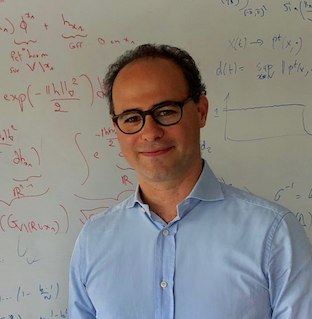
Christophe Garban is a mathematician whose research connects probability theory with statistical physics. His institutional and personal pages identify work on percolation, phase transitions and scaling limits, with a professorship at Lyon 1 beginning in 2014.[ref]
His work with collaborators constructs limiting measures for pivotal sites, clusters and interfaces in critical planar percolation. A pivotal site is a location whose state can change a macroscopic connectivity event. Counting such locations requires a scale-dependent normalization before a nontrivial continuum limit emerges. The resulting measures make sensitivity to microscopic changes part of the limiting geometry.[ref]
Pivotal, cluster and interface measures for critical planar percolation by Christophe Garban and others. Abstract and Introduction: pivotal measures, conformal covariance and cluster/interface measures
With Nathanaël Berestycki and Arnab Sen, he also constructed a state-space description yielding convergence from coalescing random walks to a coalescing Brownian flow with only finite variance of the increments. This connects his study of continuum random geometry with interacting stochastic paths.[ref]
Coalescing Brownian flows: A new approach by Nathanaël Berestycki and others. Abstract: finite-variance invariance principle and topology motivated by planar percolation
Arnab Sen is a mathematician working in probability theory and mathematical physics. His own biography identifies a Berkeley doctorate completed in 2010, subsequent research at Cambridge, and work at the University of Minnesota. His research includes random graphs, random matrices and disordered models in statistical physics.[ref]
With Nathanaël Berestycki and Christophe Garban, he developed a new state space and topology for the coalescing Brownian flow and proved an probabilistic invariance principle for coalescing random walks under a finite-variance assumption. The theorem connects discrete particle systems with a continuum stochastic flow.[ref]
Coalescing Brownian flows: A new approach by Nathanaël Berestycki and others. Abstract and Introduction: new state space, topology and finite-variance invariance principle

V. Balakrishnan is a theoretical physicist associated with the Indian Institute of Technology Madras. Its institutional profile identifies research in quantum dynamics, stochastic processes and dynamical systems, including random walks on hierarchical structures and recurrence statistics.[ref]
https://physics.iitm.ac.in/research/quantuminformationandquantumoptics/balakrishnan.html. IIT Madras, V. Balakrishnan, areas of interest and current research
His Physical Applications of Stochastic Processes by V. Balakrishnan connects probability calculations to physical motion. A particularly instructive example is the fixed-step isotropic random flight: independent directions give zero mean displacement but a mean squared displacement proportional to the number of steps. Shrinking the step length and duration together then produces a finite diffusion coefficient and a diffusion equation description.[ref]
Physical Applications of Stochastic Processes by V. Balakrishnan. Lecture 4, section 2.11, printed pages 35–39: random flights and diffusion limit
The example illustrates a recurring scientific distinction in his exposition: an average position, a typical displacement and a probability density answer different questions. Cancellation of displacement vectors does not eliminate the spreading of individual trajectories. IIT Madras's account of the chair established in his honor also identifies contributions to continuous-time random walks and recurrences in dynamical systems.[ref]
https://www.iitm.ac.in/happenings/press-releases-and-coverages/iit-madras-launches-v-balakrishnan-institute-chair. Institutional announcement, 19 July 2022: research contributions and teaching
Stuart P. Lloyd developed conditions and an iterative procedure for minimizing squared error in quantization. His paper Least Squares Quantization in PCM by Stuart P. Lloyd, published in 1982, identifies Bell Laboratories as his affiliation and records a presentation of part of the work in 1957. The motivating problem was pulse-code modulation: representing a signal sample by one of finitely many reconstruction values.[ref]
Least Squares Quantization in PCM by Stuart P. Lloyd. Page 129, author footnote and introduction
The central conditions have a clear interpretation. For fixed reconstruction values, assign an input to a nearest value. For fixed assignment regions of positive probability, place each reconstruction value at the corresponding conditional expectation. Alternating these operations gives Lloyd's algorithm; neither operation increases the mean squared error, but this does not guarantee the global optimum from every initialization.[ref]
Least Squares Quantization in PCM by Stuart P. Lloyd. Sections IV–VI: best quanta, best partition and an algorithm
For an original example, take a continuous uniform distribution on and two reconstruction values. Splitting at zero gives conditional means and , whose midpoint is again zero. The mean squared error isUsing the single reconstruction value zero instead gives . This concrete improvement explains the optimization objective: preserve signal amplitudes accurately with a limited collection of values.
Lloyd N. Trefethen is a mathematician working in numerical analysis. His author-maintained homepage records work at Oxford and a subsequent applied-mathematics appointment at Harvard. His book Spectral Methods in MATLAB by Lloyd N. Trefethen teaches spectral methods through short executable programs, connecting approximation accuracy with numerical solutions of differential equations.[ref][ref]
Spectral Methods in MATLAB by Lloyd N. Trefethen. Author's book page: forty programs and demonstrations of spectral accuracy

Lloyd N. Trefethen
. Portrait credited to Sarah Bird on Lloyd N. Trefethen homepage.An instructive theme is that an approximation's smoothness affects how efficiently its coefficients decay. A Fourier series representation of a smooth periodic function can be differentiated through its coefficients, but unresolved oscillations can still produce aliasing. High accuracy for one smooth test function does not establish that every sampled input is equally well represented.[ref]
Spectral Methods in MATLAB by Lloyd N. Trefethen. Author's description of programs comparing spectral accuracy for varying smoothness
For a concrete illustration, sampling on sufficiently many equally spaced points over a full period permits its trigonometric interpolant to reproduce the function exactly, and coefficient differentiation gives . With only four equally spaced points, the samples instead match ; differentiating that interpolant gives . The calculation illustrates the attraction of spectral methods and the need to state their resolution assumptions. It is an original example of the numerical questions made tangible by his computational exposition.
Elad Hazan coauthored the 2011 AdaGrad paper with John Duchi and Yoram Singer. The work analyzes adaptive gradient methods in online learning and stochastic optimization, using accumulated subgradients to adapt the update geometry.[ref]
A useful theoretical benchmark is cumulative regret. For loss functions , sequential choices and one fixed comparator , it isThis compares whole sequences of losses against one fixed decision, rather than demanding improvement after every update.[ref]
Adaptive Subgradient Methods for Online Learning and Stochastic Optimization by John Duchi and others. Section 1.1, regret definitions and sublinear-regret goal
For an original two-action example, let the losses of action A over three rounds be and those of action B be . A learner choosing A, B, B incurs total loss . Always choosing A also costs , while always choosing B costs . The learner therefore has zero cumulative regret against the best fixed action, even though it still suffered a positive loss in the third round. Choosing the best action separately in every round would give total loss zero, but that is a different comparator.
Likewise, if a hypothetical guarantee has the form for a fixed constant , division by gives . This elementary implication explains how a growing total cumulative regret can coexist with a shrinking average gap. It does not establish such a guarantee for an arbitrary optimization algorithm.

Elad Hazan institutional profiles at Princeton. Named research portal and portrait
Yoram Singer coauthored the 2011 AdaGrad paper with John Duchi and Elad Hazan. Their adaptive gradient methods use past subgradients to change the geometry of later optimizer updates.[ref]
An unconstrained diagonal specialization uses a diagonal AdaGrad accumulatorwith learning rate and stabilization outside the square root. The accumulator is part of the optimizer state.[ref]
For an original supplied-gradient example, let the current accumulator be , the current gradient be , and choose , . These accumulator values include the current gradient. The next displacement isThe identical current gradient coordinates produce different movements because their histories differ. Plain gradient descent with the same learning rate would move by . This calculation exposes the mechanism without asserting that either update improves every possible objective function.
The example also explains why saving only the parameter vector is insufficient to reproduce a later adaptive step. Two runs at the same , receiving the same , can move differently if their stored accumulators differ.

Yoram Singer, portrait linked from his personal research homepage
. [ref]Yoram Singer personal research homepage. Named homepage and linked portrait
Helena Ramalhinho Dias Lourenço is a researcher in combinatorial optimization, scheduling and routing. Her UPF profile explicitly gives this full name and explains her earlier publication name Helena R. Lourenço.[ref] Under that earlier name, she coauthored the iterated local search survey with Olivier C. Martin and Thomas Stützle.[ref]
One part of their framework is the iterated local search acceptance rule. An original abstract example shows why acceptance can change where the search reaches. Suppose three locally optimized candidates have costs , and the fixed perturbation-plus-improvement map sends to and to . Starting at , accepting only a strictly lower cost rejects and repeats the same failed transition. Accepting every candidate instead follows , reaching cost after two transitions. This chosen example illustrates a possibility, not a general guarantee for the always-accept rule.
The survey's actual travelling salesman problem comparison measured mean excess tour length over ten independent runs, each with a 120-second budget on a Pentium266MHz computer. For instance fl3795, Table3 reports excesses of percent for random restart, percent for always accepting the new locally optimized candidate and percent for the improving-only rule.[ref] That experiment favoured the improving-only rule under its specified setup, even though the abstract example above shows why that rule can sometimes block progress. The problem, embedded search and evaluation budget all matter.
Olivier C. Martin coauthored the 2001 survey Iterated Local Search by Helena R. Lourenço and others with Helena Ramalhinho Dias Lourenço and Thomas Stützle. Its title page identifies him with Université Paris-Sud, Orsay. The survey describes searching over outputs of an embedded optimizer, rather than treating every feasible solution as an equally likely search state.[ref]
Iterated Local Search by Helena R. Lourenço and others. Title page; §1, reduced search space; §2.1, general framework
An original finite example distinguishes uniformly chosen starting states from uniformly chosen local minima. Let a deterministic local search operator map six possible starts as follows:Here are its three possible locally optimized outputs. A uniform random start reaches them with probabilities , and , not each. This follows simply by counting the starts mapped to each output. It is a chosen abstract optimizer map, not a claim about a particular benchmark landscape.
In iterated local search, a local-search perturbation followed by induces another transition mechanism on those outputs. Its probabilities depend on both components. Consequently a chain of locally optimized candidates is not automatically a uniform sample of local minima, nor does it automatically have a prescribed equilibrium distribution. The optimizer and transition rule must be specified before making such sampling claims.
Thomas Stützle researches computational optimization, including local search and algorithm configuration. His author-maintained IRIDIA homepage describes the irace configuration software and its use of racing algorithms.[ref] He also coauthored Iterated Local Search by Helena R. Lourenço and others with Helena Ramalhinho Dias Lourenço and Olivier C. Martin.[ref]
The modular iterated local search framework keeps the embedded local search distinct from a local-search perturbation and the subsequent acceptance decision. That separation makes a solver's settings part of the experimental description rather than incidental implementation detail.
An original budget comparison illustrates a configuration pitfall. Suppose setting A takes per objective evaluation and setting B takes , with all other costs neglected. In a budget they can perform and evaluations respectively. Comparing both after evaluations instead gives B twice as much time. Neither evaluation count nor elapsed time is inherently the wrong budget; the comparison must state which resource is constrained. These are hypothetical costs, not irace timings.
This is why algorithm configuration and algorithm selection are related but distinct: one tunes a parameterized solver, while the other chooses among candidates for an instance. A useful evaluation records the tuned parameters, computational budget and held-out instances alongside solution quality.
Paul Glasserman studies simulation and statistical methods. His 1992 joint paper with David D. Yao investigates when common random numbers beneficially couples comparisons of stochastic systems, including parameter-sensitivity comparisons.[ref]
Some Guidelines and Guarantees for Common Random Numbers by Paul Glasserman and David D. Yao. Primary byline; §1, pp884–885, sensitivity-analysis setting
An original finite-difference example shows how the noise scale can depend on coupling. For , let , where has an exponential distribution of mean and variance one. Since , its expectation derivative is . Using the same for both parameter values giveswhose variance is regardless of positive .
If the two simulations instead use independent random variables with that same exponential law, the estimator remains unbiased but has varianceFor chosen and , this is , compared with under the shared-input coupling. Averaging independent replicate pairs divides either variance by their number. These are exact properties of the stipulated linear simulation model, not benchmark measurements.
The useful cancellation occurs because the two outputs respond smoothly to the same random input. Other models can give a less favourable covariance or discontinuous response. The paper's conditions, rather than the act of reusing a seed alone, justify its general variance-reduction conclusions. Common random numbers explains the underlying covariance identity and a counterexample where sharing inputs makes a comparison noisier.
David D. Yao coauthored the 1992 work on common random numbers with Paul Glasserman. Their analysis gives conditions under which coordinated random inputs improve comparisons of simulated systems, emphasizing monotonicity and continuity of event times.[ref]
Some Guidelines and Guarantees for Common Random Numbers by Paul Glasserman and David D. Yao. Primary byline and abstract; §1
The cited primary byline retains his middle initial without expanding it.An original queueing theory calculation illustrates the event-time viewpoint. Start an initially empty, first-come-first-served single-server queue with arrivals . For service times , its single-server queue departure-time recursion isThis is the paper's service-completion recursion in renamed notation.[ref]
Some Guidelines and Guarantees for Common Random Numbers by Paul Glasserman and David D. Yao. §3, equations8–9, p894; §4.2, Example4.6, p897
With service times , the departures are . Reducing all services to gives departures using the same arrival input.At time , the first system has completed one job and the second has completed two. The states differ even though corresponding job labels and arrival times are coordinated. In a stochastic comparison, random inputs should likewise be assigned consistently to the intended jobs or events; a raw position in a mixed event list need not identify the same physical event in both simulations.
The deterministic numbers above demonstrate the recursion, not a measured variance reduction. A useful random coupling must preserve each system's marginal input law and have the response properties required for the chosen performance comparison. Shared random seeds alone do not establish those properties.
Jonathan Bloom is a mathematician and teacher identified by MIT's Experimental Study Group with work in topology and redevelopment of the probability-and-statistics course 18.05. Its institutional profile connects those activities to his later computational research.[ref]
Jonathan Bloom profile by MIT Experimental Study Group. Institutional biography, topology work and redevelopment of 18.05
Bloom and Jeremy Orloff are named coauthors of Covariance and Correlation by Jeremy Orloff and Jonathan Bloom. The reading defines covariance and correlation and derives their basic properties.[ref] This documented teaching contribution offers a precise mathematical example of separating a definition from a stronger conclusion that it does not imply.
For an original example, let a random variable take values with equal probabilities and set . Thenso . Both variances are positive:and their correlation coefficient is zero. Nevertheless they are not independent random variables, becauseThe pair consists of uncorrelated random variables with exact nonlinear dependence.
This calculation explains why a covariance summary can miss a deterministic relation; it is not an empirical dataset or a claim that Bloom originated the distinction. Connecting formal properties to counterexamples is directly useful when mathematical statistics is applied to complicated data. The institutional biography documents Bloom's movement between mathematical teaching and computational work, while the named course source supplies the concrete authored contribution.
Pinned article: Introduction to the OurBigBook Project
Welcome to the OurBigBook Project! Our goal is to create the perfect publishing platform for STEM subjects, and get university-level students to write the best free STEM tutorials ever.
Everyone is welcome to create an account and play with the site: ourbigbook.com/go/register. We belive that students themselves can write amazing tutorials, but teachers are welcome too. You can write about anything you want, it doesn't have to be STEM or even educational. Silly test content is very welcome and you won't be penalized in any way. Just keep it legal!
Intro to OurBigBook
. Source. We have two killer features:
- topics: topics group articles by different users with the same title, e.g. here is the topic for the "Fundamental Theorem of Calculus" ourbigbook.com/go/topic/fundamental-theorem-of-calculusArticles of different users are sorted by upvote within each article page. This feature is a bit like:
- a Wikipedia where each user can have their own version of each article
- a Q&A website like Stack Overflow, where multiple people can give their views on a given topic, and the best ones are sorted by upvote. Except you don't need to wait for someone to ask first, and any topic goes, no matter how narrow or broad
This feature makes it possible for readers to find better explanations of any topic created by other writers. And it allows writers to create an explanation in a place that readers might actually find it.
Figure 1. Screenshot of the "Derivative" topic page. View it live at: ourbigbook.com/go/topic/derivativeVideo 2. OurBigBook Web topics demo. Source. - local editing: you can store all your personal knowledge base content locally in a plaintext markup format that can be edited locally and published either:This way you can be sure that even if OurBigBook.com were to go down one day (which we have no plans to do as it is quite cheap to host!), your content will still be perfectly readable as a static site.
- to OurBigBook.com to get awesome multi-user features like topics and likes
- as HTML files to a static website, which you can host yourself for free on many external providers like GitHub Pages, and remain in full control

Figure 2. You can publish local OurBigBook lightweight markup files to either OurBigBook.com or as a static website.
Figure 3. Visual Studio Code extension installation.
Figure 5. . You can also edit articles on the Web editor without installing anything locally. Video 3. Edit locally and publish demo. Source. This shows editing OurBigBook Markup and publishing it using the Visual Studio Code extension. 
- Infinitely deep tables of contents:


All our software is open source and hosted at: github.com/ourbigbook/ourbigbook
Further documentation can be found at: docs.ourbigbook.com
Feel free to reach our to us for any help or suggestions: docs.ourbigbook.com/#contact