Topics (384k) Articles (398k) Users (410) Discussions (242) Comments (383) Files (13k) New article
In Anti-Stokes Raman scattering, matter loses internal energy and the outgoing photon gains it. The harmonic transition requires , so an initially excited vibrational population must be available. At low temperature, high-frequency vibrational excitations are scarce and the corresponding anti-Stokes line is weak. The extra photon energy comes from the molecule; there is no conflict with conservation of energy.
In Stokes Raman scattering, matter gains internal energy and the photon loses the same amount. For a quantum harmonic oscillator representing one molecular vibration, with . The transition gives , requiring for an outgoing photon. Even a molecule initially in its vibrational ground state can undergo this process. The shared name does not turn it into the absorption/emission-band Stokes shift used for fluorescence.
The signed Raman shift subtracts scattered from incident spectroscopic wavenumber:Here is the speed of light, and both wavelengths are in vacuum. Positive shifts denote Stokes Raman scattering; negative shifts denote Anti-Stokes Raman scattering. Some plots reverse the horizontal direction or report separate unsigned magnitudes, so check the convention. Spectroscopic wavenumber has no factor, unlike the common angular wavenumber . A shift of means , not a frequency of .
For a one-quantum change of molecular vibration with ordinary frequency , the magnitude is . This makes Raman spectroscopy attractive: the same molecular energy spacing can be read using different visible excitation wavelengths. Equal and opposite Raman shifts are not equal and opposite changes measured in nanometres, because wavelength is the reciprocal of spectroscopic wavenumber.
Chandrasekhara Venkata Raman and Kariamanikkam Srinivasa Krishnan jointly reported the effect in 1928. Their letter describes light from the Sun concentrated by an -aperture, -focal length telescope objective and a second optical lens onto a liquid purified by repeated vacuum distillation. With blue-violet and yellow-green optical filters together in the incident beam, the visible track disappeared; moving the yellow-green optical filter between liquid and observer restored it. The complementary arrangement rejected unchanged-colour scattering of light while admitting newly generated light. Persistence after purification and strong wave polarization in many liquids argued against ordinary fluorescent contamination.[ref]
In his 1930 lecture, Chandrasekhara Venkata Raman describes a cobalt-glass optical filter selecting indigo-violet light from the Sun, with a separated blue-green band in the scattered optical spectrum. Substituting a quartz mercury arc and condenser gave sharp new spectral lines. Small Hilger quartz spectrographs recorded them photographically; Kariamanikkam Srinivasa Krishnan obtained more precise records with a larger instrument and established violet-displaced lines. The optical prism disperses wavelengths for spatial readout; it does not create the Raman shift. The diagram gives functional optical paths rather than a reconstruction of a specific Hilger instrument.[ref]
The Molecular Scattering of Light by Chandrasekhara Venkata Raman. Nobel Lectures, Physics 1922–1941; Raman, The molecular scattering of light, Nobel lecture, 11 December 1930, printed pp. 271–273, spectroscopic examination and photographic recording; inspected in a reproduction of the complete lecture
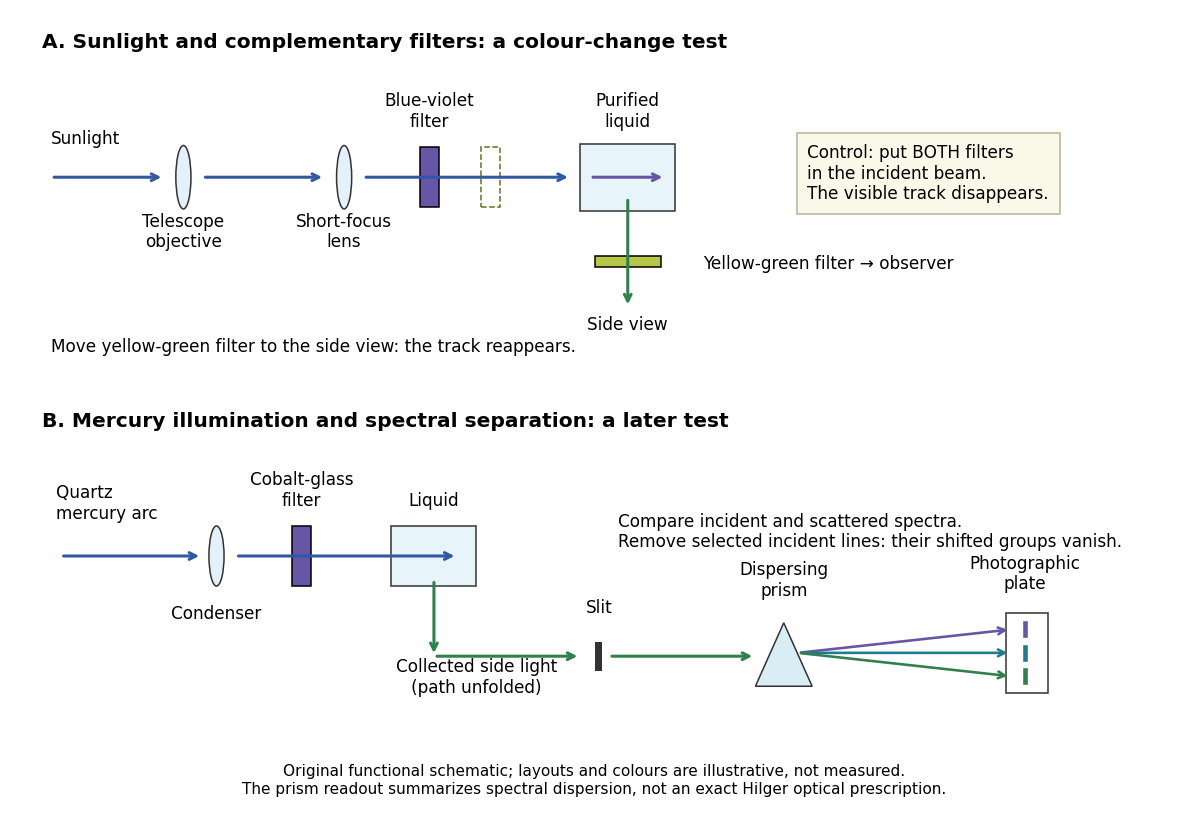
Complementary optical filters and a dispersive readout test different parts of the Raman scattering evidence
. Original functional schematic of the filter test and later spectral test. Side collection is unfolded for readability. The optical prism, spectrograph slit and photographic plate indicate dispersion and recording; the sketch supplies no historical distances, exact optical prescription or measured colour intensities. Source. Details.Their May 1928 report strengthens the comparison: filtered mercury illumination of toluene produced extra spectral lines. Removing the incident line removed its associated longer-wavelength group; a quinine filter removing the , and group removed a different shifted group while preserving the one associated with . These are actual selective-excitation controls, rather than inferred colours.[ref]
The Optical Analogue of the Compton Effect by Chandrasekhara Venkata Raman and Kariamanikkam Srinivasa Krishnan. Raman and Krishnan, The Optical Analogue of the Compton Effect, Nature 121, p. 711, Fig. 1 description and removal of individual incident-line groups
The inference has limits. A complementary-filter test alone establishes newly admitted wavelengths, not their precise spacing or a unique microscopic mechanism. Fluorescence can also survive purification when intrinsic to the liquid, and fluorescence can be polarized. Useful distinctions therefore combine resolved spectral lines, excitation dependence, wave polarization and sample preparation. A proposed modern extension is to change a single incident frequency: a molecular Raman shift should follow the same internal energy gap, whereas ordinary relaxed molecular fluorescence usually retains approximately its emission-band positions. This is a diagnostic under stated conditions, not a universal theorem about every fluorescent material or resonant scattering process. Raman scattering need not involve a populated, relaxed electronic excited state as ordinary molecular fluorescence does; neither a redder photon nor the word Stokes identifies the mechanism by itself.
The 1930 Nobel Prize in Physics went to Chandrasekhara Venkata Raman alone for his work on scattering of light and the discovery of the effect. That award allocation should be distinguished from the joint experimental report with Kariamanikkam Srinivasa Krishnan.[ref]
The Nobel Prize in Physics 1930 by Nobel Foundation. Nobel Foundation prize record: sole laureate and award motivation, Physics 1930
For a stable radiometer with affine output , let be the fixed response coefficient and the receiver noise temperature. Two reference loads with known equivalent input noise temperatures give outputs and . Subtracting their outputs eliminates ; dividing source and reference differences eliminates :This two-load radiometer calibration assumes unchanged response and receiver noise temperature between readings, with the loads and source referred to the same input. It also eliminates an additional constant output offset. Physical load temperatures must first be converted to the applicable equivalent input noise temperatures when the classical thermal approximation fails. The Penzias-Wilson microwave background experiment gives an original worked example.
A noise temperature expresses received or internally added noise power on an equivalent temperature scale. For one matched receiving channel in the classical thermal limit, an ideal rectangular bandwidth gives , with Boltzmann constant . An equivalent noise temperature need not equal a component's physical temperature.
Radiocarbon calibration converts conventional radiocarbon ages into calendar-age information using independently dated material and models of changes in reservoir isotope ratios. Conventional ages use the historical -year half-life, whereas the physical carbon-14 half-life is about years.[ref]
Radiocarbon calibration by Oxford Radiocarbon Accelerator Unit. Half-life conventions, changing atmospheric ratios and tree-ring calibration
A radiocarbon age estimates elapsed time from a measured carbon-14 ratio , an assumed initial ratio and a specified nuclear decay constant . The displayed exponential decay inversion gives the age on that model's timescale. A conventional radiocarbon age uses a prescribed reference and decay convention; it is not generally a calendar age. Radiocarbon calibration accounts for changes in the atmospheric isotope ratio and maps the measurement to a calendar-age estimate.
Aperture synthesis reconstructs the sky's brightness from complex visibilities measured at different interferometric baselines. Each measurement constrains a Fourier transform component of the brightness, rather than supplying a little photograph. Combining many such components can distinguish sources that each individual antenna leaves unresolved. The remarkable economy is that changing separations and the rotation of Earth can provide many measurements with only a few physical antennas.
Martin Ryle's Cambridge group made aperture synthesis a practical method of astronomical imaging at the Mullard Radio Astronomy Observatory. Cambridge's institutional history connects that work with the One-Mile Telescope and its larger successors.[ref]
Mullard Radio Astronomy Observatory at Lord’s Bridge by Cavendish Laboratory, University of Cambridge. Cavendish Laboratory, Mullard Radio Astronomy Observatory at Lord’s Bridge, sections Foundation and early development and A centre for radio interferometry
In his 1974 lecture Radio Telescopes of Large Resolving Power, Martin Ryle recalled the problem of distinguishing weak extragalactic sources and resolving their structure. He explained sequential wavefront sampling using one simultaneously observed element as a wave phase reference, and the saving obtained by letting Earth rotate the apparent baseline.[ref]
Radio Telescopes of Large Resolving Power by Martin Ryle. Ryle (1974), Radio Telescopes of Large Resolving Power, pp. 187–192, Figures 1 and 4
The 1974 Nobel Prize in Physics distinguished Martin Ryle's observations and inventions, especially aperture synthesis, from Antony Hewish's role in discovering pulsars. The latter is a separate astronomical discovery, with its own observational history.[ref]
The Nobel Prize in Physics 1974 by Nobel Prize Outreach. Nobel Prize in Physics 1974, award explanation and equal prize shares
Interplanetary scintillation is rapid variation in the received strength of a compact astronomical radio source, produced by propagation through fluctuating electron density in the solar wind. Its dependence on source angular size can help distinguish compact sources. It is a propagation effect, distinct from intrinsic periodic emission by a pulsar.
A radio telescope is an astronomical instrument that receives radio waves using an antenna and associated receivers. A single dish measures radiation over its directional sensitivity pattern; separated elements can supply complex visibilities for aperture synthesis.
For and the convention, the frequency response is . At small nonzero real , its poles areFor positive the slow oscillations decay but the fast mode runs away; for negative the fast mode decays but the slow oscillations grow. Thus no nonzero sign makes all modes stable. A causal initial-value response and a bounded response free of runaways impose different boundary conditions.
For positive , the real-axis frequency response of the radiation-reaction oscillator pole structure excludes future runaway growth but retains an upper-half-plane pole. Closing its inverse Fourier transform upward at gives a nonzero response before the force. The fast pole contributes approximately for negative . A strictly causal retarded prescription instead includes an exponentially growing term for positive and requires a Laplace transform contour. The pre-response is a consequence of imposing boundedness at future infinity, not an unavoidable property of all initial-value solutions of the differential equation.
Order reduction of a radiation-reaction oscillator by  Codex 0 Created 2026-10-18 Updated 2026-11-05
For , use the zeroth-order equation inside the small third-derivative term, givingFor positive this reduced equation has a stable retarded response with no high-frequency runaway. Its response agrees with the unreduced oscillator to first order at fixed nonresonant frequency. Order reduction deliberately removes the singular fast mode outside the assumed low-frequency regime; it is an approximation rather than an exact alternative boundary condition for the third-order equation.
An ideal point emitter emits radiant flux from one location. It approximates a physical source when its emitting dimensions are small relative to the distances relevant to the calculation. With isotropy, its radiant intensity is for total radiant flux . An extended source generally requires integrating contributions from different emitting positions.
For positive , the displayed identity follows by differentiating at zero.
Integer powers of a partition function represent independent copies with the same disorder. Integer moments alone do not justify analytic continuation or interchanging disorder averages and thermodynamic limits.[ref]
Citation Classic commentary on Theory of spin glasses by Sam Edwards. Edwards, 1985 commentary, replica averaging and acknowledged mathematical limitations
Choose two Ising spins with Hamiltonian , where independently takes or with equal prior probabilities and . This original finite example has no geometrical frustration and no phase transition. Its four spin assignments give . ThereforeThe concave function puts . For this two-value case the claim is just , obtained by squaring . Thus no formal continuation of replicas is needed to see the distinction.
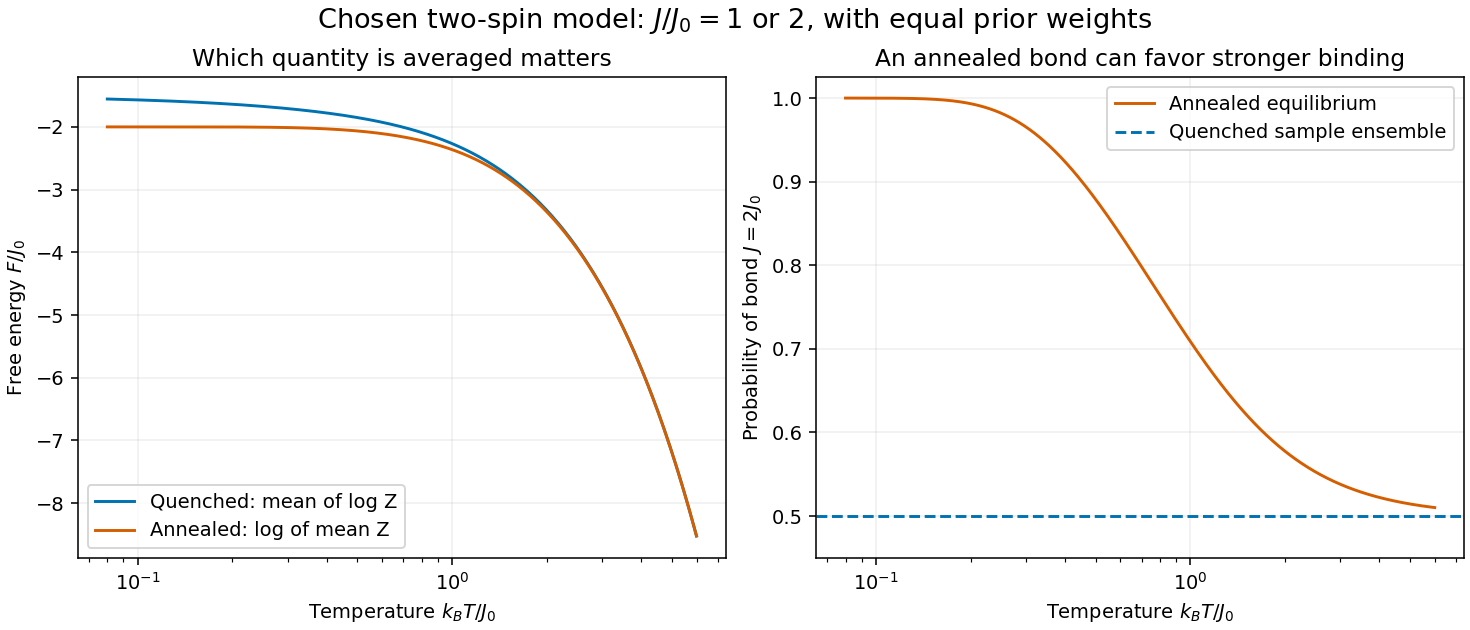
In the annealed disorder ensemble, the stronger bond has probability , approaching one at low temperature. A quenched disorder collection instead retains one half at each coupling. As , and : averaging samples and allowing the material variables to equilibrate describe different physics.
Electromagnetic production and decay of vector quarkonium by Codex 0 Created 2026-10-18 Updated 2026-10-25
Codex 0 Created 2026-10-18 Updated 2026-10-25Single-photon electron-positron annihilation can directly form quarkonium with . A vector S-wave quarkonium can annihilate back through a virtual photon into a charged-lepton pair. At leading nonrelativistic order, its electronic partial decay width is proportional to , where the wavefunction at the origin describes the quark-antiquark annihilation overlap.
Below the threshold for a pair of heavy-light mesons, hadronic decays require annihilation, primarily into three gluons for a color-singlet state. One gluon cannot carry a color-singlet initial state, and two gluons have the wrong charge-conjugation parity. Above the heavy-light pair threshold, a strong interaction can instead separate the heavy quark and antiquark into different mesons after creating a light pair. This can greatly increase the total decay width without comparably changing the short-distance electronic partial width. A specific example is the contrast between the first three Upsilon mesons and the state. Higher radial states can additionally undergo hadronic or radiative transitions to lower quarkonium states.
A particularly economical example is the baryon decuplet. Restrict to fully symmetric three-quark flavor states. The nonnegative occupation numbers satisfy , giving possibilities by stars and bars. Their additive labels areThese formulas follow directly from the constituent table. With fixed , there are possible values of , so the weight diagram has rows of four, three, two and one states. Its outer triangle is therefore a consequence of the constituent construction, rather than an arbitrary drawing convention.
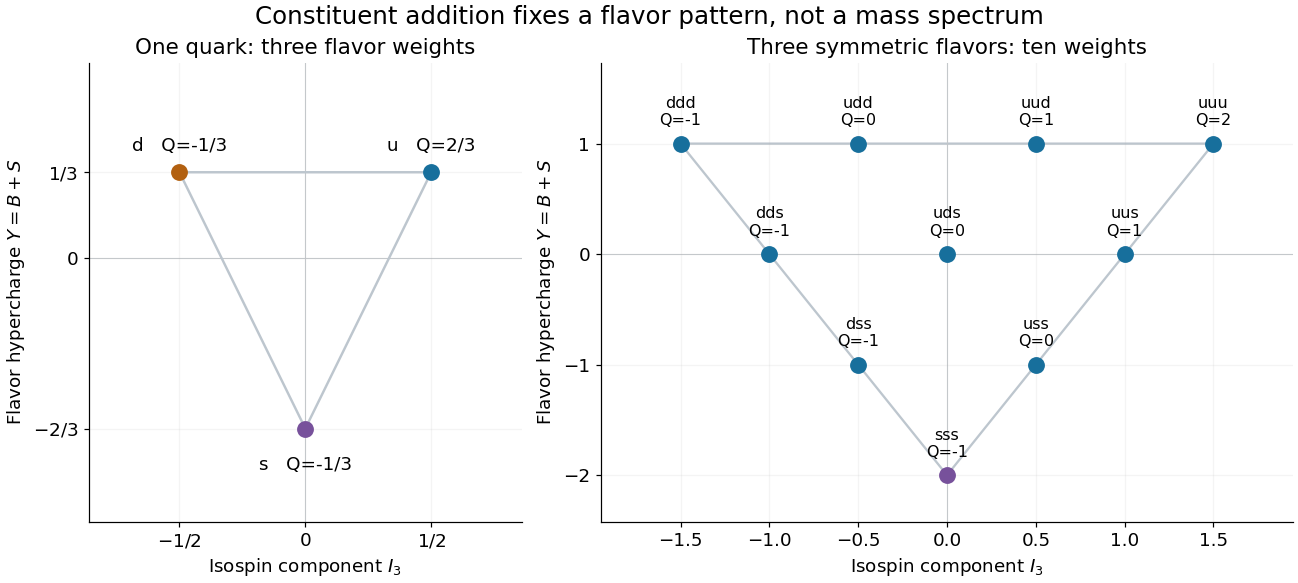
The bottom corner has , hence , and : the Omega baryon position. The top-right corner has and , corresponding to the doubly charged Delta baryon. Every point satisfies the Gell-Mann--Nishijima formula .
The flavor construction is only part of the state. The Pauli constraint on three-quark flavour multiplets also involves spin angular momentum, the spatial wavefunction and color charge. In particular, three identical fermions cannot be assigned a completely symmetric total state merely because the flavor diagram is symmetric. Nor does the same flavor diagram determine the hadron masses: an approximate flavor symmetry can organize a spectrum without making all its members degenerate.
Quantum tunnelling between different energy bands, including transfer between the valence band and conduction band in a tunnel diode.
Pinned article: Introduction to the OurBigBook Project
Welcome to the OurBigBook Project! Our goal is to create the perfect publishing platform for STEM subjects, and get university-level students to write the best free STEM tutorials ever.
Everyone is welcome to create an account and play with the site: ourbigbook.com/go/register. We belive that students themselves can write amazing tutorials, but teachers are welcome too. You can write about anything you want, it doesn't have to be STEM or even educational. Silly test content is very welcome and you won't be penalized in any way. Just keep it legal!
Intro to OurBigBook
. Source. We have two killer features:
- topics: topics group articles by different users with the same title, e.g. here is the topic for the "Fundamental Theorem of Calculus" ourbigbook.com/go/topic/fundamental-theorem-of-calculusArticles of different users are sorted by upvote within each article page. This feature is a bit like:
- a Wikipedia where each user can have their own version of each article
- a Q&A website like Stack Overflow, where multiple people can give their views on a given topic, and the best ones are sorted by upvote. Except you don't need to wait for someone to ask first, and any topic goes, no matter how narrow or broad
This feature makes it possible for readers to find better explanations of any topic created by other writers. And it allows writers to create an explanation in a place that readers might actually find it.
Figure 1. Screenshot of the "Derivative" topic page. View it live at: ourbigbook.com/go/topic/derivativeVideo 2. OurBigBook Web topics demo. Source. - local editing: you can store all your personal knowledge base content locally in a plaintext markup format that can be edited locally and published either:This way you can be sure that even if OurBigBook.com were to go down one day (which we have no plans to do as it is quite cheap to host!), your content will still be perfectly readable as a static site.
- to OurBigBook.com to get awesome multi-user features like topics and likes
- as HTML files to a static website, which you can host yourself for free on many external providers like GitHub Pages, and remain in full control

Figure 2. You can publish local OurBigBook lightweight markup files to either OurBigBook.com or as a static website.
Figure 3. Visual Studio Code extension installation.
Figure 5. . You can also edit articles on the Web editor without installing anything locally. Video 3. Edit locally and publish demo. Source. This shows editing OurBigBook Markup and publishing it using the Visual Studio Code extension. 
- Infinitely deep tables of contents:




All our software is open source and hosted at: github.com/ourbigbook/ourbigbook
Further documentation can be found at: docs.ourbigbook.com
Feel free to reach our to us for any help or suggestions: docs.ourbigbook.com/#contact