Topics (384k) Articles (398k) Users (410) Discussions (242) Comments (383) Files (13k) New article

A positive resistive electrical load obeys Ohm's law, . Its resistive load line intersects the Thévenin terminal response atprovided . For the Thévenin divider example, gives and ; gives and . At , the voltage is , half the open-circuit voltage.
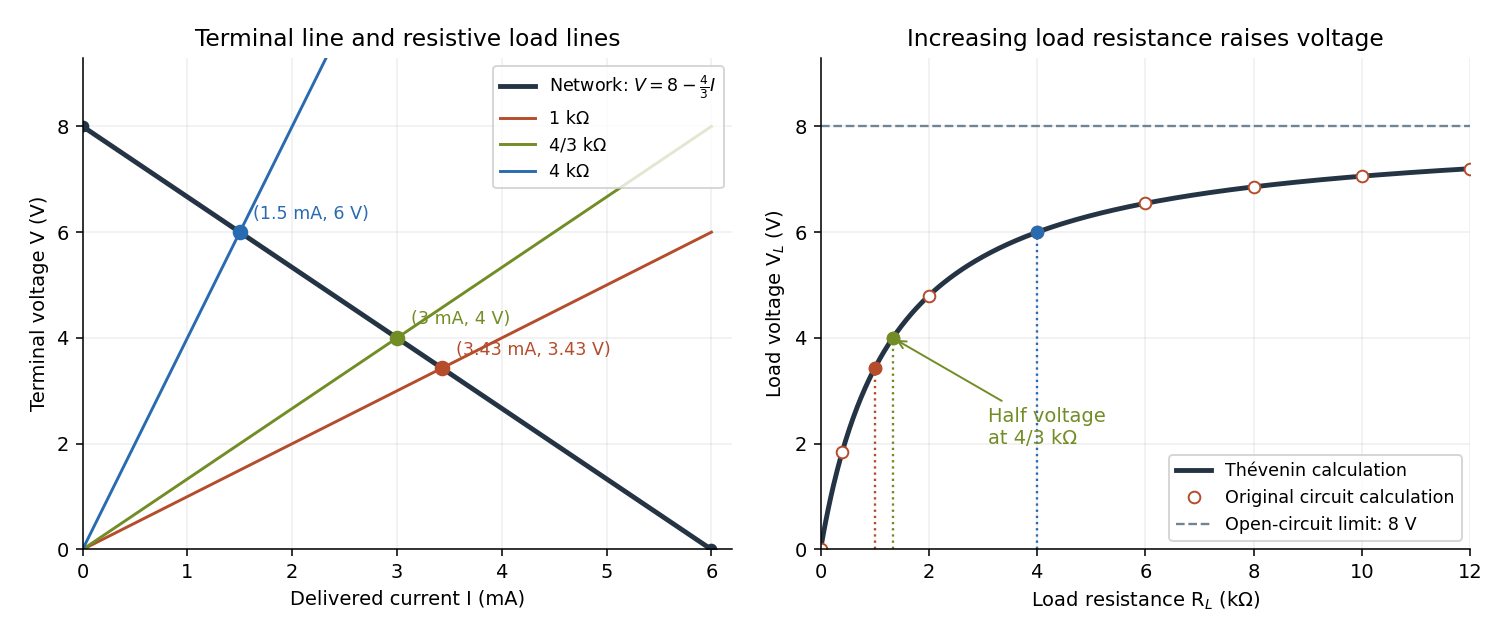
For this positive , increasing reduces the drawn electric current and raises toward . This explains voltmeter loading: a voltmeter itself is an electrical load. The equivalence also applies to a nonlinear electrical load through intersection with its terminal relation, but an arbitrary load need not give a unique operating point. If negative cancels positive , the displayed formula is singular; a real active circuit's limits and dynamics must then be considered.
To determine the Thévenin resistance, remove the external electrical load and set each independent electrical source to zero in the circuit model. A zero ideal voltage source enforces zero electric potential difference, so replace it by a short connection. A zero ideal current source enforces zero electric current, so replace it by an open connection. Retain every resistor, including any explicitly modeled supply electrical resistance. Turning an actual power supply's front-panel control to zero is not evidence that it physically becomes an ideal wire.
Retain every dependent electrical source and its controlling variable: its response to an electrical test source is part of the network's electrical resistance. Impose terminal voltage with an electrical test source and calculate entering the suppressed network at . For a nonzero test yielding a finite ratio,Alternatively inject a known entering electric current and solve for . The test electric current is opposite to the delivered-current convention of the original Thévenin terminal response. [ref]
Thevenin and Norton Equivalents, University of Houston teaching notes. Thevenin and Norton Equivalents, pp. 5–7, “Test Source Method for RTH” and Notes: suppress independent sources, retain dependent sources
For an original illustration, put a positive resistor across and a dependent electrical source in parallel that injects electric current from toward , where has units of electrical conductance. Its control is the same terminal voltage . Kirchhoff's current law givesWith and , a test draws , giving . Removing the dependent electrical source would falsely give . With , the model instead has ; with it draws zero test electric current for any imposed voltage and has no finite ratio. An active physical realization requires a supply and has a limited operating range.
For a finite nonzero and a well-defined short-circuit response, . Thus is usable when . A source-free positive resistor has both and , so this quotient cannot reveal its electrical resistance; an electrical test source can.
In the pictured original linear resistive circuit, the ideal voltage source keeps its upper node at relative to . Let connect that node to , and connect to . With the external electrical load removed, the voltage divider givesTo find the Thévenin resistance, Thévenin source suppression replaces the ideal voltage source by a wire. Both resistors now join to in parallel, givingThis is the electrical resistance looking into the original network with its independent electrical source suppressed; the external electrical load is excluded.
An independent check uses Kirchhoff's current law at , without suppressing anything:The Thévenin terminal response thus follows directly from the original topology. Shorting to in this ideal calculation gives : the lower resistor has zero voltage and the upper resistor limits the electric current. All numerical values here and in the figures are stipulated model values, not laboratory data.
With the passive sign convention applied to the network, its entering electric current is , and the same relation becomes . The electrical load uses the passive sign convention with entering electric current , so it absorbs power . A positive delivered electric current therefore produces a voltage drop for positive ; changing the reference direction without changing the equation would give the wrong sign.
The reason is linearity of Ohm's law, Kirchhoff's current law, Kirchhoff's voltage law, and the constitutive relations of any linear dependent electrical sources. Solve once at with the independent electrical sources present. Subtract this solution from a solution with prescribed delivered electric current : the fixed independent electrical sources cancel, leaving a homogeneous linear network whose terminal voltage change is proportional to . This is a short superposition principle argument for an affine function; the fixed offset need not vanish.
The qualification about a well-defined response matters. An ideal voltage source alone has . An ideal nonzero current source alone constrains and does not have a finite open-circuit voltage or a representation with finite coefficients. Linear dependent electrical sources can give negative resistance, and singular ideal networks may fail to have a unique finite response. Neither a finite nor a strictly positive passive follows merely from calling an electrical circuit linear. [ref]
Thevenin and Norton Equivalents, University of Houston teaching notes. Thevenin and Norton Equivalents, p. 11, “On a Negative Thevenin Equivalent Resistance”: dependent-source models can have negative equivalent resistance
An abstract machine specifies a computational state and rules for advancing that state without requiring one particular physical implementation. A Turing machine and a stack machine give different ways to organize the state and its transitions.
A substituent is an attached chemical atom or group considered relative to a chosen molecular framework. Testing whether two substituents are identical may require comparing their full chemical bond connectivity and stereochemistry.
Conformational isomerism concerns spatial arrangements interconverted by internal motion, such as turning about a single chemical bond. Moving the entire molecule or applying a rotation changes its position or viewing direction, not its internal arrangement.
Absolute configuration records a spatial arrangement without leaving its handedness relative to its mirror unspecified. R and S configuration is one naming convention; optical rotation is a measured response.
Stereoisomers have the same chemical bond connectivity but different spatial arrangements. A mirror pair of distinct stereoisomers comprises enantiomers; diastereomers have no mirror-pair relation.
A spreadsheet tabular model assigns a consistent meaning to each row and column. For an original example, let rows 2–4 describe three items, with quantity in column
A, unit price in column B, subtotal in column C, and total including tax in column D. Put the single shared tax rate in F1. The chosen rate is an illustrative assumption. Quantities, unit prices and F1 are inputs; columns C and D hold spreadsheet formulas and display their computed values as outputs.Enter decimal inputs
2.5, 1.75, 4.5 for the unit prices and 0.2 for the tax rate. The following table expresses those values as exact fractions so that the arithmetic is easy to check. It does not require typing a fraction into an input spreadsheet cell or assume that all software calculates with exact rational numbers.Start with
C2 containing =A2*B2 and D2 containing =C2*(1+$F$1). Here * requests multiplication, and 1+$F$1 adds the tax fraction to one. Copy these two spreadsheet formulas down into rows 3 and 4, a fill operation. The relative spreadsheet references change with the destination row: C3 becomes =A3*B3 and D3 becomes =C3*(1+$F$1); C4 becomes =A4*B4 and D4 becomes =C4*(1+$F$1). The absolute spreadsheet reference $F$1 continues to read the shared rate. Copying spreadsheet formulas adjusts relative coordinates while retaining absolute coordinates. [ref]Addresses and References, Absolute and Relative, LibreOffice Help. Addresses and References, Absolute and Relative: Relative Addressing; Absolute Addressing; When to Use Relative and Absolute References, final two paragraphs
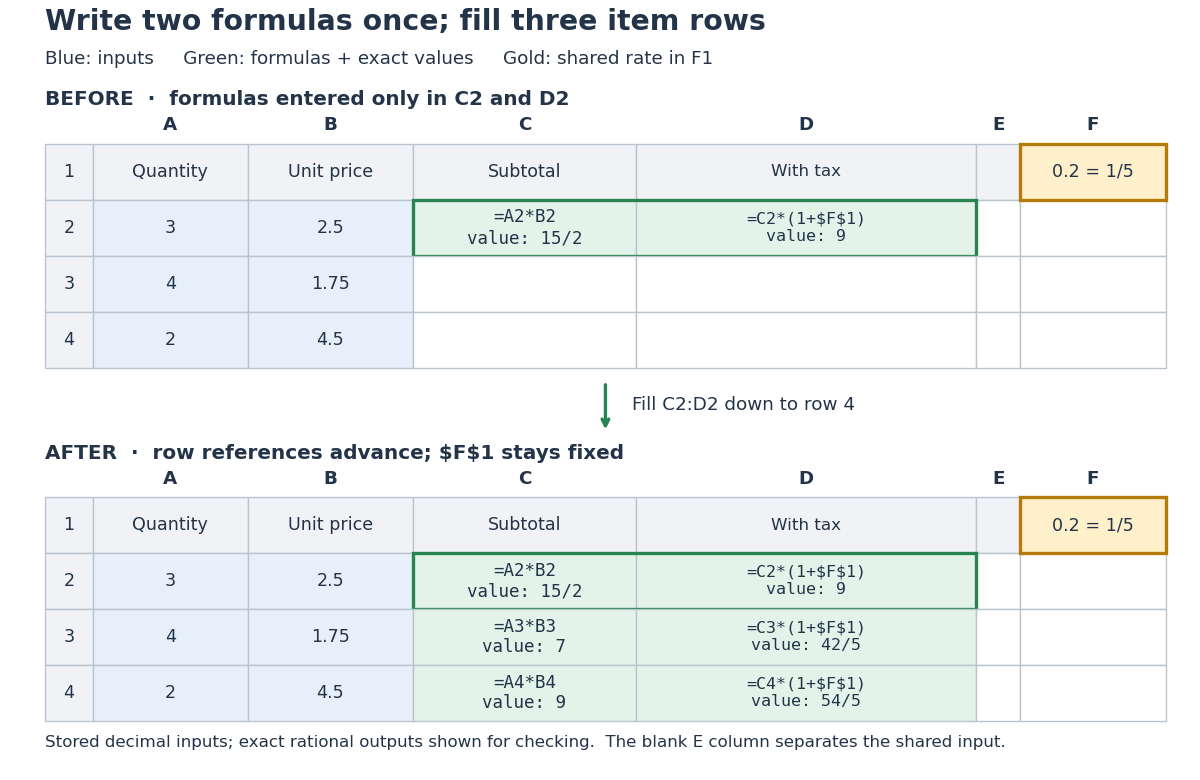
Original three-row spreadsheet tabular model before and after filling two spreadsheet formulas, with a shared absolute spreadsheet reference
. Details. The same mathematical expression applies to every item. Writing for quantity, for unit price and for the shared tax rate givesFor row 2, the exact arithmetic is . The subtotals add to , so the totals add to , agreeing with . The spreadsheet formulas encode the relationship; the displayed numbers are its results for these particular inputs.
This separation is useful for forecasting and sensitivity analysis. Keeping quantities and unit prices fixed while changing only
F1 from to gives exact totals , , and . More generally, a rate change changes each total byThis follows by expanding the two mathematical expressions and cancelling . Here , so the increases are , , and , adding to . One shared input makes the assumption visible and consistent across all rows. Overwriting a computed total with a number would instead remove that spreadsheet formula; its value would cease to follow the model when the rate changes.// Target: computer-science.bigb
A family of light-sensing proteins with interconvertible red-absorbing and far-red-absorbing forms. Phytochrome links light perception to plant development, including the lettuce red and far-red germination experiment.[ref]
Biology 2e by Mary Ann Clark and others. Biology 2e, §30.6 The Phytochrome System and the Red/Far-Red Response, Figure 30.38
Signal distortion is an unwanted change in a signal's shape or information-bearing relationships. A nonlinear response driven by a sinusoid produces DC and a second harmonic, introducing frequencies absent from the input. A linear system can also distort a waveform when its gain or phase response varies across the signal bandwidth, changing the relation between existing components. Distortion differs from additive noise, although both can degrade a measurement. The relevant comparison is to the intended signal transformation; an intentional filter is not faulty merely because it changes the waveform.
An analog multiplier produces an output proportional to the product of two input signals, often for a specified scale voltage . Multiplying two sinusoids generates sum and difference frequencies by the product-to-sum identity. This supports modulation, synchronous detection and frequency mixing. Real devices have limits on input range, bandwidth, offset and feedthrough, so an unwanted output can remain when one nominal input is zero. A four-quadrant multiplier accepts either sign on both inputs; more restricted devices implement fewer sign combinations.
Cohesin is a multisubunit chromosome-associated protein complex involved in sister-chromatid cohesion and chromosome organization. Cleavage of a cohesin component helps permit sister separation at anaphase. Cohesin also contributes to chromosomal loop organization: acute removal can eliminate loop domains without implying that every aspect of gene expression changes immediately. Its segregation and interphase-organization roles are related but experimentally separable. [ref]
Sister-chromatid separation at anaphase onset is promoted by cleavage of the cohesin subunit Scc1 by Frank Uhlmann and others. 1999, Scc1 cleavage and sister separation
[ref]Cohesin loss eliminates all loop domains by Suhas S. P. Rao and others. 2017, acute depletion and chromosome-contact maps
A program written in the input notation of a compiler or interpreter, before the particular translation being discussed.
Polystyrene is a polymer with repeating units , placing a phenyl side group on alternate backbone carbons. Addition polymerization retains the monomer's phenyl group while converting its carbon-carbon double bond into backbone bonds.
Polystyrene standards are used for organic-solvent size-exclusion chromatography. Their hydrodynamic size supplies a conditional SEC molar mass calibration; a different polymer of equal molar mass need not have the same coil size or elution volume.[ref]
Pinned article: Introduction to the OurBigBook Project
Welcome to the OurBigBook Project! Our goal is to create the perfect publishing platform for STEM subjects, and get university-level students to write the best free STEM tutorials ever.
Everyone is welcome to create an account and play with the site: ourbigbook.com/go/register. We belive that students themselves can write amazing tutorials, but teachers are welcome too. You can write about anything you want, it doesn't have to be STEM or even educational. Silly test content is very welcome and you won't be penalized in any way. Just keep it legal!
Intro to OurBigBook
. Source. We have two killer features:
- topics: topics group articles by different users with the same title, e.g. here is the topic for the "Fundamental Theorem of Calculus" ourbigbook.com/go/topic/fundamental-theorem-of-calculusArticles of different users are sorted by upvote within each article page. This feature is a bit like:
- a Wikipedia where each user can have their own version of each article
- a Q&A website like Stack Overflow, where multiple people can give their views on a given topic, and the best ones are sorted by upvote. Except you don't need to wait for someone to ask first, and any topic goes, no matter how narrow or broad
This feature makes it possible for readers to find better explanations of any topic created by other writers. And it allows writers to create an explanation in a place that readers might actually find it.
Figure 1. Screenshot of the "Derivative" topic page. View it live at: ourbigbook.com/go/topic/derivativeVideo 2. OurBigBook Web topics demo. Source. - local editing: you can store all your personal knowledge base content locally in a plaintext markup format that can be edited locally and published either:This way you can be sure that even if OurBigBook.com were to go down one day (which we have no plans to do as it is quite cheap to host!), your content will still be perfectly readable as a static site.
- to OurBigBook.com to get awesome multi-user features like topics and likes
- as HTML files to a static website, which you can host yourself for free on many external providers like GitHub Pages, and remain in full control

Figure 2. You can publish local OurBigBook lightweight markup files to either OurBigBook.com or as a static website.
Figure 3. Visual Studio Code extension installation.
Figure 5. . You can also edit articles on the Web editor without installing anything locally. Video 3. Edit locally and publish demo. Source. This shows editing OurBigBook Markup and publishing it using the Visual Studio Code extension. 
- Infinitely deep tables of contents:




All our software is open source and hosted at: github.com/ourbigbook/ourbigbook
Further documentation can be found at: docs.ourbigbook.com
Feel free to reach our to us for any help or suggestions: docs.ourbigbook.com/#contact