Topics (384k) Articles (398k) Users (410) Discussions (242) Comments (383) Files (13k) New article

Effective displayed-library coverage describes which molecular sequence variants actually occur as usable displayed molecules, rather than merely being allowed by a library design or present in its input material. In mRNA display, successful translation, fusion formation and recovery connect input sequences to usable genotype-phenotype linkages. Duplicates of one sequence do not replace missing sequences.
An original occupancy model has equally likely sequence variants, independent input molecules and usable-display probability for each input. A particular variant is usable with probability per input. Thereforewhere is the number of distinct represented variants. The expected usable molecule count is , which is generally larger than the expected distinct count.
For , and stipulated , the expected usable count is 3000 but the expected distinct count is only about 950.2. An average 95% represented fraction does not imply 95% probability that every variant is represented. By the union bound,A sufficient condition for that probability to be at most is . With in this example, this requires at least 990,349 input molecules under the stated model.
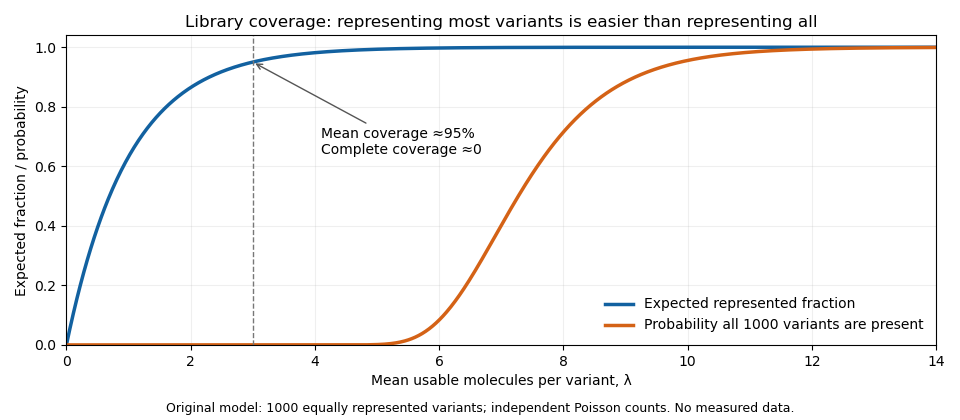
Expected represented fraction and probability of complete coverage answer different library-design questions
. Details. The figure uses a Poissonized displayed-library occupancy model: independently Poisson-distributed usable counts per variant with mean . The expected represented fraction is , while the probability of all variants being present is . That is an explicitly different count model, providing a convenient comparison rather than an exact fixed-input formula.
Real variants need not have equal abundance or display probability. In the original RNA-peptide fusion experiment, the selected and unselected encoding-sequence ratios were affected by preferential translation and reverse transcription.[ref]
RNA-peptide fusions for the in vitro selection of peptides and proteins by Richard W. Roberts and Jack W. Szostak. Figure 5 legend: input mixtures and biased unselected ratios
Coverage calculations therefore need assumptions about sequence representation and process losses; nominal library size alone does not validate them.A pinned memory object is a normally movable memory object whose address must remain unchanged during a specified operation. Pinning permits a pointer to remain usable when the code consuming it cannot participate in the runtime's relocation of references. The pinning lifetime is part of that guarantee: an address retained beyond the protected operation need not remain valid. Microsoft's language reference specifies that a
fixed statement prevents relocation during its body and restricts the declared pointer to that statement.[ref]Fixed statement in the C reference by Microsoft. Opening definition; array-element and object-field guarantees
For an original layout example, consider96 bytes with a pinned16-byte object at offsets and one other16-byte live object. The remaining64 bytes are free. Even if the other object can move anywhere, the pinned object divides the address range into regions of32 and48 bytes. A56-byte contiguous allocation cannot fit. Moving the other object into gives free intervals and , whose largest size is48 bytes. If both live objects could move, placing them in would instead leave a64-byte interval. Pinning can therefore limit memory compaction despite ample total free capacity.
The numerical layout omits allocation headers and memory alignment; a real allocator must include them. Pinning an object's address also does not by itself specify how its virtual memory pages are backed. The garbage collector's object-relocation guarantee and an operating system's physical-page residency rules concern different layers. Likewise, a pinned buffer in a storage cache may mean protection from eviction rather than this object-relocation guarantee.
Once the protected operation is finished, releasing its pin can restore the runtime's freedom to move the object during a later collection. The program still has to obey the language's reference-lifetime rules: releasing a pin does not convert an old unmanaged address into a relocatable reference. The general garbage collection process must update references when it moves surviving objects.[ref]
Fundamentals of garbage collection by Microsoft. “What happens during a garbage collection”, relocating and compacting phases
An amino sugar is a monosaccharide derivative in which an alcoholic hydroxy group is replaced by an amino group. This commonly occurs at carbon 2, but the position is part of the chemical identity rather than a requirement that all amino sugars share. IUPAC describes these compounds systematically as amino-deoxy derivatives; attachment of nitrogen at the anomeric position belongs to the distinct glycosylamine naming case.[ref]
Nomenclature of Carbohydrates (Recommendations 1996) by Alan D. McNaught. Section 2-Carb-14: amino sugars, general principles and accepted trivial names.
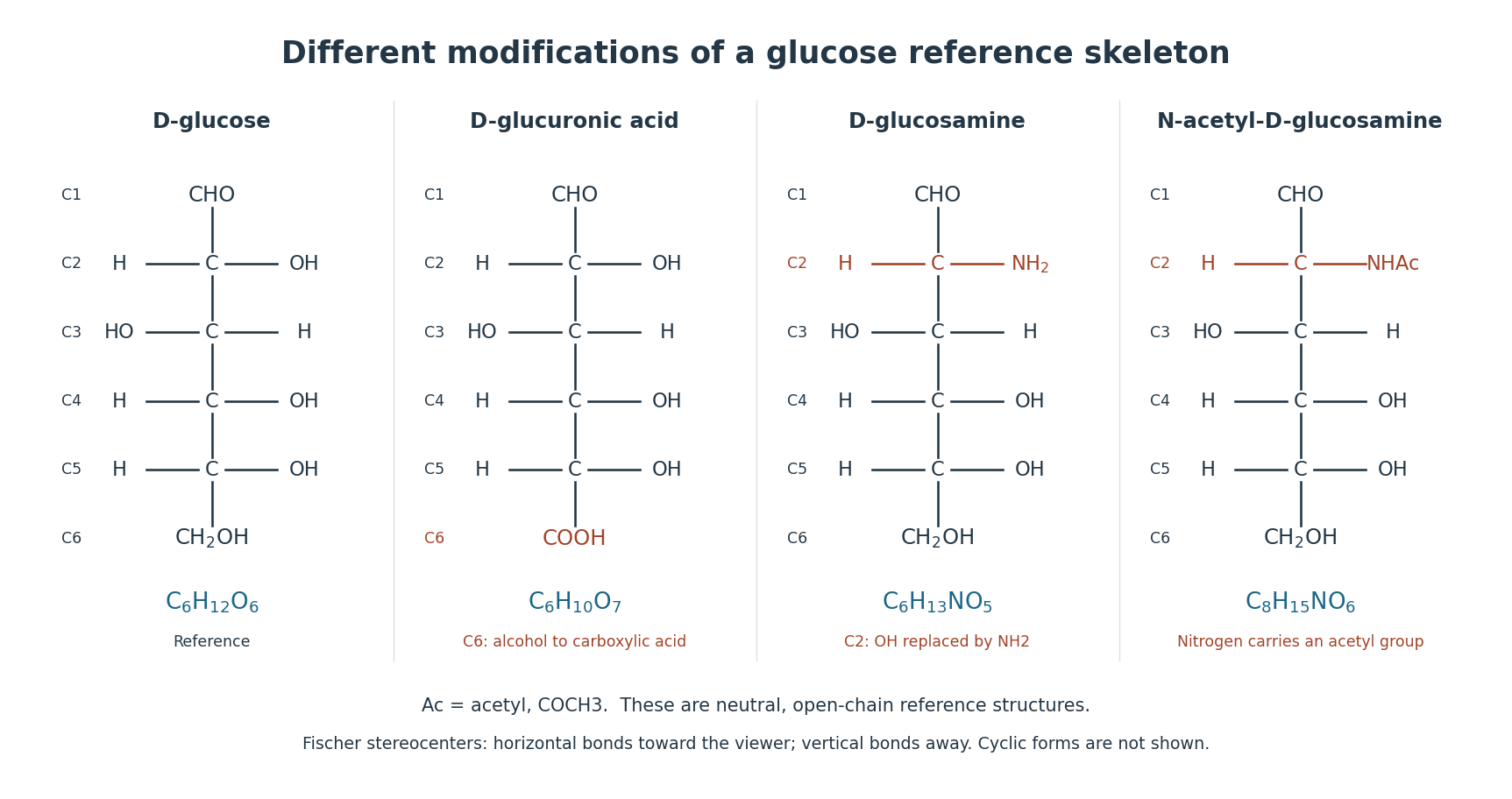
For example, glucosamine is 2-amino-2-deoxy-D-glucose: comparing it with glucose, replace the carbon-2 by . N-acetylglucosamine further modifies that nitrogen with an acetyl group. It remains an amino-sugar derivative; adding that modification does not make it a protein or an amino acid. The useful classification follows the monosaccharide framework and the location of the nitrogen-containing group.[ref]
Nomenclature of Carbohydrates (Recommendations 1996) by Alan D. McNaught. Section 2-Carb-14 and cross-reference to N-substituted derivatives in 2-Carb-25.
These modified building blocks help connect sugar chemistry to biological materials. Hyaluronic acid alternates N-acetylglucosamine with glucuronic acid, so every two-residue repeat contains one amino-sugar derivative. In an ideal segment with 100 complete repeats, there are 100 residues of each type, not 200 N-acetylglucosamine residues.[ref]
Enzymological characterization of the Pasteurella multocida hyaluronic acid synthase by P. L. DeAngelis. Abstract: alternating two-sugar composition and use of two UDP-sugar substrates.
Glucuronic acid is the uronic acid corresponding to glucose; in the usual D form, carbon 6 of D-glucose carries a carboxyl group instead of its primary alcohol group. Its neutral free-acid molecular formula is . The reference carbon numbering remains that of glucose.[ref]
Nomenclature of Carbohydrates (Recommendations 1996) by Alan D. McNaught. Section 2-Carb-22.1: D-glucuronic acid structure and numbering
Check the atom count: changing into adds one oxygen and removes two hydrogen atoms. Loss of the acidic proton gives glucuronate, with negative electric charge. The free monomer's formula should not be substituted unchanged for a residue inside a linked polysaccharide.
In a synthesis experiment, P. L. DeAngelis used UDP-glucuronic acid together with UDP-N-acetylglucosamine as activated substrates for hyaluronan synthase. Incorporation of the two sugar types into hyaluronic acid turns a repeating structural description into a reaction whose components can be varied.[ref]
Enzymological characterization of the Pasteurella multocida hyaluronic acid synthase by P. L. DeAngelis. Abstract, PMID 8703949: two UDP-sugar substrates and cell-free synthesis
A uronic acid is a monosaccharide derivative in which the terminal primary alcohol group opposite the potential aldehyde group has become a carboxyl group. The reference numbering of the original aldose is retained: carbon 1 remains the potential aldehyde carbon, rather than becoming the number assigned to the new carboxyl group.[ref]
Nomenclature of Carbohydrates (Recommendations 1996) by Alan D. McNaught. Section 2-Carb-22.1: uronic-acid structures, names and numbering
For glucose, the relevant terminal group is at carbon 6. Replacing its reference group by gives glucuronic acid, while preserving the arrangement at the intervening stereocenters. This distinguishes the position of a modification from the mere presence of a carboxyl group. Glucuronic acid supplies one of the two alternating sugar residues in hyaluronic acid, connecting the chemical classification with a biological polysaccharide.
Galactose is an aldohexose, a six-carbon monosaccharide whose open-chain reference form has an aldehyde group. It is the carbon-4 epimer of glucose: the corresponding structures differ at that one stereocenter. Its molecular formula is .[ref]
A Fischer projection makes the difference precise. With the aldehyde at the top, the carbon-2 through carbon-5 hydroxyl group pattern of D-glucose is right–left–right–right. Changing carbon 4 alone gives right–left–left–right for D-galactose. Reversing every stereocenter would instead make an enantiomer; the single-position change is an epimerization.
Neither the formula nor an accurate mass measurement distinguishes these two sugars, because moving a hydroxyl group from one side of a stereocenter to the other changes no atom counts. Their different spatial arrangements nevertheless present different binding surfaces to an enzyme. This is a useful example of why carbohydrate identification needs structural information in addition to elemental composition. The D designation fixes the reference stereochemistry; it does not itself select a single cyclic anomer or state the sign of optical rotation.
Mannose is an aldohexose, a six-carbon monosaccharide. The commonly discussed biological form, D-mannose, has neutral molecular formula . Like other sugars, it can have distinct cyclic forms; specifying D configuration does not by itself identify an alpha or beta anomer.[ref]
A Fischer projection provides an original structural comparison with D-glucose. Reading hydroxyl positions from carbon2 to carbon5, D-glucose has the pattern right–left–right–right, while D-mannose has left–left–right–right. The difference is at carbon2 alone, so they are epimers. Reversing all four stereocenters would be a different operation, producing the corresponding enantiomer.
Changing that one spatial arrangement changes neither the number of carbon atoms nor the total hydrogen and oxygen counts. A molecular-mass measurement therefore cannot, by itself, distinguish the two sugars. An identifying experiment must supply additional structural discrimination, for example through an appropriately interpreted nuclear magnetic resonance spectrum.
The useful distinction is between composition and configuration. The D label concerns a reference stereocenter; alpha/beta labels concern the anomeric center in cyclic forms. Neither label should be read as a direct statement about sweetness or the sign of optical rotation.[ref]
Nomenclature of Carbohydrates (Recommendations 1996) by Alan D. McNaught. Carbohydrate configurational conventions and cyclic-form nomenclature
In the algebraic convention used here, a tensor category over a field is a locally finite -linear abelian category with a bilinear monoidal tensor product, left and right duals for every object, and a simple monoidal unit object whose endomorphisms are . A locally finite category has finite-dimensional morphism spaces and objects of finite length. In broader usage, “tensor category” may mean merely a monoidal category; the extra hypotheses should therefore be stated.[ref]
Tensor Categories by Pavel Etingof and others. section 4.1, tensor and multitensor category definitions
Finite-dimensional representations of a group over give a model example: the tensor product has diagonal group action, the unit is the one-dimensional trivial representation, and the dual is the dual vector space with the contragredient action. A tensor category need not have a braiding; swapping two tensor factors compatibly is additional structure.
A fully dualizable object in a symmetric monoidal -category has a categorical dual together with adjoints for the evaluation and coevaluation data, recursively through the required higher levels. The meaning depends on . For , full dualizability is just ordinary dualizability. For , the evaluation morphism and coevaluation morphism must have both left and right adjoints. This is a finiteness condition expressed through composition and the monoidal tensor product.[ref]
On the Classification of Topological Field Theories by Jacob Lurie. section 2.3, especially Definitions 2.3.21–2.3.22 and Remark 2.3.24; Proposition 4.2.3
In the ordinary symmetric monoidal category of vector spaces over , a finite-dimensional vector space has dual , evaluation and coevaluationThe dual-basis identities make the two resulting zigzag composites the identity. Conversely, any algebraic tensor used as a coevaluation is a finite sum, so these identities force the whole space to be spanned by finitely many vectors. Infinite-dimensional vector spaces have algebraic duals but are not dualizable in this monoidal category.[ref]
The cobordism hypothesis identifies fully dualizable objects as the possible values on a point of fully extended framed topological quantum field theories. The higher adjoints supply the compatibility needed when bordisms are cut and glued in multiple dimensions.
The Black-Litterman model combines equilibrium-implied expected returns with additional views whose uncertainty is stated explicitly. Fischer Black and Robert Litterman introduced it to make portfolio optimization less dependent on unstable unconstrained return estimates.[ref]
Global Portfolio Optimization by Fischer Black and Robert Litterman. 1992, equilibrium reference returns and confidence-weighted views
In a standard Gaussian formulation, let the unknown return-mean vector have prior , often for asset-return covariance matrix . Views take the form , with independent . The Gaussian conditional expectation formula gives posterior meanThe matrix describes absolute or relative views, while describes their uncertainty.
For one mean with prior , prior variance , and a view of with equal variance, the posterior mean is . Increasing the view variance pulls the result toward ; making it very small pulls toward . The uncertainty about a mean is distinct from the covariance matrix of fluctuating returns, and must not be substituted for it without specifying the portfolio model.
Portfolio optimization chooses asset allocations to optimize an objective under specified constraints. In a one-period mean-variance optimization model, the return vector has mean and covariance matrix . Portfolio weights give expected return and return variance . A standard problem isThe constraints describe a fully invested portfolio, a target expected return and no short selling. Different assumptions produce different optimization problems. Harry Markowitz made the dependence on covariance and the tradeoff between mean and variance central to portfolio selection.[ref]
Portfolio Selection by Harry Markowitz. 1952, printed pages 80–82: weighted returns, covariance, budget and efficient portfolios
For two uncorrelated assets with expected returns and , each with standard deviation , a weight in the first gives variance . Its unconstrained minimum is at , yielding mean and standard deviation . A target of at least instead requires , making the constrained minimum . The same covariance matrix therefore gives a different solution when the objective's feasible set changes.
Estimated means and covariances are model inputs, rather than known future outcomes. Sampling uncertainty, transaction costs and additional allocation restrictions can materially change the resulting weights.
Symbolic model checking verifies a Transition system by representing sets of states and transitions as formulas or decision structures rather than enumerating each state separately. Encode a current state by bits and its successor by bits . A formula describes the transition relation. If denotes currently reachable states, the next reachable set isIterating from the initial-state formula reaches a fixed point in a finite system. Intersecting that set with a bad-state formula checks a safety property.
Binary decision diagrams can make these operations compact when the represented Boolean structure is favorable. A system with Boolean state components has up to states, so sharing structure can be decisive. The representation can nevertheless become exponentially large, and variable ordering strongly affects a decision diagram's size. Symbolic representation mitigates state-space explosion; it does not abolish it.
State-space explosion is the rapid growth of a model's possible global configurations as its components are combined. If independent components each have two local states, their Cartesian product has global states. Thirty such components already permit combinations, before accounting for additional data values.
Model checking must establish a property over relevant reachable behavior, so checking one representative execution is insufficient. The reachable subset can be much smaller than the full product, and symbolic representations can compactly describe many configurations at once. However, compactness depends on structure; it is not a universal removal of exponential difficulty. The practical aim is to exploit shared structure without omitting behavior needed for the claimed formal verification.[ref]
https://www.cs.cmu.edu/~modelcheck/. CMU model-checking group, finite-state concurrent systems and symbolic traversal
Gaussian beam overlap under lateral displacement quantifies how a transverse offset reduces interference between Gaussian beams. For equal linear polarizations, matched wavefront curvature and an unlimited receiving plane, use normalized field amplitudesThe parameter is the radius at which the intensity has fallen to of its central value. Completing the square in their overlap integral givesThe equal-radius case reduces to the expression in mode-overlap factor in optical heterodyne detection. The prefactor shows that centring the beams does not remove waist-size mismatch in optical heterodyne mode matching.
For an original example, centred beams have and only of the perfectly matched beat power at fixed collected powers. Adding displacement gives , reducing the beat-power fraction to about .
An alignment tolerance follows in the equal-radius case. To retain at least of the matched beat power, require , hence . A chosen radius permits about displacement under these assumptions.
NIST's primary heterodyne setup used a polarizer and single-mode fibre to ensure matching rather than infer it from total power alone.[ref]
Frequency response metrology for high-speed optical receivers by Paul D. Hale and others. PDF p. 1, Heterodyne measurements, spatial/polarization matching
These original overlap examples omit aperture clipping, angular tilt and wavefront-curvature mismatch. They describe the detector's optical field overlap, not a universal coupling efficiency for every fibre or lens arrangement.Modal damping coupling is the interaction between undamped modal coordinates produced by off-diagonal entries of the modal damping matrix. With mass-normalized modes and , the equations areThus contributes to mode 's force when . Distinct undamped natural frequencies fix the modal directions up to scaling and ordering; repeated-frequency subspaces admit additional basis rotations and must be treated before interpreting an off-diagonal entry as unavoidable nonclassical damping.[ref]
The Decoupling of Damped Linear Systems in Oscillatory Free Vibration by Fai Ma, Ali Imam and Matthias Morzfeld. §§2.1–2.2, modal damping and classical-decoupling criterion
For an original example, takeIts eigenvalues are and , so it is positive definite. At modal velocities , total dissipated power isA diagonal-only approximation would give1.5 instead, despite leaving both diagonal coefficients unchanged.
The individual modal energies obey, with no external forcing,For these velocities, while : one modal energy grows temporarily, even though the total falls at rate0.7. This modal energy transfer is compatible with a passive mechanical network; it is not evidence that an external energy source drives the growing coordinate.
For harmonic forcing, the complete response solvesOff-diagonal effects therefore depend on forcing frequency and the other dynamic terms, not solely on the size of relative to . Neglecting them is an approximation whose error can be enhanced near nearby resonances. Solving the coupled equations or the damped quadratic eigenvalue problem retains those interactions; assigning independent scalar damping ratios does not, by itself, justify dropping them.
Mitral regurgitation is backward blood flow from the left ventricle into the left atrium through the mitral valve during ventricular systole. Incomplete leaflet coaptation permits a second outflow route while ventricular pressure drives forward ejection through the aortic valve. The imaging framework distinguishes primary leaflet disease from secondary dysfunction associated with the surrounding ventricular apparatus.[ref]
Recommendations for Noninvasive Evaluation of Native Valvular Regurgitation by William A. Zoghbi and others. Section III, Mitral Regurgitation; III.B, primary and secondary mechanisms
An original volume balance separates total ventricular emptying from forward output. Suppose there is no other abnormal communication and no appreciable inlet flow during the chosen systolic interval. ThenFor stipulated total ejection 90 mL and forward aortic ejection 60 mL, the regurgitant volume is 30 mL and the regurgitant fraction relative to total ejection is . Reporting only the 90 mL volume change would not identify how much reached the forward outlet. The technical report describes this complementary ventricular-volume/aortic-flow approach.[ref]
Recommendations for Noninvasive Evaluation of Native Valvular Regurgitation by William A. Zoghbi and others. Figure 8, page 316; Section III.H.2
Backward volume also depends on duration, not just instantaneous speed. For a chosen outlet surface with normal directed toward the left atrium,This defines an integrated transport quantity. A short high-speed episode and a longer lower-speed episode can have the same integral, and a single peak velocity supplies neither surface area nor duration.
Consequently, leaflet anatomy, mitral coaptation index, regurgitant volume and chamber remodeling are distinct observations. Doppler echocardiography relates measured motion to flow, while anatomical imaging identifies the moving structures. Combining these measurements makes the question of leakage more precise than treating any one image dimension as a complete measure of mitral regurgitation.
Mitochondrial fusion is the joining of previously separate mitochondria, allowing their internal contents to mix. Because each mitochondrion has two boundary cell membranes, complete mitochondrial fusion requires joining both the outer and the inner mitochondrial membrane. Together with mitochondrial fission-fusion cycle, it makes mitochondria a changing network rather than a fixed collection of bean-shaped objects.
A useful experiment distinguishes joining from mere contact. Hsiuchen Chen and colleagues mixed mouse cells carrying differently coloured fluorescent proteins targeted to the mitochondrial interior, then fused the cells so both labelled populations shared one cytoplasm. Appearance of both colours within the same mitochondria reported content mixing. Loss of either mitofusin Mfn1 or Mfn2 reduced this mixing and produced fragmented mitochondria; restoring the missing protein rescued the defect. Mitochondrial fusion therefore has a measurable molecular requirement and permits exchange within the mitochondrial population.[ref]
Mitofusins Mfn1 and Mfn2 coordinately regulate mitochondrial fusion and are essential for embryonic development by Hsiuchen Chen and others. Results, Mitochondrial fusion is severely reduced in mutant cells; polyethylene-glycol cell-fusion assay and rescue experiments
A strong liar for an odd composite integer is a base for which the Miller-Rabin primality test reports a pass. Write with odd. A base is a strong liar whenThe base “lies” because these conditions hold for every allowed nonzero base when is prime, but can also hold for a composite.
For , base 2 is a strong liar because and divides . For every odd composite, strong liars occupy at most a quarter of the standard base sampling space; independently sampling bases bounds all-pass error by . A fixed handpicked list needs a separate guarantee for the intended input range.[ref]
Probabilistic Algorithm for Testing Primality by Michael O. Rabin. §§1–2, strong-pseudoprime condition and quarter bound
Pinned article: Introduction to the OurBigBook Project
Welcome to the OurBigBook Project! Our goal is to create the perfect publishing platform for STEM subjects, and get university-level students to write the best free STEM tutorials ever.
Everyone is welcome to create an account and play with the site: ourbigbook.com/go/register. We belive that students themselves can write amazing tutorials, but teachers are welcome too. You can write about anything you want, it doesn't have to be STEM or even educational. Silly test content is very welcome and you won't be penalized in any way. Just keep it legal!
Intro to OurBigBook
. Source. We have two killer features:
- topics: topics group articles by different users with the same title, e.g. here is the topic for the "Fundamental Theorem of Calculus" ourbigbook.com/go/topic/fundamental-theorem-of-calculusArticles of different users are sorted by upvote within each article page. This feature is a bit like:
- a Wikipedia where each user can have their own version of each article
- a Q&A website like Stack Overflow, where multiple people can give their views on a given topic, and the best ones are sorted by upvote. Except you don't need to wait for someone to ask first, and any topic goes, no matter how narrow or broad
This feature makes it possible for readers to find better explanations of any topic created by other writers. And it allows writers to create an explanation in a place that readers might actually find it.
Figure 1. Screenshot of the "Derivative" topic page. View it live at: ourbigbook.com/go/topic/derivativeVideo 2. OurBigBook Web topics demo. Source. - local editing: you can store all your personal knowledge base content locally in a plaintext markup format that can be edited locally and published either:This way you can be sure that even if OurBigBook.com were to go down one day (which we have no plans to do as it is quite cheap to host!), your content will still be perfectly readable as a static site.
- to OurBigBook.com to get awesome multi-user features like topics and likes
- as HTML files to a static website, which you can host yourself for free on many external providers like GitHub Pages, and remain in full control

Figure 2. You can publish local OurBigBook lightweight markup files to either OurBigBook.com or as a static website.
Figure 3. Visual Studio Code extension installation.
Figure 5. . You can also edit articles on the Web editor without installing anything locally. Video 3. Edit locally and publish demo. Source. This shows editing OurBigBook Markup and publishing it using the Visual Studio Code extension. 
- Infinitely deep tables of contents:




All our software is open source and hosted at: github.com/ourbigbook/ourbigbook
Further documentation can be found at: docs.ourbigbook.com
Feel free to reach our to us for any help or suggestions: docs.ourbigbook.com/#contact