
Past exam of the mathematics course of the University of Cambridge 2005 ia Paper 4 7E Solution Created 2026-09-24 Updated 2026-11-05
For finite sets , the inclusion-exclusion principle isTo prove it, fix an element occurring in exactly of these sets. Its coefficient on the right is , by the binomial theorem applied to . An element occurring in none has coefficient zero. Summing these elementwise coefficients proves the formula.
Write the prime factorization with distinct primes and positive exponents. In let be the multiples of . A number is coprime to exactly when it is outside their union. For a nonempty index set , the intersection has elements, since that product divides . Applying inclusion-exclusion to the complement therefore givesFor , the empty product gives . If positive integers are coprime, their prime factors are disjoint, so the product separates and proves the multiplicativity of the Euler totient function:For a positive divisor , write the exponent of a prime in as , allowing . Its contribution to is if , and if . Every contribution is an integer; multiplying proves totient divisibility along divisors:Finally suppose . If the required form is immediate. If were odd, some odd prime would divide it, and the even factor in would make an even number divide an odd number, impossible. Thus write with odd primes and . Counting powers of two in the totient formula giveswhere is the -adic p-adic valuation. Every term in the sum is at least one, so there is at most one odd prime and, if present, . Moreover . Since is coprime to , and has no prime factors other than , the integer must be a power of two. Its exponent is one, hence and . This provesMore precisely, the integers whose totient divides them are and with , ; substitution in the product formula proves the converse. A positive power of alone does not satisfy the divisibility condition.
Past exam of the mathematics course of the University of Cambridge 2005 ia Paper 4 6E Solution Created 2026-09-24 Updated 2026-10-14
An equivalence relation is reflexive, symmetric and transitive: for all , one has ; implies ; and , imply . Define the equivalence class . Reflexivity puts in its class, so these classes cover and are nonempty. If and share , symmetry and transitivity give ; the same properties show that every element of either class is in the other. Thus two classes are equal or disjoint. The distinct equivalence classes form a partition of the set.
For the relation defined by a subgroup , proves reflexivity. If , its inverse belongs to , proving symmetry. If also , their product is , proving transitivity. Finally,These are exactly the left cosets. The map , , is a bijection, with inverse . If is finite and has such cosets, their disjoint union gives . This proves the Lagrange theorem:For , finitely many possible powers imply for some , so a positive power is the identity element. If its least positive exponent is , the powers are distinct: equality of two would produce a smaller positive exponent. They are closed under products and inverses by reducing exponents modulo , hence form the cyclic subgroup of cardinality . The Lagrange theorem gives , and consequentlyNow take a positive modulus . On residue classes modulo , consider the classes with representatives coprime to . The following integer facts are used: multiplication is associative; reducing representatives respects products; a prime dividing a product divides a factor; and the Bezout identity gives when . If are coprime to , no prime divisor of divides , so their product class is again in the set. The class of is its identity element. The Bézout equation gives , and is also coprime to because any common divisor of would divide . Thus every class has an inverse, and these classes form the group of units modulo an integer.
Representing classes in gives precisely the group in the question; for this is the one-element group. Its cardinality is the Euler totient function . Applying the finite-group exponent result yields the Fermat-Euler theorem:For the congruence is automatic.
Past exam of the mathematics course of the University of Cambridge 2005 ia Paper 4 5E Solution Created 2026-09-24 Updated 2026-10-14
A countable set is a set that is finite or can be put in bijection with the natural numbers; equivalently, it admits an injective function into the natural numbers. To enumerate the rational numbers, list pairs with , in increasing order of , and then list , discarding repetitions. Each level is finite and every rational eventually appears. An enumeration of the rationals then enumerates by listing in diagonals of constant . ThusTo prove that the real numbers are uncountable, suppose had an enumeration . Write each in its decimal expansion that does not end in an infinite string of nines. Define a new decimal by taking if the th digit of is , and otherwise. Then , has no ambiguous terminating/nines representation, and differs from at digit . The Cantor diagonal argument contradicts the supposed enumeration. Consequently the real numbers are uncountable.
For the discs, use the enumeration of just constructed. Every positive-radius disc contains a rational-coordinate point: its interior contains a small open rectangle, and each coordinate interval contains a rational number. For each disc , let be the least index of an enumerated rational-coordinate point in its interior. This minimum exists and requires no arbitrary simultaneous choice. Disjoint discs cannot receive the same point, so is an injective function into the natural numbers. This proves the countability of pairwise disjoint open disks and also the same conclusion for closed discs, by using their disjoint interiors.
For circles, take all concentric circles centred at the origin with radii . Two different radii give disjoint circles, and every radius is positive. The radius map is a bijection from the uncountable interval to this family. An uncountable disjoint family of nontrivial circles is therefore possible: the rational-point argument for discs relies on their nonempty interiors, which circumferences do not have.
Past exam of the mathematics course of the University of Cambridge 2005 ia Paper 4 4C Solution Created 2026-09-24 Updated 2026-10-14
On the horizontal road the total normal reaction is . The kinetic friction force has magnitude , so Newtonian mechanics gives until rest. ThusFor the wet high-speed stage, add the four tyre drags: the total linear drag is , not . Hence and . At the switching speed , the elapsed time and distance areThe remaining stage has the same constant kinetic friction deceleration as on a dry road, but starts at . It therefore contributes time and distance . Adding both stages of the two-stage stopping under linear drag and dry friction givesThe exponential first stage reaches its positive switching speed in finite time; it need not reach zero under linear drag.
Past exam of the mathematics course of the University of Cambridge 2005 ia Paper 4 3C Solution Created 2026-09-24 Updated 2026-10-14
Outside a spherical planet, Newtonian mechanics gives the inverse-square central force equationThe satellite's mass cancels. The angular momentum is conserved, so the orbit lies in a plane. In that plane the general equations in polar coordinates areA synchronous circular orbit fixed above a surface point must be equatorial, prograde and have angular velocity . Substitution of constant into the radial equation givesThe radius is measured from the planet's centre; an external orbit requires it to exceed the planet's radius.
Now let the release speed be , with , in the same tangential direction. At release , butThus the satellite initially moves outward. Its specific total energy is for this small increase, so the Kepler orbit is an ellipse, with the release point its pericentre. To make this explicit, put . The radial turning-point equation from energy and angular momentum conservation has rootsIts semi-major axis is . The speed follows from the same conserved energy:It is greatest at pericentre and least at apocentre. In particular, the tangential speed at the two turning points satisfies . The orbital period becomes , so the orbit is no longer fixed over the same surface point.
Past exam of the mathematics course of the University of Cambridge 2005 ia Paper 4 2E Solution Created 2026-09-24 Updated 2026-10-14
For nonnegative integers , the binomial coefficient counts the -element subsets of a fixed -element set. It is zero when , and , including . For , taking the complement is a bijection from -element subsets to -element subsets; taking a complement twice gives the identity. HenceFor , count ordered pairs of subsets of an -element set with , and . Choosing first and then gives . Choosing first and then the additional elements of from its complement gives . These count the same pairs, proving the nested-subset binomial identity:For the Vandermonde identity, let disjoint sets have cardinalities . A -element subset of contains some number of elements of . For a fixed , there are choices. The classes for different are disjoint and exhaust all -element subsets, so double counting givesThe zero convention makes this valid for all nonnegative , even if . No factorial cancellation is needed for either counting proof.
Past exam of the mathematics course of the University of Cambridge 2005 ia Paper 4 1E Solution Created 2026-09-24 Updated 2026-10-14
The Wilson theorem says that for a prime number . Thus , and since , we get . The Fermat little theorem says when does not divide . Applying it to gives , so is the inverse of modulo . Since , the required residue isThis is the unique representative in .
For the simultaneous integer congruences, the modulus- condition is already implied by . Write ; the modulus- condition becomes , hence . The modulus- condition then gives , or . ThereforeEvery such integer satisfies all four integer congruences; reversing the substitutions shows that there are no others. The uniqueness modulo also follows from the Chinese remainder theorem applied to the coprime moduli .
Past exam of the mathematics course of the University of Cambridge 2005 ia Paper 4 12C Solution Created 2026-09-24 Updated 2026-10-14
Take for the coefficient of restitution. Conservation of energy in the initial vacuum fall givesThe fixed plate has zero velocity, so the restitution rule makes the first upward rebound speed . The ratio of rebound to impact kinetic energy is ; henceGravity preserves the speed magnitude between departure from and return to the same plate height. Therefore the upward speed after the th bounce is . The geometric bounce sequence hasThe total travelled distance for is the first fall plus ascent and descent for every rebound. Summing the geometric series givesThe idealized infinitely many impacts accumulate in finite time, after which the limiting state is rest on the plate; gives rest at the first impact.
For the atmospheric fall, use upward signed velocity and height . Newtonian mechanics with quadratic drag givesBefore impact , so . Set , , and . Separation gives , establishing the descent from rest under quadratic drag:The speed approaches the terminal velocity , although the formula is used only until the first impact. This occurs when . In particular, the atmospheric impact speed is , and both speed and height formulas recover the vacuum fall as .
Past exam of the mathematics course of the University of Cambridge 2005 ia Paper 4 11C Solution Created 2026-09-24 Updated 2026-11-05
For a particle constrained to , the kinetic energy and potential energy areIn the stipulated gentle-surface small-slope approximation, the second kinetic term is higher order. The leading Euler-Lagrange equations for therefore give the small-slope particle motion on a height graph:This is also the small-slope component of gravity along the surface, with . Geometric acceleration terms must remain negligible at the speeds considered; the approximation is not asserted for arbitrarily fast motion on a sharply curved surface.
For , the equations are , . If , put . For arbitrary initial data the motion isIt is simple harmonic motion across the trough and uniform motion along it. If , both coordinates move uniformly; if , the same formula uses and instead.
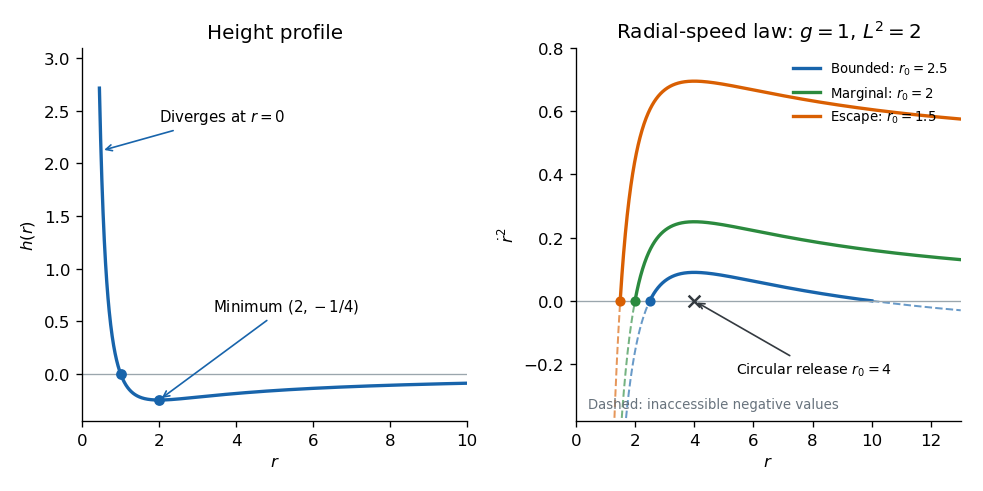
For the radial height profile, is positive for , zero at , and negative for . Its derivative is , so the minimum is . It diverges to positive infinity as and tends to from below as . The requested profile sketch is shown below.
The equations in polar coordinates in the planar approximation areMultiplying the second equation by gives . Thus the specific angular momentum is conserved, andAt release with negligible radial velocity, the initial specific kinetic energy is indeedIt is not the total energy. Put . The conserved specific total energy and effective potential areThe radial turning points for an inverse-square height well follow fromAs a function of , this expression tends to at zero, has its maximum at , and tends to at infinity. Only regions where it is nonnegative are dynamically accessible. If , there are two positive turning radii,and the radial coordinate is confined between them. They merge at , the circular orbit. If , the particle escapes to arbitrarily large radius with radial speed tending to zero; if , it escapes with positive limiting radial speed. Consequently the bounded-orbit condition, including the circular case, isThe circular release is at . For , the release point is the smaller turning radius; for , it is the larger one. These statements concern the prescribed planar small-slope model. The literal surface is steep near its central singularity, so that approximation must be valid along the particular orbit under consideration.

Past exam of the mathematics course of the University of Cambridge 2005 ia Paper 4 10C Solution Created 2026-09-24 Updated 2026-10-14
The rim-mass wheel has moment of inertia . A uniform solid cylinder has axial moment , so the roller of mass has . No slip gives equal contact speeds, , when denote angular-speed magnitudes. ThereforeWith parallel signed axes the two angular velocities have opposite signs. Their kinetic energies add regardless of that convention:The reflected inertia of a no-slip wheel and roller must be used because accelerating the wheel also accelerates the roller. The transmitted contact forces redistribute energy without dissipating it. For an applied wheel torque , the input power is , so the work-energy theorem gives , or ; this also holds at rest by continuity or the constrained equation of motion.
Assume the driving constants are positive. With the speed-dependent torque,Separating this linear equation givesFor the fan, its resisting roller torque dissipates power . Expressing this in the wheel coordinate gives a resisting wheel torque . Thus, with ,The right-hand side is positive at zero, strictly decreasing for nonnegative , and has a unique positive zero; the wheel starting at rest approaches this terminal angular speed. HenceFor a nonzero fan drag this is less than , and as it tends to . The cubed radius ratio is essential: one factor arises from converting roller power to wheel torque, in addition to the two factors in .
Past exam of the mathematics course of the University of Cambridge 2005 ia Paper 3 9A Solution Created 2026-09-24 Updated 2026-10-14
Assume sufficient smoothness and a regular boundary for the integrations below, with outward. Put , so on . Expanding the Dirichlet energy givesBy Green's first identity, the middle integral isThus the Dirichlet principle follows with an explicit remainder:Equality means is constant on each connected component; its zero boundary value forces that constant to be zero.
Now let solve the heat equation and set . Differentiation followed by Green's first identity givesUnder time-independent Dirichlet boundary conditions, on , while in . ThereforeIf equality holds at a particular time, continuity makes throughout at that time. Its boundary values are still , so uniqueness of the Dirichlet problem implies . Conversely has and gives equality. This proves the full equality criterion for Dirichlet energy dissipation for the heat equation.
For the dynamic boundary condition for the heat equation, substitute directly into the boundary term. The interior equation is unchanged, soThis is Dirichlet energy dissipation with a dynamic heat boundary condition. It remains valid when vanishes, because no division by is used. The last part preserves energy monotonicity; its stationary states need not have the earlier prescribed Dirichlet data. For example, with strictly positive on a connected boundary, a stationary harmonic state has zero outward normal derivative and is constant, as follows by applying Green's first identity to that state itself.
Past exam of the mathematics course of the University of Cambridge 2005 ia Paper 3 8D Solution Created 2026-09-24 Updated 2026-10-14
First is a linear subspace. To prove it is nonzero, use orthogonality and :Hence . If then also implies . For ,so is invariant. If had dimension two, its one-dimensional orthogonal complement would be invariant and would act there as a scalar . The determinant would be , so , forcing . Dimension three also forces . Both contradict the hypothesis. ConsequentlyChoose an orthonormal basis beginning with a unit vector in and followed by a basis of . In this basis the orthogonal matrix has block formThe first column of is some . Its perpendicular unit second column with positive orientation must be . Thus the restriction is the plane rotationTrace invariance gives , provingA Euclidean reflection in fixes that plane pointwise and reverses , so it occurs exactly when . This is equivalent to , hence exactly to . Finally,This exhibits the three-dimensional improper orthogonal transformation as a rotation about the axis composed with Euclidean reflection in .
Past exam of the mathematics course of the University of Cambridge 2005 ia Paper 3 7D Solution Created 2026-09-24 Updated 2026-10-14
The identity belongs to the center of a group. If are central, then for every ,so the center is a subgroup. For a central , for every , giving . Thus the center is a normal subgroup.
Write a matrix of the Heisenberg group as . Direct matrix multiplication and inversion giveThe identity is and each matrix has determinant one, so these formulas show closure under products and inverses inside . Hence is a subgroup.
The two products and differ only in their upper-right entries, by . Commutation with every therefore requires for all real . Setting forces ; setting forces . These conditions are also sufficient. ThusDefine the surjective group homomorphism by . The multiplication formula gives , and its kernel of a group homomorphism is precisely . The first isomorphism theorem yieldsThis center quotient of the real Heisenberg group can also be checked directly: two elements have the same coordinates exactly when they differ by multiplication by a central element, and quotient multiplication adds these coordinates.
Past exam of the mathematics course of the University of Cambridge 2005 ia Paper 3 6D Solution Created 2026-09-24 Updated 2026-10-14
Represent the Riemann sphere by the complex projective line, with finite represented by and infinity by . An invertible matrix acts by , giving the stated fractional map on finite points. Applying and then is exactly matrix multiplication , including at poles and infinity. Thereforeso is a group homomorphism from the special linear group to the Möbius group.
Every Möbius transformation has an invertible complex matrix representative . Choose with . Such a nonzero square root exists in , and has determinant one while representing the same projective map. This proves surjectivity. If the map is the identity, fixing zero and infinity forces , and fixing one forces . The determinant-one condition gives . Conversely both scalar matrices and act trivially. HenceFor the normal forms, use the fact that a complex matrix has a Jordan normal form: either it is diagonalizable or it has one nontrivial Jordan block. For a determinant-one representative, distinct eigenvalues are . Diagonalizing gives , whose projective action is . Distinctness means , so is neither zero nor one.
If the eigenvalue is repeated, the determinant condition gives . A diagonalizable representative would be and would give the identity, excluded here. A nontrivial Jordan block is similar to , giving . Any invertible conjugating matrix gives a Möbius transformation; rescaling it to determinant one does not change that map. Thus these matrix similarities are genuine conjugacies in the Möbius group, proving the requested Möbius conjugacy normal forms.
Conjugacy preserves fixed points bijectively. A nonidentity scaling has exactly the two fixed points zero and infinity, while either translation has exactly one, infinity. The identity fixes every point. This proves all three possibilities and excludes any further finite number of fixed points.
Finally, suppose , with and . Then for every finite in the topology of the Riemann sphere; infinity remains infinity. Since is continuous on that sphere,This is iteration of a one-fixed-point Möbius transformation. The limiting statement includes the unique fixed point itself and uses spherical convergence, which also handles intermediate iterates equal to infinity.
Past exam of the mathematics course of the University of Cambridge 2005 ia Paper 3 5D Solution Created 2026-09-24 Updated 2026-10-14
A group action is a map from to satisfying and . Define the orbit of a group action and the stabilizer subgroup . The latter is a subgroup: the identity fixes , products of elements fixing fix , and inverses do too.
For finite , the orbit-stabilizer theorem statesTo prove it, send a left coset to . If , then and . Conversely, equality of the two images implies , hence equality of the cosets. Every point of the orbit of a group action has such a preimage. This is therefore a bijection, and each coset has elements, proving the formula.
For the action on subgroups, conjugation maps a subgroup to a subgroup because it preserves products and inverses. Furthermore andThus this is the conjugation action. The stabilizer subgroup of is its normalizer , and since each conjugates onto itself. Hence the number of distinct conjugate subgroups isNow suppose is proper. Put and list the distinct conjugate subgroups as . Each has elements and all contain the same identity. Counting the identity just once, even if other elements overlap, givesThus some element of lies in no conjugate of . This proves conjugates of a proper subgroup do not cover a finite group by an explicit count; it does not require the conjugates to intersect only at the identity.
Past exam of the mathematics course of the University of Cambridge 2005 ia Paper 3 4A Solution Created 2026-09-24 Updated 2026-10-14
For the unit-speed curve, the unit tangent vector, curvature of a space curve, principal normal vector and binormal vector areDifferentiating gives , so form a positively oriented orthonormal basis. The hypothesis makes the principal normal vector well-defined.
To determine the sign of the torsion of a space curve without relying on a pictorial handedness convention, take , , and use the unit-speed circular helixWriting , direct differentiation gives its Frenet frame:ConsequentlyAt the marked point is , with , , and . For , points opposite to and the torsion of a space curve is positive. Replacing by reflects the circular helix across the horizontal plane and makes the torsion of a space curve negative; then points in the same direction as . The direction of increasing is fixed in both panels.
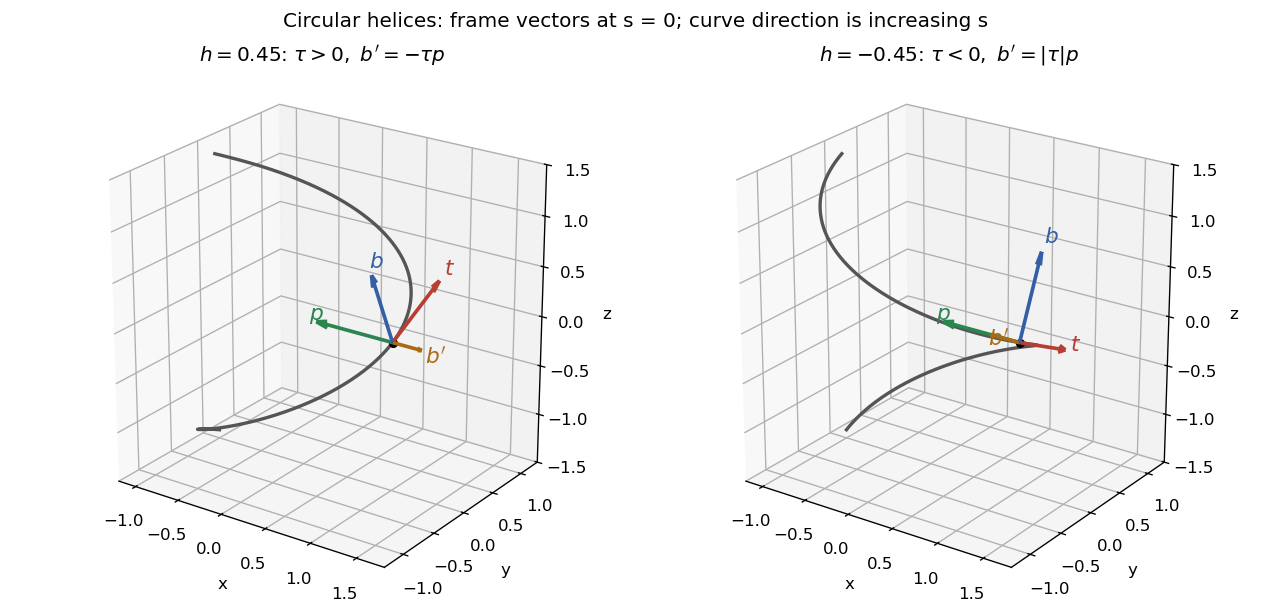
Unit-speed circular helices of opposite torsion, with tangent, principal normal, binormal and binormal derivative at the marked point
. Details. 
Past exam of the mathematics course of the University of Cambridge 2005 ia Paper 3 3A Solution Created 2026-09-24 Updated 2026-10-14
Let . The time equations and the dot product differentiation rule give the local identityThe divergence of a cross product isCombining them yields . On a fixed bounded region with a boundary regular enough for the divergence theorem, differentiating under the integral and applying that theorem givesHere is the outward unit normal, so the sign expresses loss of the interior quadratic quantity by outward flux. No vanishing-boundary assumption is required.
Past exam of the mathematics course of the University of Cambridge 2005 ia Paper 3 2D Solution Created 2026-09-24 Updated 2026-10-14
A cyclic group is a group generated by a single element: there is such that every element is for some integer . For a finite group of prime order , choose . Its cyclic subgroup has order dividing by Lagrange's theorem, and its order is greater than one. Hence , and . Thus every group of prime order is cyclic.
A group homomorphism from is determined by , since . Its image generator must satisfy , so its order of a group element divides . As an element of its order also divides . These integers are coprime, so the only possible order is one. Thus , andThis map is indeed a group homomorphism, so there is exactly one, the trivial homomorphism.
Past exam of the mathematics course of the University of Cambridge 2005 ia Paper 3 1D Solution Created 2026-09-24 Updated 2026-10-14
By the spectral theorem for real symmetric matrices, choose an orthonormal eigenbasis with . If , thenThus every point of the ellipsoid has distance at least from the origin. Equality holds precisely whenBoth coefficients are strictly positive, so . The surface equation then gives . ThereforeExactly two points attain the minimum. The strict ordering makes the largest-eigenvalue eigenspace one-dimensional; this is the equality case in nearest points to the origin on a positive-definite ellipsoid.
Past exam of the mathematics course of the University of Cambridge 2005 ia Paper 3 12A Solution Created 2026-09-24 Updated 2026-10-14
The substitution is nonsingular in the interior , , . Its inverse isThus is equivalent to , while is equivalent to . Positivity gives the full transformed domainThe forward Jacobian determinant isTherefore . The boundary faces where the formula fails have measure zero. The change of variables formula givesThe integrand is nonnegative, so Tonelli's theorem permits reordering the integration even before convergence has been established. Integrating first in , then in , givesThe assumptions make all three integrals of exponential functions converge. Equivalently, the ordered-cone substitution by products and ratios can be followed by the increment variables , , , all independently positive and with Jacobian determinant one; the exponent then separates into three linear terms with coefficients , and .
There are unlisted articles, also show them or only show them.