
Bounded definition of omega 2026-10-31
In ZF, is the least nonzero limit ordinal. Ordinality is expressed by a bounded formula in set theory asserting transitivity and strict total membership order, with well-foundedness supplied by the Axiom of foundation. Put . Then is equivalent over ZF to , again bounded. Therefore nested transitive models of ZF have the same .
Legendre expansion of the sign function 2026-10-31
For normalized Legendre polynomials , parity makes the sign function orthogonal to every even index. Integrating the Legendre differential equation gives . The differentiated generating function gives the derivatives at zero and hence the displayed odd coefficients. The Parseval identity and squared norm two then evaluate .
Legendre polynomial evaluation representer 2026-10-31
For orthonormal Legendre polynomials on , the polynomial represents evaluation at zero on polynomials of degree at most : . This follows by expanding in the orthonormal basis, or from the Riesz representation theorem. With and , orthonormality givesThe last identity telescopes using . The norms are unbounded: makes the sum dominate a divergent harmonic series. Thus the evaluation identities hold eventually for every fixed polynomial but cannot extend to convergence for every vector, by the Uniform boundedness principle. Point evaluation is also not defined on equivalence classes.
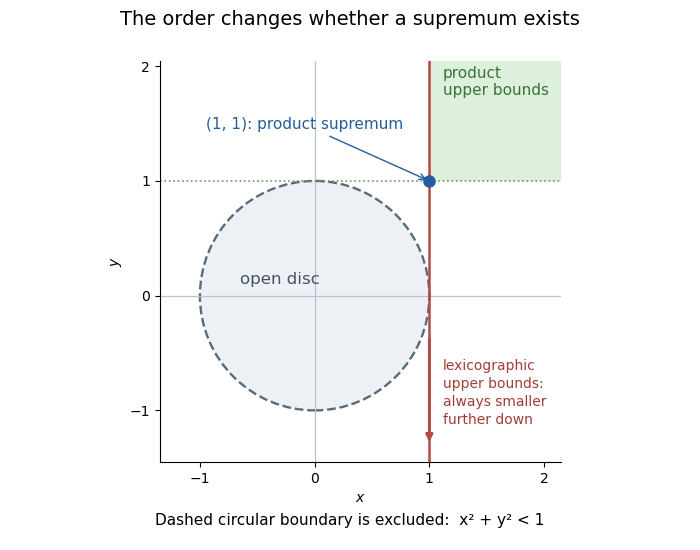
For , the product order gives least upper bound , because each coordinate has supremum one. The lexicographic order instead has no least upper bound. Every point is an upper bound, but is a strictly smaller upper bound; a point with first coordinate below one cannot bound the disc. The same geometric set therefore has different order-completeness behavior under the two partial orders. Neither conclusion is determined by the usual drawing alone.

Specific latent heat of vaporization 2026-10-31
The energy per unit mass required to change a saturated liquid to vapour at a stated pressure and coexistence temperature. In a steam-condensation calorimetry experiment, sensible cooling of the condensate must be subtracted from the measured receiver heat gain.
Power-law river kinematic wave 2026-10-31
With constant lateral supply , a discharge law of the displayed form gives equilibrium area and characteristic speed . Under a Chezy law, a wetted-perimeter relation gives . Small area perturbations are transported downstream with amplitude inversely proportional to this characteristic speed; finite compressive disturbances can still form shocks because the flux is convex.
Let , increasing until and decreasing afterwards. For dry initial data and zero upstream depth, a characteristic emitted at time has and position , for as long as its depth stays nonnegative. The height follows by integrating the source along a characteristic, and the position follows from the derivative of the Manning flux.
When and , define the earlier emission time by . The front where this water is just exhausted hasIt moves downstream because . Behind it depth is zero; ahead, unexhausted characteristic labels determine the wet profile. This construction presumes removal limited by water availability: continuing a negative source unchanged at zero depth would violate nonnegativity. If reaches zero, the remaining initially generated water has also vanished.
Matrix norm induced by an energy norm 2026-10-31
For a real symmetric positive-definite matrix , the energy norm is . In the defining supremum of the induced matrix norm, substitute . The matrix square root is an invertible matrix, so this ranges over every nonzero vector and proves the displayed identity. This matrix similarity is useful because contraction in the energy norm becomes an ordinary Euclidean operator norm estimate after a change of coordinates.
Row-column bound for the matrix 2-norm Created 2026-10-31 Updated 2026-11-05
For each row, the weighted Cauchy-Schwarz inequality gives . Summing over rows bounds the result by the maximum absolute row sum times the maximum absolute column sum times . Taking square roots and the supremum proves the displayed induced matrix norm inequality. It gives a Euclidean estimate directly from entries without computing singular values.
First-order Horn clause 2026-10-31
A first-order clause containing at most one positive first-order literal. A clause with exactly one positive literal is definite; with no positive literal it is a constraint or goal clause.
Flex configuration of the Hesse pencil 2026-10-31
For primitive and , these nine points are the inflection points of every nonsingular finite member of the Hesse pencil. On the cubic, substituting the equation into its Hessian curve gives . Nonsingularity forces one coordinate to vanish, and the remaining two cubes sum to zero, producing exactly the nine displayed points. They are the fixed base configuration of the pencil, independently of its smooth parameter.
Ore's theorem 2026-10-31
Ore's theorem, named after Øystein Ore, says that a finite simple graph with vertices is Hamiltonian if every nonadjacent pair has degree sum at least .
For a proof, enlarge a hypothetical counterexample to an edge-maximal non-Hamiltonian graph. Adding a missing edge creates a Hamiltonian cycle, hence the original graph has a Hamiltonian path . If both and are edges, the path closes to a cycle by reversing its final segment. Thus the index sets of these two kinds of edges are disjoint in , giving , a contradiction. The degree condition is sufficient and need not follow from a lower bound of on every individual degree.
Let be a first-order consistent arithmetic first-order theory with the Hilbert-Bernays-Löb derivability conditions, and suppose . Provability of and provability of falsity are equivalent inside , because either refutable first-order sentence implies the other. Thus is equivalent inside to its formal consistency statement. The second incompleteness theorem gives .
For integers , the standard Rodrigues' formula has the endpoint value and squared norm displayed above. The lowest-power term after differentiations is , giving the endpoint value after division by . For the norm, integrate by parts times against the same polynomial; its leading coefficient is , so the final derivative is . All boundary terms vanish and the remaining Gamma function integral is . Normalizing the value at zero to one divides the polynomial by and its squared norm by the square of that factor. Only when or do these normalizations already coincide.
GNS representation of a vector state 2026-10-31
For a vector state on a C-star algebra, and . Thus is a well-defined linear isometry from the quotient pre-Hilbert space onto . It extends to an isometry from the completed GNS space onto : its range is complete and therefore closed, and contains the dense subspace . The space is invariant under both and its adjoints. On quotient vectors, , proving the displayed unitary equivalence after continuity. The cyclic vector maps to .
If , then , since the rank-one map sends to any chosen . In this case, for the rank-one orthogonal projection , is equivalent to , by evaluating at and using .
GNS dimension from density matrix rank 2026-10-31
For the state on a C-star algebra on , the GNS construction has the displayed Hilbert-space dimension. Here is a density matrix. Its null space for the GNS seminorm consists of with , because . Thus the GNS space is the space of matrices with the Hilbert-Schmidt inner product. If has rank , diagonalization identifies these matrices with arbitrary columns, giving dimension . Left multiplication is the representation and is its cyclic vector. In particular a pure rank-one matrix state gives the defining -dimensional representation, while a full-rank state gives a -dimensional space.
On the C-star algebra of convergent complex sequences, a functional in the displayed coordinate representation is a state on a C-star algebra exactly when all its weights are nonnegative and sum to one. Coordinate projections test positivity of at finite indices. Positive sequences with the first terms zero and the rest one test after passage to the limit. The known dual isometry makes the norm the sum of the absolute weights, proving necessity and sufficiency.
If only finitely many weights are positive, the GNS construction identifies the quotient by with the values at precisely those supporting indices. Its inner product is the weighted coordinate inner product. Passing to the standard Hilbert norm gives diagonal evaluation operators and cyclic vector whose entries are the square roots of the weights. Arbitrary finite coordinate values and the limiting value can be assigned independently by a convergent sequence, which proves cyclicity. For weights at infinity and at each of the first two indices, the space is and the cyclic vector is .
Prime-power contraction in a formal group 2026-10-31
Let be the valuation ring of a complete non-Archimedean valued field whose residue field has characteristic , and let . For a one-dimensional formal group law over , repeated addition gives with . Hence . The series converges for because its coefficients are bounded and .
For and , choose . The values remain in the ball , so . Associativity identifies . The argument also works in equal characteristic , where the linear coefficient vanishes, and does not require a discrete valuation. It proves contraction of prime-power multiplication near the formal identity without assuming a characteristic-zero formal logarithm.
Formal torsion radius for prime power order 2026-10-31
Let a one-dimensional formal group law be defined over the valuation ring of a complete discretely valued non-Archimedean valued field of characteristic zero and residue characteristic . If in the maximal ideal has exact formal order , its absolute value satisfies the displayed lower bound. Use the coefficient splitting , where and . On the maximal ideal, and . If , the first term strictly dominates, so and repeated multiplication never reaches zero. Every nonzero -power torsion point is therefore at least that large.
The lowest even quantum harmonic oscillator quantum state has density , and the lowest odd quantum state has density . Since , integration by parts gives whenever the boundary terms vanish. For , this proves the displayed identity. Odd moments vanish in both quantum states by parity; even moments quantify the larger spatial spread in the odd quantum state. In particular the relative-coordinate variance is three times as large, and the odd density vanishes at particle coincidence.
There are unlisted articles, also show them or only show them.