
Constant-stress Reynolds-averaged wall flow 2026-10-14
For a stationary, horizontally homogeneous mean flow without a horizontal pressure gradient, the averaged horizontal Navier-Stokes equation is . Integrating gives the displayed physical shear stress. The derivative of the Reynolds covariance belongs in the stress-divergence equation, not inside the stress itself. The kinematic stress is , which must be used when an eddy viscosity with units of kinematic viscosity multiplies the mean gradient.
For shear , the spatially averaged perturbation kinetic energy obeys . Pressure and the Coriolis force do no net work. Thus positive radial-azimuthal velocity correlation extracts mean-flow energy. A leading two-dimensional shearing wave has .
// Target: astrophysics.bigb
Rotating anisotropic convection can produce an azimuthal-meridional velocity correlation even without a gradient of the mean rotation rate. Its Reynolds stress transports angular momentum and can drive differential rotation, whereas a purely viscous closure only erases shear. Energy comes from the thermally driven convection; the Coriolis force changes the correlations but does no work on a parcel.
At zero frequency, sum the Kaluza-Klein tower of three-spatial-dimensional Yukawa kernels: . The geometric series gives the displayed function. It behaves as for , the four-spatial-dimensional Coulomb kernel, and as for , the three-spatial-dimensional kernel with a zero-mode normalization factor.
Sylvester matrix Created 2026-10-14 Updated 2026-10-18
For polynomials of polynomial degrees , the Sylvester matrix has shifted coefficient rows of followed by shifted rows of , using descending-power order. It is a square matrix of size . Its transpose represents the linear map with , ; its determinant is the resultant.
For an original parameter example, choose and . ThenThe two lists of coefficients become three rows because is multiplied by both and . Thus the common-root parameter values are and . At , the resultant is , so the two polynomials have no common root.
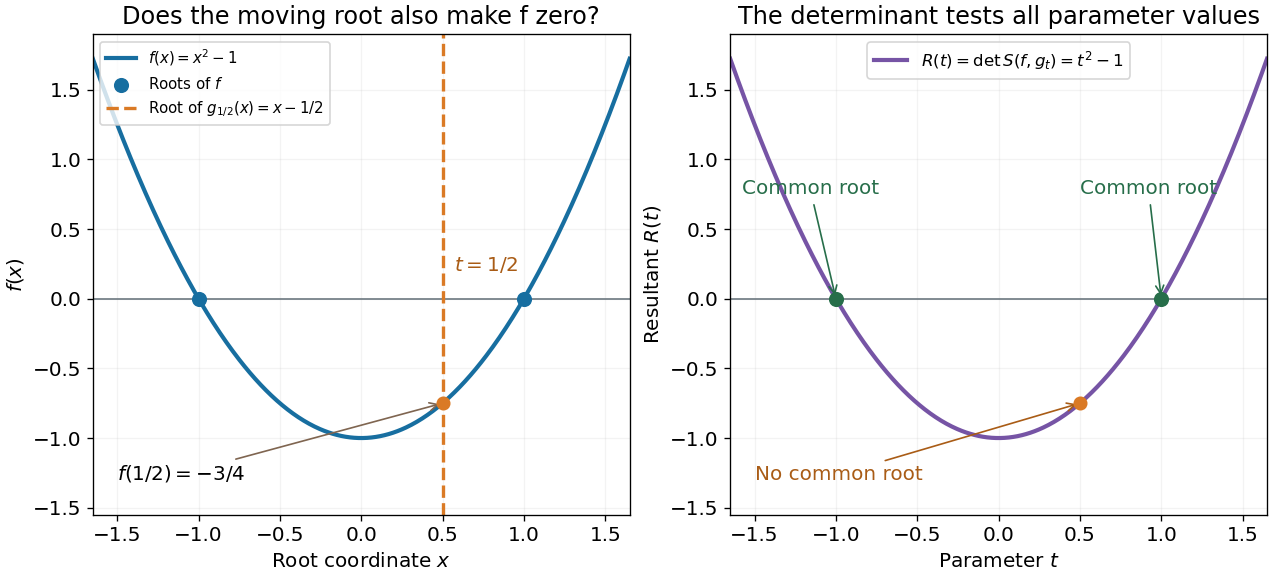

One can verify the certificate without any determinant expansion:For , division by gives a Bézout's identity for polynomials. At , the identity instead becomes a nontrivial cancellation between multiples of two polynomials sharing the polynomial factor .
The general proof needs only a short linear algebra outline. A common polynomial factor gives a nonzero cancelling pair within the degree bounds, making the Sylvester matrix singular. Conversely, if are coprime polynomials and , then divides ; the bound forces and then . Thus the linear map has zero kernel of a linear map exactly in the coprime case. Over an algebraic closure, a nonconstant common polynomial factor is equivalent to a common root.
In 1840, James Joseph Sylvester described forming the shifted coefficient rows and taking a signed sum of products selected by permutations. In modern notation, this is the Sylvester matrix and its determinant. The construction turns the nonlinear common-root of a polynomial question into linear algebra. His paper's word derivatives concerns elimination, rather than the formal derivative used below.[ref]
A method of determining by mere inspection the derivatives from two equations of any degree. The Collected Mathematical Papers of James Joseph Sylvester, Volume I; Paper 9, A method of determining by mere inspection the derivatives from two equations of any degree; Collected Mathematical Papers, volume I (1904), pp. 54–55, rules 1–4; original Philosophical Magazine XVI (1840), pp. 132–135
Resonance hybrid 2026-10-14
A resonance hybrid is the combined electronic description expressed using several resonance structures. The word does not describe a mixture of separate molecules or ions: a nitrate ion has one electron density, rather than three species in chemical equilibrium. Equal weighting is appropriate for the equivalent nitrate contributors in the elementary model; the unequal carbon dioxide contributors illustrate why it is not a general rule. See Chemistry 2e, 7.4: resonance hybrids do not fluctuate between forms.
Resonance structure Created 2026-10-14 Updated 2026-10-20
A resonance structure is one Lewis structure contributing to a chemical resonance description. The contributors retain the same atomic nuclei in the same positions, the same connections, and the same total valence electron count and electric charge; allocations of bond pairs, lone pairs, and formal charges differ. They are alternative representations of one electronic structure, not distinct substances with different atomic arrangements. See Chemistry 2e, 7.4: resonance forms.
Head-drag correction to planar flagellar propulsion Created 2026-10-14 Updated 2026-11-05
For a small-slope inextensible filament with prescribed transverse coordinate , tangential-to-normal resistance ratio , and head drag parameter , transverse force balance gives . The mean axial swimming speed is . The mean material longitudinal deformation velocity vanishes for a periodic inextensible stroke anchored longitudinally at its base. A moving base offset must be distinguished from a coordinate measured relative to the actual attachment point.
Basal bending moment of a planar flagellum 2026-10-14
At leading order in slope, the hydrodynamic torque on the distal filament is . The displayed opposite torque is required at its base. It is the total internal bending moment; identifying it with the active moment assumes no separate passive elastic moment. If a passive moment is specified, subtract that contribution to determine the required active moment.
Nonlinear resistive-force balance for a travelling filament Created 2026-10-14 Updated 2026-11-05
For an inextensible planar filament with tailward tangent , a travelling shape has material velocity in stationary fluid. Thus the relative fluid velocity is the displayed vector. With and , a local inertial normal drag has axial component . A positive tangential slip gives the opposite axial force. A prescribed tangential law therefore gives the force-free balance . The weight is part of the constitutive approximation and must be justified separately from its speed exponent.
Linear resistive-force propulsion of a travelling filament Created 2026-10-14 Updated 2026-11-05
For a periodic inextensible filament, let , , and . The material velocity is . Applying the linear local drag tensor gives thrust . Equating this to head drag gives the displayed speed ratio. Whole spatial periods, or period averages, are needed for . Cauchy-Schwarz gives , with equality only for constant axial tangent projection almost everywhere.
For a heavy spherical head with a much thinner long rigid tail, let be its excess weight, the head translation resistance, and the tail normal translation resistance. Neglect tail mass relative to head mass, sphere rotation resistance relative to tail rotation resistance, and in tail lever arms. In shear , the stable orientation satisfies , , with . Resolving resistive-force theory force and torque balance gives the displayed signed vertical velocity. Since , stronger shear increases towards zero and reduces the downward settling speed. The stable head is below the far tail end. Very large shear can make the neglected sphere-rotation contribution significant.
Four-terminal sensing 2026-10-14
Four-terminal sensing uses one pair of contacts to carry electric current and a separate pair to sense electric potential difference. The sensing instrument draws negligible electric current, so the voltage drops along its own leads are negligible, and the current-contact drops outside the sensing interval are excluded. A measurement using just two shared leads includes their electrical resistance and contact drops, which can overwhelm the small sample signal in a resistance-versus-temperature experiment for superconductivity. Four contacts do not automatically remove offsets from the thermoelectric effect. [ref]
https://www.tek.com/en/documents/technical-article/low-voltage-measurement-techniques. Tektronix, Low-Voltage Measurement Techniques, four-lead arrangement and thermoelectric offsets
For a stable offset , let denote the magnitude of the reversed electric current. The measured electric potential differences are and , so subtraction gives the displayed electrical resistance. For example, with stipulated , and , the two readings are and ; their difference correctly recovers . If the offset changes between readings, its change leaves a residual measurement error; the sample and measuring circuit must remain sufficiently stable during reversal.
Finite residual Created 2026-10-14 Updated 2026-11-05
The finite residual consists of all elements killed by every homomorphism to a finite group. A group is a residually finite group precisely when its finite residual is trivial. Intersecting all finite-index subgroups gives the same result: the normal core of each such subgroup is normal of finite index and lies inside it.
Symmetric-group characters are integer-valued Created 2026-10-14 Updated 2026-11-05
The character of a Young permutation module counts fixed tabloids and is integer-valued. Dominance order on partitions makes its decomposition into Specht modules triangular with diagonal multiplicity one. Descending induction in any order refining dominance therefore expresses each irreducible Specht character as an integer combination of permutation characters, proving integrality.
Induction ring of symmetric-group characters Created 2026-10-14 Updated 2026-11-05
The graded abelian group of ordinary virtual characters has product for degrees . Its unit is the trivial degree-zero character. Associativity follows by transitivity of induced representations through the three-factor Young subgroup; commutativity follows by conjugating the block positions. The Frobenius characteristic map identifies this ring with the ring of symmetric functions, sending irreducible Specht characters to Schur functions. This product is different from pointwise multiplication of characters of the same symmetric group.
Conjugate fundamental spinor of SU(2) 2026-10-14
For the defining SU(2) action , the conjugate row transforms by . Thus is invariant. The alternating invariant tensor satisfies . Choose its inverse ; then . Raising the conjugate index, , gives another defining spinor. The resulting antilinear intertwiner squares to , so the defining representation is a pseudoreal representation.
For the block-rotation maximal torus in the special orthogonal group , the Weyl group acts by permutations and independent inversions of . Its invariant Laurent polynomials are the symmetric polynomials in , hence the polynomial ring in their elementary symmetric polynomials . Restriction of the group representation ring of a compact group is injective because every group element is conjugate into the torus and characters distinguish virtual representations. For the defining complexified representation , the exterior-power characters satisfy . For , its coefficient is plus an integral linear combination of for . Induction puts every in the restriction image, proving equality with the invariant ring and giving polynomial generators .
Decimal preperiod 2026-10-14
The shortest prefix before the repeating tail of a decimal representation. For a reduced fraction with denominator , where is coprime to ten, its length is ; the tail length is given by decimal period from multiplicative order.
Mean logarithmic stretching in an isotropic renovating shear Created 2026-10-14 Updated 2026-11-05
For independent uniform orientations in a renovating shear flow, the incident angle relative to each new shear is uniform even after earlier deformations. One interval stretches a unit material line by . Write this as , where and . The angular logarithmic integral gives . Add these independent logarithmic increments to get the displayed rate. At fixed shear rate, small gives and large gives . The unique positive maximum is at , obtained from with .
There are unlisted articles, also show them or only show them.