
The chemical element with atomic number 92. Its long-lived radioactive isotopes illustrate actinide production by the rapid neutron-capture process.
Isotopes of a chemical element have the same atomic number , hence the same number of protons, but different neutron numbers and therefore different mass numbers . For example, every neon atomic nucleus contains ten protons: neon-20, neon-21, and neon-22 contain ten, eleven, and twelve neutrons, respectively. They occupy one chemical element box in the periodic table, rather than three boxes.
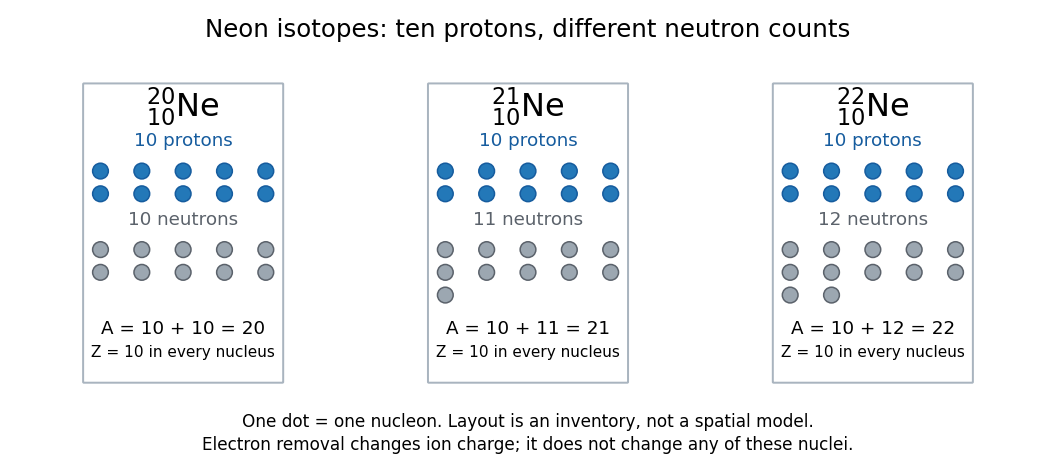

Three labels answer different questions. The chemical element fixes ; the isotope specifies which neutron number accompanies that ; the ion label specifies the net electric charge. Neutral and the ion both contain ten protons and twelve neutrons; they contain ten and nine electrons, respectively. Ordinary ionization changes the electron count, leaving the isotope unchanged. Changing the neutron number can change nuclear binding energy and the possibility of radioactive decay. Isotopic abundances can help distinguish material sources, while radioactive decay can additionally supply chronological information.
A mass spectrum makes the distinction experimentally visible: a single chemical element can give separate ion peaks at different mass-to-charge ratios. Its bulk atomic weight is a weighted mean governed by isotopic abundances, rather than the location of one compulsory peak. The historical mass spectrograph experiment and the synthetic neon mass spectrum below illustrate these complementary observations.
A nuclear species specified by atomic number, mass number, and nuclear energy state. Isotopes compare nuclides with the same atomic number; changing only the nuclear energy state does not create a different isotope.
Lithium is the chemical element with atomic number three. Its stable isotopes include lithium-6 and lithium-7. Lithium observed in old stellar atmospheres is an important but processing-sensitive test of Big Bang nucleosynthesis.
Beryllium is the chemical element with atomic number four. Its isotope beryllium-7 provides an important route to primordial lithium-7.
The atomic number is the number of protons in an atomic nucleus, and fixes the chemical element. It is a count, with no units. An atomic nucleus with six protons is always carbon, regardless of how many neutrons accompany them or how many electrons surround it. See the IUPAC Gold Book, atomic number.
Three independent bookkeeping questions become easy once their symbols are kept separate. Let count neutrons, count electrons, be the mass number, and be the net electric charge. A proton carries electric charge and an electron carries , where is the positive elementary charge; a neutron carries zero net electric charge. HenceThe reasoning is just counting: add protons and neutrons for , and subtract negative electron contributions from positive proton contributions for . A neutral chemical atom has , so . For a positively charged ion, fewer electrons remain. Notation gives the mass number at upper left and atomic number at lower left, with standing for the chemical element; a right superscript such as specifies the electric charge in units of . See Flowers et al., Chemistry 2e, atomic structure and symbolism.
For neutral carbon-12, , the atomic number gives six protons, the subtraction gives six neutrons, and neutrality gives six electrons. Neutral carbon-13, , instead has neutrons, with the same six protons and six electrons. Thus these two isotopes occupy the same carbon box in the periodic table.
For neutral sodium of mass number , , the counts are eleven protons, neutrons, and eleven electrons. Removing one electron gives the ion : , so . Both its atomic number and its twelve neutrons stay unchanged. This is ionization, not conversion into the chemical element neon, even though a neutral neon chemical atom also has ten electrons.
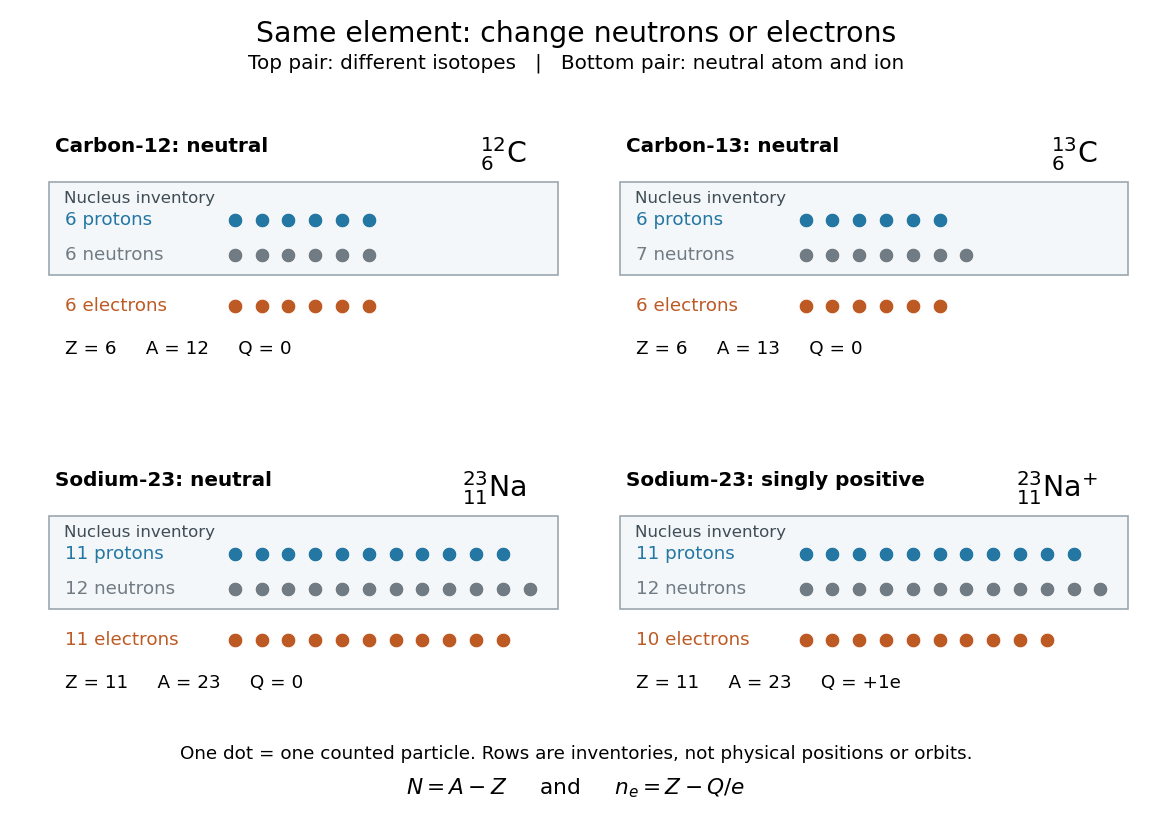
Atomic number fixes chemical element identity: changing isotopes changes neutrons, while forming a sodium ion changes electrons
. The dots are counting tokens, with protons and neutrons in an atomic nucleus inventory and electrons in a separate inventory. Their layout does not depict physical positions, sizes, or orbits. Neutral carbon-12 and carbon-13 differ by one neutron; neutral sodium of mass number 23 and its singly positive ion differ by one electron. Details.
This bookkeeping is useful whenever a symbol must be translated into a physical inventory. Mass number answers how many protons plus neutrons there are; electric charge answers the imbalance between protons and electrons; atomic number alone answers which chemical element it is. Keeping those questions distinct prevents an isotope or an ion from being mistaken for a different chemical element.
Potassium is the chemical element with atomic number 19 and symbol . It is a alkali metal. It commonly forms . The ion plays a major role in cellular electrical gradients, whereas elemental potassium is a reactive metal; nutritional or physiological statements about potassium normally concern its compounds and ions.[ref]
Calcium is the chemical element with atomic number 20 and symbol . It is a alkaline earth metal. Its common ion is . Calcium in calcium carbonate or a biological signaling system is present in chemically bound or solvated forms, rather than as elemental metal; this distinction is essential when connecting mineral and biological chemistry.[ref]
Sodium is the chemical element of atomic number eleven. Carbon-fusion channels in carbon burning include , producing sodium-23 and a proton. Its abundance in expelled stellar material depends on later reactions and mixing, rather than on this one production channel alone.
The chemical element with atomic number eighteen. Argon is a colourless noble gas. It can provide a protective atmosphere around hot, reactive materials, for example in welding, where excluding oxygen limits oxidation. Commercial production separates it by distillation of liquid air.[ref]
Argon — Element information, properties and uses. Periodic Table by Royal Society of Chemistry; Fact box, Uses and Natural abundance: atomic number, group, protective atmosphere and liquid-air distillation
Its discovery shows why a small disagreement can matter more than a reassuringly repeatable result. Two preparations can each give consistent measurements while producing different mixtures. The Rayleigh-Ramsay argon density experiment investigated just such a discrepancy. Gas density links the weighing to a mean molar mass; a separate separation process tests which component accounts for it.
The chemical element with atomic number seventeen.
The chemical element with atomic number sixteen.
The chemical element with atomic number fifteen.
The chemical element with atomic number thirteen.
The chemical element with atomic number nine.
The chemical element with atomic number five.
The periodic table arranges chemical elements in increasing atomic number, across successive periodic table periods. Its columns are periodic groups, numbered 1–18. The layout places recurring outer electron configurations above one another, making similarities in chemical bonds and chemical reactions easier to recognize. Ordering is by proton count, not by mass; the mass number of a particular isotope does not determine its box. See the official IUPAC periodic table and numbering conventions.
For the first eighteen neutral chemical atoms in their ground states, a compact description counts electrons in successive electron shells. Thus carbon has , meaning two electrons in the first electron shell and four in the second; the sum agrees with its atomic number. Sodium has , whose sum is . These are occupancy counts, not circular trajectories of electrons.
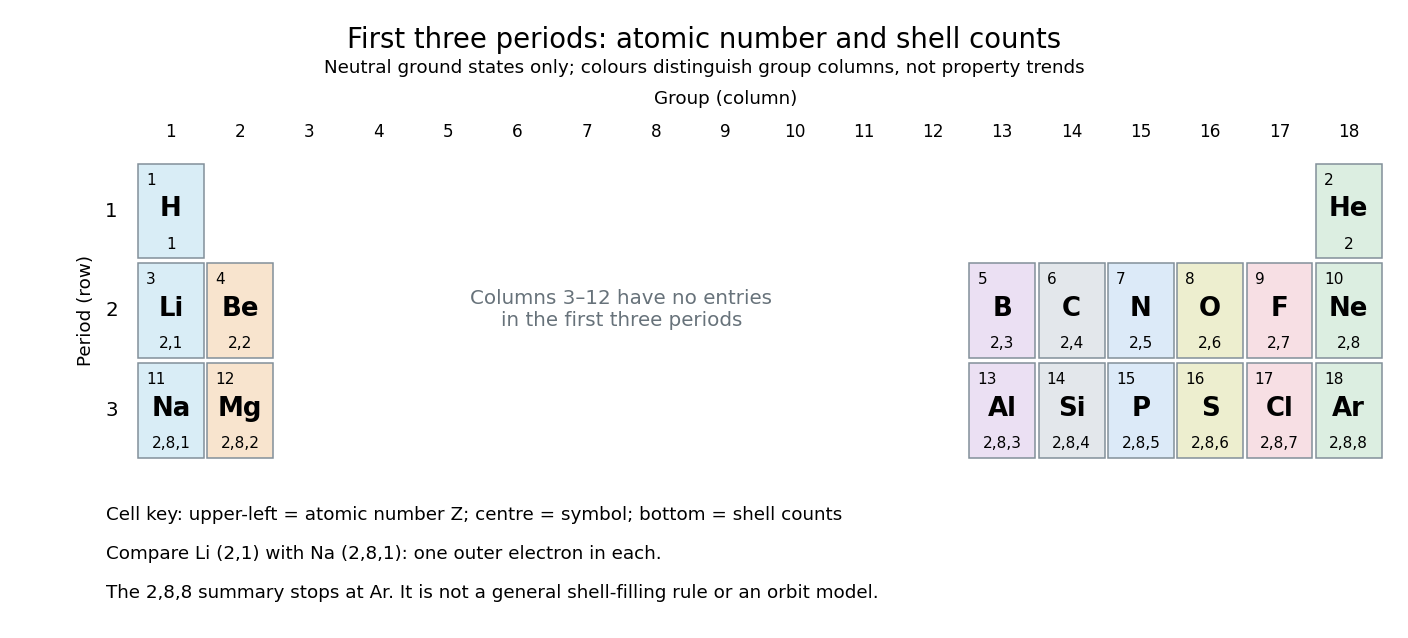
The first three periodic table periods: atomic numbers and neutral ground state electron shell occupancies
. Colours distinguish periodic group columns only, without encoding numerical property trends. The spaces in columns 3–12 preserve the eighteen-column periodic table layout: no chemical elements occupy those positions in these three periodic table periods. Each cell gives a chemical element's symbol, atomic number, and electron shell counts. Details.
Reading each row from left to right gives:
The counting outline is short: the occupied electron subshells in this range are , , , , and , filled in that order for these neutral ground states. Each electron subshell holds up to two electrons and each electron subshell up to six, giving , , and along these three rows. This summary applies only through argon; it is not a general rule that each electron shell fills completely before the next begins, nor a claim that the third electron shell can hold only eight electrons. See Flowers et al., Chemistry 2e, electronic structure and electron configurations.
The recurring outer counts make the arrangement useful. Lithium and sodium each have one valence electron, whereas fluorine and chlorine each have seven valence electrons. Such similarities help anticipate chemical reactions, without making all properties identical throughout a periodic group. Helium is an instructive exception to an eight-electron shortcut: its two electrons complete the first electron shell, so it belongs above neon and argon in periodic group 18. Hydrogen shares column 1 with lithium and sodium but has its own distinct chemistry. See Flowers et al., Chemistry 2e, periodic-table organization.
Copper is the chemical element with atomic number 29 and symbol . It is a transition metal. Its high electrical conductivity supports wiring, and and are common oxidation states. Copper-containing alloys include brass and bronze, whose properties differ from those of the pure metal.[ref]
Zinc is the chemical element with atomic number 30 and symbol . It is a metal. Its common ion is . Coating iron with zinc protects it through both a surface barrier and preferential zinc oxidation; zinc in an enzyme instead has a coordinated ionic role rather than behaving as a bulk metallic coating.[ref]
Platinum is the chemical element with atomic number 78 and symbol . It is a transition metal. It resists many corrosive environments but can be highly active at its surface as a catalyst. This contrast shows that bulk chemical persistence and catalytic surface activity are compatible properties.[ref]
There are unlisted articles, also show them or only show them.