
Sodium hydroxide is the ionic compound . Dissolution in water supplies sodium and hydroxide ions, giving a strongly basic solution.
It illustrates the distinction between formal salt concentration and the equilibrium activities used in accurate pH calculations. Neutralization consumes hydroxide, while the sodium ion can remain a spectator in the net acid-base equation.
Tetradecyltrimethylammonium bromide is a cationic surfactant with a fourteen-carbon hydrophobic chain and a positively charged trimethylammonium headgroup; bromide supplies the counterion.
In water, aggregation into micelles depends on concentration and solution conditions. Comparing related surfactants with different chain lengths helps separate the influence of hydrophobic chain size from that of the charged headgroup.[ref]
https://www.ebi.ac.uk/chebi/CHEBI:3565. ChEBI: cetrimide, chemical identity and structure
Fluorescein is an organic dye whose electronic structure supports strong visible fluorescence under suitable conditions. Its protonation state affects both absorption and emission, making pH part of the measurement conditions.
Attaching a fluorescein-derived label to a biological molecule can make its location observable by fluorescence microscopy. The label is a reporter: interpreting the image requires distinguishing label brightness from the amount of the target molecule.
Manganese dioxide is the oxide conventionally written . Assigning each oxygen oxidation state −2 gives manganese formal oxidation state +4.
Different crystal forms and defect populations can change its electrochemical and catalytic behaviour. An oxidation-state calculation establishes formal electron bookkeeping, rather than uniquely specifying the material's structure or reaction rate.
[ref]
Chemistry 2e by Paul Flowers and others. Chemical equations, oxidation-state conventions and solution equilibria; chapters4,14–17
Sulfuric acid is , with two acidic protons and successive hydrogen-sulfate and sulfate conjugate-base forms. The two dissociation steps need not have the same equilibrium behaviour.
In a permanganate-iron titration, sulfuric acid supplies the acidic medium needed for the intended redox stoichiometry. Choosing an acid involves its counterion as well as its proton contribution, because other ions can participate in competing reactions.
[ref]
Chemistry 2e by Paul Flowers and others. Chapter14, Acid-Base Equilibria: sulfuric acid and successive dissociation
An ionic compound of sodium cations and hydrogen anions. Its oxidation state assignments are for sodium and for hydrogen.
Relative centrifugal force is the dimensionless ratio of the local centrifugal acceleration magnitude to the conventional gravitational reference . Despite its name, it is an acceleration ratio: the actual force on a specified mass is . With angular speed and rotor radius , . If is the numerical rotational speed in revolutions per minute and the numerical rotor radius in centimetres, unit conversion givesThus rpm alone does not specify the centrifugal acceleration.[ref]
Basics: Centrifugal Force & Centrifuge Type by Eppendorf. Important definitions, Rcm vs rpm, and How to calculate relative centrifugal force: radius dependence and acceleration ratio
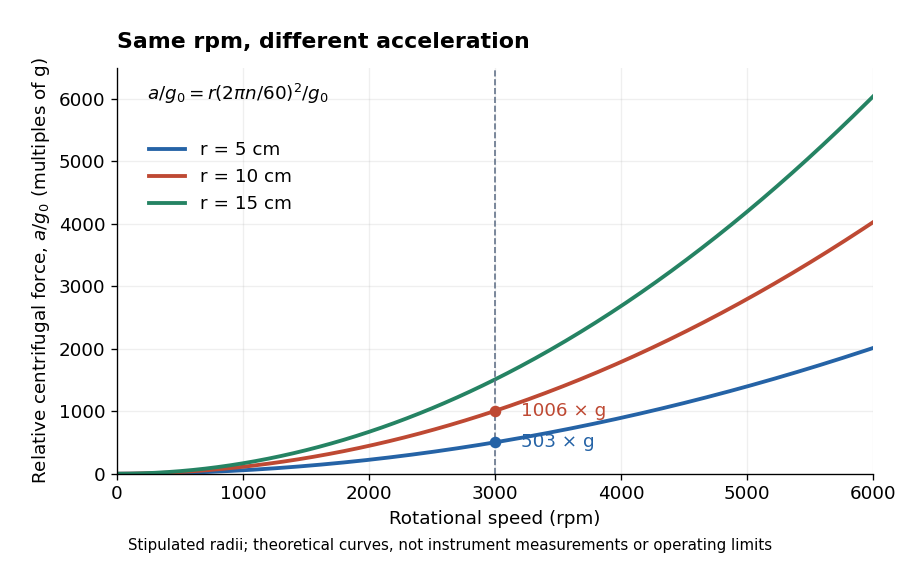

For a stipulated , rotor radii of and give approximately and times . Doubling the rotor radius doubles relative centrifugal force; doubling rpm quadruples it. Even equal relative centrifugal forces do not guarantee equal separation: travel distance, elapsed time, viscosity, sample density and particle shape still matter. These are comparisons of a mathematical model, not instructions for running an instrument.
The rotor radius is the perpendicular distance from the rotation axis to a specified sample position, not the tube's length. A filled tube spans a range . Consequently, one rotational speed produces different local centrifugal accelerations along that range. A reported relative centrifugal force needs a stated reference position, such as the outermost sample radius.
Let be the perpendicular distance from the force centre to the tangent of a regular planar orbit. Conserved physical angular momentum has magnitude , while conserved energy is . Eliminating speed gives the displayed equation when . For a differentiable polar curve, , connecting the geometric tangent distance to the radial energy equation.
Peptidoglycan is a mesh of linked sugar chains cross-linked by short chains of amino acids in the cell walls of most bacteria. Its absence from the cell walls of archaea helps distinguish envelope chemistry without confusing either cell wall with a cell membrane. See OpenStax Microbiology, 3.3: cell walls and peptidoglycan.
A protoplast is the living contents of a biological cell bounded by its cell membrane after removal of the cell wall. Removing the cell wall need not immediately destroy the cell membrane; stability depends on the preparation and surroundings. Lysozyme acts on susceptible bacterial peptidoglycan, not on cellulose or chitin, so it is not a universal wall-removal enzyme.
Plasmolysis is withdrawal of the membrane-bounded contents from parts of a cell wall after water loss. A sufficiently concentrated external hypertonic solution, with solutes effectively excluded by the cell membrane over the observation time, can cause this. The cell wall remains; the enclosed material contracts. Plasmolysis is therefore distinct from osmotic lysis, which breaks the cellular boundary during excessive swelling. A return to a less concentrated surrounding chemical solution can reverse plasmolysis if the biological cell remains functional.[ref]
5.2 Passive Transport. Biology 2e, §5.2, Tonicity in Living Systems and Figure 5.13: membrane withdrawal under hypertonic conditions
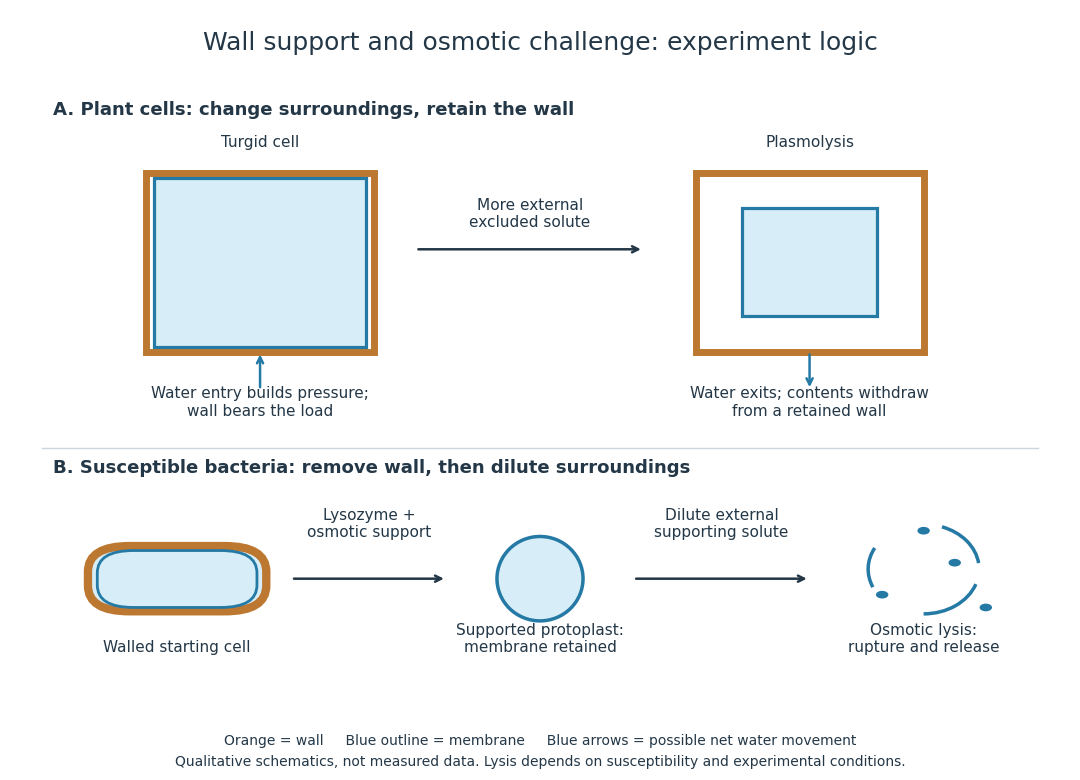

Turgor pressure is the internal hydrostatic pressure above the external pressure in a biological cell. When water enters a walled biological cell by osmosis, expansion loads the cell wall. Rising pressure can oppose further net entry while the cell membrane retains its selective permeability. Mechanical support therefore does not require the cell wall to block water.
As an original mechanical check, idealize a small flat patch of cell wall of surface area under uniform turgor pressure . Its outward force is . Doubling at fixed pressure doubles the load; equal internal and external pressures give zero net pressure load. This is a force balance, not a measured wall strength or a complete model of a curved, growing biological cell. It says nothing about which solutes cross the cell membrane.
A fungal cell wall contains structural polysaccharides including chitin and glucans. Its composition and organization vary among fungi; the diagram illustrates a composite rather than a pure chitin shell. A fungus sharing a cell wall with a plant does not imply shared wall chemistry.[ref]
24.1 Characteristics of Fungi. Biology 2e, §24.1, Cell Structure and Function: structural wall polysaccharides
A plant cell wall provides reinforcement outside the cell membrane, with cellulose as a major structural component. It is a composite rather than a solid sheet of pure cellulose. Wall construction varies with the kind and developmental state of the biological cell.
The cell nucleolus is a region inside a cell nucleus without a surrounding membrane, where much ribosomal RNA is made and processed and ribosome subunits begin to assemble with proteins. The subunits are exported to the cytoplasm; the cell nucleolus is not itself a translating ribosome. See Clark, Douglas and Choi, Biology 2e, 4.3: nucleolus and ribosomal subunits.
The nuclear envelope is the double-membrane boundary around a cell nucleus. Regulated passage connects nuclear processes to the surrounding cytoplasm: transcription produces RNA in the cell nucleus, while exported messenger RNA can undergo biological translation on ribosomes outside it. See NHGRI: nuclear membrane.
There are unlisted articles, also show them or only show them.