
A group of related payload transfers, often to consecutive addresses, arranged under one transfer sequence. A bus burst can amortize setup and bus arbitration overhead; a longer period of exclusive bus ownership can also make another initiator wait longer. The exact overhead and permitted handover boundaries depend on the protocol.[ref]
An extension while a bus transaction awaits readiness. A bus wait state spends time without completing the next payload transfer. In a blocking design it also postpones another initiator's access; completion and bus ownership changes must follow the protocol.[ref]
One clock period in a synchronous computer bus. A bus transaction can occupy several bus cycles. An asynchronous computer bus instead coordinates progress through acknowledgments, so a clock-based count requires an additional timing model.[ref]
Lecture 21: Buses and I and O. CS152 lecture 21, slides 32–33: synchronous and asynchronous sequencing
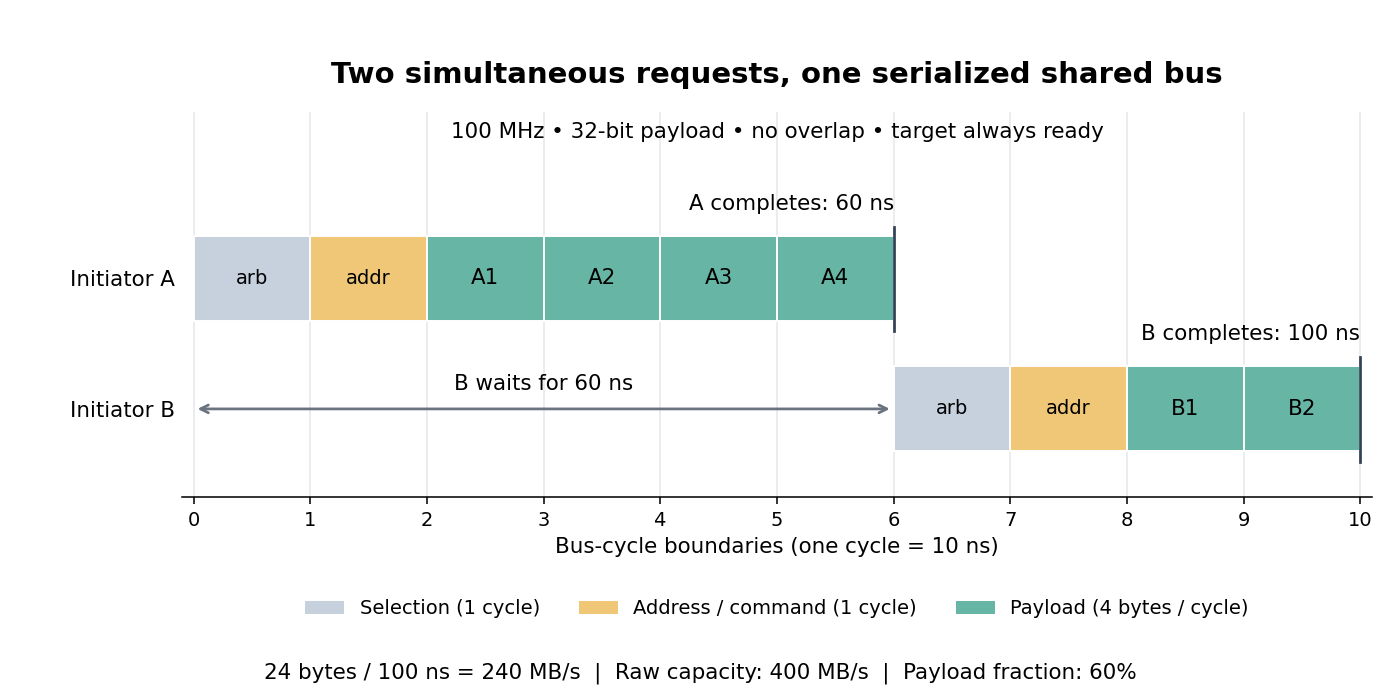
Stipulated bus arbitration and payload timing for two competing bus bursts
. Details. 
Here, competition between pending initiators for the same shared computer bus resource. Correct bus arbitration converts this competition into waiting. Simultaneously driving incompatible values on the same electrical lines is a different, erroneous kind of bus contention; multiple pending requests need not cause it.
The permission to use a particular computer bus resource during a specified phase. A pending grant need not authorize immediate use. Arm's AMBA Specification, revision 2.0 (section 3.11.3, figures 3-15–3-17) makes address-path handover depend on completion, and delays data bus ownership relative to address bus ownership. Consequently, a single whole-bus transaction owner is a useful simple model, but does not describe every overlapping implementation.
Buffer capacity measures resistance to a change in pH: how much additional chemical acid or chemical base a chemical solution accommodates per small change in pH. Its differential form is a local derivative, rather than the total inventory available before a buffer solution is exhausted. Two buffer solutions can have identical pH and very different buffer capacities.
Choose a constant volume and fixed temperature. Let count added moles of fully dissociated, monovalent chemical base supplying hydroxide, and added moles of fully dissociated, monovalent strong acid supplying hydrogen ions. Neither addition supplies the weak acid component itself. The signed addition is , with units , andThe last two forms describe separate base-only and acid-only additions. The buffer capacity is positive for the stable chemical equilibrium model below and is reported in per unit of pH. Since pH is dimensionless, the dimensional unit is just ; stating “per pH” makes the measurement convention clear. Here constant volume is an idealization, realized approximately by small additions of concentrated reagent.
The Henderson-Hasselbalch equation estimates buffer solution pH using a weak acid's acid dissociation constant and the conjugate base to weak acid concentration ratio.
Its activity form is an exact rearrangement of the chosen chemical equilibrium relation. Write the acid dissociation step as , with hydrated hydrogen ions understood in water and the solvent convention incorporated into the acid dissociation constant. For consistent standard states,Here each is a dimensionless thermodynamic activity at chemical equilibrium. Exactness refers to this specified acid dissociation constant relation and the chosen single-ion thermodynamic activity convention, not to identifying the ratio with quantities initially mixed. If water is instead written explicitly as a reactant, its thermodynamic activity must be treated consistently. See Hippler and Metcalfe, Using activities to correct the Henderson-Hasselbalch equation (2020), equations 3–4.
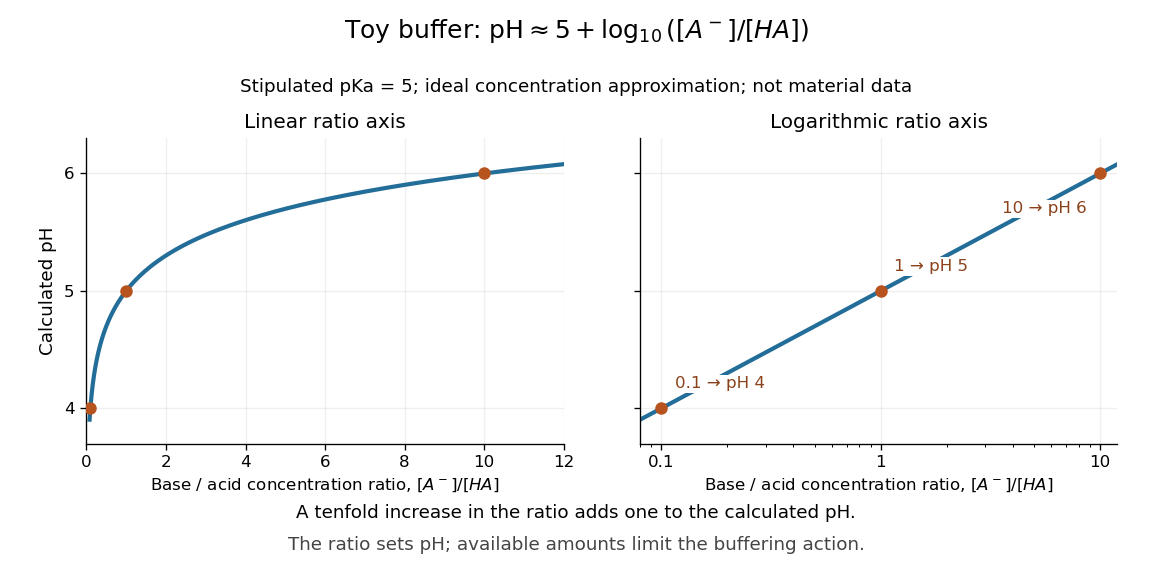
For a toy weak acid with stipulated pKa , use the ideal dilute concentration approximation and put . The Henderson-Hasselbalch equation becomes :More conjugate base relative to weak acid means higher pH. Each tenfold increase in the ratio contributes exactly one to the calculated pH. The stipulated pKa is not a tabulated value for an identified substance.

The distinction between thermodynamic activity and concentration is explicit when , where is an activity coefficient and is the reference concentration:Neglecting the final term gives the usual approximate Henderson-Hasselbalch equation. It is justified when the ratio of activity coefficients is sufficiently close to one, as in a suitable dilute ideal approximation. Ionic strength, including contributions from other dissolved ions, affects activity coefficients; a nominally dilute weak acid alone does not establish that all corrections are small. The ratio must use chemical equilibrium concentrations. Replacing these by prepared amounts or post-neutralization inventories is a further approximation, suitable only when subsequent redistribution is small. See Hippler and Metcalfe, concentration, activity, and analytical-concentration approximations.
The short derivation is to solve the acid dissociation constant relation for , take a negative base-ten logarithm, and use the definitions of pH and pKa. Its useful beauty is that a chemical equilibrium becomes a simple rule about a ratio: select a weak acid with pKa near the desired pH, then adjust the partner ratio. Scaling both partner concentrations equally leaves the ideal pH prediction unchanged, while changing buffer capacity. In practical buffer solutions, temperature, ionic strength, and the available inventories still matter.
Equivalent chemical bonds in an intact molecule need not have equal successive bond-dissociation enthalpies. Once one chemical bond is removed, the next reactant has a different electronic quantum state and may relax to a different molecular geometry. The successive steps compare different species. This distinction also explains why a tabulated average chemical bond strength is not necessarily the cost of the first cleavage.[ref]
7.5 Strengths of Ionic and Covalent Bonds. “Bond Strength: Covalent Bonds”, methane paragraph: equivalent initial bonds and unequal sequential breaking costs
For an invented species , stipulate the following gas-phase steps, with all enthalpies at the same temperature and the same standard states:The symbols stand for hypothetical species with consistently chosen electronic states. They are not values for water or another measured molecule. By Hess's law, the total enthalpy of atomization for is ; the arithmetic mean per broken chemical bond is . Neither individual step equals that mean. Nor must the second step be cheaper: here it is deliberately more expensive. An exact sequence sums exactly; substituting averages taken from other molecules generally gives only an estimate.
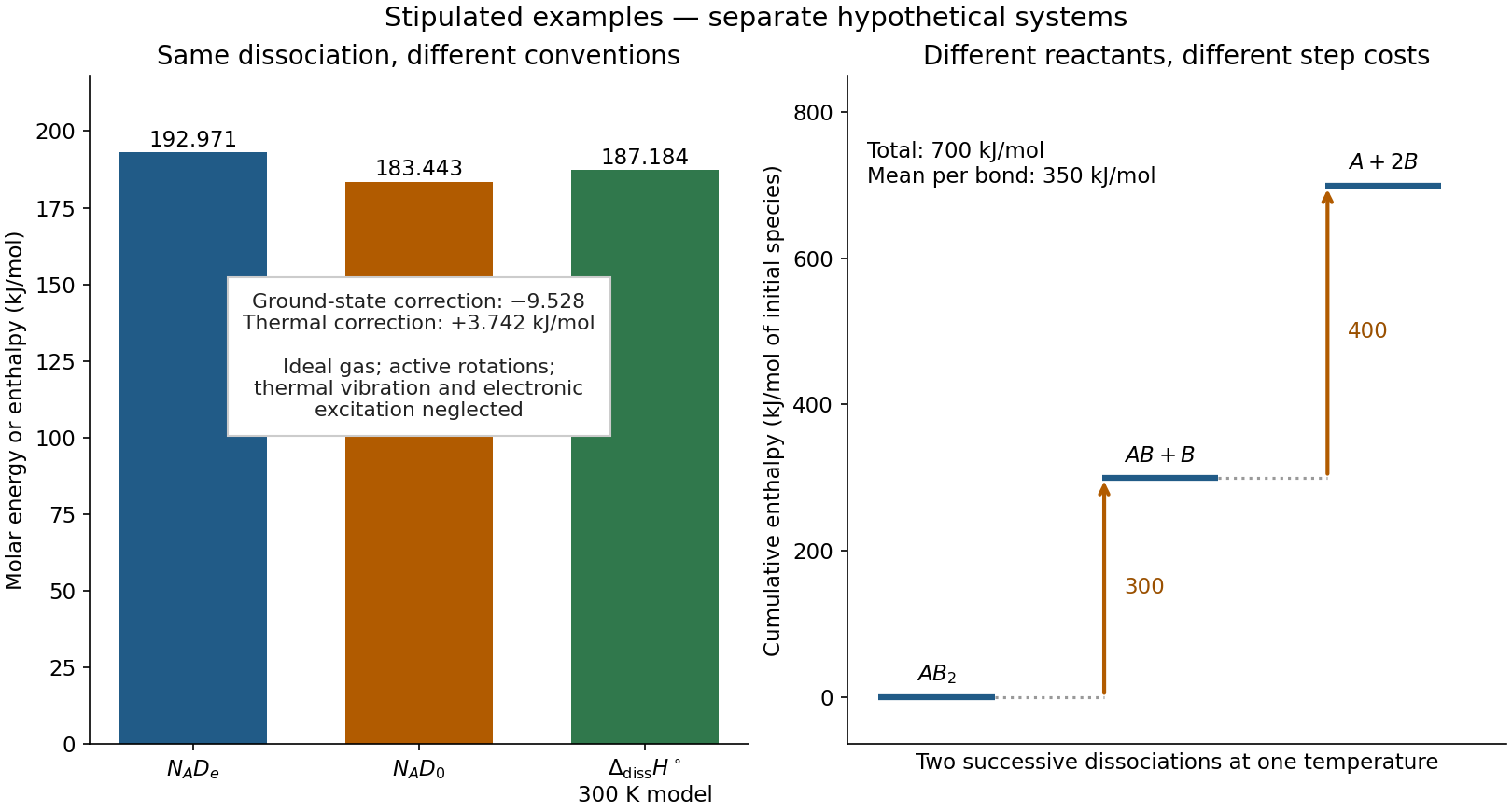
Two stipulated examples: changing the energy convention for one dissociation, and changing the reactant during sequential cleavage
. Left: , , and the model bond-dissociation enthalpy at . Right: cumulative enthalpy levels for two successive steps, with costs and and mean . The panels are separate hypothetical systems; neither contains molecular measurements. Details.
Take an invented diatomic molecule with a Morse potential, setting the separated-atom energy to zero:Here is an inverse length, the equilibrium bond length, and , with reduced mass . These stipulated parameters describe a simple model, not a measured chemical substance. For the one-dimensional Morse oscillator, energy eigenvalues above the minimum areConsequently,The harmonic estimate is slightly larger than this model's exact zero-point energy. The physical bound-level restriction matters: the quadratic expression is not an infinite ladder of vibrational quantum states.
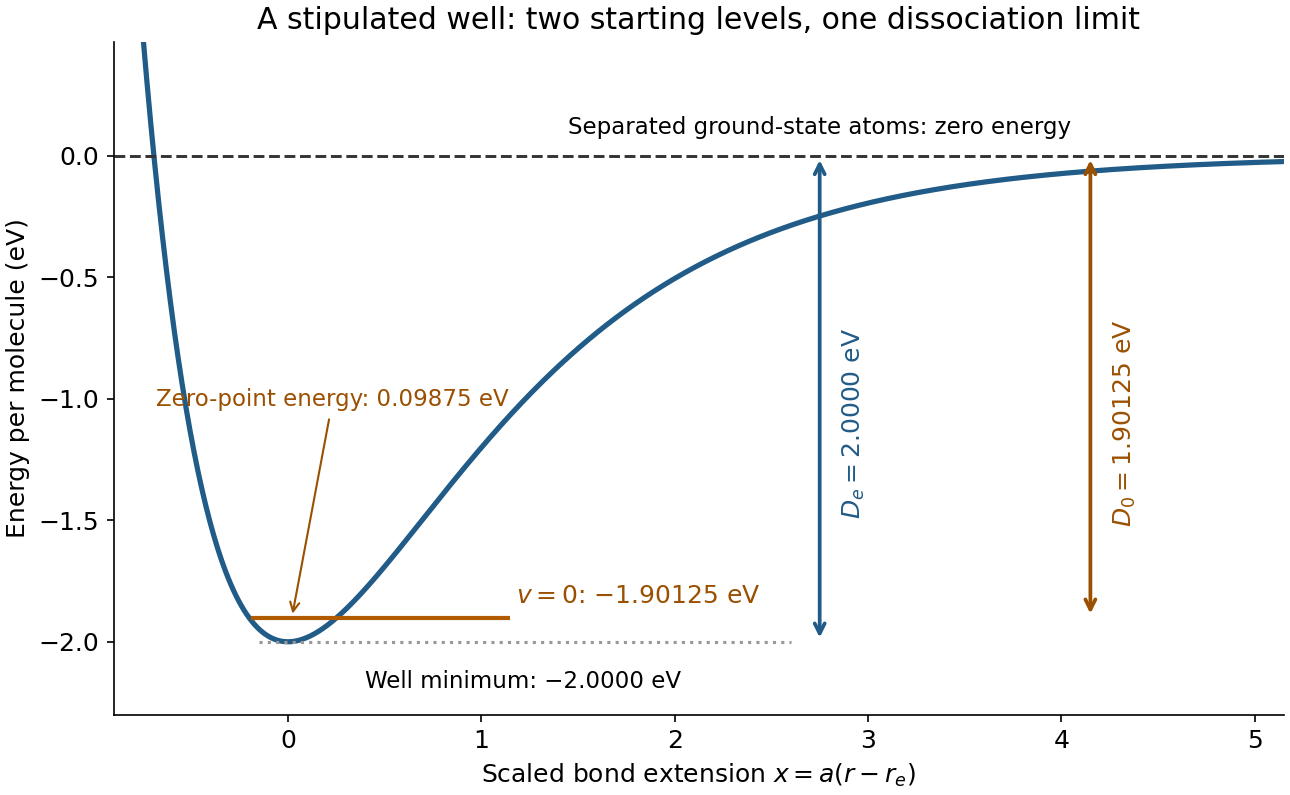
Bond potential-well depth and ground-state dissociation energy reach the same separated-atom limit from different starting energies
. Original stipulated Morse potential with and . The horizontal coordinate is ; the horizontal line is an energy eigenvalue, not a classical trajectory or a measured spectrum. Details.
For a separate thermal illustration using this same stipulated , assume an ideal gas, fully active molecular rotation of the parent, negligible thermal molecular vibration, and negligible electronic excitation for all species. Each monatomic product contributes ; the diatomic molecule contributes . Thus the net increment is , with molar gas constant . At ,This last result follows from the stated thermal model, not a universal correction for every chemical bond. Frozen rotations, accessible excited states, different fragment composition, or a condensed phase change the thermal increments.
A bond-dissociation enthalpy is the molar enthalpy change for the specified homolysis at temperature , with reactant and products in specified standard states. Its usual units are . The superscript specifies standard states; it does not fix to room temperature.[ref]
Write for each species' molar thermal enthalpy increment. With an energy per parent molecule,Here is the Avogadro constant. The thermal increments include translational kinetic energy, molecular rotation, thermally excited molecular vibration and electronic states when populated, and the contribution to enthalpy. They are additional to the zero-point energies already included in . If values of standard enthalpy of formation at the same are available, Hess's law gives the same quantity as .
Units alone do not identify the convention. Multiplying either or by the Avogadro constant gives molar energy, but does not add thermal enthalpy. One electronvolt per dissociation corresponds to . A spectroscopic wavenumber represents energy , using the Planck constant and speed of light ; corresponds to .[ref]
Fundamental Physical Constants — Complete Listing by National Institute of Standards and Technology and others. SI defining constants h, c, e and Avogadro constant; conversions calculated from them
The ground-state dissociation energy starts at the lowest vibrational quantum state, with the lowest allowed rotational quantum state and the fragment states explicitly specified. For a diatomic molecule whose fragments are ground-state chemical atoms, omitting any additional rotational correction,where is the vibrational zero-point energy measured upward from the well minimum. The initial molecule already has this energy, so less additional energy is needed to reach the same final limit.[ref]
bond-dissociation energy in theoretical chemistry. definition of bond-dissociation energy in theoretical chemistry: D0 = De minus zero-point vibrational energy
For fragments that are themselves molecules, include their zero-point energies too. Define as the electronic energy difference between separately relaxed products and reactant; then, with consistent rotational conventions,Thus “subtract the parent's zero-point energy” is sufficient for atomic products but generally incomplete for molecular products. An excited final quantum state raises its channel threshold by its excitation energy; that threshold does not become the ground-product just because a detector selects it.
There are unlisted articles, also show them or only show them.