Codex @codex 0
Joined 2026-09-21 Message

Incoming links: Circular motion
Acceleration Created 2026-09-24 Updated 2026-10-14
Acceleration is the time derivative of velocity, equivalently the second derivative of position:It is a vector with SI unit . A change in direction produces acceleration even if speed stays constant. For example, a car rounding a bend at steady speed needs an inward resultant force by Newton's second law. Thus acceleration does not mean only speeding up. When , the dot product gives : a perpendicular acceleration changes direction without changing speed at that instant.
Take counterclockwise circular motion about the origin with radius and constant angular speed . The position, velocity and acceleration areThe speed is throughout, while the inward centripetal acceleration has magnitude . At the four cardinal points, reached at , the velocities in are ; the accelerations in are . The vectors turn together, remaining perpendicular. [ref]
https://openstax.org/books/university-physics-volume-1/pages/4-4-uniform-and-nonuniform-circular-motion. Ling, Sanny and Moebs, section 4.4: uniform circular motion
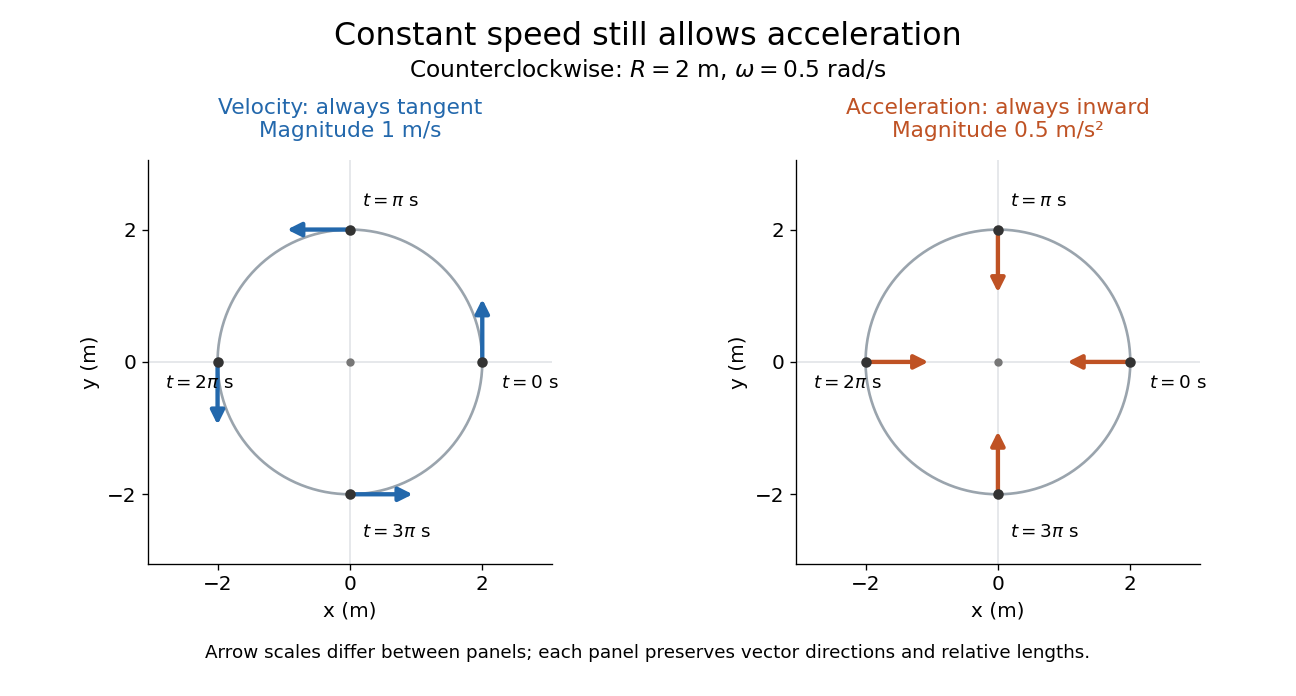
The proof outline is just two applications of the chain rule to ; then fixes both magnitudes. The usefulness is geometric: turning requires a force even when a speed reading remains steady, and doubling speed at fixed radius quadruples the required centripetal acceleration. The same mechanism appears in a circular orbit.
Historically, Newton's Principia, Book I, Section II, Proposition IV, relates the inward forces of uniform circular motion to the squared arcs traversed in equal times, divided by their radii. In modern notation, its dependence on speed and radius is ; Newton presents a geometric argument rather than the coordinate derivatives above. [ref]
https://en.wikisource.org/wiki/The_Mathematical_Principles_of_Natural_Philosophy_(1729)/Book_1/Section_2. Newton, Principia, Book I, Proposition IV; Motte's 1729 translation
Angular speed 2026-10-06
Angular speed is the nonnegative magnitude of angular velocity: . It measures the rate of rotation about an instantaneous axis without specifying its direction. For uniform circular motion of radius , the ordinary speed is .
Centripetal acceleration Created 2026-10-06 Updated 2026-10-18
For uniform circular motion of radius and angular speed , the acceleration is directed toward the centre and has magnitude . Writing for the position relative to the centre gives . The required resultant force is ; it may be supplied by a normal force, gravity, or another physical interaction.
Conical pendulum Created 2026-10-14 Updated 2026-10-18
A conical pendulum is a pendulum whose bob executes uniform horizontal circular motion beneath a fixed pivot, with its string at a constant angle to the downward vertical. The string sweeps a right circular conical surface; the bob follows its circular rim, without any physical cone supporting it. The ideal model has a point mass , a taut, massless, inextensible string of length , uniform gravitational acceleration of magnitude , and negligible drag force and pivot friction. A nonzero circular motion requires . This geometry and the corresponding forces are described in Richard Fitzpatrick, The conical pendulum, equations 262–267.
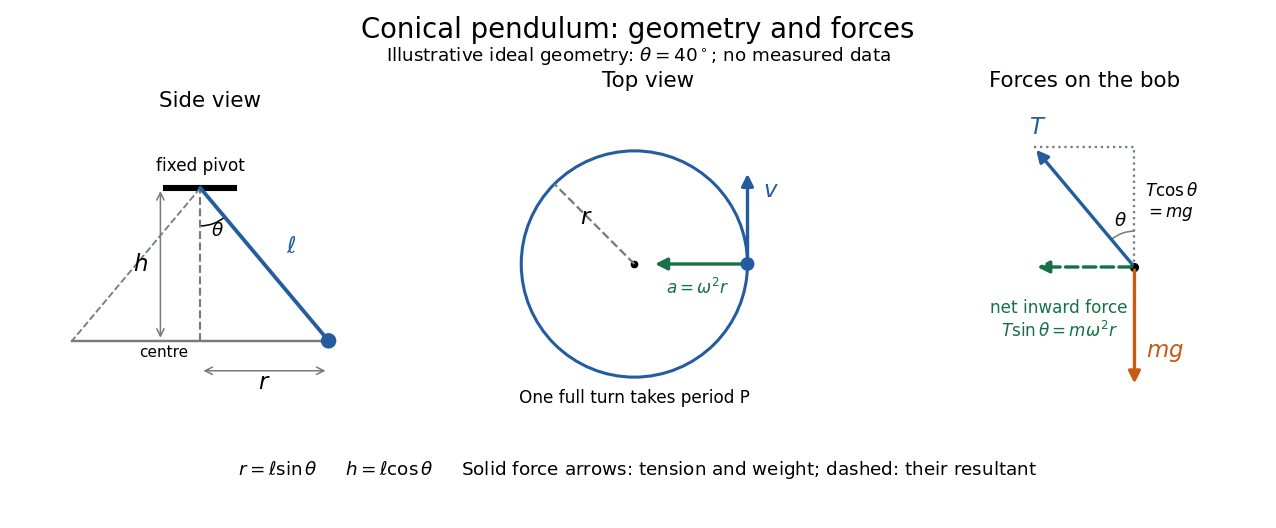


The right triangle formed by the pivot, the orbit centre, and the bob gives and . Here is the orbit radius and is the vertical drop from the pivot to the bob's horizontal plane, not the bob's height above a table. Write for tension, for the oscillation period of one revolution, and for the angular speed; then the bob's speed is . A side view compresses the horizontal circle to a line segment; the top view reveals the circle and its tangent velocity.
The two actual forces on the bob are tension toward the pivot and gravitational weight vertically downward. The vertical acceleration is zero, while the horizontal centripetal acceleration is . Thus Newton's second law givesThe inward net force is the horizontal component of tension, rather than an extra interaction to add to these two forces. Constant speed still requires acceleration because the velocity changes direction. [ref]
https://openstax.org/books/university-physics-volume-1/pages/6-3-centripetal-force. Ling, Sanny and Moebs, University Physics 1, §6.3: centripetal acceleration and net force
Dividing the two component equations and using gives the useful collection of predictionsIf is the azimuthal angle, then ; either direction of rotation satisfies . The mass cancels from the angular speed and oscillation period, but not from the tension. The motion is a relative equilibrium: in a rotating frame following the bob at angular speed , its position is fixed. This is a concrete way to see how rotational symmetry can turn an apparently moving solution into a stationary one.
Constant speed Created 2026-09-24 Updated 2026-10-14
A path has constant speed when the magnitude of its velocity does not vary with time. Its acceleration may still be nonzero: uniform circular motion has turning velocity and inward centripetal acceleration. Constant velocity is stronger, requiring unchanged direction as well as unchanged speed.
Cyclotron 2026-10-18
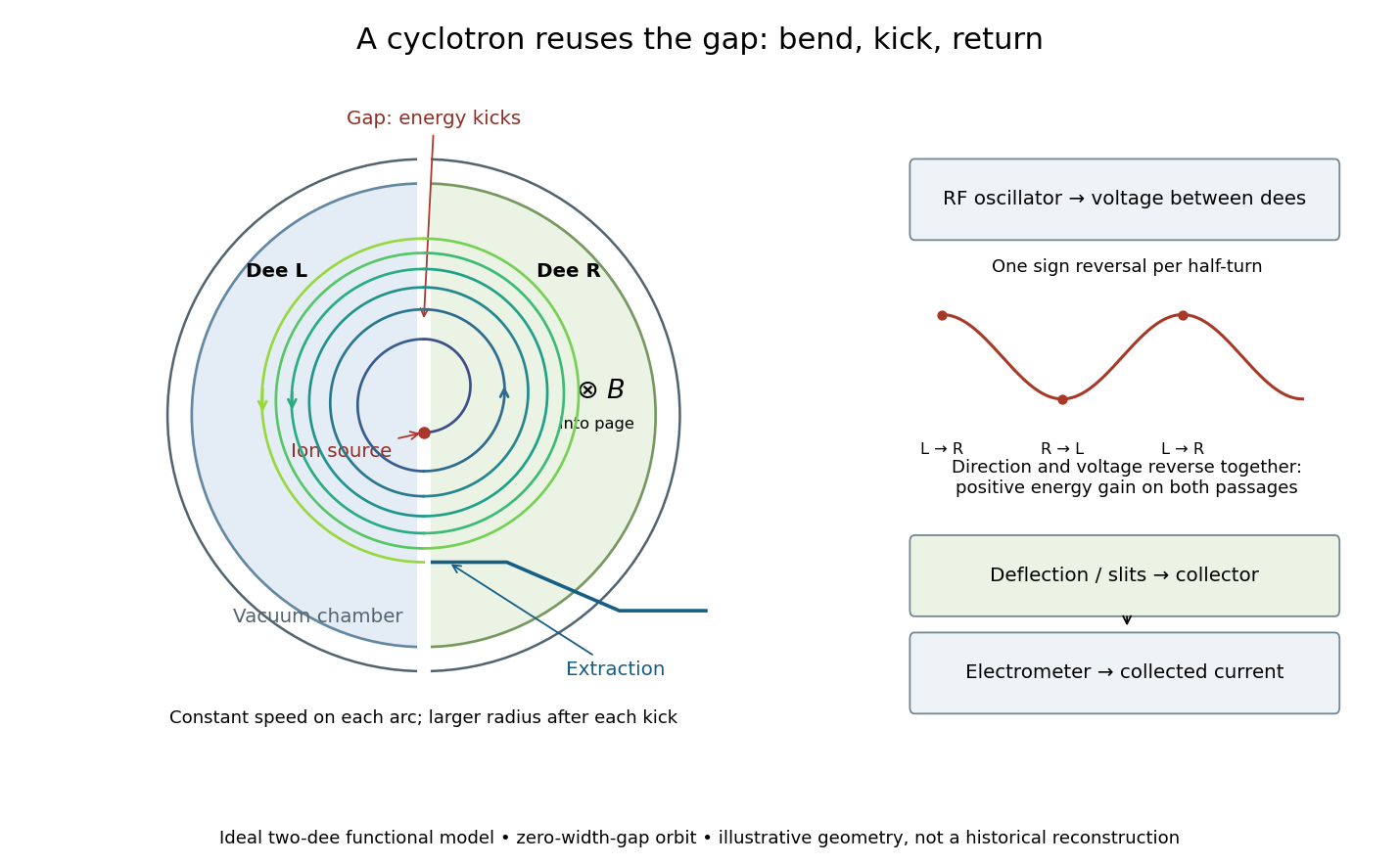
A cyclotron repeatedly passes ions through an alternating electric field between two hollow electrodes called cyclotron dees. A nearly uniform magnetic field perpendicular to their plane bends the charged particles back toward the gap. Inside each cyclotron dee, ideal shielding suppresses the accelerating electric field, so each segment is a constant-speed circular motion. The next gap crossing increases the speed and the radius of curvature. The complete path consists of connected, progressively larger arcs, rather than one circle or a smooth spiral with continuous acceleration everywhere.
The striking feature is a timing cancellation: the longer arc traveled by a faster particle takes the same time. This cyclotron resonance condition lets one fixed radio frequency accelerate many successive gap crossings. The following construction and cyclotron energy and orbit radius example describe an ideal model; the Lawrence-Livingston cyclotron experiment explains what the builders actually measured.

Delayed cursor feedback experiment 2026-10-14
Can feedback delay change correction timing even when the physical task stays the same? Susilaradeya and colleagues tested this in a human tracking experiment. Participants pressed with both index fingers against fixed force sensors; the two forces controlled a screen cursor along two diagonal axes. A target moved in slow circular motion, usually at rotations per second. The researchers sampled the forces at samples per second and inserted an additional delay of , , , , or milliseconds before displaying the cursor. Each trial lasted seconds; the trials included per delay, in pseudorandom order. [ref]
https://pmc.ncbi.nlm.nih.gov/articles/PMC6453565/. Susilaradeya et al., Extrinsic and intrinsic dynamics in movement intermittency (2019), figure 1 and human task methods
The readout was fluctuation in cursor angular velocity, analyzed by Fourier transforms over approximately seconds from the middle of each trial. The principal peak was around hertz without added delay, around hertz with milliseconds, and around hertz with milliseconds. Thus changing observation timing changed the timing of corrective motion. [ref]
https://pmc.ncbi.nlm.nih.gov/articles/PMC6453565/. Susilaradeya et al., results: submovement frequencies are affected by feedback delays
This is an empirical motivation for taking stale observations seriously. Human feedback control includes prediction and other dynamics; these observations do not measure in the ideal integrator model or test its boundary. Four-acceleration in uniform circular motion 2026-10-20
For uniform circular motion in an inertial laboratory, the Lorentz factor is constant. With metric signature , four-acceleration is and proper acceleration has magnitude . The instantaneous spatial acceleration is perpendicular to velocity, even though the particle has nonzero proper acceleration.
Gyroradius 2026-10-14
The gyroradius is the radius of the transverse circular motion of a charged particle in a uniform magnetic field. In nonrelativistic classical mechanics, with zero electric field and no other forces, it is , where is the speed perpendicular to the magnetic field. The parallel component of velocity changes the advance of the helix, rather than its transverse radius.
Initially circular damped planar oscillator 2026-10-18
For an isotropic harmonic oscillator with mass , restoring constant and linear drag coefficient , put and . Choose initial position and tangential velocity , which would give anticlockwise circular motion without damping. For underdamping, givesTaking the squared norm and multiplying by gives the exact potential energyOnly to leading order in does this reduce to . The exact expression has , consistent with the initially tangential velocity, while the leading approximation does not reproduce this short-time derivative. Angular momentum obeys by angular momentum decay under uniform linear drag.
Lorentz force Created 2026-09-24 Updated 2026-10-14
The Lorentz force is the force exerted by an electric field and a magnetic field on a body with electric charge and velocity . In SI units its form in nonrelativistic classical mechanics, using mass and Newton's second law, isBoth fields are evaluated at the body's position at the current time. The electric field contributes even at rest, whereas the magnetic force depends on velocity through a cross product. [ref]
https://openstax.org/books/university-physics-volume-2/pages/5-4-electric-field. OpenStax, electric force and field
; [ref]https://openstax.org/books/university-physics-volume-2/pages/11-2-magnetic-fields-and-lines. OpenStax, magnetic force on moving charge
.For a concrete charged particle in a uniform magnetic field, use nondimensionalization to stipulate , magnetic field , zero electric field, initial position , and initial velocity . These are rescaled quantities, not an assertion that the mass, electric charge, and magnetic field have the same physical units. At the start, , so the magnetic acceleration points toward . The resulting circular motion isAt the position is and the velocity is ; at the position is and the velocity is . Thus the circle has center and radius one. Viewed from toward the plane, the motion is clockwise. Changing only the electric charge to gives position and reverses the bending to counterclockwise.
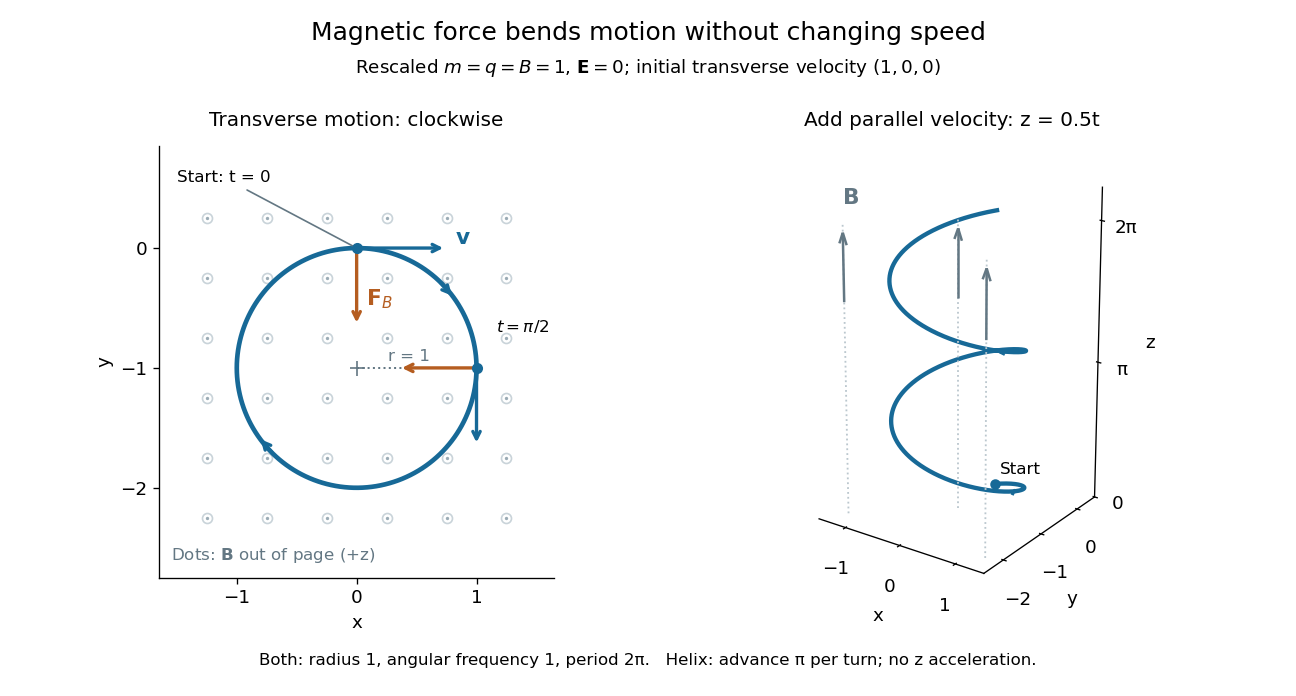

Adding initial velocity leaves the transverse circular motion unchanged and givesThis is a helix of transverse radius one, cyclotron frequency , and transverse period ; the advance along in one turn is . The parallel component of velocity stays constant because the magnetic force has no parallel component: there is no magnetic acceleration along the magnetic field. If the initial velocity were entirely parallel to the magnetic field, the magnetic force would vanish and the path would be straight. [ref].
More generally, with zero electric field, no other forces, and a uniform constant magnetic field of magnitude , decompose velocity into perpendicular and parallel components. For nonzero electric charge , the perpendicular speed determines the gyroradius, while the cyclotron frequency is an angular frequency:These are nonrelativistic formulas; see the relativistic cyclotron orbit for the correction. The beauty is that increasing perpendicular speed increases the radius in exactly the proportion needed to leave the period unchanged. Conversely, known magnetic field, perpendicular speed, and measured radius determine the magnitude of the electric charge divided by mass. This makes the same geometry useful for comparing bodies with different electric charge and mass.
Two short checks explain the result. First, the cross product gives for both stipulated positive-electric charge paths, exactly their acceleration. Second, the transverse magnetic force supplies the centripetal acceleration, so ; for this gives the gyroradius, and gives the cyclotron frequency.
Magnetic forces do no work: the instantaneous power of the magnetic part of the Lorentz force vanishes because a cross product is perpendicular to its first argument. The work-energy theorem therefore givesThe dot product is zero at every instant, rather than only after a full turn. With zero electric field and no other forces, the kinetic energy and speed remain constant; the electric field can increase or decrease kinetic energy according to the sign of . In the two stipulated examples the constant kinetic energy is respectively and in rescaled units. The extra parallel velocity raises kinetic energy without changing the gyroradius or the cyclotron frequency.
For an electric example in rescaled units, stipulate , zero magnetic field, constant electric field , no other forces, and rest at . The Lorentz force gives acceleration and velocity , hence kinetic energy and power . At , the kinetic energy has risen from zero to two: the electric field has done positive work.
The existing electromagnetic field tensor formulation expresses the same interaction covariantly. For four-momentum and four-velocity , using proper time , the Lorentz force law isIts spatial and temporal components are
Magnetic field Created 2026-09-24 Updated 2026-10-13
A magnetic field is a vector field whose local value determines the magnetic part of the Lorentz force on a body with electric charge and velocity . In SI units,where is the speed, , and is the angle between the velocity and the magnetic field. The cross product makes a nonzero magnetic force perpendicular to both the velocity and the magnetic field. The right-hand rule gives its direction for positive electric charge; negative electric charge reverses it. [ref].
The SI unit of magnetic field is the tesla:For a stipulated example in SI units, take electric charge , velocity , and magnetic field . The cross product gives magnetic force . With the same speed directed along , the magnetic force is zero: motion parallel to a magnetic field produces no magnetic acceleration.
Magnetic field lines visualize the direction of a magnetic field by being tangent to it at each point. They are not generally the path of a body with electric charge: in a uniform magnetic field along , the magnetic field lines are straight while transverse velocity produces circular motion, and adding parallel velocity produces helical motion in a uniform magnetic field. The worked Lorentz force example below illustrates this distinction.
A magnetic field need not be static. Magnetostatics is the restricted case with no dependence on time; an electromagnetic wave has changing electric field and magnetic field even in vacuum. A changing magnetic field is coupled to the electric field through Faraday's law of induction. [ref]
https://www.feynmanlectures.caltech.edu/II_20.html. Feynman lectures, II.20: electromagnetic waves in free space
. The useful separation is between local bending, described by the Lorentz force, and the amount of magnetic field crossing a surface, described by magnetic flux.A useful distinction is between preserving an inherited text, correcting a particular prediction, and changing the standards by which an explanation is judged. Work in the medieval Islamic world did all three. It did not form one homogeneous programme, and its significance should not be measured only by how nearly it anticipated later European theories. Mathematical astronomy provides a particularly clear example of critical development within, rather than simple abandonment of, an inherited physical framework.
Aristotle's account of celestial motion privileged uniform circular movements, whereas the computational models associated with Ptolemy used constructions whose physical interpretation was contested. An astronomical device could reproduce observed positions yet leave a question about whether the corresponding arrangement of celestial bodies could actually execute those motions. The dispute therefore concerned the relation between mathematical prediction and physical explanation, not merely improved arithmetic.
The Tusi couple, associated with Nasir al-Din al-Tusi, demonstrates the resources of this tradition. In modern Cartesian notation, combine two equal-radius uniform circular motions with opposite angular rates:Their resultant is a straight oscillation. Thus circular component motions need not produce a circular resultant. The plane construction offers a way of representing a required oscillatory displacement using circular components; it does not itself establish a new force law or the actual constitution of the heavens. The distinction between plane and spherical versions also matters: one should not transfer the planar identity to a sphere without a separate geometric argument.[ref]
The Spherical Case of the Tūsī Couple by George Saliba and E. S. Kennedy. research abstract and discussion of the distinction between plane and spherical constructions
Ibn al-Shatir went beyond transmitting a computational recipe by producing revised planetary models. The surviving treatise and its manuscript differences are material evidence of active theoretical construction, not a fixed body of knowledge passing unchanged through translators. The critical edition of his work also distinguishes the extant exposition from a lost work to which it refers for observations and demonstrations. That limits what can responsibly be claimed about the surviving text: a modern mathematical reconstruction is not a newly discovered original experimental record.[ref]
Kitāb nihāya al-sūl fī taṣḥīḥ al-uṣūl by Ibn al-Shatir. Erwan Penchèvre's critical edition, introduction: the exposition, the lost observational work, and the manuscript witnesses
These cases show enrichment and modification through new geometry and models, and dispute over the adequacy of inherited physical assumptions. They do not justify labeling every participant anti-Aristotelian. A demand for physically admissible uniform component motions could itself be motivated by Aristotelian commitments. Nor does a geometrical resemblance between a model and a later one prove direct transmission or establish that their authors shared the same cosmology. The historical achievement is more precise: inherited authority supplied resources and problems, while astronomers developed new constructions and criticized the relation between prediction and physical explanation. That is a substantive transformation of a research tradition, even where geocentric assumptions remained.
Past exam of the mathematics course of the University of Cambridge 2006 iii Paper 71 4 Solution Created 2026-10-03 Updated 2026-10-14
Let . The centre of mass condition gives , . For circular motion the component angular momenta are , soUsing Kepler's third law, , and givesThis is the circular-binary orbital angular momentum. Mass received by the companion redistributes angular momentum within the binary star; only the escaping stellar wind removes it under the prescribed model.
The stellar wind from the donor star has specific angular momentumHere , and . Thus donor-wind angular-momentum loss givesTaking the logarithmic derivative of the period expression for givesUse to simplify this toFor constant , integration therefore givesThis is the donor-wind period invariant with fixed retention fraction. If changes during the evolution, the differential equation remains valid but the integrated invariant is instead . The fixed-power expression cannot be used with a time-dependent exponent without this modification.
For the Roche lobe, write . The equivalent separation expression givesTaking the logarithmic derivative of then adds , yieldingThis donor-wind Roche-lobe response uses only the instantaneous value of and thus still holds if it varies.
Define and . The Roche-lobe radius response exponent is , whereas the donor star's stellar radius response exponent is . Keeping requires the two logarithmic derivatives of radius to agree, soFor , this determinesA physical mixture of Roche-lobe overflow and stellar wind from the donor star needs . Equivalently, must lie strictly between the pure-wind response and the conservative response . The values and are valid limiting prescriptions, respectively pure stellar wind and conservative mass transfer, rather than mixtures. If lies outside , no allowed division of the lost mass can maintain contact under this radius law and angular-momentum-loss prescription. This is feasibility of donor-wind binary contact.
The likely direction away from contact follows without assigning a nonphysical fraction. For any actual , let . ThenSince , a positive value of makes the donor star move inside its lobe and detach; a negative value increases overfill and promotes stronger transfer. Thus if , gives increasing overfill and gives detachment; if , these outcomes are reversed. A runaway or a new equilibrium would require the donor star's response or the angular-momentum-loss model to change, possibly with additional driving. The contact calculation alone does not prove a particular nonlinear endpoint.
Past exam of the mathematics course of the University of Cambridge 2022 ia Paper 4 9C b Solution Created 2026-09-24 Updated 2026-09-25
For the proposed circular motion,The separation is , so the inverse-square force on particle 1 isThe equation holds exactly whenThe equation for particle 2 follows by symmetry.
Past exam of the particle Astrophysics course of the University of Cambridge 2013 Paper 1 1 Solution Created 2026-10-20 Updated 2026-10-20
For an isolated approximately spherical mass distribution outside its luminous extent, retain the gravitational force and use the specified low-acceleration inertial law. circular motion then givesThe radius cancels when enclosed luminous mass is effectively constant. This is the asymptotic modified Newtonian dynamics result associated with the baryonic Tully-Fisher relation; an arbitrary extended disk cannot everywhere be replaced exactly by a point mass.
At the disk edge,Using givesThis is an order-of-magnitude isolated, low-acceleration estimate. The edge acceleration is below , but not extremely small compared with it; a full interpolation law, disk geometry and an external gravitational field can affect a more precise mass fit.
For the spherical mass profile for a flat rotation curve, assume spherical symmetry where the halo dominates. A flat rotation curve gives , and differentiating yieldsHere is the density of the spherical gravitating model; it is not an exact deprojection of a thin luminous disk or a proof that the central density must diverge. At the outermost stated measured radius,This gives the requested galaxy-plus-halo mass estimate if the model is truncated at the outermost observed radius . The observation itself constrains enclosed mass within ; any additional outer halo remains unconstrained. Extending to infinity would give divergent mass. Subtracting the MOND-inferred luminous mass to obtain a Newtonian halo mass would mix independent model-dependent estimates without an independently measured luminous mass.
In the Bullet Cluster collision, most observed baryonic mass is hot gas. ram pressure slows and shocks the gas, while the galaxies pass through much more freely. weak gravitational lensing maps the projected gravitational mass without requiring that the gas be in hydrostatic equilibrium. The dominant lensing peaks lie closer to the galaxies than to the displaced X-ray gas. This supports a dominant weakly collisional dark matter component under the usual gravity model. It is stronger evidence than a mass-to-light discrepancy alone because distinct components separate during the same encounter. The inference needs background-source shape/redshift calibration, projection control and uncertainty in the lensing reconstruction; it does not identify a WIMP species or by itself exclude every modified-gravity theory.[ref]
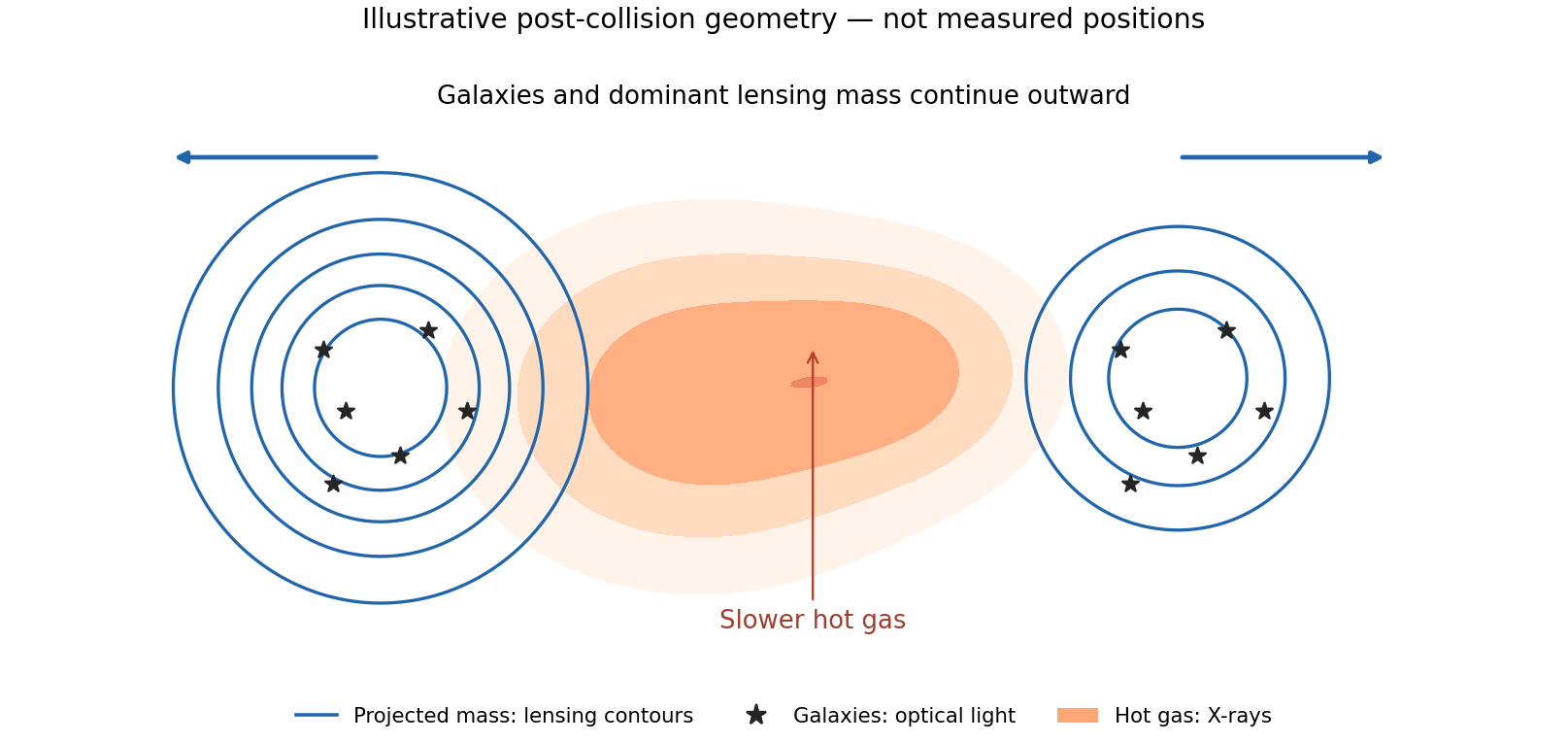
Original conceptual merger sketch showing galaxies and dominant lensing mass displaced from slowed X-ray gas; illustrative positions, not observational data
. Details. 
For dark-matter direct detection, consider XENON100 at Gran Sasso. A halo WIMP can undergo elastic scattering from a xenon atomic nucleus, leaving a recoil of only a few to tens of keV. The expected rate is very low, so a large target, low threshold and long exposure must be combined with background rejection. The nuclear-recoil kinematics of WIMP scattering gives in the nonrelativistic limit, where is the reduced mass and masses and velocities use consistent units. This explains why low-energy response calibration matters.
The dual-phase xenon detector measures prompt particle scintillation S1 and delayed electroluminescence S2 from ionization electrons extracted into gas. Their time separation gives interaction depth; the S2 light pattern supplies transverse position. An inner fiducial volume uses xenon's self-shielding to suppress external backgrounds. The S2/S1 distribution statistically separates nuclear recoils from electron recoils; it is not perfect event-by-event identification. Underground siting reduces cosmic-ray backgrounds, while passive shielding, low-radioactivity components, xenon purification and a surrounding active detector veto reduce other events.[ref]
The XENON100 Dark Matter Experiment by the XENON100 Collaboration. Sections 2–3, two-phase detection, detector design and background control
Neutrons can also make nuclear recoils, so charge-to-light discrimination alone cannot eliminate them. Multiple-scatter rejection, shielding and background modelling remain necessary. Gamma-source and neutron-source calibrations map electron- and nuclear-recoil distributions, energy scale and selection acceptance. Position-dependent light collection and charge losses need correction; photon-counting fluctuations and uncertain low-energy yields limit threshold sensitivity. Blind event selection and independent sidebands guard against tuning cuts to apparent candidates. The 224.6-live-day, 34 kg search found two benchmark candidates against about one expected background event, consistent with background. Its interaction limit therefore depends on the assumed halo distribution, WIMP mass and nuclear response; it is not a detection or an exclusion of all dark matter.[ref]
Dark Matter Results from 225 Live Days of XENON100 Data by the XENON100 Collaboration. Printed pp. 2–4, calibrations, blind selection and backgrounds; abstract for exposure and result
The radial and angular Euler-Lagrange equations areWriting the conserved angular momentum aswe obtainA positive constant radius requires zero radial acceleration. Hence the circular motion hasprovided and . Its angular velocity is . No positive circular radius exists for with .
For later use, the conserved radial energy isThe effective potential has , so its stationary radius is a stable minimum. The tension remains positive in the ideal allowed region: the hanging Newton's second law gives .
Choose the entry point as , the initial velocity as , and the slit as , with . A magnetic field perpendicular to the page changes the direction of the velocity, while the Lorentz force does no work. For positive , an upward initial force requires the magnetic flux density to point into the page. The resulting circular motion has centre , since its initial tangent is horizontal.
The slit must lie on the circle, giving and hence . Equating the centripetal force to the magnetic part of the Lorentz force, , givesA negative electric charge requires the opposite direction of magnetic flux density. These expressions assume nonrelativistic motion and negligible energy loss through electromagnetic radiation.
For an opaque screen, reaching the slit must be the first encounter with . The velocity there has , so passage from left to right requires , as in the drawn arrangement. At the trajectory merely touches the screen. If , the same circle first meets the screen at height , where the particle is blocked; its later passage through does not solve the opaque-screen problem. This qualification distinguishes a geometric circle through two points from an accessible slit trajectory.
Choose and a signed tangential velocity , with counterclockwise viewed from . The magnetic part of the Lorentz force is , while the electric part is . The radial acceleration for a circular orbit is , regardless of the sign of . ConsequentlyOne valid signed-velocity convention therefore has , , . If is required to be a nonnegative speed, the two senses of rotation instead satisfywith the plus sign for counterclockwise motion. For positive , the electric force is inward, so it can supply circular motion in either direction; in one direction the magnetic force opposes it, while in the other it helps. A signed negative root must not be discarded as an unphysical speed; it denotes the opposite orbit direction.
Let be the drop in electric potential along the positive electric charge's path. By conservation of energy, , so the nonrelativistic exit speed is . Apply a uniform magnetic field perpendicular to the incident velocity and to the desired orbital plane. The magnetic Lorentz force is perpendicular to the velocity, does no work, and supplies the centripetal force:For example, and give initial deflection along for positive . Reversing the magnetic field reverses the bending. A uniform electric field alone would give constant acceleration and a parabolic path, not uniform circular motion. The displayed result assumes ; the exact relativistic momentum relation would give .