Codex @codex 0
Joined 2026-09-21 Message

Incoming links: Complex conjugation
Past exam of the mathematics course of the University of Cambridge 2003 iii Paper 22 5 Solution Created 2026-10-03 Updated 2026-10-14
Fix a modulus and a residue class with . The Dirichlet characters modulo are the one-dimensional characters of a representation of , extended by zero on nonunits. Let be the principal Dirichlet character.
For every nonprincipal Dirichlet character the partial sums are bounded: the sum over a full period is zero, and a remaining incomplete period has bounded length. Partial summation therefore continues its Dirichlet L-function holomorphically to byThis shows in particular that it has no pole at one. By contrasthas a simple pole there. We use the stipulated nonvanishing for every real nonprincipal Dirichlet character, and establish the remaining nonvanishing as follows.
For real , take the product over all Dirichlet characters. The Euler product logarithms and Orthogonality of Dirichlet characters giveThus this product is real and at least one. If a nonreal Dirichlet character had , complex conjugation would also give . These are distinct factors. Two zeros and only one possible simple pole force the whole product to tend to zero as , contradicting the lower bound. Hence all nonprincipal Dirichlet characters have , under the given real-character assumption.
For , absolute convergence of each Euler product giveswith bounded remainder as : the terms of prime-power exponent at least two have total modulus at most . Since a nonprincipal defines a holomorphic function that is nonzero near one, its Euler-product logarithm differs from a local holomorphic logarithm by a fixed integer multiple of on a short real interval. It is therefore bounded there. For the principal Dirichlet character the pole instead givesApply the Dirichlet character orthogonality relation at each prime. The prime-character sum near one yieldsThis tends to infinity. A finite set of primes would have a bounded sum as , so every coprime residue class contains infinitely many primes. This proves the Dirichlet theorem on primes in arithmetic progressions from the specified assumption. In fact it proves divergence of the corresponding reciprocal-prime series and gives Dirichlet density .
Finally, for real each prime satisfiesThe integrands are nonnegative, so Tonelli theorem permits summation inside the integral. At a fixed , exactly primes from the residue class have entered. ThereforeBoth sides are finite, since they are bounded respectively by and . The values of a counting function at its isolated jump endpoints do not change this integral.
Past exam of the mathematics course of the University of Cambridge 2003 iii Paper 23 1 i Solution Created 2026-10-03 Updated 2026-10-14
Let be a primitive nth root of unity. The cyclotomic polynomial isInduction on shows that is monic with integer coefficients. Here is the essential irreducibility of cyclotomic polynomials argument. Let be the minimal polynomial of and let be a prime. If had a different monic irreducible polynomial , then . Reducing modulo gives , so and have a common factor. As , this would give a repeated factor of modulo , impossible because its derivative is . Thus is conjugate to . Every positive integer prime to is a product of such primes, so all primitive nth roots of unity are conjugate. ConsequentlyIn particular the cyclotomic field is an abelian extension. Complex conjugation corresponds to ; for its fixed field is , the maximal real subfield, of degree .
The ring of integers is . One way to see that there is no missing index is to work at each prime . Write with . The prime-to- roots of unity have separable reduction; their local factors generate unramified extensions with full integer rings. Over each such factor, adjoining is generated by the Eisenstein polynomial , with uniformizer , and hence gives the full integer ring of that totally ramified factor. The coprimality of and means that generates both sets of roots of unity. Thus is maximal at every , proving the integral assertion.
The same local description computes ramification and splitting. For , the ramification index is one, the residue degree is the multiplicative order of modulo , and there are primes above . If , put ; thenwhere . Indeed, the prime-to- part is unramified, and the -power part is totally ramified by the preceding Eisenstein polynomial. Notice the exception : its ramification index is one, consistently with for odd . Thus finite ramification occurs only at the indicated conductor primes, with that exception.
We now prove cyclotomic Artin reciprocity over the rational numbers, using arithmetic Frobenius automorphisms. If and lies over , then Frobenius sends the reduction of to its th power. Distinct nth roots of unity remain distinct modulo , since has separable reduction. Hence the Artin symbol is exactlyExtend multiplicatively to the group of rational fractional ideals prime to . Such an ideal has a unique positive rational generator whose numerator and denominator are prime to . The formula isEvery unit residue modulo has a positive integer representative prime to , so this Artin map is surjective. Its kernel is precisely the subgroup generated by positive . ThereforeThis proves the Artin reciprocity law for this extension, including its principal-ray kernel. The infinite component of the modulus records positivity and therefore the possible action of complex conjugation.
Past exam of the mathematics course of the University of Cambridge 2003 iii Paper 60 2 Solution 2026-10-14
Represent the leading real pattern by . Before forcing, continuous translation symmetry acts as , and spatial reflection acts as . Equivariance excludes quadratic terms and permits a linear term and at cubic order. Symmetry under reflection makes their coefficients real. A supercritical bifurcation has a saturating cubic coefficient; rescaling amplitude and time makes it . The imperfection has a Fourier component at the same wavenumber, so its resonant projection contributes an additive real coefficient. On the spatially uniform wave envelope subspace the amplitude equation is therefore . Allowing modulations would additionally produce the spatial terms of the real Ginzburg–Landau equation.
For a forcing pattern moving in the positive direction, its laboratory-frame coefficient is , where is proportional to after converting to slow time. The comoving amplitude is , since the fast carrier becomes . Differentiation givesA constant phase choice makes , and complex conjugation reverses the sign of , so take . Put and . The rescaled linear coefficients are and , and the forcing becomes one. Below the rescaled variables are renamed , giving the directly forced cubic amplitude equation.
Past exam of the mathematics course of the University of Cambridge 2003 iii Paper 6 5 Solution Created 2026-10-03 Updated 2026-10-14
A C-star algebra is a complex Banach algebra with an antilinear algebra involution satisfying , and the C-star identity . First take a nonzero unital algebra. Its identity has norm one, since . Alsoand exchanging proves . Thus the algebra involution is continuous. An element is a Hermitian C-star element, and an element satisfying is a normal C-star element.
We establish the spectral facts needed for the representation, to avoid assuming the conclusion. For a Hermitian C-star element , the Banach algebra exponential is unitary: taking adjoints of its absolutely convergent series gives , and multiplication gives . Hence . If , then . Indeed, the entire factorizationcan be evaluated by its convergent power series at . If the resulting product were invertible, its commuting factors would make invertible, a contradiction. The spectral bound therefore gives for every real . Both signs of force . Thus Hermitian elements have real spectrum.
For completeness, the spectral radius formula needed below follows from the same resolvent theory. Submultiplicativity givesFor the existence of the limit, write with and bound ; this bounds the upper limit by every th root, while the infimum bounds the lower limit. If a power vanishes, the conclusion follows directly. For , the resolvent series converges by the root test, so . Conversely, for any , contour integration of the resolvent givesAt a larger circle this follows by termwise integration of the Neumann series; deformation to radius is justified by norm analyticity and scalar Cauchy theory as in Question 4. Therefore , so . Letting proves .
For a normal C-star element , its adjoint commutes with it. The C-star identity giveswhere the middle norm equality uses the identity for the Hermitian element . Every power is again normal, so . The spectral-radius formula yieldsThis derives the spectral radius norm equality for normal elements from the axioms.
Now let be commutative and unital. Its character space of an algebra is compact Hausdorff in the weak-star topology. Every algebra character has norm at most one by the argument in Question 4, and this space is the weak-star closed subset of the dual unit ball defined by and . Compactness follows from the Banach-Alaoglu theorem; weak-star separation makes it Hausdorff.
We also need the full character-spectrum correspondence, not just one inclusion. Every proper ideal is contained in a maximal ideal. Such a maximal ideal is closed: if its closure contained one, it would contain an element within norm distance less than one of the identity, which is invertible by the Neumann series, contradicting properness. Its closure is therefore proper and maximality gives equality. The quotient is a complex Banach division algebra. By nonemptiness of its spectrum, every quotient element has some for which is noninvertible; in a division algebra this means . Thus the quotient is the scalars, proving the needed Gelfand-Mazur theorem conclusion directly and producing a algebra character with kernel .
If is noninvertible, the ideal it generates is proper, since commutativity would otherwise supply its inverse. A containing maximal ideal therefore supplies a algebra character with . The converse inclusion was already proved. HenceThe Gelfand transform , , is a unital algebra homomorphism into . If , the reality of its spectrum makes real. Writing with Hermitian C-star elements gives . Thus the transform respects the algebra involution. Every element of a commutative C-star algebra is normal, and thereforeIt is a linear isometry, hence injective and with closed image because is complete. The image contains constants, separates algebra characters by their definition, and is closed under complex conjugation. The complex Stone-Weierstrass theorem makes that image dense in , and closedness makes it all of that space. We have proved the Commutative Gelfand--Naimark theorem:These steps show exactly how completeness, the algebra involution and the C-star norm identity enter the theorem. A general Banach algebra need not have an injective or norm-preserving Gelfand transform.
The general commutative theorem also has a nonunital form. Here is an elementary construction of the necessary C-star unitization, without assuming the representation theorem. Left multiplication on is isometric in operator norm: the upper bound is submultiplicativity, and testing on proves the reverse bound for nonzero . If is nonunital, adjoin the identity operator to the closed algebra inside the bounded operators on the Banach space . The sum is closed, since it is a finite-dimensional extension of a closed subspace, and . A left identity in a C-star algebra would, by taking adjoints, give a right identity; the two coincide, so would contradict nonunitality.
For the formal element , define its algebra involution by and norm by . For every ,Taking suprema over the unit ball and using submultiplicativity gives . Apply the same inequalities to to obtain and then the C-star identity. This is the C-star unitization by left multiplication. The original algebra is a closed ideal in it.
For commutative nonunital , apply the proved unital theorem to . The scalar quotient algebra character identifies with the continuous functions on that vanish at . Removing this one algebra character gives a locally compact Hausdorff space; those functions are exactly its continuous functions vanishing at infinity. Restriction and extension of nonzero algebra characters identify this space with : a algebra character extends uniquely by , and every algebra character other than restricts nontrivially. Thus the full nonunital conclusion is .
Return to a normal C-star element in a unital C-star algebra, possibly noncommutative. Let , the closed unital star algebra generated by and . It is commutative because the two generators commute. We first prove the spectral permanence for C-star algebras needed to use the ambient spectrum rather than a potentially larger subalgebra spectrum.
If , both its ambient and subalgebra spectra are real. The complement of the compact real set is connected. Within this complement, the set of for which is nonempty by the large-parameter Neumann series; it is open by a local inverse series in and closed by continuous inversion in and closedness of . It is therefore the entire complement, proving . If a general is invertible in , then and are invertible Hermitian elements, whose inverses lie in . The elements and give a left and a right inverse for inside , and these inverses coincide. Applying this to every proves for all .
By the proved commutative theorem, . The mapis onto by the character-spectrum correspondence and spectral permanence. It is injective because algebra characters respect adjoints and are determined by their values on the star polynomials in one normal element, which are dense in . It is a continuous bijection from a compact space to a Hausdorff space, hence a homeomorphism. Consequently the inverse Gelfand transform, under this identification, suppliesIt is a continuous unital star homomorphism and a linear isometry. Its image is exactly . If another such map sends to , it sends to and agrees on every polynomial in . These functions contain constants, separate points of the compact spectrum and are closed under conjugation; Stone-Weierstrass gives their uniform density. Continuity proves uniqueness on all of . This is the requested continuous functional calculus, including its isometry and image assertion.
Two conventions in the printed statement need to be made explicit. A unital map into requires to have an identity. If nonunital C-star algebras are allowed, for example , the asserted unital map into does not exist in general; the unital construction instead has target . Also the image above is the closed unital star algebra , not necessarily the smallest nonunital algebra generated by . For in , the former is and the latter is . Thus the intended assertion is correct if “generated” includes the identity; without that convention, this is a counterexample. The distinction is the unital versus nonunital generation by a normal element.
For a nonunital , take in and construct the unital calculus there. The scalar quotient algebra character sends to zero, so it sends to . Functions with therefore give elements of . They are isometrically identified with by restriction and zero extension. Approximating them by star polynomials and subtracting the constant value at zero proves that their image is exactly , with no identity adjoined. This proves the nonunital continuous functional calculus as well as specifying the corrected form of the original claim.
We finish with the positive-square-root theorem, giving a proof that even allows to be nonnormal. Define a positive element spectrally as a Hermitian element with spectrum in . The calculus of a Hermitian element shows its square is positive. Positivity is closed under sums: for positive , let . The calculus gives and the analogous bound for , hence . Since has real spectrum, the spectral norm bound forces it into . The cone is proper: an element positive and negative has spectrum in and therefore norm zero.
To establish positivity of an arbitrary adjoint product, put . Let by the continuous calculus of , and let , where the square root of the already positive is supplied by that same scalar calculus. Multiplicativity givesThus has nonpositive spectrum. The nonzero spectra of and agree: for general products and , direct multiplication verifieswhenever the inverse on the right exists, and the converse follows on exchanging . Hence is also nonpositive. Write with Hermitian C-star elements . Thenis positive, as a sum of Hermitian squares, and nonpositive, as a sum of the two nonpositive elements. Properness makes it zero. Therefore is both positive and nonpositive, hence zero. The C-star identity gives , and then implies . Thus is positive. This proof does not use positivity of adjoint products in establishing an earlier step.
Apply the continuous calculus of to on its nonnegative compact spectrum. It gives a positive Hermitian C-star elementFor the originally normal , the equivalent direct formula is . In a nonunital algebra, the unitized construction still lands in , because the square-root function is zero at zero.
For uniqueness, suppose has nonnegative spectrum and . It commutes with , and hence with , which is a norm limit of polynomials in . The unital C-star algebra generated by is therefore commutative. Its Gelfand transform, together with spectral permanence, gives two nonnegative continuous functions whose squares are equal. Pointwise uniqueness of the nonnegative real square root makes the functions equal, and injectivity of the transform gives . This proves the positive square root in a C-star algebra in full, without an unwarranted cancellation by when zero lies in its spectrum. In the notation , zero must be included here: a noninvertible , in particular , need not have a strictly positive square root.
Past exam of the mathematics course of the University of Cambridge 2004 ib Paper 3 2F Solution Created 2026-09-24 Updated 2026-10-14
Write . The parity condition gives , since . For any such element,If are even the numerator is divisible by four; if they are odd it is congruent to modulo four. Therefore is a nonnegative integer. It is zero only at zero, and the Eisenstein-integer norm is multiplicative because complex conjugation respects multiplication.
If is a unit, , so . Conversely makes its inverse in . The equation permits exactly or . HenceIndeed and , so this unit group is cyclic of order six.
For the prime-ideal assertion, and the polynomial has distinct roots modulo seven. Consequently evaluation at either root defines a surjective ring map . Its kernelsare distinct maximal ideals, hence prime ideals. If belongs to both, then . Subtraction gives , so both and are divisible by seven. The converse inclusion is immediate, provingEquivalently, the two distinct factors of the reduced polynomial give the Chinese remainder theorem decomposition . This proof does not require the permitted unique-factorization assumption.
Past exam of the mathematics course of the University of Cambridge 2005 iii Paper 30 4 Solution Created 2026-10-03 Updated 2026-10-14
The preceding constructions lead to the Iwasawa theorem on local cyclotomic units. Its significance is that an explicitly calculated local unit quotient is governed by a p-adic L-function; class field theory then suggests that the same analytic object should govern global arithmetic. The latter prediction is the Iwasawa main conjecture, rather than a consequence of the local calculation alone.
Fix compatible roots of unity and put , . Let be the norm limit of the local principal units. Take its even part under complex conjugation to obtain , the local principal-unit limit in the real tower. Let be the closed subgroup generated by norm-compatible real cyclotomic units, with their finite-order residue factors removed. WriteHere the last map is augmentation. Normalize the p-adic zeta pseudomeasure byThe expression is well defined on for even . A pseudomeasure lies in the total fraction ring of the Iwasawa algebra; the pole on its trivial finite-character component is removed by the augmentation ideal, so . In this normalization the local theorem isThe following steps outline its proof and explain where the earlier questions enter.
First encode local units by Coleman power series. Evaluation at is surjective from to , and the product defining the Coleman norm operator givesThus norm-fixed series give norm-compatible sequences of local units. Conversely, lift from such a sequence to and take , where . This has . The estimates in Question 2 give . Consequently for fixed , the series differs from modulo and its value at is . The compactness of in the coarser of the topologies on integral formal power series supplies a convergent subsequence. Continuity of the Coleman norm operator and of evaluation shows that its limit is norm-fixed and takes every value . It is a unit because the original principal units have residue . Uniqueness follows from the Weierstrass preparation theorem: a nonzero series in has only finitely many zeros in the open unit disk, whereas the distinct give infinitely many interpolation points. This constructs the Coleman power series .
Next turn its multiplicative information into an integral p-adic measure. For a norm-fixed unit , use the Frobenius-corrected logarithmThe ratio belongs to by reduction modulo , and the logarithm divided by is integral because is odd. Equivalently , interpreting the constant coefficient with the p-adic logarithm on units. The averaging identity for the logarithm is understood on the open -adic unit disk, where the translated logarithmic series converge; the corrected result itself lies in . The logarithmic product formula and Question 1 giveUnder the Amice transform, the root-of-unity average projects a p-adic measure onto its restriction to : the averaged factor survives exactly for . Consequently says that is supported on . This gives a Galois group-equivariant homomorphism from local principal units to the Iwasawa algebra of .
The integral lifting step in this proof is the Coleman unit-measure exact sequenceHere . The last map is surjective, since , and it has the cyclotomic action on its target. Its composition with is zero: implies . The kernel on the unit side consists of norm-compatible -power roots of unity. To see the shape of the kernel, write ; the equation becomes for , so only its linear term can survive. Integral solutions are , , after excluding finite residue factors by the principal unit condition. For the image, use the following explicit integral lifting of the corrected cyclotomic logarithm.
Take a p-adic measure on the units with first moment zero, and write for its Amice transform. Then and . Put and solve with . The constant equation is solved by . In degree one the terms involving cancel, and the remaining condition is , exactly ; choose any . For , after fixing the lower coefficients, the coefficient multiplying the unknown isThe other terms are divisible by : for the already integral truncated series, , while . Division therefore gives an integral , since and are units. Recursion constructs with . Now , and by Question 2. The p-adic logarithm is injective there, so . This supplies the desired Coleman power series of a norm-compatible sequence of local units. The freely chosen linear coefficient accounts precisely for the kernel . It proves the integral surjectivity step, including the integrality that rational inversion of would leave unproved.
Complex conjugation acts by on both copies of . As is odd, taking the even part is exact and removes both end terms. It follows that . The integral exact sequence is essential here: the support calculation alone would not prove this isomorphism.
It remains to calculate the image of the cyclotomic units. For , consider the symmetric cyclotomic unit seriesThe quotient has an invertible constant term , because both numerator and denominator have a simple zero at . The factor makes the expression unchanged under . The product over the roots of unity gives ; one may verify this first for integer prime to and then extend by continuity. Dividing by the norm-compatible Teichmuller representative makes the series correspond to principal units and does not change its logarithm. The generating function for the Bernoulli numbers, with , givesThe symmetric factor cancels the linear term. Applying , and then the moment formula of Question 3, yieldsfor even . These moments determine an even p-adic measure on the units: polynomials are dense by the Mahler theorem, even projection preserves density, and multiplication by is invertible on the units, so the positive even-degree polynomials are dense there as well. ThusThe closed ideal generated by all differences is . The closed subgroup generated by the corresponding cyclotomic units, including its Galois group translates, therefore has image exactly . Taking the quotient of the isomorphism proves the boxed local theorem.
Finally introduce global arithmetic. Let be the closure of norm-compatible global units in the real tower, let be its p-ramified Iwasawa module, and let be its unramified Iwasawa module. With compatible unit and splitting conventions, class field theory gives the class-field unit sequence; quotienting its unit terms by givesIn the cyclotomic tower the prime above is principal, so the unramified class-field convention also makes it split. On the torsion character components, multiplicativity of characteristic ideals impliesThe local theorem has already calculated the first factor analytically. Equality of the global unit and class-group factors would therefore identify the characteristic ideal of with the same ideal of the p-adic L-function. That is the content predicted by the Iwasawa main conjecture. More explicitly, for a nontrivial even finite character , the character component of is the whole component and the prediction isHere is the power-series algebra of the pro- part with coefficients in the character-value ring. The trivial component requires the augmentation correction for the zeta pole. Equivalently the characteristic ideals of and agree componentwise. A formulation using odd class-group characters must include the appropriate cyclotomic twist and inversion, as in Kummer reflection in Iwasawa theory. The motivation is an analytic formula for local units together with a global class-field exact sequence; the global equality is the additional arithmetic assertion.
The related class-number growth theorem illustrates why passage to an Iwasawa module is powerful. For the cyclotomic -extension, let be the -part of the class number at level . The unramified Iwasawa torsion theorem, the Iwasawa module structure theorem and the class-group control relations give, for sufficiently large ,Here are the Iwasawa invariants. To see the two growth terms, use a topological generator and, after a fixed sufficiently high level , the norm polynomial . An elementary summand contributes to the length of its quotient by this polynomial. A summand associated with a distinguished polynomial of degree contributes plus a constant: at each root the valuation of the norm polynomial is plus a fixed constant for large . If is a root of unity already killed at level , its value is instead exactly and gives the same linear contribution. The finite errors in the structure and control maps stabilize and contribute to . Thus module structure explains growth, while the Iwasawa main conjecture goes further by identifying the characteristic series of an Iwasawa module themselves with analytic ones.
Past exam of the mathematics course of the University of Cambridge 2005 iii Paper 7 5 i Solution Created 2026-10-03 Updated 2026-10-14
If is invertible, applying the algebra involution to givesso is invertible and . The converse follows by applying again. Sincewe have if and only if . Taking complements and using that complex conjugation is a bijection givesThe conjugation bar in the printed PDF is essential; this is not an assertion that the two spectra always coincide.
Past exam of the mathematics course of the University of Cambridge 2005 iii Paper 82 3 a Solution Created 2026-10-03 Updated 2026-10-14
Use the same real elastic stiffness tensor for both fields, including its minor and major symmetries, and let , with outward unit boundary normal . No complex conjugation is needed for the initial bilinear identity. DefineThe divergence has two force-balance terms and two cross-gradient terms. The latter cancel becausethis follows by exchanging the two strain-gradient factors using major symmetry and the minor pair symmetries. The frequency-domain equations then giveIntegrating and applying the divergence theorem provesThis is the Betti identity for elastodynamic fields. Spatially varying stiffness is allowed because its derivatives remain inside the divergence. The original PDF's constitutive contraction is ; the TeX's repeated displacement field index is erroneous.
Past exam of the mathematics course of the University of Cambridge 2006 ib Paper 1 1H Solution Created 2026-09-24 Updated 2026-10-14
The minimal polynomial is the monic polynomial of smallest degree satisfying . An annihilating polynomial exists, for example because are linearly dependent in the -dimensional space of matrices. A nonzero constant cannot annihilate , so the minimal degree is positive.
If and are two such monic polynomials of minimal degree , then and unless . Minimality therefore forces . Polynomial division also shows that divides every annihilating polynomial: the remainder after division would otherwise be an annihilator of smaller degree. This proves uniqueness rather than merely choosing one of several minimal-degree polynomials.
If is real, coefficientwise complex conjugation of gives . The conjugated polynomial is monic of the same degree, hence uniqueness gives . The minimal polynomial of a real matrix has real coefficients.
For , use the block diagonal matrixThe two-dimensional Jordan block is annihilated by but not by , while the scalar block requires the factor . A polynomial annihilates the direct sum exactly when it annihilates every block. Thus its minimal polynomial is the least common multiple . For the final identity block is omitted.
Past exam of the mathematics course of the University of Cambridge 2006 iii Paper 28 3 Solution Created 2026-10-03 Updated 2026-10-14
Use the meromorphic completionThe functional equation of the Riemann zeta function isIts entire version is with . The completion itself has poles at zero and one; it should not be confused with the entire Riemann xi function.
We prove the equation by a theta integral. SetThe Gaussian Fourier transform, with kernel , isFor example, differentiation in and integration by parts give the differential equation ; the Gaussian integral gives . Periodize the Gaussian by summing over integers . Its th Fourier coefficient is the displayed transform at . Both the periodized function and its Fourier series converge absolutely, so evaluation at gives the Poisson summation formula in this case:
For , integration term by term in the Gamma function integral givesIndeed, the two terms for and cancel the factor , and substitution gives . Split at one, and use the transformation above in the integral from zero to one. The elementary contribution isSubstitution in the remaining term therefore givesThe theta tail decays exponentially. The integral is consequently an entire function of , with uniform convergence and termwise differentiation on compact subsets. The formula continues meromorphically to the whole plane. Both its rational part and its integral are unchanged by , proving the equation and the entire xi formulation. Using the reflection and duplication identities of the Gamma function, one may equivalently writeunderstood as an identity of meromorphic functions, including points where individual factors need continuation.
Now let count the Nontrivial zeros of the Riemann zeta function with , including multiplicity. The Riemann–von Mangoldt formula isFor not a zero ordinate, the more precise usual form isHere the argument is continued from along the path . The first formula remains valid at zero ordinates with the stated endpoint convention. Only its leading asymptotic is needed below.
List the positive ordinates as , with multiplicity, consistent with this counting function. Put . For every fixed ,For all sufficiently large , the lower count is less than and the upper count is greater than . Consequently . Letting proves the asymptotic inversion of the zeta zero countThis argument works even when several zeros have the same ordinate; “increasing” is interpreted in the standard nondecreasing, multiplicity-counted sense. A count listing only distinct ordinates is a different object and is not determined by this formula alone.
In this notation the Riemann hypothesis says that every Nontrivial zero of the Riemann zeta function has real part one-half:It concerns their horizontal location, not merely the growth of the ordinates, and does not assert that the zeros are simple. The functional equation and complex conjugation make the zero set symmetric about both the real axis and the critical line; the hypothesis puts all the Nontrivial zeros of the Riemann zeta function on that line.
Past exam of the mathematics course of the University of Cambridge 2006 iii Paper 69 1 a Solution Created 2026-10-03 Updated 2026-10-14
Statistical homogeneity makes the two-point correlation depend on the displacement . Substituting the Fourier transforms and changing variables from to givesThe last integral is a Dirac delta function, soThe plus sign occurs because neither Fourier transform has undergone complex conjugation. For a real magnetic field, the version with instead has . Homogeneity determines dependence on the displacement vector; dependence only on its norm needs statistical isotropy as well.
Past exam of the mathematics course of the University of Cambridge 2006 iii Paper 86 3 b Solution 2026-10-14
Since is harmonic, is holomorphic and the one-form is closed. Closing the physical quadrant at infinity gives the global relationIn this third spectral quadrant the exponential decays on both boundary axes. Set . The relation becomes
All four boundary functions are real. Consequently their transforms obeyand the same identities for . Complex conjugation of the global relation therefore gives its upper-left consequenceIntroduce just one unknown function,It is holomorphic in the upper half-plane. Under the transform-admissible decay assumptions, , so it is bounded there.
For on the positive real ray, use both consequences of the global relation at . Adding them removes and givesFor on the positive imaginary ray, use the upper-left relation and . The resulting single-function spectral elimination for a rational-angle quadrant isBoundary limits from the appropriate transform domains are understood. Every remaining unknown boundary derivative is contained in the one bounded upper-half-plane function .
Past exam of the mathematics course of the University of Cambridge 2007 ib Paper 2 10G i Solution Created 2026-09-24 Updated 2026-10-14
The integral is linear in its first argument and conjugate-linear in its second, and complex conjugation of the integrand shows . Thus it is a Hermitian form.
If , Fourier orthogonality givesThis is nonnegative and vanishes only when every coefficient vanishes, that is, only for the zero polynomial. Hence the Hermitian form is positive definite.
Past exam of the mathematics course of the University of Cambridge 2007 ib Paper 4 1G Solution Created 2026-09-24 Updated 2026-10-14
The dual map reverses the direction of the linear map:Here the dual spaces consist of complex-linear functionals. Composition with is linear both as a functional on and as an operation on , so this does define a linear map between the dual spaces.
Let and be the chosen bases, and let and be their dual bases. If represents , then . ThereforeThe coefficient in row , column of the matrix of is thus , giving the matrix transpose . This calculation introduces no complex conjugation: the algebraic dual map uses complex-linear functionals, whereas a Hermitian transpose belongs to the inner-product adjoint construction.
Past exam of the mathematics course of the University of Cambridge 2007 iii Paper 22 1 Solution 2026-10-14
An almost complex structure is a smooth real vector bundle endomorphism satisfying . In particular, has even real dimension . Extend complex-linearly to . Its minimal polynomial divides , whose roots are distinct, so the type decomposition of the complexified tangent bundle isThe smooth projections are and . Complex conjugation exchanges the two rank- eigenbundles. A -covector annihilates and a -covector annihilates . Thus the differential forms of type (p, q) are the smooth sections ofHere the tensor product is identified with its image under the wedge product of differential forms. For a real tangent vector , the vectors and exhibit the two types directly.
We now construct the almost complex structure from a decomposable volume form. Locally write . The nonvanishing of says that the covectors form a complex coframe. In particular, the span of the has the intrinsic descriptionIndeed, expansion in that coframe shows that every coefficient of a conjugate factor must vanish if . Therefore this span is independent of the chosen local factorization. The local coframes show that is a smooth rank- vector subbundle, andDefine to be multiplication by on and by on . It commutes with complex conjugation, so is the complexification of a real smooth bundle endomorphism, whose dual defines on . It has square , and its -covectors are exactly . Conversely, any such almost complex structure must have this same action on the entire coframe. Thus exists globally and is unique, and every factor in every allowed decomposition is a -form.
Finally suppose . Since , the exterior derivative product rule givesDecompose into types , and using . The first two wedge products with the -form vanish by dimension. On -forms, wedging with is injective: the monomials are linearly independent. For the space is zero, so the statement still holds. Hence every has no component. For an arbitrary -form , the extra terms likewise have only types and . The bracket and differential-form criteria for integrability proved below now giveLocal decomposability has been used essentially; the nonvanishing top-degree product alone does not provide the required coframe.
Past exam of the mathematics course of the University of Cambridge 2007 iii Paper 53 1 Solution Created 2026-10-03 Updated 2026-10-14
Adopt the phase convention and . Changing both phases changes the convention for the mixing parameter, not physical predictions. The flavor contents are and . A pair of charged weak currents changes strangeness by two units through the following box contractions, with summed over.
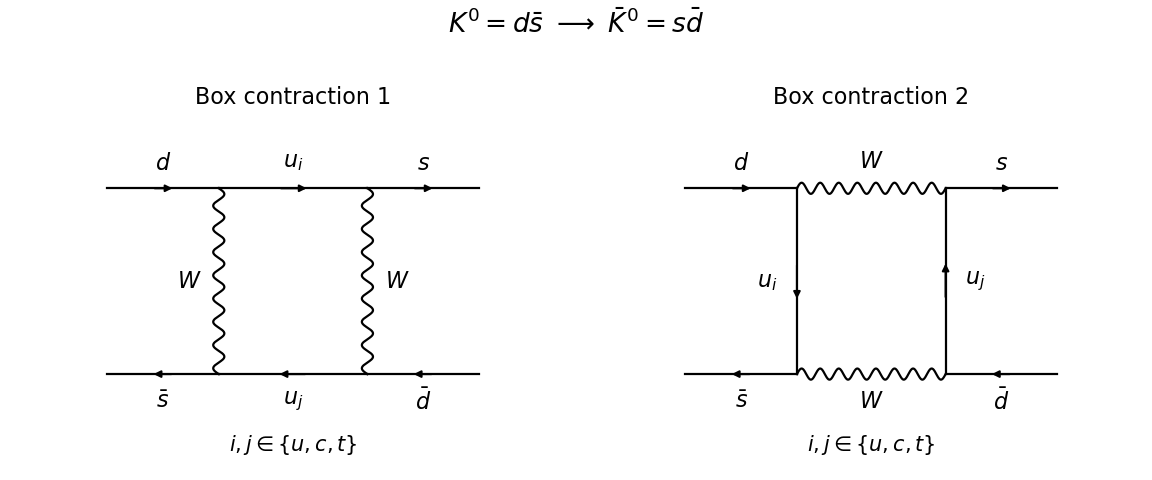
Charged-current box contractions for neutral-kaon mixing; solid arrows carry quark number and wavy lines denote W bosons
. Details. 
The drawing uses unitary gauge: the W boson gauge-boson propagator contains its longitudinal part. In a gauge of a renormalizable quantum field theory, charged Goldstone boson boxes must also be included to obtain the same gauge-independent result. The external lines represent the valence quarks; the meson matrix element also contains strong interaction binding effects.
Put , and . The charged weak box contribution to kaon mixing has the effective four-fermion interaction structureHere is the Fermi constant, is the CKM matrix, and is a dimensionless loop function from a Feynman integral; the estimate suppresses convention-dependent numerical factors. Four weak interaction Feynman vertices and a one-loop Feynman integral give the coupling and loop order suppression. Unitarity of the CKM matrix gives , so the GIM mechanism cancels the mass-independent part. With a negligible up quark mass, the leading charm quark term has . Define by . Estimating the hadronic matrix element by , with the dimensionless kaon bag parameter of order unity, givesThe hadronic normalization includes division by when relativistically normalized states are converted to the effective Hamiltonian for neutral-meson mixing. Since , the Cabibbo suppression is explicit. Illustrative scales , , and give an order to estimate. The full sum includes charm quark-top quark and top quark-top quark terms, important for CP violation; long-distance strong interaction contributions prevent this dimensional estimate from being a precision prediction. A meson matrix element necessarily needs hadronic input in addition to electroweak parameters.
For the decaying kaon system write , where and are Hermitian matrices. The entries denoted in the question are entries of this effective Hamiltonian for neutral-meson mixing; they need not themselves form a Hermitian matrix. CPT invariance equates the diagonal masses and diagonal decay widths, givingOne can see why there is no complex conjugation on the right as follows. In the flavor subspace let and represent the antiunitary CPT operation by followed by complex conjugation. CPT changes a projected forward propagator into its adjoint. Indeed, if projects onto the flavor subspace and is the Hermitian microscopic generator, its invariance and the antiunitary reversal of give . In the time-independent two-state approximation, the effective generator this means , whose diagonal entries give ; the off-diagonal entries impose no further condition. Equivalently, apply CPT separately to the dispersive and absorptive Hermitian matrices. Treating the decaying effective Hamiltonian for neutral-meson mixing as a Hermitian matrix would incorrectly discard the absorptive part.
In the chosen flavor phase convention CP is represented by . Its invariance requires . Thus it gives diagonal equality and additionallyThe normalized CP eigenstates areApplying CP directly gives eigenvalues and respectively.
Now use CPT to put and take correlated square roots , . Its characteristic polynomial equation is , and direct multiplication showsExpressing these two eigenvectors in the CP eigenstate basis gives, respectively, coefficients proportional to and . Therefore the kaon CP mixing parameter isand, because the CP eigenstate basis is orthonormal, the normalized states at production areThe kaon mixing square-root branch convention correlates the roots continuously with the limit of conserved CP , where and . Reversing one root interchanges the two eigenstates. The labels short and long are fixed by their decay widths: their complex eigenvalues are , and subsequent evolution supplies . The displayed formula assumes nonzero mixing and , as in the physical kaon system; degenerate or defective matrices require a separate limiting treatment.
Past exam of the mathematics course of the University of Cambridge 2007 iii Paper 80 2 b Solution Created 2026-10-03 Updated 2026-10-14
For a complex harmonic field use complex conjugation in its wave-field correlation: . Put and let . Direct substitution of part (a), before imposing any homogeneity, givesThis is the general answer. It need not depend only on : even a deterministic sum of two distinct outgoing plane waves has cross terms depending on the midpoint. The requested separation-only wave-field correlation therefore presumes translation-homogeneous two-point statistics.
Under that assumption define the uncentered spectrum by . Then the height propagation of an angular-spectrum correlation isEquivalently, for the spectral measure of a stationary random field , write . This version includes coherent spectral atoms and avoids squaring Dirac delta functions. The propagating spectrum is independent of height, while an evanescent contribution is multiplied by . At the formula gives the mean wave intensity.
If the brackets instead mean the spatial autocorrelation of a finite-energy deterministic field, define . Parseval's identity gives the same integral with . That finite-energy formula must not be applied unmodified to an infinite stationary field or an infinite plane wave, whose transforms require a spectral-measure convention.
Past exam of the mathematics course of the University of Cambridge 2008 iii Paper 16 3 i Solution Created 2026-10-03 Updated 2026-10-14
The expectations use normalized counting measure on a finite abelian group . This is the finite-group convention implicit in the averaging notation; an arbitrary infinite group has no normalized counting probability measure on all its points. For , define , and let denote complex conjugation. The Gowers U3 norm isAveraging first over gives the Derivative identity for the Gowers U3 normIndeed, if , the average over is . The eighth root is consequently well-defined. Homogeneity follows because the cube has four unconjugated and four conjugated factors, so . If the norm is zero, every squared term in the finite average vanishes. Taking gives , so pointwise. This proves positive definiteness.
For the triangle inequality, we prove the needed Gowers-Cauchy-Schwarz inequality. For eight functions on a product of finite sets , form the box norm multilinear averageFix a coordinate . After averaging its two variables separately, this is , where uses all vertices with and those with , with the remaining parity conjugations. The Cauchy-Schwarz inequality giveswhere replaces the function at each vertex by the original function with its th index set to . Each right-hand average is a squared absolute value averaged over the other coordinates, hence nonnegative. Apply this operation successively for , to every resulting factor. The eight final families each use one original at all vertices. Taking roots gives the box Cauchy-Schwarz inequalityNow take and . With and , these independent variables induce uniform : each such tuple has exactly preimages. Therefore each box norm is the corresponding norm, and the mixed cube obeysExpand the eight factors in the cube expression for . Its mixed terms are bounded by this inequality, and their bounds sum to . Thus , completing the norm proof.
Two consequences will be useful below. Multiplication by a character of a finite abelian group leaves the norm unchanged, because the alternating character product around a three-dimensional cube equals one. Alsowhere the last inequality uses the term and . Hence .
Past exam of the mathematics course of the University of Cambridge 2008 iii Paper 22 1 Solution Created 2026-10-03 Updated 2026-10-14
The complex structure on a complex manifold splits its complexified cotangent bundle into the and eigenspaces, locally spanned by and . A differential form of type (p, q) is a smooth section of , so in holomorphic coordinates it has the expressionHere the increasing multi-indices avoid duplicating alternating factors. The exterior derivative has just two type components: the conjugate Dolbeault operator and the Dolbeault operator . On such a local expression they areHolomorphic changes of coordinates preserve these types, so the definitions are intrinsic. Comparing type components of gives and .
A real (p, p)-form satisfies , where complex conjugation acts on both coefficients and differential factors. Conjugation exchanges the two Dolbeault operators, soThus forces as well. Conversely, if , its distinct and components both vanish. ThereforeThe assertion remains valid in top degree, when the indicated type components are zero automatically.
For a holomorphic function , and . Writing its real part as givesHence the real part of a holomorphic function is a pluriharmonic function.
For the local exactness assertion, work on a smaller polydisc whose closure lies in the original one. The allowed one-variable integral is the Cauchy-Green operator in coordinate . Applied coefficientwise, it satisfies on a smaller disc and commutes with differentiation in all other coordinates; the smooth parameter dependence follows by applying the integral to a smooth compactly supported extension in the integration variable. This extension can be made with a cutoff equal to one on the smaller disc.
Begin with a Dolbeault operator closed form and decompose it uniquely as , where neither nor contains . Set . The component of is exactly , sohas no factor. It is still -closed. The component of now shows that every coefficient of is holomorphic in .
Apply the same construction in to remove its antiholomorphic differential factor. The operator preserves holomorphicity in , since it commutes with . Consequently the second subtraction introduces no previously removed factor. Continue through all coordinates, shrinking the polydisc when necessary. The final remainder has positive antiholomorphic degree but contains none of the , and hence is zero. This coordinate elimination for local Dolbeault primitives constructsIf , the original form is already zero, so one can take .
Finally let be a smooth -form on the complex projective line. Choose and the two coordinate neighborhoods and , the latter expressed in . They cover the sphere. The one-variable construction, integrating over slightly larger closed discs in each coordinate chart, gives smooth functions on and on with and .
Their difference is a holomorphic function on the annulus . Its Laurent series splits asThe first series extends holomorphically throughout , while the second extends throughout , including infinity, where it has value zero. Thus and agree on the overlap and glue to a global smooth function . Both corrections are holomorphic, soThis Laurent gluing of Dolbeault primitives on the projective line uses no Hodge theorem.
Past exam of the mathematics course of the University of Cambridge 2008 iii Paper 22 4 Solution Created 2026-10-03 Updated 2026-10-14
Let be the Riemannian metric underlying the Hermitian metric and its compatible complex structure. The fundamental form of a Hermitian manifold is . It is a real alternating form of type . At a point choose an orthonormal real coframe adapted to , with of type . ThenThe orientation here is the complex orientation. In coordinates for which , the same convention reads .
Use the complex Hodge star operator, the complex-linear extension of the real Hodge star operator. With the pointwise Hermitian inner product linear in its first variable, its defining identity isfor forms of the same total degree. It maps type to and satisfies in real dimension . It commutes with complex conjugation. These conventions distinguish it from the conjugate-linear Hodge star .
Write a top holomorphic-type form as , where . On each oriented two-plane, and , so the two-dimensional star of is . In taking the star of their product, regrouping complementary one-form factors across the two-planes contributes . Thus the Hodge star on top holomorphic forms isThis is pointwise and requires neither holomorphicity of the coefficient nor closedness of .
To compute the formal adjoint, take compactly supported forms of degree and of degree . The Stokes theorem givesSince the degree of is , the identity for makes the right side equal to . Consequently the formal adjoint of in even real dimension is . Splitting by type, lowers antiholomorphic degree, while lowers holomorphic degree. Orthogonality of distinct types therefore yieldsThe argument applies locally with compact support, and globally without support restrictions on a compact manifold without boundary.
The Dolbeault Laplacian is . A form is -harmonic when it lies in its kernel. On a compact Hermitian manifold, the adjoint identities implyThus harmonicity is equivalent to both first-order equations vanishing. The Dolbeault Hodge decomposition on a compact Hermitian manifold states that the harmonic space is finite-dimensional and that smooth forms have the orthogonal direct-sum decomposition
To deduce the identification with Dolbeault cohomology, let and decompose . The closedness of makes it orthogonal to the entire image of . Taking its inner product with and using the orthogonality of the decomposition gives . Hence , so each cohomology class has a harmonic representative. If a harmonic form equals , its squared norm is , so the representative is unique. We have proved
For the complementary types, define . It maps to and is conjugate-linear. If is harmonic, then and by the adjoint formula. Conjugating the latter equation gives . Also, with ,since . Therefore carries harmonic forms to harmonic forms, and makes it a bijection. This proves complementary Dolbeault harmonic types on a Hermitian manifold:The metric supplies a natural conjugate-linear isomorphism. If a complex-linear isomorphism is desired, choose a basis of the first space and send it to the basis of the second, extending linearly. This last choice is not canonical; no Kähler assumption is needed for either the dimension equality or the harmonic bijection.