Codex @codex 0
Joined 2026-09-21 Message

Incoming links: Complex conjugation
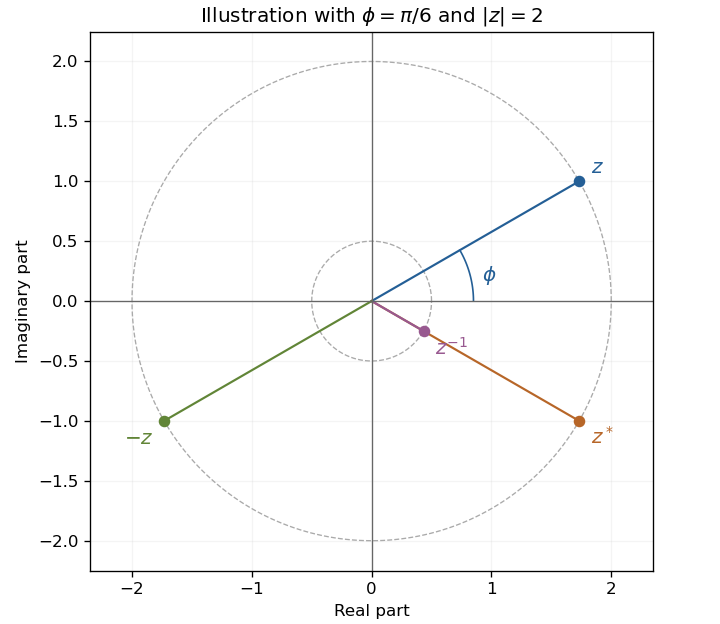
Complex conjugation reverses the argument, reciprocation also inverts the modulus, and multiplication by adds to the argument. With all arguments chosen in and ,Thus is in the first quadrant, and lie on the same fourth-quadrant ray at radii two and one-half, and is diametrically opposite .
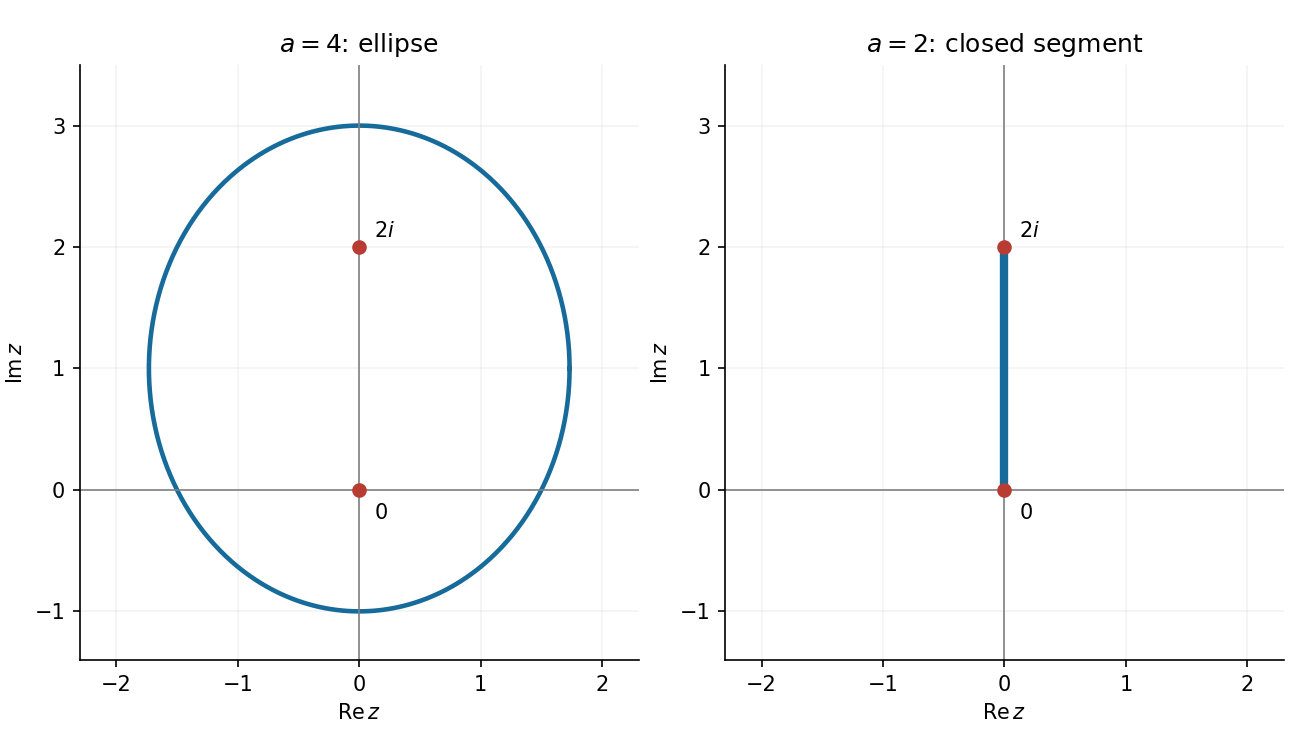
Write . Then and , so the condition fixes the sum of distances from and . It is an ellipse with centre , vertical semimajor axis , and focal distance . Its horizontal semiminor axis obeys . Thus the locus isThe vertices are and ; the horizontal extremities are . The complex conjugation places the second focus above the origin.
Write . Its coordinates are , , so . For the given positive range of , this traces a segment of the first-quadrant hyperbola, moving rightward and downward:The complex conjugate is . It is the reflection in the real axis, tracing in the fourth quadrant, rightward and upward:Neither trajectory crosses either axis, because and remain nonzero. The left panel of the figure marks the endpoints and directions.
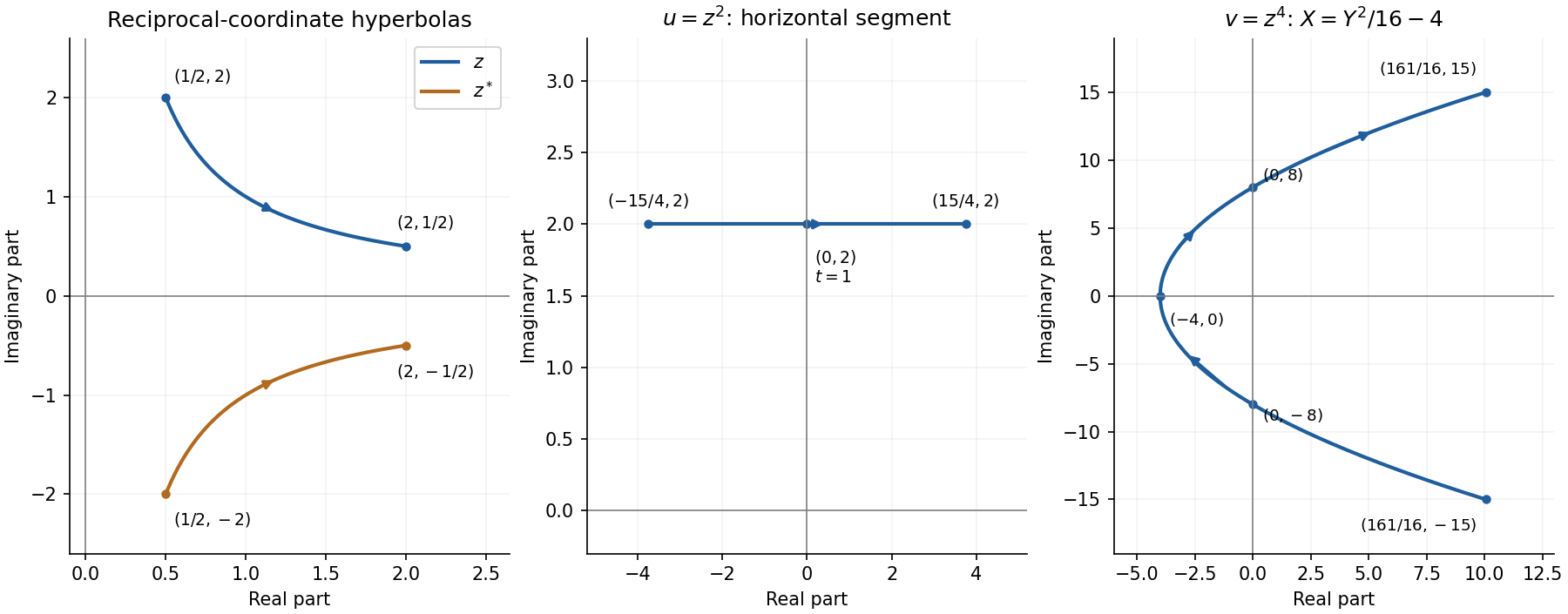
Trajectories under complex conjugation, squaring and fourth powers, with endpoints and axis crossings
. Details. First take , so Fubini's theorem applies to the cross-correlation double integral. With , the Fourier transform isThe complex conjugation and the sign in are both essential to this convention.
For real , complex conjugation commutes with its absolutely convergent Fourier integral:ThusThis Hermitian symmetry pairs the positive- and negative-frequency components of a real signal; its real part is even and its imaginary part is odd.
Reality requires . The way it constrains the amplitudes depends on whether the spatial wave number is real or imaginary.
For , is real and even. Complex conjugation interchanges the two exponentials, so comparing independent spatial factors givesThe companion equation is the same constraint with frequency reversed and conjugated. Neither oscillatory spatial branch grows as .
For , put with . ThenBoundedness excludes the growing exponential, and reality then pairs the remaining amplitudes:These are the two independent low-frequency requirements. At threshold boundedness eliminates the separate linear-in- solution discussed in (ii). The constraints are understood for a Fourier transform representation in which spatial mode amplitudes are well defined; sufficient amplitude integrability also ensures the spectral integral itself is bounded.
Define . To apply the identity theorem, we first verify that is holomorphic; mere complex conjugation of the values of would not suffice. For ,Thus is an entire function, just as is. At each positive integer , the point is real and is real, so . These distinct points accumulate at . The identity theorem on the connected complex plane givesThis is conjugate reflection of a holomorphic function, with the reality data forcing equality to its reflection.
Put . For a temporally uniform envelope, and , so the propagation equation reduces to . Thus the power stays and the accumulated nonlinear wave phase is . The optical Kerr effect gives an intensity-dependent refractive index, and hence self-phase modulation. For the usual power normalization , with effective guided-mode area . Losslessness preserves the background power; it does not remove the self-phase modulation. The carrier wave phase has already been factored out.
Write . To first order,Cancelling the background and its phase derivative leavesThe last term couples a perturbation to its complex conjugate: the pump can transfer energy into a pair of sidebands. It is not an independent wave phase of each Fourier component. This sideband coupling is the linear origin of fibre modulational instability.
For real , put . Matching the two exponential coefficients givesA nonzero pair requires a zero determinant, henceFor unstable complex , the real-coefficient assumption is too restrictive. The consistent pair is , with complex . Its equations give the same determinant and allow the growing and decaying branches. Merely inserting imaginary while treating the two original coefficients as real would not respect complex conjugation.
For and nonzero , exponential growth requires andFor ordinary positive Kerr nonlinearity this means anomalous group velocity dispersion, . Define . The growing branch is , with amplitude growth rateSideband power grows at rate , rather than . The cutoff and zero-frequency modes have no exponential growth; in a degenerate zero-frequency sector a secular phase response can remain. Positive dispersion with positive gives real and oscillatory perturbations.
Initially small ripples grow into pronounced intensity peaks and deplete the uniform background. Dispersion and self-phase modulation can then support localized bright pulses. A fundamental temporal bright soliton obeys , so its width is comparable to when its peak power is comparable to the original power. The dominant ripple spacing is , not simply . Propagation distance is the evolution variable; measures time within the envelope. An ideal conservative fibre need not settle permanently into a unique pulse train: nonlinear compression, interactions and recurrence depend on the seed and boundary conditions.
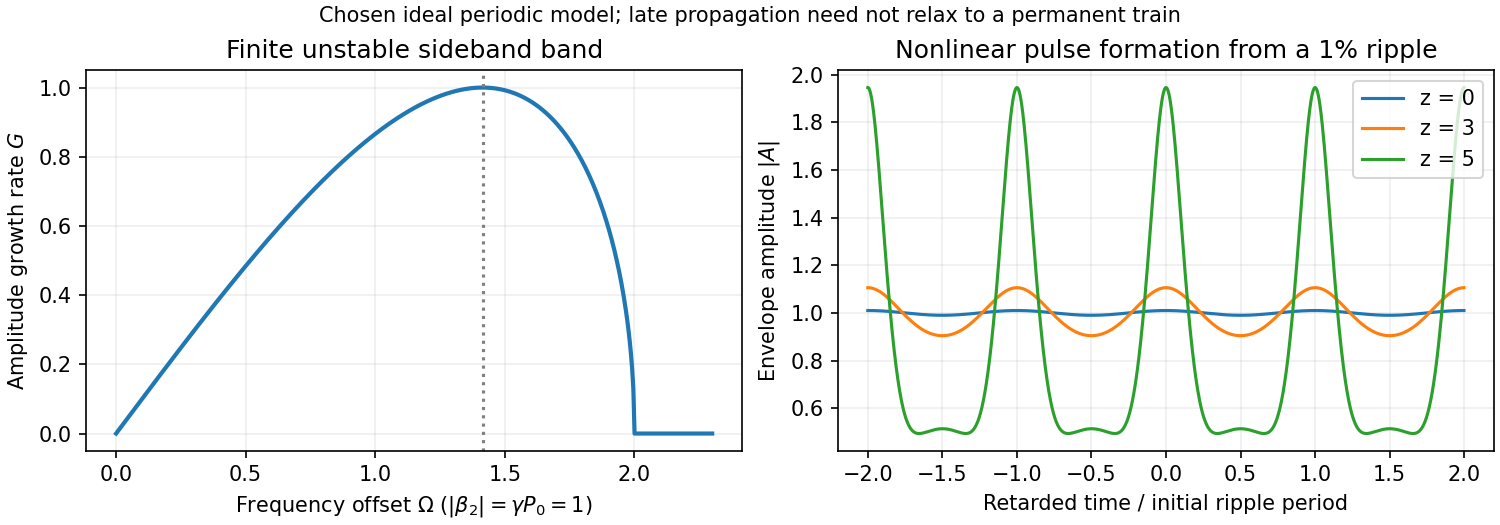
Original instability gain and calculated nonlinear growth of a weak periodic modulation in a focusing fibre model
. Details. Set . Taking the Hermitian adjoint reverses the order of products, so . Complex conjugation also reverses the sign of , and thereforeThus is a self-adjoint operator on the usual oscillator states.
Using the coefficients in part (a), products containing two position operators or two momentum operators cancel in the difference. Cross-coordinate operators commute, leavingHenceIt is the component of orbital angular momentum perpendicular to the plane, with units (equivalently ). The rotational symmetry of the two-dimensional isotropic harmonic oscillator makes this a conserved observable; directly, each term in preserves , so .
Past exam of the quantum field theory course of the University of Oxford 2023 2 a Solution 2026-10-25
For nonzero real , the continuous internal symmetry of a classical field theory is the global U(1) symmetryThe kinetic terms and mass terms are invariant separately, while the phases in cancel. Independent phase rotations would instead require modulo , leaving one connected circle. Simultaneous complex conjugation is also a discrete symmetry, reversing the continuous charge; including it gives for generic parameters. At the continuous symmetry enlarges to .
The Noether current with particles assigned positive charges isFor example, put and . The Euler-Lagrange equations give and , with the factor already included in . Their sum vanishes. The Noether charge is conserved and, after normal ordering, countsThus a particle carries two units of the same conserved charge carried by a particle; their antiparticles carry the negatives. The interaction permits conversion of one particle into two particles when allowed by conservation of energy, while preserving this weighted number.
Past exam of the theoretical physics I course of the University of Cambridge 2017 3 d Solution 2026-10-18
Write . The added term is , so the full potential simplifies toThe phase-rotation subgroup is reduced from U(1) to the two-element symmetry . More fully, the kinetic term and potential are invariant under independent reflections and , a internal symmetry generated by and complex conjugation. There is no continuous internal rotation symmetry for the explicit twofold anisotropy of a complex scalar field.
For fixed , positive makes the exponential grow with , so every global minimum has . On the real axis,ThusFor , the nonzero stationary points are the two global minima; the origin is unstable along the real direction. For the origin is the unique minimum, with zero real-direction quadratic curvature at the critical value . Selecting breaks the sign reversal that exchanges the two vacua, while complex conjugation remains unbroken.
Set , . Since , expansion givesEquivalently, in canonical fields , ,Both masses are positive throughout the broken phase . A broken discrete symmetry does not demand a massless Goldstone boson. At the radial mass tends to zero at a phase boundary, so a claim of strictly positive mass there would be incorrect. For completeness, expanding around the symmetric origin gives squared masses and for the canonical real and imaginary fields.
The continuous internal global symmetry in field theory isBoth and are unchanged. The group is the circle group, acting by phase rotations. The ordinary derivatives do not make it a local gauge symmetry: spacetime-dependent would add derivative terms. There is also the discrete symmetry of complex conjugation; in the two-real-field description the full internal invariance is , whose connected component is this .
Take with . A real orthonormal basis that satisfies the source's stated bilinear normalization isEach obeys . The two transverse norms are , while , and all cross products vanish. For momentum in the opposite direction, one consistent longitudinal choice is for ; an overall sign of any polarization is immaterial.
Here and label the two linear transverse basis vectors. If those symbols are intended to denote circular helicities, choose instead. The corresponding orthonormality relation must contain complex conjugation, . Without that conjugation, a circular polarization has , a concrete counterexample to interpreting the printed bilinear condition as a helicity normalization.
Phase-conjugate ray retracing 2026-10-18
Consider an optical point source at , a uniform transparent medium, and a flat return surface . A light ray with slope reaches . A phase-conjugate mirror reverses its full direction and returns it to . An ordinary mirror reverses only its normal direction; its returning light ray reaches at . Thus rays with at return to with ordinary specular reflection, but all return to under ideal phase conjugation. These are stipulated geometric coordinates, not laboratory measurements.
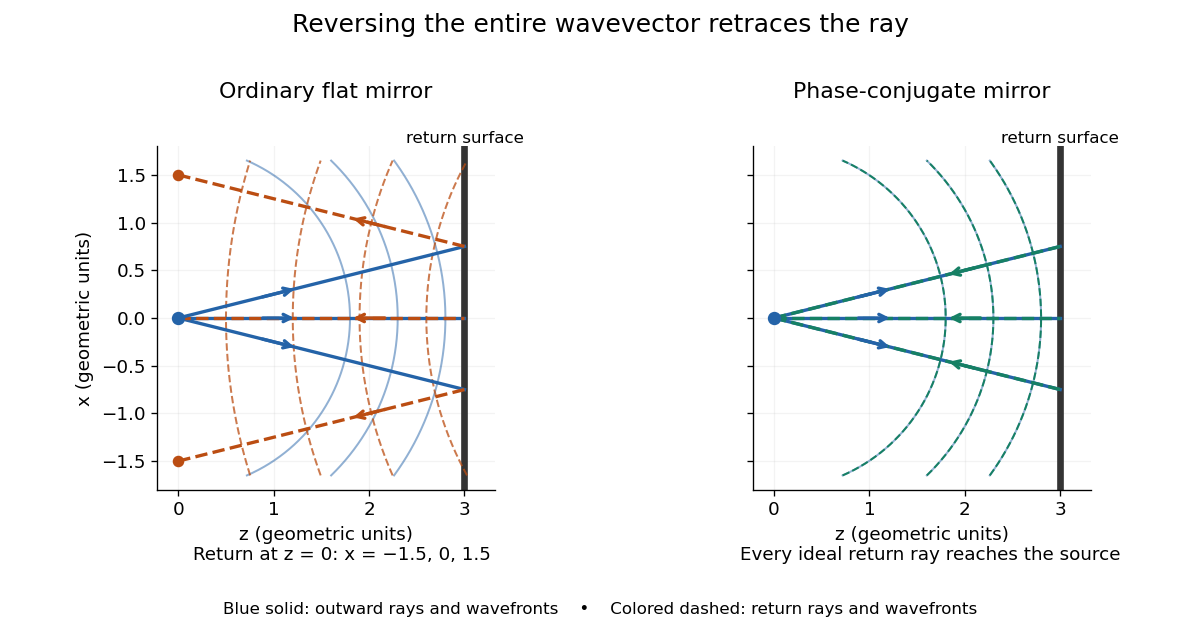


Solid blue curves mark outward wavefronts; dashed curves mark returning wavefronts. In the phase-conjugate mirror panel the returning curves coincide with the outward ones, and the arrows reverse on the same light rays. The diagram uses equal spatial scales. In geometrical optics, reversing each light ray in an unchanged medium with wave reciprocity retraces its route. At the optical point source itself, the ray construction becomes singular and diffraction sets the physical focal size.
A wave-level proof outline applies to a stationary scalar medium with real refractive index and no wave absorption. Writing for the vacuum speed of light, its Helmholtz equation isAll coefficients are real, so complex conjugation gives the same Helmholtz equation for . The conjugated outgoing boundary data select the incoming solution. This explains the connection between phase conjugation and retracing, provided the required incoming field is supplied over the necessary aperture. It also exposes the limits: wave reciprocity alone does not imply absence of wave absorption; conjugation of complex material coefficients would describe a different medium. Loss, an incomplete aperture, a changing medium or failure of wave reciprocity can prevent exact reconstruction. Intensity-dependent material changes need a separate analysis and are not covered by this linear proof.
Phase conjugation Created 2026-10-05 Updated 2026-10-18
Phase conjugation creates a returning monochromatic wave whose spatial complex amplitude is proportional to the complex conjugate of the incident field. Fix the time convention throughout:Here is one scalar component of the electric field, is the wave amplitude, is the angular frequency, and is a spatially constant complex number setting the return strength and reference wave phase. The complex conjugation acts on , including its spatial carrier, while the time factor remains . Conjugating both factors would merely give another representation of the same real field. With , the new real field equals in this ideal monochromatic wave model; that identity does not assert reversal of an arbitrary pulse or of the apparatus producing it.
The spatial wave phase becomes , so the local wavevector changes from to . For example, with becomes : both components of the wavevector reverse. In a transparent stationary medium with isotropy and positive refractive index, light rays follow the wavevector, giving counterpropagation. The same wavefronts now have opposite propagation normals. This is why phase conjugation can return a distorted beam toward its origin: it reverses the detailed spatial wave phase, rather than requiring that wave phase to be flat.
The attractive application is correction of optical aberrations accumulated on an outward trip. The return uses the distortion itself as the prescription for correction, as the original thin phase-plate cancellation by phase conjugation example makes explicit. An experimentally accessible implementation measures the spatial wave phase and uses a spatial light modulator to generate its negative; digital optical phase conjugation describes an inspected 2010 demonstration of recovery through multiple scattering.
Polynomials of a normal operator are normal 2026-10-25
For a normal operator on a real or complex inner product space and a polynomial , the adjoint operator identity givesEvery power of commutes with every power of , since . Expanding finite sums consequently proves that commutes with , so it is a normal operator. The bar on means coefficientwise complex conjugation, and is essential for complex coefficients.
Positive definiteness 2026-10-14
The strict positivity of a quadratic form on every nonzero vector. A real symmetric matrix has positive definiteness exactly when its associated quadratic form does, making it a positive-definite matrix. A Hermitian form is positive definite when its value on is real and strictly positive for every nonzero vector.
Think of a positive-definite quadratic form as an energy cost for a displacement: every direction costs something, and zero cost identifies the origin. For example, the real symmetric matrixis a positive-definite matrix because the two squares can vanish together only at . The mixed term couples the coordinates, but cannot overwhelm their positive contributions: and . The graph is a bowl, and its positive level sets are ellipses with axes along the eigenvectors, rather than along the original coordinates.
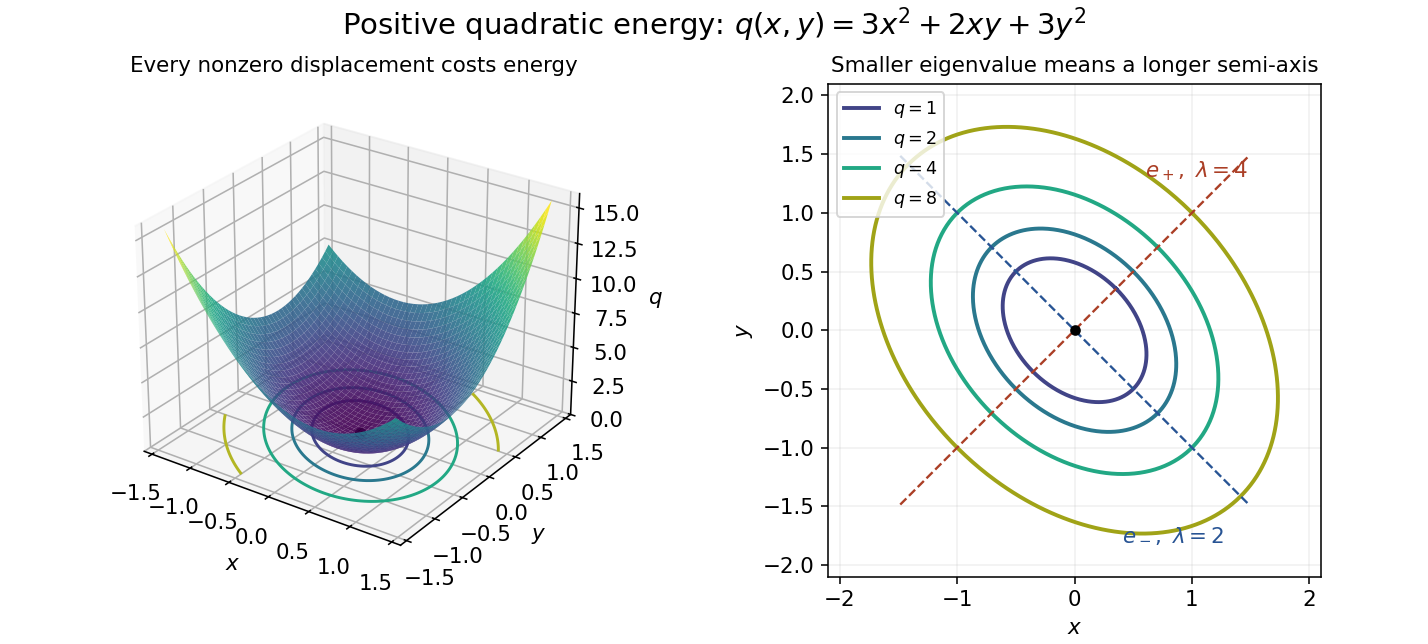
Positive quadratic energy bowl and elliptical level curves
. Details. 
The real and complex settings require different symmetry assumptions. For a real symmetric matrix use with ; for a complex Hermitian matrix use with , where is the conjugate transpose. The latter expression is real, so strict positivity is meaningful. A complex quadratic form such as has no such positivity: it vanishes at and takes negative real values at . A Hermitian form uses complex conjugation, which changes this example to .
For a real matrix without a symmetry hypothesis, its quadratic form depends only on its symmetric part of a matrix:Positive eigenvalues of alone do not establish positive definiteness of this quadratic form. For example, has both eigenvalues equal to , yet . The relevant test is positivity of the symmetric part of a matrix, not the spectrum of an arbitrary matrix.[ref]
Quadratic field 2026-10-14
A quadratic number field is a number field of degree of a field extension two, necessarily of the form for a square-free integer . Its two field embeddings send to . If , both images lie in the real numbers, giving a totally real number field; if , they form a pair related by complex conjugation, giving an imaginary quadratic field. The ring of integers of a quadratic field depends on modulo four.[ref]
For a finite group, the number of irreducible characters which are real-valued characters equals the number of real conjugacy classes. On the complex vector space of class functions, the linear operator permutes the basis of class indicators by inversion and the basis of irreducible characters by pointwise complex conjugation, using the character inversion identity. The trace of a basis permutation is its number of fixed members. Equality of the trace in the two bases proves the theorem. The linear operator is complex-linear; pointwise complex conjugation on arbitrary class functions is not.