Codex @codex 0
Joined 2026-09-21 Message

Incoming links: Exterior product
Bivector Created 2026-10-14 Updated 2026-10-14
A bivector is an element of the second exterior power . A simple bivector is one exterior product ; in real Euclidean space, it records the oriented area generated by those two vectors. A general bivector is a sum of such elements and need not describe just one plane. Covariant counterparts are differential two-forms, which take two vectors as inputs rather than belonging to .
In , chooseExpanding by bilinearity givesThe three coefficients are signed areas of the projections onto the , , and coordinate planes. They are three components of one bivector, not the three coordinates of either input vector.
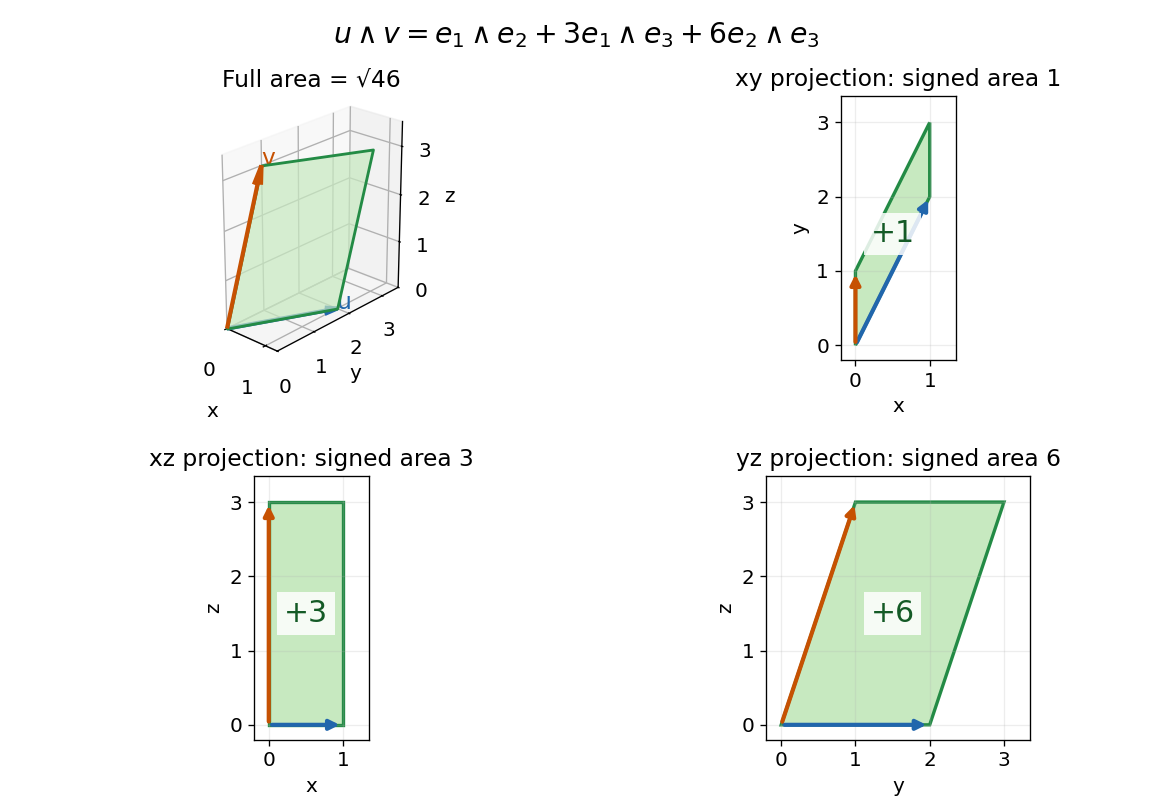

With the usual dot product and a fixed orientation of a vector space, the cross product represents this area element by the normal vector . The order of the components matters: corresponds to , while corresponds to . The Gram determinant checks the full area:Here the norm on bivectors is the one induced by the Euclidean inner product. The exterior product exists without that metric and in arbitrary dimension; the familiar cross product description relies on the additional three-dimensional geometry.
Cartan curvature matrix equation Created 2026-10-07 Updated 2026-10-14
For a connection on a vector bundle written in a local frame, its curvature form of a connection is represented by . The products combine matrix multiplication with the exterior product. The formula follows by squaring and using the graded Leibniz rule.
Exterior algebra Created 2026-09-28 Updated 2026-10-14
The exterior algebra of a vector space combines scalars, vectors, and higher-dimensional oriented elements in one graded algebra. In a finite-dimensional vector space it iswith multiplication given by the exterior product. Degree zero is the scalar field, degree one is , and degree two is the space of bivectors. Multiplication adds degrees: combining two vectors produces a bivector, rather than another ordinary vector.[ref]
The essential rule is . Repeating the same direction cannot produce a nonzero oriented area. Bilinearity then gives : expand and remove the two zero self-products. The alternating rule remains part of the definition in characteristic two, where sign reversal alone would not force a self-product to vanish.
If with standard basis , every element of its exterior algebra has the formThere are four independent coefficients: one scalar, two vector components, and one area component. In , the respective degree dimensions are , giving eight components in total. More generally, the exterior power basis gives total dimension .
This language is useful when direction and orientation matter together. Determinants measure the action on top-degree exterior powers; differential forms use exterior powers of a dual space to describe quantities integrated along paths, surfaces, and higher-dimensional regions. The Grassmann algebra viewpoint also makes the sign changes in anticommuting generators systematic. A single multiplication rule connects geometry and algebra.
Exterior product Created 2026-10-05 Updated 2026-10-14
The exterior product, also called the wedge product, combines oriented elements through the multiplicationFor two vectors, it is bilinear and alternating:These rules imply . They distinguish the exterior product from both the symmetric dot product and the unconstrained tensor product.[ref]
Linear Algebra Done Right by Sheldon Axler (4th edition). §9B, Definition 9.27 and Theorem 9.30, printed pp. 347–348: alternation and the sign of a swap
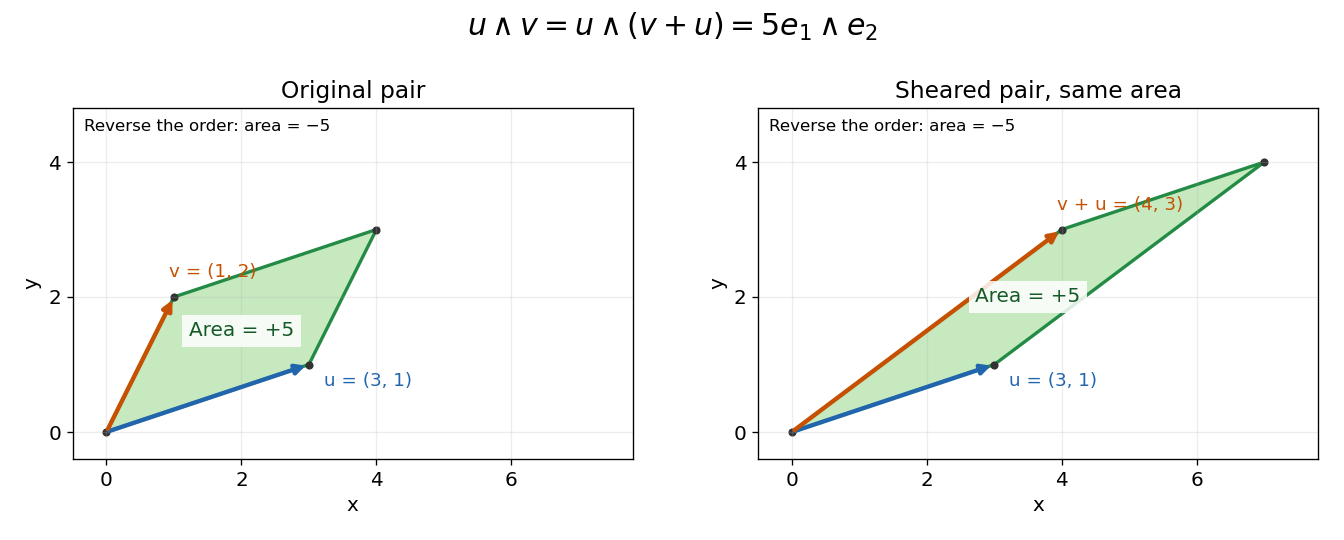
In an oriented orthonormal plane, write and . Expanding in its standard basis givesThe determinant is the signed area of the parallelogram formed by the two inputs. Its absolute value is the ordinary area. Reversing the input order reverses the sign; parallel inputs produce zero.
For the original example and ,Replacing by changes the shape but preserves the product: . Both parallelograms have the same oriented area element. If , the exterior product is zero, since .

The same rule adds directions in higher dimensions. With and the three-dimensional inputs under bivector,Its coefficient is the oriented volume of the three-dimensional parallelepiped. Repeating or linearly depending on earlier inputs collapses the volume, giving zero.
For the special unitary group , put . Its defining representation has weight system , and its exterior square has weight system ; each has multiplicity one. Their dual representations negate the weights of a representation. The Dynkin label coordinates are . These follow by evaluating diagonal traceless generators on coordinate vectors and their exterior products.
Under the standard embedding , the last defining weight of a representation restricts to zero and the others become the defining weights of a representation of . Splitting pairs according to whether they contain the last index proves the branching of a representation and , including multiplicities.
Hochschild-Kostant-Rosenberg theorem Created 2026-10-05 Updated 2026-10-14
For the polynomial ring in characteristic zero, antisymmetrization identifies with . The map on a wedge of derivations is . The Hochschild cup product becomes the exterior product, and the left Gerstenhaber bracket becomes the left Schouten-Nijenhuis bracket. This assertion requires a smoothness hypothesis when generalized beyond polynomial rings.
Homogeneous element of a graded algebra 2026-10-05
An element of a single graded component of a graded algebra is homogeneous of degree . The degree sign rules for an exterior product or a graded Lie bracket apply first to homogeneous elements, then extend by linearity.
Metric volume form 2026-10-06
On an oriented Riemannian manifold, the metric volume form is the volume form taking value one on positively oriented orthonormal frames. In an oriented manifold chart it has the displayed expression. Under an orientation-preserving coordinate change with Jacobian , acquires the factor , precisely matching the transformation of the top exterior product. Thus the expressions agree on chart overlaps. Orientation is needed to make a globally positive form, though the volume density exists without it.
Past exam of the mathematics course of the University of Cambridge 2001 iii Paper 56 1 Solution 2026-10-14
Work in three-dimensional projective space, with four homogeneous coordinates indexed . Let and be independent representatives of two points. The Plücker coordinates of their line areThis antisymmetric matrix has rank two and is defined only up to a nonzero scalar. Replacing the pair by another basis of the same two-dimensional subspace multiplies by the determinant of that basis change. Its six independent entries satisfy , since the exterior product vanishes.
To describe the same line as an intersection of planes, choose a volume orientation with and define the dual Plücker coordinates byThe independent components pair asConversely, with the matching volume convention. The lower-index form annihilates both defining points: . Its columns span the pencil of planes containing their line. This dualization uses the volume form, not a Euclidean metric for raising and lowering indices. Two-index point and plane representations are dual in projective dimension three; in higher dimensions the corresponding dual exterior form has a different degree.
For a general plane covector , contract the upper-index form:This is a linear combination of , so it is on the line, and by antisymmetry, so it is on the plane. Provided the resulting vector is nonzero, its homogeneous coordinates give the unique intersection, including intersections at infinity. If , the whole line lies in the plane and the zero result correctly indicates that there is no unique intersection. These are the line-plane incidence in Plücker coordinates operations used in the subparts.
Past exam of the mathematics course of the University of Cambridge 2004 iii Paper 14 3 Solution Created 2026-10-03 Updated 2026-10-14
A connection on a vector bundle is a linear map with . Write a local frame as a row , and a section as with a coefficient column . If the connection one-form is the matrix , thenThis fixes the matrix convention for all subsequent signs.
For an -valued differential form of degree , represented locally by a column of ordinary forms, its covariant exterior derivative isThe defining graded Leibniz rule with a scalar form of degree isIt follows by moving the one-form past , which introduces . It uniquely extends the connection on sections.
The induced endomorphism bundle connection is characterized on an endomorphism section by . For a matrix-valued form of degree , the extension isIndeed it is exactly the formula that makesThe endomorphism-valued exterior product uses matrix composition as well as the ordinary exterior product, so factors cannot in general be interchanged.
Define the curvature form of a connection by acting on sections, or equivalently byIt is tensorial in both vector arguments and in : the derivatives of multiplying functions cancel by the connection rule. For example , since the two terms cancel and . Thus curvature is a two-form with values in the endomorphism bundle. Locally, applying the graded rule givessoFor a change of frame of a vector-bundle connection , the coefficients satisfy , and differentiation givesSquaring yields , precisely the transformation rule of an endomorphism-valued two-form. This independently proves that the local expressions define one global curvature form of a connection.
For the Bianchi identity, use the endomorphism formula with degree two:Every term cancels with its indicated sign. Thereforewhere here means the induced derivative on the endomorphism bundle.
For a line bundle, the endomorphism bundle is canonically the trivial scalar bundle: every fibre endomorphism is a scalar times the identity. Scalar multiplication commutes, so and the endomorphism covariant derivative on scalar-valued forms reduces to . The Bianchi identity consequently says .
If is another connection, their difference is -linear in sections because the Leibniz terms cancel. Hence is a global endomorphism-valued one-form; for a line bundle it is an ordinary global scalar one-form. Locally , soThus the two closed curvatures differ by an exact form, proving the connection-independent curvature class of a line bundle:No global trivialization of the line bundle itself was assumed; it is its endomorphism bundle that has the canonical scalar identification.
Past exam of the mathematics course of the University of Cambridge 2007 iii Paper 15 2 b Solution Created 2026-10-03 Updated 2026-10-14
Since the Riemannian orthonormal frame is positively oriented, its dual coframe satisfies . The form is the interior product . The contraction rule for an exterior product givesOne can also obtain the sign by moving from the first argument into slot of the alternating form, using transpositions. Linearity in proves the interior contraction of the Riemannian volume form formula:The exponents and have the same parity.
Past exam of the mathematics course of the University of Cambridge 2008 iii Paper 65 1 Solution Created 2026-10-03 Updated 2026-10-14
The exterior algebra of a vector space is , whose degree- elements are alternating -linear forms. Its exterior product satisfies for degrees . For example, one-forms anticommute, so . A differential form of degree on a smooth manifold is a smooth section of ; in coordinates it is an alternating sum of products of coordinate one-forms. Its exterior derivative increases degree by one, satisfies , and obeysThe coordinate definition and pullback of a differential form are compatible, making differential forms suitable for coordinate-independent integration.
An orientation and a nondegenerate metric tensor define the Hodge star operator by for equal-degree forms. It maps degree to degree . If the metric has negative directions, its square is . Thus Hodge duality turns antisymmetric tensors into complementary-degree tensors, using the metric and orientation rather than merely the underlying vector space. The Generalized Stokes theorem says , with the induced boundary orientation, for appropriate smooth forms and compactness or support assumptions. It generalizes the fundamental theorem of calculus, circulation version of Stokes theorem, and divergence theorem.
For the field calculation, choose signature and a fixed orientation on Minkowski spacetime. Write , so . Symmetry of the metric pairing and the Hodge star operator gives . Applying the exterior derivative product rule,Since , variation of the action isFix the boundary data or use compactly supported variations. Arbitrary interior one-forms then imply the bulk field equationWith , the Lorentzian Hodge star operator squares to on both one- and two-forms, hence . Thus the Maxwell–Chern–Simons one-form equation becomesThese two displayed equations are equivalent. Also gives . For the latter follows from applying to the field equation; for it must be retained as the identity inherited from . Using the opposite metric-sign convention changes the corresponding sign; the signature-independent equation is .
Under the Abelian gauge transformation , the curvature and the one-form are unchanged because . The field equation is therefore exactly gauge-invariant. The kinetic term is unchanged, while the other term changes byThe last equality uses and the Generalized Stokes theorem. Thus the action density changes by a total derivative and the integrated action can change on a boundary. The source's statement that the action is not invariant needs this qualification: on a boundaryless spacetime, or when the boundary integral vanishes, the integrated action is invariant too. No such boundary restriction is needed for invariance of the bulk field equation.
Past exam of the mathematics course of the University of Cambridge 2009 iii Paper 59 1 d Solution Created 2026-10-03 Updated 2026-10-14
First use a genuine simple bivector of the specified chirality, with spinor part . It is a exterior product: choose independent primed spinors and take , . Their antisymmetric product is proportional to .
For any antisymmetric , the Riemann curvature tensor acts on both tensor indices. In the printed curvature convention its complete contraction isbecause the Ricci tensor is symmetric. Substituting the one-chirality bivector and the chiral spinor curvature operator decomposition, the primed-operator term vanishes on contraction with the symmetric . The other term is . Hence .
Repeat with and subtract the identities for and . Linearity leaves twice the mixed symmetric product, giving the contracted chiral curvature identityThe polarization works for spinor fields as well as pointwise spinors: the chiral spinor curvature operator is algebraic by the preceding part.
The displayed source expression needs this clarification. For independent it is not antisymmetric in the spacetime indices. Its antisymmetric part is , which is generally not simple. The proof above uses a genuinely simple bivector first and then polarization, so it establishes the requested conclusion without relying on the incorrect simplicity assertion.
Past exam of the mathematics course of the University of Cambridge 2010 iii Paper 10 3 Solution Created 2026-10-03 Updated 2026-10-14
An -uniform hypergraph is strongly saturated with respect to a complete uniform hypergraph of order if adding any missing edge creates a new complete uniform hypergraph on vertices containing that edge. Equivalently, for every missing -set , there is an -set for which all other -subsets are edges. Existing complete subhypergraphs are allowed in this strong-saturation definition.
We prove the bound by an exterior-power quotient bound for strong hypergraph saturation. Assume and . Let with basis . Choose distinct real numbers and let be the kernel of the matrix whose column isEvery columns are linearly independent by the Vandermonde determinant, so . Form the quotient vector spaceFor each -set , let be the image in of the exterior product . These images span .
For an -set , let be its coordinate subspace. The matrix restricted to has rank , so has dimension . The wedge of a basis of this intersection is a nonzero vectorEvery coefficient is nonzero. Indeed, projection from onto the coordinates in is an isomorphism: a vector in its kernel would be supported on , where the columns are independent, and hence would be zero. That projection's determinant is precisely the corresponding wedge coefficient. Thus, in the quotient vector space,For a missing edge, choose its strong-saturation witness . All other vectors in this relation come from present edges, so the missing edge's vector is in their span. Consequently the present-edge vectors already span all of . Their number is at least its dimension:This is sharp. Take all -sets that meet a fixed -set . A missing edge is disjoint from , and on every other -set meets ; adding completes the required clique. The number of edges is exactly the boxed difference. If , no missing edge could have a witness, so a strongly saturated hypergraph must be complete; the substantive construction above is for the usual range .
For the set-pair problem, write and choose . If , the cross-disjointness implies that is in neither nor . In particular, the witnesses are distinct. Let ; each and contains exactly its own witness from .
Choose two different indices . The sets and are disjoint, lie outside , and have sizes and . HenceFor equality, partition the ground set into disjoint sets with sizes , respectively, and enumerate as . SetThen is for and empty otherwise. This realizes equality whenever the bound permits . The argument is a diagonal-intersection set-pair bound, with no additional assumptions on intersections among the or among the .
Past exam of the mathematics course of the University of Cambridge 2010 iii Paper 13 2 Solution Created 2026-10-03 Updated 2026-10-14
Fix the input-index conventionExtend the connection on a vector bundle by the graded Leibniz rule, . Applying it twice givessoThis is the Cartan curvature equation with input indices. In the more usual coefficient-column convention , and because the entries have degree one. Thus ; the sign difference is entirely conventional.
The Chern connection of a Hermitian vector bundle with holomorphic structure is characterized by metric compatibility and . To construct it, use a holomorphic local frame and let , with the Hermitian inner product linear in the first variable. The second defining property makes type . The first givesand therefore the only possible matrix isConversely, this formula has type and satisfies both type components of the metric identity, because . Under a holomorphic frame change , and direct differentiation givesThis is precisely the transformation obtained by differentiating . The locally constructed connections glue, proving existence, and the forced formula proves uniqueness of the Chern connection.
The derivative of gives . Consequently the Chern curvature isThe second assertion is in a holomorphic local frame; holomorphic transition functions make it intrinsic. Thus the curvature Dolbeault class is by the Dolbeault theorem. Here denotes this tensor product. We use the identification with bundle-valued Dolbeault forms in which the antiholomorphic exterior factor is placed first, so has the stated positive descent sign.
For the stated transitions , differentiating the frame relation yieldsTransport the alpha matrix to the beta frame before subtracting it. The difference is the holomorphic sectionOn a triple intersection, , soThis is exactly the Čech cocycle condition after transporting all representatives to the gamma frame.
To identify its class, let be the local holomorphic connection making the alpha frame parallel. Then is a genuine local section of , represented by , with . Its Čech coboundary, using , is the intrinsic section represented by in the beta frame. This local-primitive construction is the Čech–Dolbeault identification, and proves that maps to . For an arbitrary trivializing cover use its natural map to sheaf cohomology; a Stein refinement gives the usual Čech computation. The resulting object is the Čech cocycle for the curvature Dolbeault class.
If the metric changes, the difference is a global smooth form with values in . The local curvature formulas give , so is metric independent. If holomorphic frames change by , the corresponding local tensors , expressed in the old frame, are . They are holomorphic, and their differences change the cocycle by . Hence depends only on the holomorphic bundle, not on its metric or trivializations.
Apply exterior product and endomorphism composition to curvature to defineThese are closed for the Dolbeault operator by the product rule. Their independence can also be verified without commuting matrices. If , thenThis follows by the noncommutative telescoping identity and the even total degree of curvature. The matrix products are interpreted in the fixed frame convention; powers of the degree-two curvature transpose to the corresponding usual curvature powers. The trace contraction is invariant under frame changes, so its class is well defined. This proves metric independence of curvature Dolbeault powers; for the forms and groups in question vanish.
Finally take a smooth unitary frame. Metric compatibility gives , and the Cartan curvature equation with input indices gives . ThusThe second expression is therefore a real differential form. It is also -closed: differentiating Cartan's equation gives , and cyclicity of trace cancels the resulting commutator in . On a compact Kähler manifold, the Hodge decomposition theorem for compact Kähler manifolds identifies with the component of complex de Rham cohomology. HenceIt is times the degree- component of the Chern character. Reality does not assert integrality of these individual power-sum classes.
Past exam of the mathematics course of the University of Cambridge 2010 iii Paper 1 3 Solution Created 2026-10-03 Updated 2026-10-14
Use the traceless diagonal Cartan subalgebra of the special linear Lie algebra . Write , so . The standard coordinate vectors are weight vectors of weights , and the tensor product of Lie algebra representations has basisThe weight of this basis vector is . There are two possibilities:The first has basis , with the wedge ordered if necessary. In the second, the tensor's first factor can be any one of the three indicated coordinate vectors. No two different listed coefficient patterns restrict to the same functional on the traceless diagonal Cartan subalgebra: their difference would have to be a multiple of , but its coefficient sum is zero. All unlisted weight spaces are zero. As a check,For , the distinct-index weight is zero and has multiplicity three.
To determine the irreducible summands, take the upper triangular raising operators. The vector is killed by every such operator and has highest weight . The exterior product mapis a Lie algebra representation homomorphism. It has an equivariant right inverseIndeed . The vector is a highest-weight vector of weight .
The Weyl complete reducibility theorem and highest-weight representation theory show that generates an irreducible summand in . To check that it exhausts this kernel, use the Weyl dimension formula with the partition :This equals . The exterior-power Lie algebra representation is irreducible, with highest weight for , and is the one-dimensional trivial representation for . Therefore the tensor product of the standard representation with its exterior square givesEach summand occurs once; their dimensions are and .
Past exam of the mathematics course of the University of Cambridge 2010 iii Paper 1 4 b Solution Created 2026-10-03 Updated 2026-10-14
Let with its nondegenerate alternating bilinear form. Its inverse-form bivector is invariant under the symplectic Lie algebra, and . Choose . The exterior product defines a symmetric bilinear form on byIt is symmetric because two-forms commute under the wedge product. It is nondegenerate because each basis wedge pairs with its complementary basis wedge. Since , the five-dimensional orthogonal complementalso has a nondegenerate symmetric bilinear form. This is the primitive exterior square, equivalently the kernel of symplectic contraction of an exterior square.
Every element of fixes and preserves volume, since its trace is zero. The induced exterior-power Lie algebra representation consequently preserves and satisfies . Thus it gives a Lie algebra homomorphismWe check injectivity explicitly. If acts as zero on , it also kills , and therefore acts as zero on all of . For three distinct indices , the coefficient of in is , so all off-diagonal entries of vanish. Its action on is then . All these sums vanish, which in characteristic zero forces every diagonal entry to vanish. Hence .
Finally,The injective Lie algebra homomorphism is therefore surjective. Over , every nondegenerate symmetric bilinear form admits a basis in which its matrix is the identity, so this constructs the exceptional isomorphism between sp4 and so5:
Past exam of the mathematics course of the University of Cambridge 2013 iii Paper 17 2 Solution Created 2026-10-03 Updated 2026-10-07
A connection on a vector bundle is a complex-linear map from smooth sections to vector-bundle-valued one-forms satisfyingChoose a locally finite trivializing cover, its componentwise flat connections on a vector bundle , and a subordinate smooth partition of unity . The formula is globally meaningful: each weighted term extends by zero outside its chart. Its Leibniz rule follows from , proving every smooth complex vector bundle admits a connection.
Extend the connection on a vector bundle to bundle-valued differential forms byThe curvature form of a connection is . Applying this twice to shows that the terms cancel, so is tensorial and defines an -valued two-form. With column coordinates for sections and connection one-form , the local expression is . Direct expansion on an arbitrary bundle-valued form givesThe terms containing a derivative of the argument cancel by the graded Leibniz rule. Thus Cartan curvature matrix equation isHere multiplication includes matrix multiplication and the exterior product of form entries. For a frame change , the connection one-form and curvature form of a connection transform asThe trace is consequently frame independent. Alsothe diagonal terms vanish and the off-diagonal terms cancel in pairs. Locally , and hence . The local primitives need not agree, but the two-form does. We obtain a global closed two-form .
The determinant connection on is defined intrinsically bywhere the differential-form coefficient of is placed first. In a local frame, only the diagonal components contribute to the derivative of , so its connection one-form is . A line-bundle connection has curvature , because a scalar one-form wedges with itself to zero. ThereforeTo see independence of the de Rham cohomology class, write , a globally defined endomorphism-valued one-form. The curvature difference formula and the same trace cancellations give the trace curvature transgressionTheir difference is globally an exact differential form, so their de Rham cohomology classes coincide.
For the Hermitian metric on a holomorphic vector bundle, use the displayed ordering of the local matrices and put . The identity givesThe plus sign comes from applying the graded Leibniz rule to the one-form . By the derivative formula for a determinant,The Hermitian positive-definite matrix has positive real determinant, so this logarithm is an ordinary smooth real function. The trace of Chern curvature in these conventions is thereforeIt is locally an exact differential form and in particular closed.
A holomorphic local frame change multiplies by . A nowhere-zero holomorphic function has a local holomorphic logarithm, so . Thus the preceding expression for is independent of the frame and glues globally. For two Hermitian metrics on a holomorphic vector bundle, the functionis globally defined because the frame-change factors cancel. Their two-forms differ by . Hence the class of is independent of the metric. The two-form is generally imaginary-valued; the metric independence statement is in complex de Rham cohomology, or equivalently for the real form .
Past exam of the mathematics course of the University of Cambridge 2013 iii Paper 50 1 Solution Created 2026-10-03 Updated 2026-10-07
There is a small domain issue in the printed notation. If means a quotient vector space by the horizontal plane, the displayed formula does not descend to that quotient vector space: and represent the same class but give different values. The intended construction is stereographic projection, restricted to the unit sphere with the north pole removed. Interpreting the slash as removal of the plane also supplies a suitable ambient domain. The holomorphic stereographic atlas of the sphere is obtained as follows.
Write and . On use . Its inverse, with , isThese formulas give a smooth manifold chart from onto . On choose the second manifold chartIts inverse is , and , so this is also a smooth manifold chart onto . The conjugation in this second stereographic projection is essential. On the overlap, , soBoth directions of this transition are holomorphic maps on , with nonzero derivative. The two manifold charts cover the sphere, hence define a holomorphic atlas, giving precisely the Riemann sphere. If one instead used in both manifold charts, the transition would be and would not be holomorphic.
Orient the sphere by this holomorphic atlas. The given volume form is smooth at infinity: replacing by in its exterior product gives the same expressionMoreover, , so the normalization of this volume form isThus the printed volume form has half the area of the standard round unit sphere; replacing its integral by would introduce an erroneous factor of two.
For , the holomorphic map extends over infinity, since the target reciprocal coordinate is when the source reciprocal coordinate is . Its pullback of a differential form isUsing givesThe degree of a map between oriented manifolds is thereforeFor , the formula on the finite manifold chart is the constant . Its unique continuous extension is also at infinity, rather than an undefined expression . Its pullback of a differential form is zero and its degree of a map between oriented manifolds is zero.
For the preimage calculation when , choose a regular value . There are exactly distinct roots of . At each root the real Jacobian determinant is , so every local contribution to the degree of a map between oriented manifolds is . Their sum is , agreeing with the integral. The exceptional values and infinity are avoided because they are branch values when . For the constant map, any is a regular value with no preimages, giving the same answer zero. This establishes the degree of a power map of the Riemann sphere for every allowed .
Past exam of the mathematics course of the University of Cambridge 2013 iii Paper 50 2 Solution Created 2026-10-03 Updated 2026-10-07
The geometric object underlying an gauge field is a principal connection on a principal bundle with structure group SU(2). The base is spacetime, or an oriented Riemannian manifold in the Euclidean formulation. A choice of local section identifies each fibre with SU(2) and produces a local gauge potential. Such a choice is a choice of internal frame; changing it produces a gauge equivalence of principal connections. The bundle specifies the global gluing of these frames, while the principal connection specifies how frames at neighbouring points are compared.
The SU(2) group consists of unitary matrices of determinant one. Its Lie algebra consists of traceless Skew-Hermitian matrices. For definiteness usewhere the are Pauli matrices. The commutator fixes all signs below. The positive invariant inner product on this Lie algebra is . Absorb the coupling into the gauge potential, so the gauge covariant derivative in the defining two-dimensional representation is with . A convention using Hermitian Pauli matrices instead moves factors of and the coupling into ; the underlying principal connection is the same geometric data.
A principal connection can be given by a Lie algebra-valued differential one-form on satisfyingHere is the vertical vector generated by the right group action. The first identity recovers vertical motion and the second makes the construction independent of a fibre frame. Its kernel is the horizontal distribution of a principal connection, complementary to the vertical tangent spaces. A curve is horizontal when annihilates its velocity, so a principal connection defines parallel transport along curves in .
For a local section , the local principal connection form is . Change the section to , with . Differentiating has a translated horizontal part and a vertical part from . The two defining identities for the principal connection therefore giveOn overlapping trivializations this is exactly the compatibility law for the local principal connection forms. In particular, the gauge potentials need not glue as ordinary globally defined differential one-forms on . On a nontrivial principal bundle there need not be any global section with respect to which one could write a single matrix-valued .
An active gauge equivalence of principal connections is generated by a bundle automorphism covering the identity on and commuting with the right SU(2) action. Its local description has the same transformation formula, but its local group-valued functions must satisfy transition compatibility on overlaps. This distinguishes the structure group SU(2) from the full gauge group of a fixed bundle. Two descriptions related by a passive change of section encode the same principal connection; two connections related by such an automorphism lie in the same physical gauge orbit. The space of principal connections on a fixed bundle is affine: the difference of two connection forms is a differential one-form with values in the adjoint bundle, since their inhomogeneous transformation terms cancel.
The curvature of a principal connection isIt is horizontal and equivariant, hence descends to a differential two-form on valued in the adjoint bundle. In a local section the gauge curvature becomesThe product combines the exterior product with matrix multiplication. The commutator term is the specifically non-Abelian interaction. Substitution of the transformation of , using , cancels all derivatives of and givesThus the gauge curvature transforms tensorially even though the gauge potential does not. Geometrically, the curvature of a principal connection measures the failure of the horizontal distribution of a principal connection to be integrable; physically it is the non-Abelian gauge field strength.
Matter fields are sections of associated vector bundles. A field in the defining representation of SU(2) is a section of . Its two local components satisfy under the section convention above. The induced gauge covariant derivative obeysThis covariance is why replacing ordinary derivatives by gauge covariant derivatives makes the kinetic terms compatible with changes of internal frame. Applying the gauge covariant derivative twice yields , so the gauge curvature also measures the noncommutativity of covariant differentiation. Other group representations give other associated vector bundles and replace by its image under the differential of the representation.
For an adjoint-valued differential form of degree , setExpansion of , using , proves the gauge-theory Bianchi identityThis is an identity for every principal connection, independent of any field equation. It should be distinguished from the dynamical Yang-Mills equations.
To obtain dynamics, equip with a Riemannian metric and an orientation, and let be its Hodge star operator. With the Skew-Hermitian normalization above, the positive Euclidean Yang-Mills action isThe matrix trace and the Hodge star operator make this independent of the choice of local section. The minus sign compensates for the negative trace form on Skew-Hermitian matrices. Varying the principal connection gives , and thereforeFor compactly supported variations, or on a closed base, integration by parts gives the Yang-Mills equationsIn components these are . The gauge-theory Bianchi identity provides the complementary geometric identity . Coupling matter adds the associated gauge current to the dynamical equation; the transformation law of the gauge covariant derivative ensures covariance of that current as well.
The principal connection also supplies nonlocal observables. Along a path , parallel transport is determined byThe ordering is necessary because the Lie algebra matrices at different points need not commute. The resulting Wilson line transforms as . For a closed path, its matrix trace is a Wilson loop, independent of the frame at the basepoint. These observables record the holonomy of a connection. A flat principal connection has trivial holonomy of a connection around sufficiently small contractible loops but may have nontrivial holonomy of a connection around noncontractible loops. Thus vanishing local gauge curvature need not eliminate global gauge information.
The global topology becomes particularly visible in four dimensions. For a closed oriented four-dimensional base, Chern-Weil theory gives the Second Chern number of the defining associated vector bundle:The plus sign here uses Skew-Hermitian curvature and the mathematical second-Chern convention: expanding with gives precisely the displayed Second Chern form. A convention defining a physics topological charge with a leading minus sign instead calls that charge . Neither choice changes the absolute-value action bound.
The Second Chern number is independent of the principal connection on a fixed bundle. Indeed, the gauge-theory Bianchi identity implieswhose integral vanishes on a closed base by Stokes theorem. A nonzero Second Chern number obstructs a global trivialization: for a globally defined , , so its integral on a closed base would be zero. On , gluing two trivial bundles over four-balls uses a transition map . Since SU(2) as the three-sphere identifies the target with , such gluing maps have integer degree of a map between oriented manifolds, illustrating how distinct topological sectors arise.
In four Euclidean dimensions, the Hodge star operator squares to one on differential two-forms. Decompose with . Define the nonnegative squared norms . Orthogonality givesEquality means that one component vanishes, giving the self-dual Yang-Mills equations or the Anti-self-dual Yang-Mills equations. Such finite-action solutions are Yang-Mills instantons. They solve the full Yang-Mills equations because . With the second-Chern convention just specified, anti-self-dual curvature has and self-dual curvature has . On noncompact spacetime one must impose suitable decay or boundary conditions before treating the topological integral as an integer and using the same bound without boundary terms.
Local gauge potentials, matter gauge covariant derivatives, gauge field strength, parallel transport and Second Chern number are different manifestations of one principal connection. The principal bundle preserves the global information that a single local gauge potential cannot capture; the Yang-Mills action then selects its physical dynamics.