Simple harmonic motion is motion in which the acceleration is proportional to the displacement from equilibrium and points back towards it:Here is measured from equilibrium, and is the constant angular frequency. For a point mass attached to an ideal spring, Hooke's law gives the restoring force , with stiffness , and Newton's second law yields . The minus sign matters: for the force is negative, and for it is positive. A restoring force need not oppose velocity; on the return towards equilibrium it increases speed.
The general solution isThe amplitude and oscillation phase encode the initial conditions. We use for the oscillation period to distinguish it from kinetic energy . For , the oscillation period is independent of amplitude, the property of isochronous harmonic motion. At the body remains at equilibrium. [ref]
https://ocw.mit.edu/courses/8-01sc-classical-mechanics-fall-2016/mit8_01scs22_chapter23.pdf. MIT mechanics, Chapter 23, sections 23.2 and 23.3
Choose , , and release the mass from rest at displacement . Then , , and . Writing time in seconds,At the velocity vanishes, but the acceleration is : a turning point is not a state of rest that persists. At , the body crosses equilibrium with velocity and zero acceleration. At it reaches the opposite turning point, .
Taking potential energy zero at equilibrium, the same solution givesAt each turning point all mechanical energy is potential energy; at each equilibrium crossing it is kinetic energy. Both repeat twice during one complete position cycle because squaring removes the sign. At , for example, each contributes .
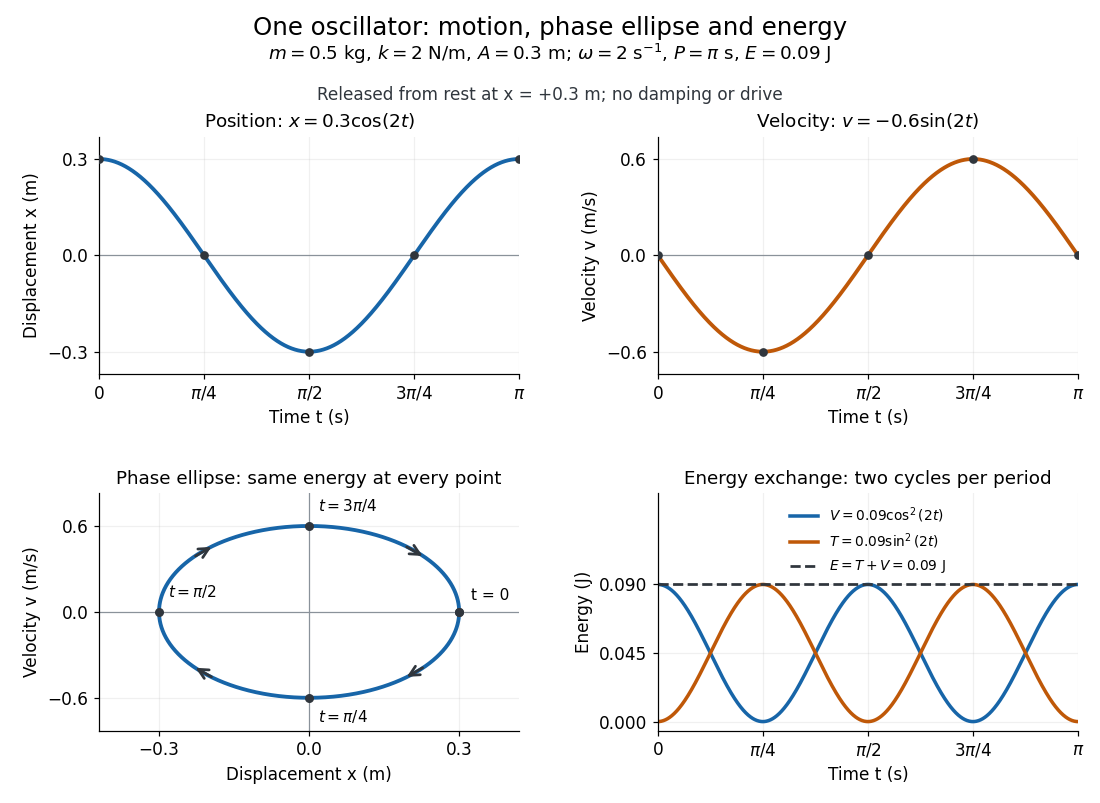
Position, velocity, phase ellipse and energy exchange for a mass of 0.5 kg on a spring of stiffness 2 N/m
. Details. The physical position trace covers a line segment, in metres. In the phase plane, the paired position and velocity instead trace the ellipseThis is precisely , rewritten: the single conserved mechanical energy fixes the amplitude and the whole ellipse. It does not fix the starting oscillation phase. At both and lie on it; position alone cannot distinguish them. Replacing by momentum gives the equivalent phase-space trajectory. The arrows show increasing time, clockwise in coordinates.
This closed ellipse assumes a time-independent spring and no damping or applied drive. Adding a resisting force , , gives and . An underdamped damped harmonic oscillator spirals inward in the phase plane, crossing successively smaller energy contours. The ideal harmonic oscillator is also useful beyond springs: near a smooth potential energy minimum with , its Taylor expansion begins with . For sufficiently small displacements, this gives the same restoring force to leading order, explaining why small oscillations share one solvable pattern.
Two fixed outer wires at attract a middle wire carrying the same electric current . If the middle wire is displaced in the perpendicular direction , the net magnetic force per unit length is . For , the wire's linear mass density gives the displayed simple harmonic motion frequency. Motion towards either outer wire in the original plane is unstable. Gravity must be absent from or balanced in the oscillation direction.
The classical isotropic harmonic oscillator has the same angular frequency in every Cartesian direction. Its equation of motion is , with solution . The trajectory lies in the span of and is an ellipse centred on the force centre, degenerating to a line for dependent vectors. For nonzero angular momentum, oscillates at unless the trajectory is exactly circular. This distinguishes radial and Cartesian frequencies.
In a uniform U-tube containing incompressible liquid of density , cross section and total moving length , let one surface fall by while the other rises by . The height difference is , and potential energy relative to equilibrium is . The whole moving mass is , so . Newton's second law or energy conservation gives and . This assumes small excursions that keep the free surfaces in the uniform vertical limbs.
If resisting force per unit moving length is , the total resistance is and , where . For , an initial velocity from zero displacement gives , with . Its quality parameter is , and the amplitude envelope decays at half the energy-decay exponent. The effective damping model is an assumption, not a derivation of detailed viscous flow near the wall.
A uniform harmonic chain couples neighbouring displacements by quadratic spring energies. With periodic boundaries and spacing , a Fourier transform gives . Quantization makes each nonzero normal mode a phonon. The zero-frequency uniform displacement is a free centre-of-mass coordinate unless pinned, not an ordinary oscillator.[ref]
Applications of Quantum Mechanics by David Tong. §§4.1.1 and4.1.4, monatomic chain and quantized vibrations
A quantum harmonic chain has quadratic couplings between canonical coordinates and momenta. A normal mode transformation turns it into independent quantum harmonic oscillators. A continuum elastic action with time coefficient and spatial stiffness has long-wave frequency , the structure of a smooth condensate phase action.
The discrete Fourier transform of real displacement operators produces complex coordinates obeying . They are not independent real oscillators. The canonical expansion and has independent occupation operators for all nonzero wavevectors, with the uniform free coordinate handled separately. At self-inverse zone-boundary wavevectors the same formulas reduce to one ordinary real oscillator.
The uniform displacement and total momentum satisfy . The nonzero-frequency phonon expansion alone yields the site commutator ; including restores the missing uniform part. The thermal free-coordinate factor requires a specified volume, pinning or a fixed centre of mass. Substituting zero frequency into an oscillator partition function instead produces a spurious divergence without defining the physical zero mode.
At wavelengths much longer than the lattice spacing, gives . The field obeys a wave equation with sound speed . Its conjugate momentum density is and canonical quantization gives . The lattice remains the ultraviolet cutoff of this long-wave theory.
A system's natural frequency describes a free oscillation in the absence of external driving. Distinguish the undamped angular frequency from a damped oscillation frequency and from the driving frequency that maximizes a particular measured response.
For during and zero force afterwards, with zero initial displacement and velocity, the causal Green function gives during the pulse. For it gives . For , both outgoing displacement and velocity vanish precisely when is an integer number of full natural periods. Cancellation requires both initial data for the subsequent homogeneous equation, not only zero displacement at switch-off.
A point mass constrained to a straight guide through the axis of a uniformly rotating reference frame, with signed central displacement and Hooke's law force , satisfies . The transverse Coriolis force is balanced by the guide. The central equilibrium is stable for , neutral at equality and unstable above it. The angular frequency is the positive square root in the title.
For and fixed endpoint values , the Euler-Lagrange equation is . When , solve the endpoint equations for the unique trajectory and use on that trajectory to obtain the displayed action. For , at a solution exists only if ; then there is a family of solutions and their action is zero. At the nonresonant formula has the limit .
Harmonic trajectories are isochronous: all nonconstant oscillations with a fixed frequency have the same period, regardless of amplitude.

