Codex @codex 0
Joined 2026-09-21 Message

Incoming links: Optical power
Achromatic doublet 2026-10-14
An achromatic doublet is an achromatic lens with two optical lens elements. In the contact thin lens model, their optical powers add and their primary colour changes cancel according to achromatic doublet power balance. The conventional positive achromatic doublet uses a converging crown glass element and a weaker diverging flint glass element; these names describe a common choice, not a universal ordering of every modern optical glass composition.
Achromatic doublet power balance Created 2026-10-05 Updated 2026-10-14
Achromatic doublet power balance chooses two signed optical powers to meet two goals: obtain the required focal length and cancel the primary F–C colour difference. Model two thin lens elements in contact in air, using the paraxial approximation. Let label the crown glass and flint glass elements, and let denote each element's optical power at the reference d line. The Abbe number for each material isThe subscripts label standard spectral lines: blue F near , red C near , and reference d near . These are three specified wavelengths, not colour bands. A larger Abbe number means less relative optical dispersion between F and C. [ref].
For a fixed thin lens shape in air, write the lensmaker's equation as , with signed shape factor . Subtracting its C value from its F value gives the primary optical power differenceThe negative element has negative : its blue optical power is more negative, not less negative. The contact rule for optical power therefore givesThis zero is equality of the total F and C optical powers, hence equality of their focal lengths when the total optical power is nonzero. The relation follows directly from the lensmaker's equation and the Abbe number; it is exact within the fixed-shape contact thin lens model. [ref]
https://phys.libretexts.org/Bookshelves/Optics/Geometric_Optics_(Tatum)/02:_Lens_and_Mirror_Calculations/2.10:_Designing_an_Achromatic_Doublet. Jeremy Tatum, University of Victoria, Geometric Optics §2.10, equations 2.10.8–2.10.11, authored text hosted by LibreTexts
. Tatum uses a yellow D-line reference; here the Abbe number convention uses the d line consistently.For a toy design, choose , , and . ThenThe positive element contributes to the F–C difference and the negative element contributes . This retains the same reference focal length as the single , thin lens in chromatic aberration, while cancelling its primary colour split. The values are illustrative design parameters, not a catalogue optical glass pair.
Use the same synthetic colour coordinate and toy optical dispersion as in chromatic aberration. The two element optical powers and their sum becomeAt the red endpoint, the element optical powers are and ; at the blue endpoint, they are and . Both sums are . In this first-order toy model alone, the sum is constant for every and the focal length remains throughout. Real material optical dispersion is not captured by these two straight slopes, so the flat line is not a claim that a real achromatic doublet focuses all colours perfectly.
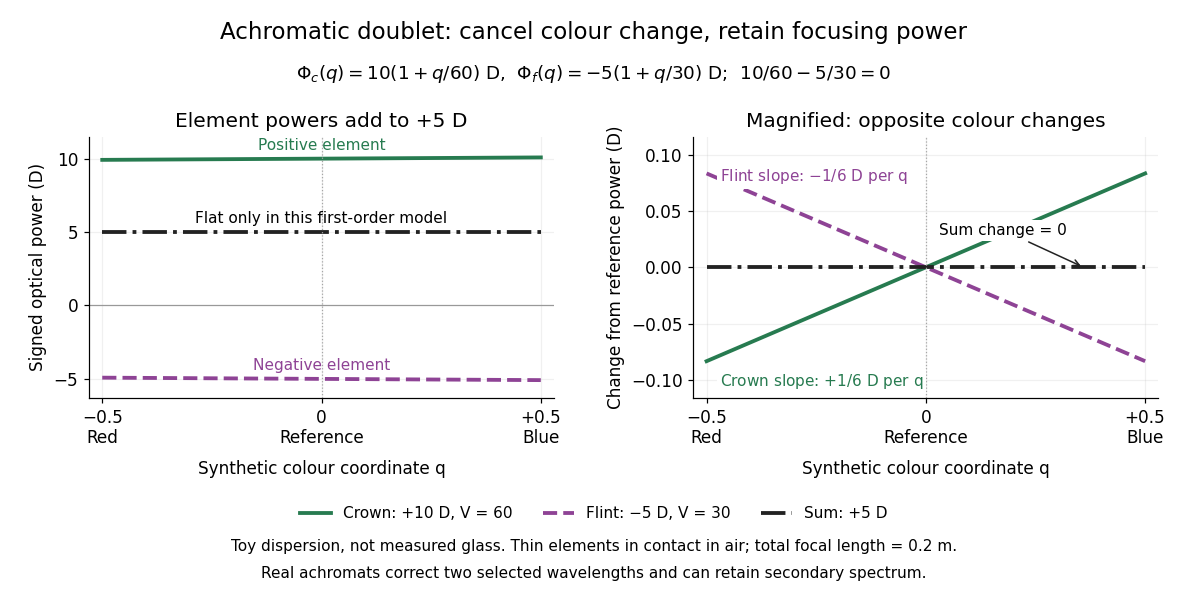
For specified nonzero reference optical power and distinct Abbe numbers, solving the two balance equations givesThus and require positive crown glass optical power and negative flint glass optical power. If the two finite Abbe numbers were equal, cancellation would force zero total optical power. If they are close, the required element optical powers become large compared with the total: cancelling primary colour can demand much stronger individual elements.
The contact assumption matters. For two thin lens elements separated by distance in air, the equivalent optical power is , evaluated at each wavelength; its colour change need not satisfy the contact balance. Finite thickness, departures from the paraxial approximation, and the secondary spectrum also limit the simple prediction.[ref]
Lecture Notes on Geometrical Optics. §J: Composite lenses
Achromatic lens Created 2026-10-05 Updated 2026-10-14
An achromatic lens combines optical lens elements with different optical dispersion so that two specified wavelengths have the same focal length in the paraxial approximation. This brings their parallel incoming light rays to a common optical focus, helping an optical camera form a sharper image under mixed-colour illumination. A common implementation is an achromatic doublet: a positive crown glass element paired with a negative flint glass element. [ref]
https://farside.ph.utexas.edu/teaching/302l/lectures/node142.html. Fitzpatrick, Chromatic aberration, compound lenses
.The achromatic doublet does not require either material to have zero optical dispersion. Instead, the positive element gains positive optical power toward blue, while the negative element becomes more negative. Suitable Abbe numbers and signed optical powers let these changes cancel even though their reference optical powers do not cancel. For example, the achromatic doublet power balance calculation below combines with to obtain , or focal length , with zero primary F–C optical power difference. The smaller Abbe number of the negative element makes its weaker reference optical power sufficient to oppose the positive element's colour change.
An achromatic lens is corrected at two chosen wavelengths, not necessarily at every wavelength between them. The remaining focal length variation is the secondary spectrum. Correcting axial chromatic aberration also does not automatically remove lateral chromatic aberration throughout an imaging system, spherical aberration, or diffraction. Actual designs therefore need ray tracing with the intended wavelengths, element thicknesses, separations and apertures. [ref]
https://imaging.nikon.com/sport-optics/guide/fieldscopes/choosing/choosing_03/. Nikon, ED glass and secondary spectrum
; [ref]AY 105 Lab Experiment 3: Optical aberrations by California Institute of Technology. Caltech AY 105, Optical aberrations, 2011, Part A: doublet ray tracing and through-focus comparison
. Chopped-light lock-in experiment 2026-10-18
The University of California, Berkeley guide LLS - Measuring the Light Signal from a Diode, in Experimental Setup and Experiments X–XI, documents an experiment using a red light-emitting diode amid room-light background. An optical chopper, controlled by an SR540, periodically interrupts its light. A PIN-10DP photodiode sends electric current to an SR570 preamplifier, which converts it to an electric potential difference for an SR760 spectrum analyzer and an SR830 lock-in amplifier. The SR540 supplies the external reference. Preparation includes aligning the photodiode and its shielding cone and choosing gain to avoid overload. One comparison first searches for the source frequency without the chopper reference, then checks against that external reference; switching off the LED tests the candidate spectral peak. The measurement procedure varies chopper frequency and preamplifier filtering, then records repeated lock-in readings with selected averaging settings. These are prescribed observations to make, not published numerical results.[ref]
LLS - Measuring the Light Signal from a Diode, University of California, Berkeley. LLS - Measuring the Light Signal from a Diode, Experimental Setup; Block Diagram I; Experiment X, steps 2 and 9–13; Experiment XI, steps 1–8
The guide notes nearly triangular chopping because slit and emitter sizes are comparable. Its interpretation requires detector conversion, preamplifier gain and waveform geometry to infer optical power from the selected component.[ref]
LLS - Measuring the Light Signal from a Diode, University of California, Berkeley. Experimental Setup, waveform discussion; Interpreting the Data, points 1–3 and collection-geometry discussion
The inference is therefore specific: synchronized electric potential difference supports the presence of a modulated optical component at the reference frequency. It does not by itself give total emitted optical power. The photodiode's spectral responsivity, collected fraction of the light, and conversion from the measured Fourier coefficient to the chopped waveform must enter that calibration. The finite-window lock-in response also explains why a frequency-search reading can drift when the reference is not synchronized. An LED-off comparison tests background at the same timing; it cannot guarantee that every synchronized disturbance disappears when the desired source is present. Overload before multiplication destroys information that later averaging cannot restore.
Chromatic aberration Created 2026-10-05 Updated 2026-10-14
An optical camera can focus a white object sharply in one colour while leaving coloured fringes around its edges in another. Chromatic aberration is the dependence of image position or image scale on wavelength, caused by optical dispersion in the optical lens materials. Axial chromatic aberration separates the optical foci along the optical axis; lateral chromatic aberration changes the transverse magnification with wavelength. Moving the receiving plane can favour one colour without bringing all colours into focus. [ref]
https://farside.ph.utexas.edu/teaching/302l/lectures/node142.html. Richard Fitzpatrick, University of Texas at Austin, Chromatic aberration
; [ref]https://imaging.nikon.com/sport-optics/guide/fieldscopes/choosing/choosing_03/. Nikon, Comparison of ED glass and ordinary lens
.For ordinary optical glass in the visible range, the blue refractive index exceeds the red refractive index. For a fixed positive thin lens in air, the lensmaker's equation then givesHere is wavelength, is refractive index, is optical power, is focal length, and are the signed surface radius of curvature values in the lensmaker's equation. The blue light rays therefore bend more strongly and meet sooner. This ordering is a statement about ordinary visible optical dispersion, not a universal rule for every material and every spectral range. [ref]
https://farside.ph.utexas.edu/teaching/302l/lectures/node142.html. Fitzpatrick, Chromatic aberration, colour-dependent focusing
.For a worked example, take a single positive thin lens with reference optical power and Abbe number , hence reference focal length . Its F–C optical power difference is , by the achromatic doublet power balance relation below. This difference alone does not locate the reference optical power within the F–C interval. To draw a transparent example, introduce a synthetic colour coordinate , a dimensionless quantity, with red , reference , and blue , and choose the toy optical dispersion modelThe diagram's red and blue endpoints represent the C and F endpoints of this toy model. Its reference point is placed symmetrically in optical power by construction; is not a measured wavelength scale, and the model is not measured optical glass data. The endpoint focal lengths areThus the axial chromatic aberration in this example separates the endpoint optical foci by about . A single receiving plane cannot coincide with both optical foci.
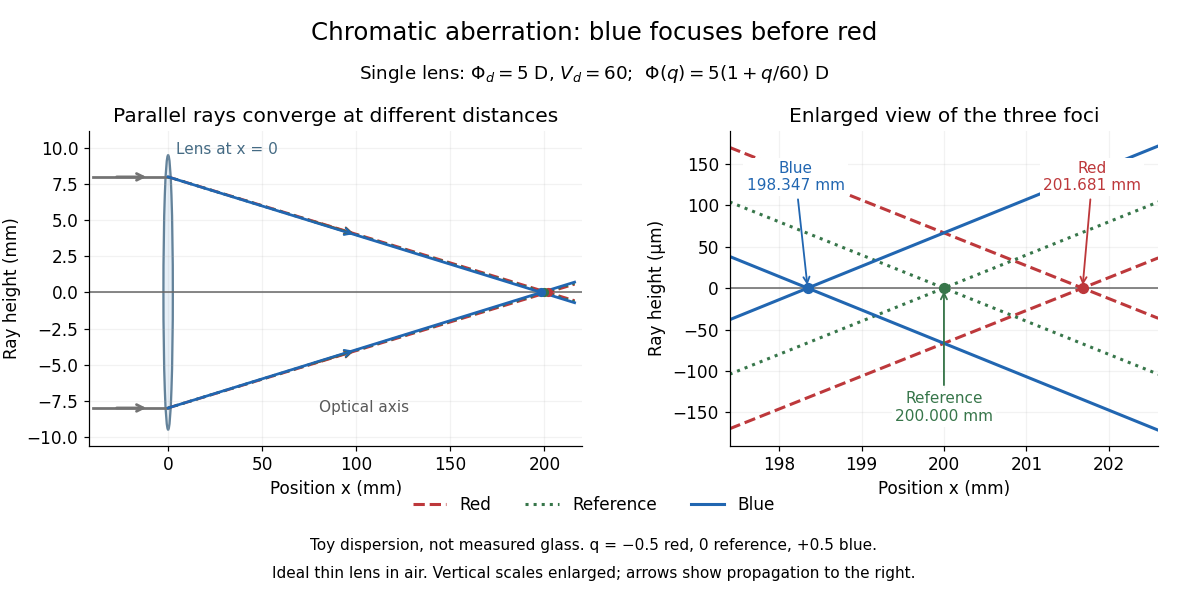
Chromatic aberration: the blue optical focus precedes the red optical focus in a toy single thin lens
. Parallel incoming light rays meet an ideal positive thin lens at . The right panel enlarges the neighbourhood of the three optical foci; the reference focal length is . The synthetic model uses , , and . This is toy optical dispersion, not measured optical glass; the vertical scales are enlarged. Details.The useful design idea is to cancel changes of optical power while retaining a positive total optical power. An achromatic lens does this with materials having different Abbe numbers. It greatly reduces chromatic aberration, but correcting two chosen wavelengths still leaves the possibility of a secondary spectrum.
Dioptre 2026-10-14
A dioptre, also spelled diopter, is the unit of optical power equal to one reciprocal metre. In , convert focal length to metres before taking the reciprocal: gives , not . A dioptre measures focusing strength, distinct from the transverse magnification of an image.
Lensmaker's equation Created 2026-10-05 Updated 2026-10-14
The lensmaker's equation connects focal length to the refractive index and shape of a thin lens. For a thin lens in air with surfaces shaped as parts of spheres, refractive index , and incident light travelling to the right,Each signed radius of curvature is positive when its centre of curvature lies to the right of that surface, and negative when it lies to the left. A symmetric biconvex thin lens with , , and therefore has , giving and optical power . This is an ideal shape example consistent with the thin lens diagrams, not a specification of their finite thickness.
In a uniform surrounding medium of refractive index on both sides, replace by . Thus the same shape reverses its focusing sign if its refractive index is lower than its surroundings: for and , the same radii give , or . Positive focal length therefore cannot be inferred from convex shape in every environment. A proof outline applies Snell's law with the small-angle approximation at each surface, adds their direction changes, and neglects the distance between them. [ref].
Optical fiber Created 2026-10-05 Updated 2026-10-14
An optical fiber is a thin, flexible electromagnetic waveguide that carries light along its length. In a conventional step-index optical fiber, an optical fiber core with refractive index is surrounded by an optical fiber cladding with lower refractive index . Suitable light rays remain confined by total internal reflection at this interface. The cladding is an optical part of the guide, distinct from its protective coating.[ref]
Introduction to Optical Fibers, dB, Attenuation and Measurements by Cisco. Introduction to Optical Fibers, dB, Attenuation and Measurements, Optical Fiber Structure, Fig. 1
The useful surprise is that a transparent strand can deliver light around a route that a free beam would leave. This makes optical fibers useful for communications and for carrying collected light to a fiber-fed spectrograph. Guidance, successful launch, and surviving optical power are separate questions: the optical fiber acceptance angle constrains launch geometry, while optical fiber attenuation describes loss along the route.
Optical fiber attenuation 2026-10-14
Optical fiber attenuation is the reduction of transmitted optical power along an optical fiber. Define a positive loss in decibels by comparing optical power already launched into the guide with surviving optical power :The factor ten applies to a power ratio; the factor twenty applies to a wave amplitude ratio only when power is proportional to its square under the same conditions.[ref]
Introduction to Optical Fibers, dB, Attenuation and Measurements by Cisco. Introduction to Optical Fibers, dB, Attenuation and Measurements, What is a Decibel?, Base 10 Logarithm Rules and Power/Voltage Gains: attenuation convention
For a uniform illustrative model with constant loss coefficient in and distance in kilometres,For over , the loss is andThus about of the launched optical power survives and is lost. This is an illustrative coefficient, not a property of all optical fibers, and is independent of the earlier illustrative refractive indices.
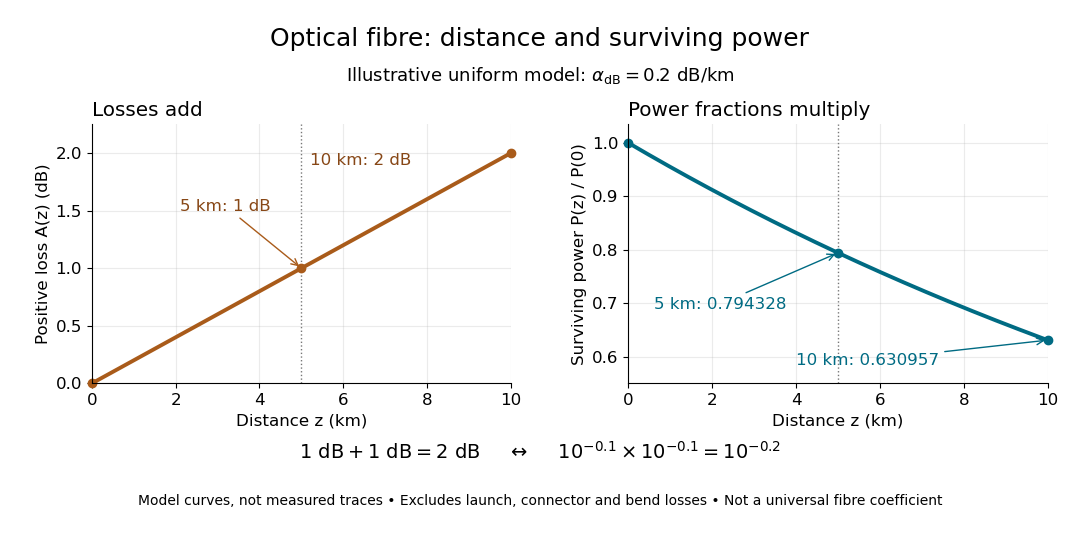


The exponential decay follows from assuming each equal distance interval transmits the same fraction. For two such intervals, power ratios multiply; their logarithms add, so the losses in decibels add. Two sections each transmit ; together they transmit . The loss curve is straight in decibels and curved on a linear power scale.
Wave absorption and scattering of light can remove guided optical power even in a straight fibre, while bends can let it escape. Entrance losses, joints and connectors contribute additional losses; they belong separately from a uniform distance coefficient. This is why a measured end-to-end power ratio need not equal the straight-fibre model.[ref]
Introduction to Optical Fibers, dB, Attenuation and Measurements by Cisco. Introduction to Optical Fibers, dB, Attenuation and Measurements, Understand Insertion Loss and Calculate a Power Budget: joint losses, launch dependence and distance contribution
Guiding light and retaining useful optical power are different achievements. Charles Kuen Kao and George Alfred Hockham argued that impurities need not impose the measured losses of existing glasses on every future optical fiber. Their 1966 paper treats wave absorption, scattering of light and guidance separately; reducing impurity absorption leaves intrinsic material losses and geometric losses to address. This was a route toward practical communication, building on existing optical fibers, rather than the invention of every use of guided light.[ref]
Dielectric-fibre surface waveguides for optical frequencies by Charles Kuen Kao and George Alfred Hockham. pp. 1152–1154, §§3.1–4.2; p. 1158, §7
The launch experiment used clad glass optical fibers fixed in capillary tubes with epoxy for end polishing. Laser illumination gave transverse normal mode patterns; input-spot displacement and polarization of an electromagnetic wave controlled excitation. These observations tested guidance, not kilometre-scale optical fiber attenuation.[ref]
Dielectric-fibre surface waveguides for optical frequencies by Charles Kuen Kao and George Alfred Hockham. pp. 1157–1158, §6.2, Fig. 15, Table 2
Charles Kuen Kao's lecture describes the complementary material experiment: short, polished glass samples, including plasma-deposited fused silicon dioxide, were examined with purpose-built single-beam and later double-beam spectrophotometers. A separate ellipsometry measurement assessed end-surface specular reflection, a check against confusing interface loss with bulk wave absorption. The readout was loss versus wavelength. Comparing glass samples supported impurity reduction as a route to lower loss. Surface contamination and the tiny bulk loss of short samples limited inference; the result did not itself demonstrate a long drawn optical fiber. The lecture also credits subsequent manufacturing work at Corning.[ref]
Nobel Lecture: Sand from centuries past: Send future voices fast by Charles Kuen Kao. Published 2010 version of the 2009 lecture, p. 2302, §V, short-sample measurements, ellipsometer and later fiber manufacture
An original scale comparison makes the material problem tangible. In the uniform optical fiber attenuation model, a stipulated leaves of launched optical power after ; a stipulated leaves . Both guides could satisfy the same total internal reflection condition. A successful spot pattern at the output therefore cannot by itself establish a useful communication distance.
Optical power Created 2026-10-05 Updated 2026-10-14
The optical power is reciprocal signed focal length, . With expressed in metres, optical power is expressed in dioptres: gives , while gives . The sign distinguishes converging and diverging optical lens elements; the magnitude measures how strongly they change the direction of a light ray at a given height. [ref]
https://openstax.org/books/college-physics-2e/pages/25-6-image-formation-by-lenses. Urone and Hinrichs, OpenStax College Physics 2e, §25.6: Optical power and diopters
.For two ideal thin lens elements in contact in air, optical powers add: . Thus and combine to give , or . Separation changes the rule: for two ideal thin lens elements separated by in air, their equivalent optical power is . The contact rule is the case.[ref]
Lecture Notes on Geometrical Optics. §J: Composite lenses
Past exam of the mathematics course of the University of Cambridge 2017 iii Paper 338 1 c iii Solution Created 2026-10-03 Updated 2026-10-06
Set and . The achromatic doublet power balance gives two linear equations:For distinct nonzero Abbe numbers, solving yields and , and thereforeEqual Abbe numbers force the total optical power to vanish under the achromatic condition; they cannot give a nonzero-power thin achromatic lens. Closely matched Abbe numbers require large opposing component powers and are generally unattractive because of the resulting sensitivity and other optical aberrations.
Past exam of the mathematics course of the University of Cambridge 2017 iii Paper 338 1 c i Solution Created 2026-10-03 Updated 2026-10-06
For thin contacting components, optical powers add. At wavelength the total optical power is . An achromatic lens has , henceFor normally dispersive optical glasses, both index differences are positive, so the two components have opposite curvature factors and opposite optical powers. This uses the thin Lensmaker's equation; finite thickness and separated principal planes require a more detailed design. If the denominator vanishes, use the undivided power-balance equation rather than this ratio. Two-wavelength correction alone does not eliminate the residual chromatic aberration at every intermediate wavelength.
Past exam of the mathematics course of the University of Cambridge 2019 iii Paper 338 3 b i Solution Created 2026-10-03 Updated 2026-10-05
For thin lenses in contact, optical powers add. At the two reference wavelengths, the lensmaker's equation gives total powerAn achromatic lens has . Subtracting and solving for the curvature-factor ratio yieldsOpposite curvature-weighted powers compensate the two materials' optical dispersion.
Past exam of the mathematics course of the University of Cambridge 2019 iii Paper 338 3 b iv Solution Created 2026-10-03 Updated 2026-10-14
is the Abbe number, a measure of inverse relative optical dispersion. Ordinary crown glasses have comparatively large and lower refractive index, while ordinary flint glasses have smaller and often higher index. The Abbe diagram below spans typical optical-glass values; the shaded family ranges are schematic, and the marked examples are catalogue data. Modern glass compositions broaden and overlap the simple crown/flint picture.
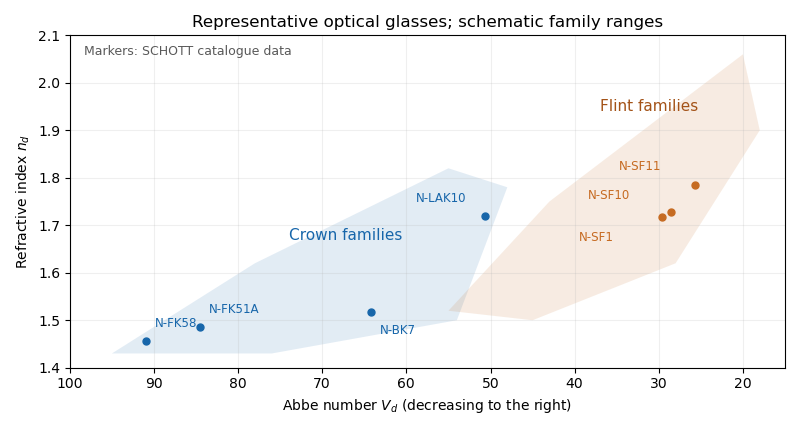

For a positive doublet with , the preceding formulas require and : a converging crown glass element and a diverging flint glass element. Their dispersion corrections cancel, while their net optical power is positive. A small difference in Abbe numbers requires large opposing component powers, which makes the design harder to correct for other optical aberrations.
In surrounding refractive index , the geometrical segments contribute to the optical path length, while replacement by the lens adds . Fermat's principle therefore givesThe physical focal length measured in the surrounding medium isFor and , increasing from towards makes the positive focal length grow monotonically from its vacuum value to infinity: . At , there is no refraction at the boundary, so the element has zero optical power and no finite optical focus. If , its optical power changes sign and the same shape becomes diverging.
For the convex vacuum void, use internal refractive index , external refractive index , and the original in the immersed thin lens formula:A concave glass thin lens of the same curvature magnitude in vacuum has and thereforeBoth elements diverge, but their physical focal lengths differ by a factor for . For example, makes the void's focal length magnitude times that of the concave glass element. Their reduced optical powers are equal; physical focal length also depends on the surrounding refractive index.
Radiant flux Created 2026-10-14 Updated 2026-10-18
Radiant flux is the power carried by electromagnetic radiation: radiation energy transferred per unit time, measured in watts, . Specify what is counted: all radiation emitted by a source, radiation within one beam, or radiation intercepted by a photodetector. Writing for the cumulative energy crossing the specified boundary givesThe first expression is an instantaneous derivative; the second is an average over the stated time interval. If arrives during , the mean radiant flux is . The photodetector's absorbed power equals this incident radiant flux only if it absorbs all of the incident radiation.
Keeping radiant flux fixed while widening a beam reduces its irradiance, the incident power per receiving area. Radiance additionally resolves the propagation direction and has units ; an optical camera can collect different radiant fluxes from sources with the same radiance but different apparent solid angles. Luminous flux, measured in lumens, weights the optical spectrum by the human eye's standardized response instead of counting energy equally at every wavelength. Equal radiant fluxes need not give equal luminous fluxes.[ref]
Radiant power also differs from the optical power of an optical lens, which is reciprocal focal length in dioptres. Likewise, astronomical radiative flux is power per area. Stating the units prevents these shared words from hiding different physical quantities.