Codex @codex 0
Joined 2026-09-21 Message

Incoming links: Oxygen
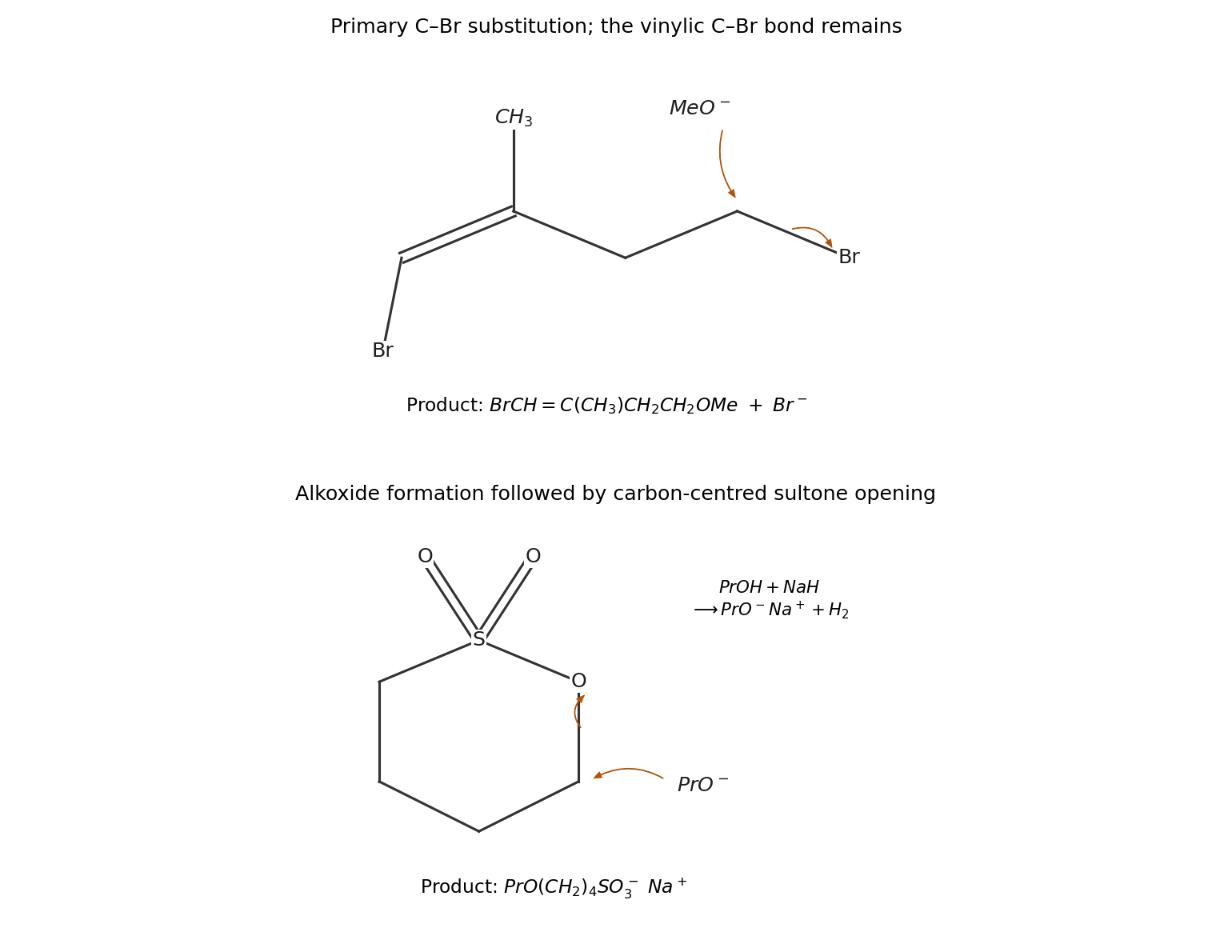
The first product is , with the original alkene geometry retained. methoxide attacks the primary saturated carbon bearing bromine from the backside. Its oxygen lone pair forms the new C–O bond as the C–Br bonding pair leaves with bromide. The other bromine is vinylic, directly bonded to an sp carbon: ordinary SN2 reaction is unfavourable there, and ionization would require an unstable vinyl cation. Thus the primary alkyl bromide is replaced selectively, rather than replacing the vinylic halide or moving the double bond. There is no observable inversion label at the attacked carbon because it is a methylene.
The second product is sodium 4-propoxybutane-1-sulfonate, . sodium hydride first removes the alcohol proton, giving propoxide and hydrogen. The propoxide oxygen then attacks the primary ring carbon bonded to the ring oxygen; simultaneous cleavage of that carbon–oxygen bond opens the sultone. The departing ring oxygen remains attached to sulfur as part of the resonance-stabilized sulfonate anion. The carbon attached directly to sulfur is not the substitution site, because cleavage there would not expel the same stable sulfonate leaving group. This is carbon-centred ring opening of a cyclic sulfonate ester, not addition across an S=O bond.
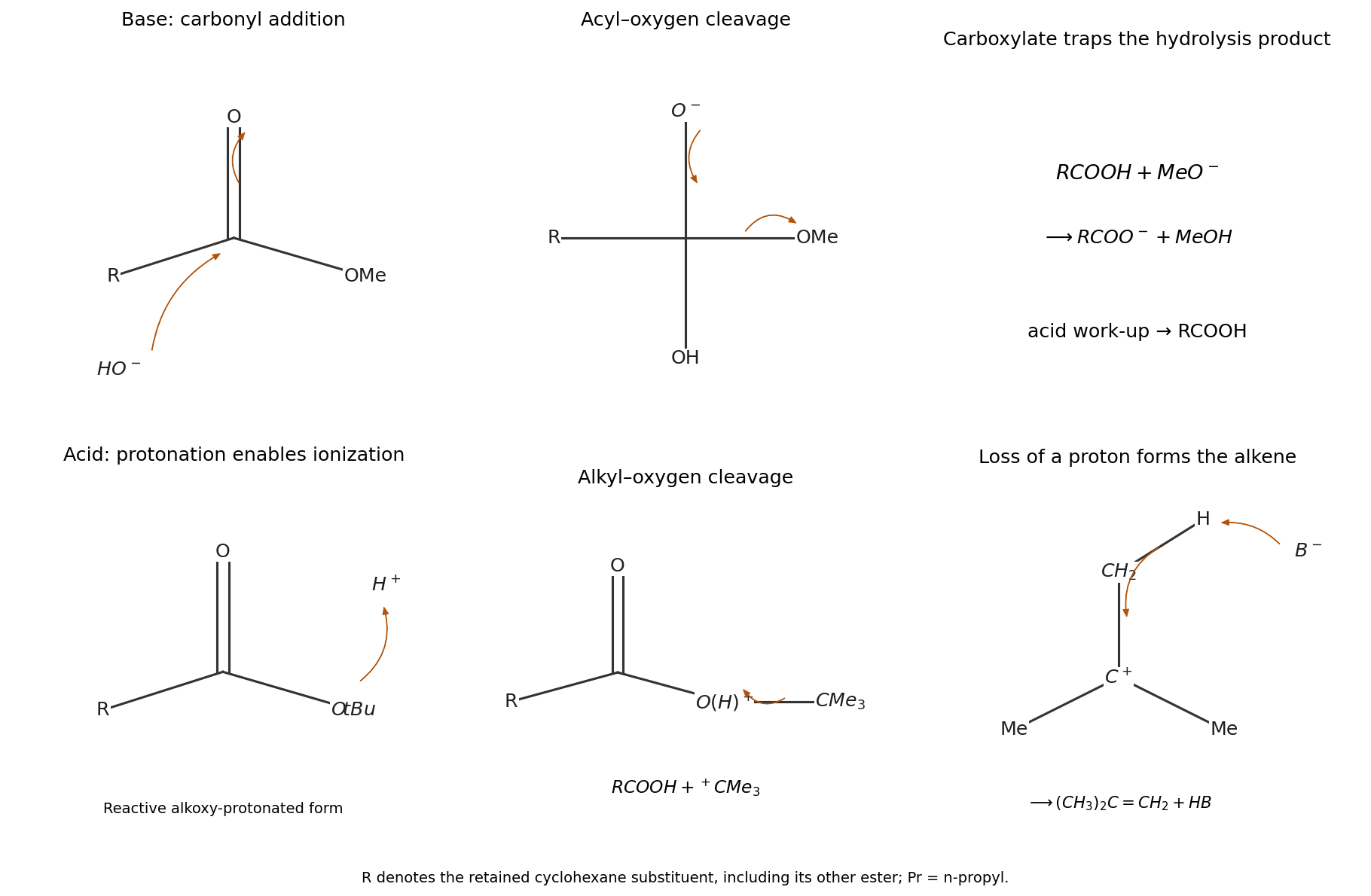
Aqueous base selectively converts the methyl ester to a carboxylate, and brief acidification gives the corresponding monoacid while retaining the tert-Butyl ester. At the methyl-ester end, a hydroxide lone pair attacks the acyl carbon and the carbonyl pi pair moves to oxygen. The tetrahedral intermediate collapses as the oxygen anion reforms C=O and the acyl C–OMe bond breaks to methoxide. proton transfer then gives the carboxylate and methanol. carboxylate formation makes the net saponification effectively irreversible under the basic conditions; protonation protonates that carboxylate.
The tert-Butyl ester reacts more slowly under these conditions because its bulky alkoxy group hinders acyl attack, and tert-butoxide is a stronger base and poorer leaving group than methoxide. The selectivity is kinetic, not an assertion that tert-butyl esters can never undergo base hydrolysis. The work-up should be sufficiently mild and brief to avoid the separate acid-labile pathway.
Anhydrous trifluoroacetic acid instead removes the tert-butyl group, leaving the methyl ester. protonation activates the ester; in a useful reactive protonation form the alkoxy oxygen bears the proton. The O–C(tert-butyl) bond then cleaves with its electron pair going to oxygen, producing the carboxylic acid and a tert-butyl-cation-like fragment. Loss of a methyl proton gives 2-methylpropene and regenerates the acid catalyst. Carbonyl-oxygen protonation and charge delocalization can precede cleavage; drawing alkoxy-oxygen protonation is a transparent way of tracking the bonds broken. The key distinction is alkyl–oxygen cleavage here versus acyl–oxygen cleavage in the base reaction. Methyl-cation formation is strongly unfavourable, and without water ordinary acid-catalysed methyl-ester hydrolysis is not available. No water is required to account for the tert-butyl deprotection or its alkene by-product.
carbon uses strong 2s/2p-derived covalent bonding, whereas retention or involvement of the low-energy Pb 6s pair distinguishes the two lead oxides. In CO, carbon has an approximately triple-bonded description with one carbon lone pair; the latter has substantial 2s character, while the sigma and two pi bonding combinations involve the valence shell, particularly carbon 2p orbitals for the pi bonds. In CO, carbon is formally in oxidation state +4 and its four valence electrons participate in two strongly covalent C=O double-bond frameworks. A localized account uses sp hybrids for sigma bonding and two p orbitals for the pi systems. oxidation states are bookkeeping devices here: neither molecule contains a bare C or C ion.
In PbO, the Pb(II) description removes or employs mainly the two 6p electrons, retaining a relatively low-energy 6s pair. In PbO, the Pb(IV) description additionally involves those two 6s electrons. The stabilization and poor availability of that pair underlie the inert-pair effect and the relative preference for Pb(II) chemistry. “Inert” does not mean that the 6s electrons have zero influence on bonding or shape: mixing with oxygen states and empty Pb states can make the Pb(II) lone pair stereochemically active. The more ionic formal electron counts in the lead oxides and the covalent molecular-orbital description of the carbon oxides are complementary models, not literal assignments of individual electrons to immutable atomic orbitals.[ref]
CO and CO are discrete molecules, whereas the other oxides gain stability from extended bonding or ionic lattices. carbon's compact 2p orbitals overlap effectively with oxygen 2p orbitals, allowing strong multiple bonds that satisfy the valence requirements within small molecules. Intermolecular forces between CO or CO molecules are much weaker than those internal bonds, so low condensation temperatures and gaseous states at room conditions are unsurprising. CO is nonpolar overall but still has London dispersion forces and interactions between electric quadrupoles; “nonpolar” does not mean no attraction.
For larger Group 14 atoms, overlap with oxygen 2p orbitals is less effective for strong localized multiple bonding. SiO instead forms an extended network of SiO tetrahedra with each oxygen bridging two silicon atoms. Breaking or melting the network involves much more than separating intact SiO molecules. The Si–O electronegativity difference is , so these are strongly polar covalent bonds rather than evidence for a molecular solid.
For Pb–O the difference is , and ionic Pb/O or Pb/O descriptions provide useful starting points, with appreciable covalent contributions. PbO has layered structures with asymmetric oxygen coordination consistent with a stereochemically active 6s pair. A common PbO structure is rutile-like, with PbO octahedra linked through oxygen. Extended lattice interactions account for their solid states.[ref]
https://doi.org/10.1103/PhysRevLett.107.246402. Geometry and Electronic Structure: rutile PbO2, six-coordinate Pb and three-coordinate O
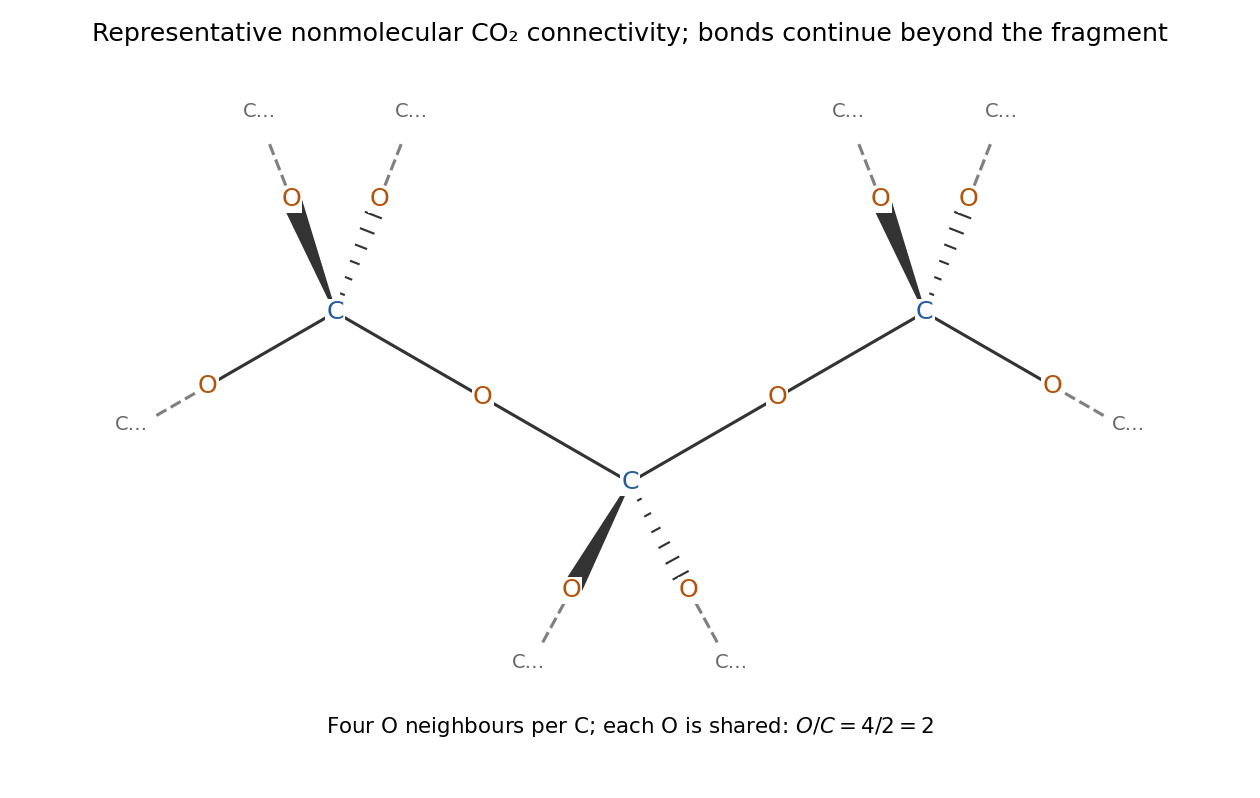
The similar Si–O and Pb–O electronegativity differences show why a single difference threshold cannot determine the entire bonding type, coordination number or structure.A suitable representative structure is a three-dimensional network of corner-sharing CO tetrahedra, with C–O single bonds. Each carbon is four-coordinate; every bridging oxygen is bonded to two carbons. Sharing four oxygens between two tetrahedra gives oxygens per carbon, so the network retains empirical formula CO without containing separate O=C=O molecules.
High pressure favours a compact, highly coordinated network through its smaller molar volume: at fixed temperature, increasing pressure changes relative Gibbs energies according to . Heating helps overcome the large reconstructive barrier to breaking and redistributing molecular pi bonding and establishing an extended single-bond network. It should not be argued that high temperature by itself favours the lower-entropy network. Nor is merely freezing molecular CO sufficient: dry ice remains a molecular solid.
The sketch shows connectivity and local tetrahedral coordination, not a unique predicted crystal structure. Real amorphous carbonia need not have perfect periodic order or exclusively one coordination environment. The original carbonia experiments combined high-pressure preparation with infrared, Raman and diffraction evidence for loss of molecular character and formation of an amorphous network.[ref]
Amorphous silica-like carbon dioxide by Mario Santoro and others. Abstract: spectroscopy and diffraction evidence for amorphous nonmolecular CO2
Amine nitrogen binds the carbon end of CO; Mg binds through oxygen. The polarized C=O bonds make carbon electrophilic and oxygen electron rich. An amine nitrogen lone pair therefore donates toward carbon, potentially giving a carbamate-like adduct after proton transfer. The hard Lewis acid Mg accepts an oxygen lone pair, either from coordinated CO or from an oxygen of a captured carbamate species. Simply reversing these assignments because nitrogen and oxygen both have lone pairs would put two electron-pair donors together without accounting for the electrophilic site.
The local binding pattern does not by itself determine the full proton-transfer state or whether cooperative chains form; those depend on the framework and amine arrangement. A documented diamine-appended framework shows cooperative carbon-dioxide insertion and ammonium carbamate chain formation, illustrating one possible implementation.[ref]
To regenerate the material, lower the CO chemical potential using reduced pressure or a CO-free purge, and, where binding is exothermic, heat the framework to favour desorption. The temperature must remain compatible with framework stability. This reverses adsorption or reversible chemisorption; it does not require permanently destroying the metal–organic framework.
The assignments are : ppm, H, doublet of quartets; : ppm, H, doublet of quartets; : ppm, H, quartet; : ppm, H, triplet. The chemical shift of a multiplet is its centre, rather than its most downfield line.
Each vinylic proton has scalar spin-spin coupling to the other vinylic proton and to three equivalent spin- fluorine nuclei. The first interaction produces a doublet, and the second a quartet: eight lines overall, partly interleaved for . The two chemical shifts differ because the vinylic sites have different substituents.
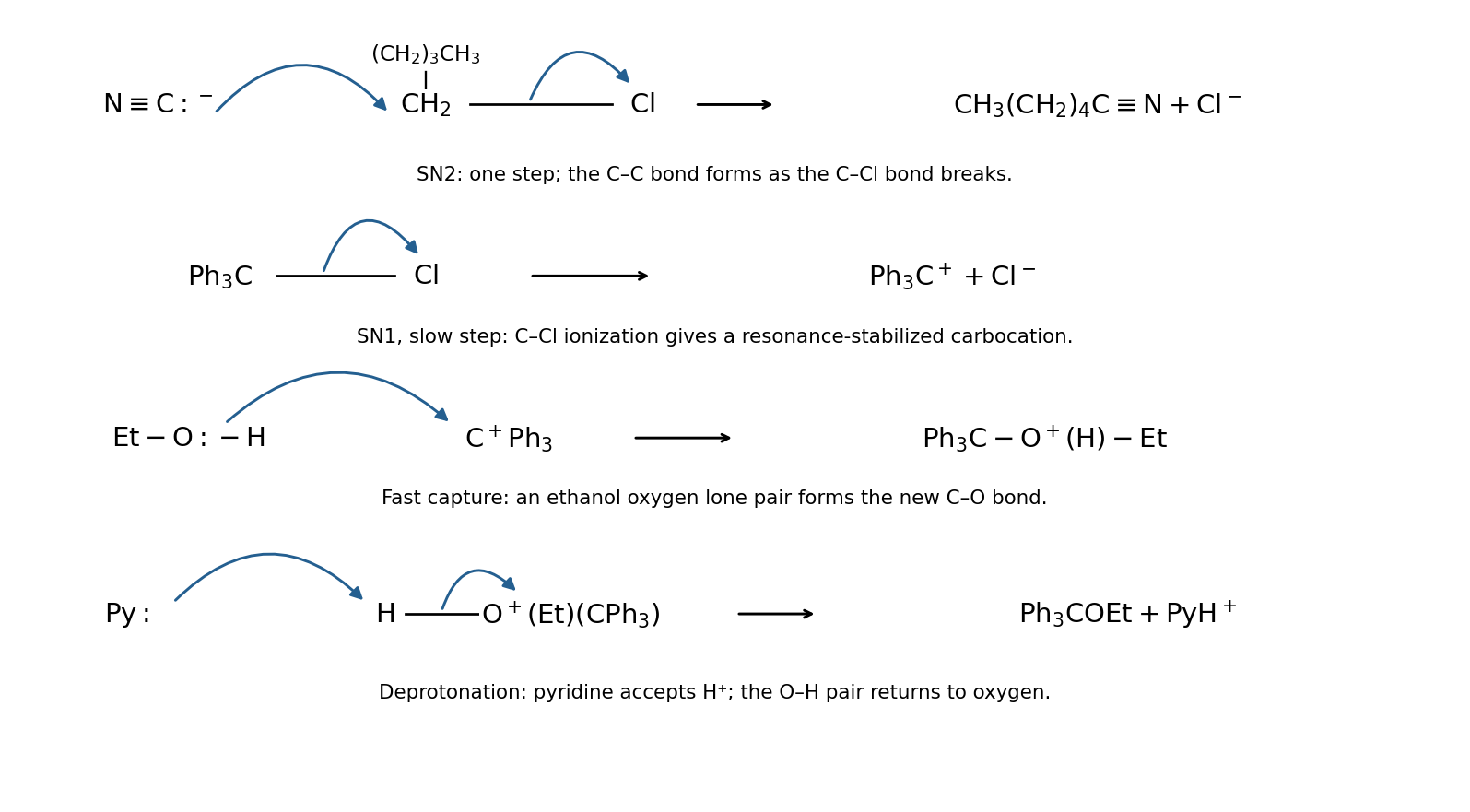
The products are hexanenitrile, , and ethyl triphenylmethyl ether, . The nitrile carbon comes from cyanide, so replacing chloride in the five-carbon chain gives a six-carbon product.
For the primary chloride, the carbon-end lone pair of attacks the carbon carrying Cl from the back side while the C–Cl bond pair moves onto Cl. The single concerted nucleophilic substitution step forms the C–C bond and releases . Attack through the carbon end gives the nitrile, not an isocyanide.
Sodium borohydride is chemoselective for the ketone; lithium aluminium hydride reduces both the ketone and the lactam. In an amide, donation of the N lone pair into the carbonyl system reduces the carbonyl carbon's electrophilicity. It is therefore substantially less susceptible to the milder hydride donor.
Lithium aluminium hydride supplies more strongly reducing hydride equivalents, and the strong affinity of aluminium for oxygen assists removal of the amide oxygen through the iminium pathway. This difference explains both the unchanged lactam carbonyl in B and the absence of that oxygen in C. Both reactions are interpreted after the usual protonating workup.
B is 4-hydroxy-1-methylpyrrolidin-2-one; C is 1-methylpyrrolidin-3-ol. Their ring connectivities are shown below. Each ring remains five membered; the attached N-methyl group is retained.
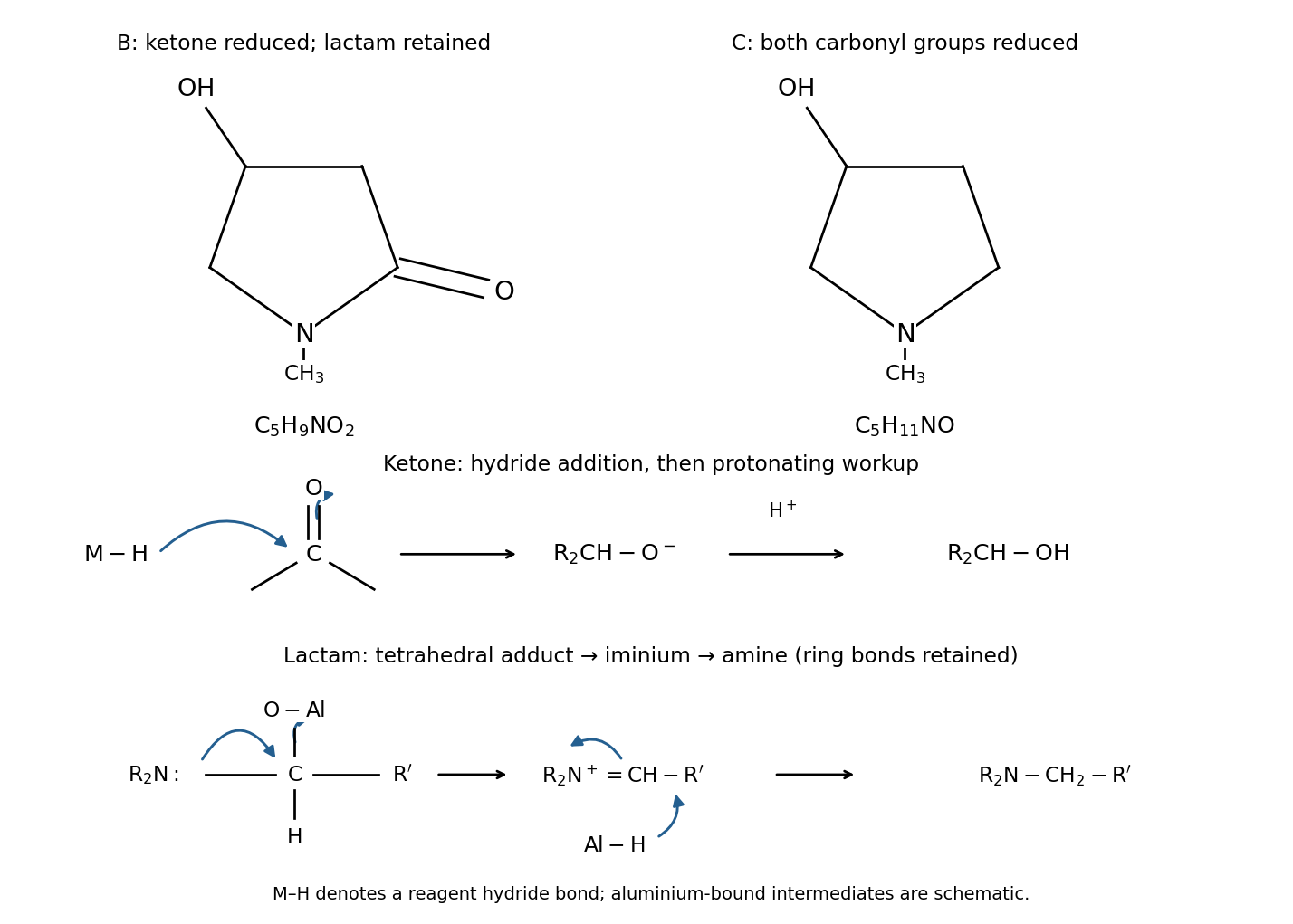
For B, a B–H bond of sodium borohydride supplies a hydride equivalent to the ketone carbonyl carbon, and the carbonyl pair moves to oxygen. This gives an alkoxide, whose protonation during the reaction or workup gives the secondary alcohol. The lactam carbonyl remains. Converting one to adds two H atoms and gives .
For C, lithium aluminium hydride reduces that ketone in the same net way and also reduces the lactam. Coordination of the amide oxygen to aluminium assists hydride attack at its carbonyl carbon, giving a tetrahedral intermediate. The N lone pair then forms a C=N bond while the C–O bond breaks to an aluminium-bound oxygen group. A resulting iminium ion accepts a second hydride at carbon, yielding the cyclic tertiary amine. Aqueous workup protonates the ketone-derived alkoxide.
The lactam conversion replaces by ; its oxygen is removed rather than retained as another alcohol. Together with ketone reduction, the net change is , giving . No stereochemistry is specified: the new alcohol stereocentre is formed as a racemic mixture in an achiral environment.
Basic methanol exchanges the ester alkoxy group while retaining the acetal; dilute aqueous acid removes the acetal while retaining the ethyl ester on the stated reaction timescale. An acetal lacks an electrophilic carbonyl and is stable to ordinary base: expelling methoxide directly would require a poor leaving group. The ester can instead undergo nucleophilic acyl substitution through a carbonyl-derived tetrahedral intermediate.
Under acid, protonating an acetal oxygen converts an alkoxy substituent into departing methanol, and the resulting oxocarbenium is stabilized by its remaining oxygen. Water then drives acetal hydrolysis toward the aldehyde. Ester hydrolysis is also possible under acid, but is slower under the conditions implied by the product data. The retained ethyl group and six distinct carbon-13 NMR environments support E rather than the carboxylic acid that prolonged hydrolysis could produce.
D is , and E is . D results from transesterification; E results from acid-catalysed acetal hydrolysis.
For D, methoxide attacks the ester carbonyl carbon and moves the carbonyl pair to oxygen. Collapse of the tetrahedral reaction intermediate reforms C=O and expels ethoxide. Proton transfer with the methanol solvent regenerates methoxide. Excess methanol favours replacement of the ethyl ester by a methyl ester; the dimethyl acetal survives these basic conditions.
For E, protonate one acetal oxygen, then break its C–O bond with the pair going to oxygen, releasing methanol and forming an oxocarbenium ion. Water attacks that carbon. Deprotonation gives a hemiacetal; protonation of its remaining methoxy oxygen permits loss of a second methanol. The hydroxyl oxygen's lone pair forms C=O during this loss, and deprotonation gives the aldehyde, regenerating the acid catalyst.
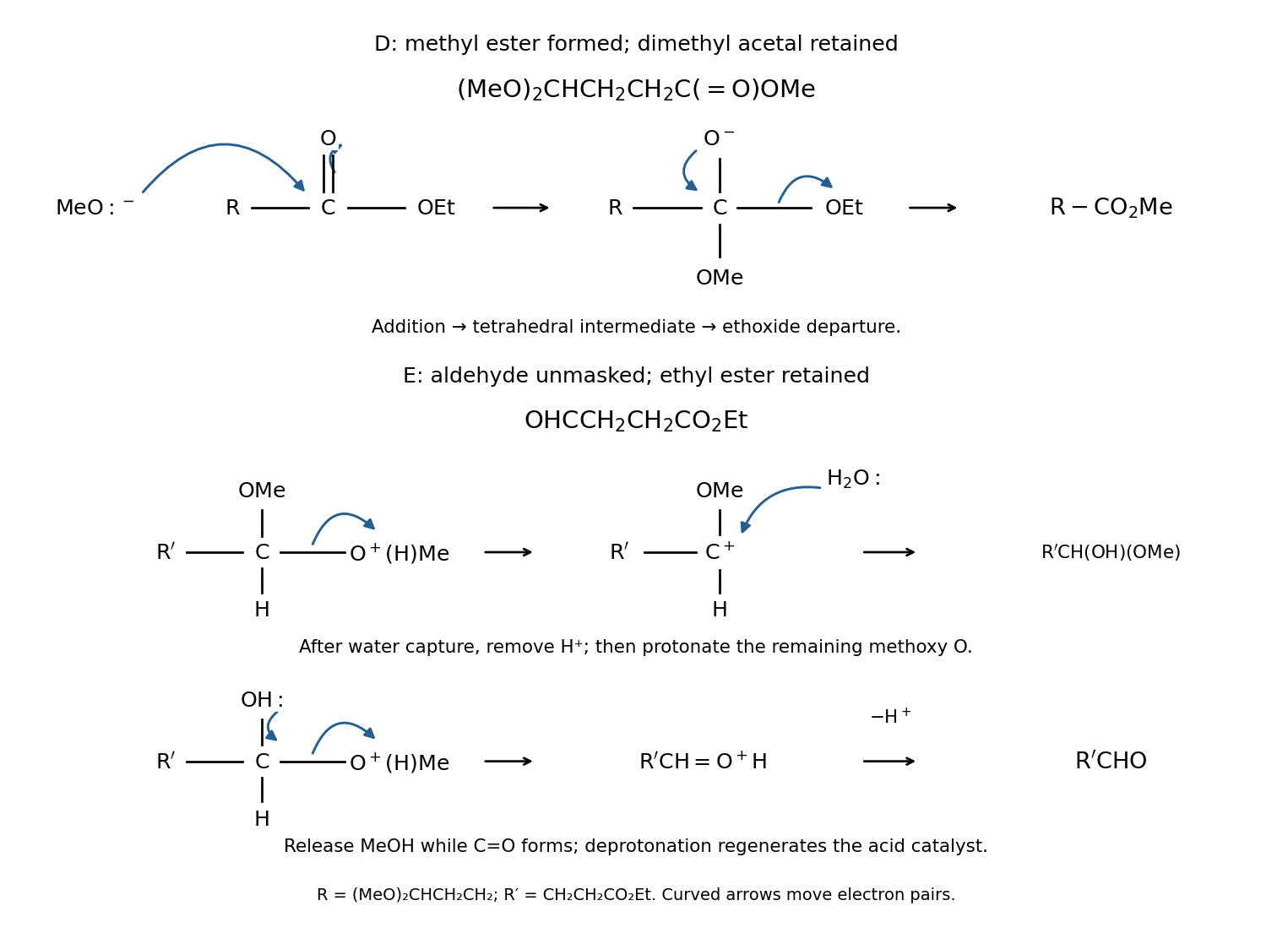
Original products and electron-flow steps for transesterification and acid-catalysed acetal hydrolysis
. Details. The spectroscopy is consistent with these products. D has one ester carbonyl near and six carbon-13 NMR environments: acetal CH, two distinct chain sites, carbonyl, ester , and the two equivalent acetal groups. Thus seven carbon atoms give six resonances. E has separate ester and aldehyde carbonyl bands, approximately and , and six distinct carbon atoms: two carbonyls, two chain methylenes and the two ethyl carbons.
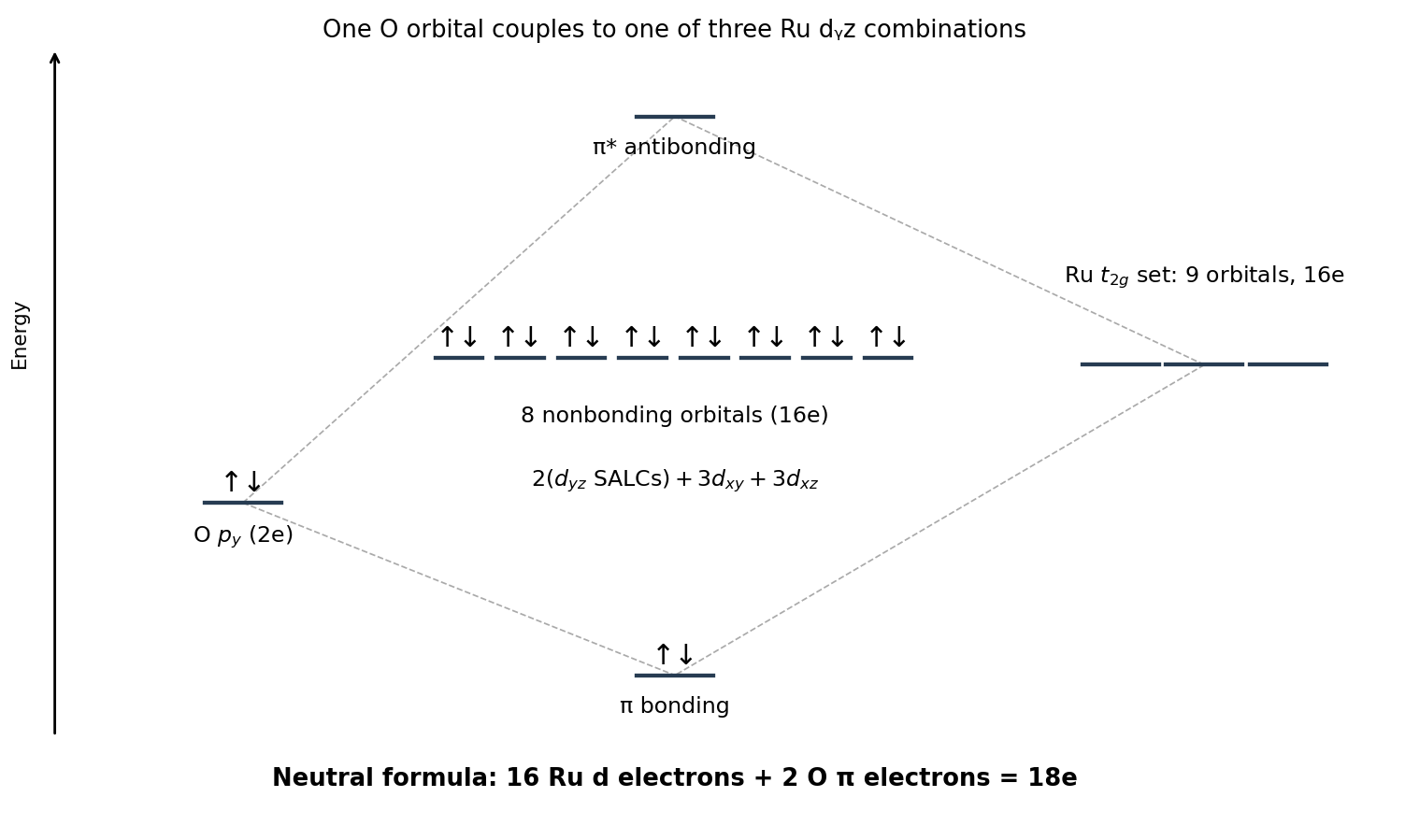
Use the stated local axes: is radial along O–Ru, is tangential within the Ru–O plane, and is perpendicular to that plane. The oxygen's three hybrids make the in-plane sigma framework. Its remaining orbital is perpendicular to the plane and can overlap with one orbital on each Ru.
Choose the local orbital phases so their O-facing lobes agree. Of the three metal orbitals, onlyhas the appropriate combination to interact with oxygen . The other two independent combinations have coefficients summing to zero and are nonbonding with respect to the central oxygen. Mixing with gives one lower pi-bonding orbital and one upper pi-antibonding orbital. Each Ru also retains its and orbitals as nonbonding with respect to this central-oxo pi interaction. Thus the complete low-energy diagram contains one bonding level, eight metal-nonbonding levels, and one antibonding level. The eight consist of two combinations, three and three orbitals. They need not be exactly degenerate once other ligands are considered.
For the neutral formula as printed, oxide contributes and six acetates contribute . The Ru oxidation numbers therefore sum to , giving sixteen metal d electrons overall, formally two Ru(III) and one Ru(II), possibly delocalized. Including the oxygen pi pair gives eighteen electrons, filling the bonding orbital and all eight nonbonding orbitals, leaving pi* empty. If the often encountered singly charged cation were intended instead, there would be seventeen electrons and one singly occupied nonbonding level. This charge distinction changes occupancy, not the orbital connectivity.
Water is the preferred solvent ligand in the qualitative prediction. Its oxygen is a hard donor, it is less sterically demanding than ethanol, and it can occupy a crowded Eu(III) coordination sphere. Actual solvent occupancy also depends on activities and crystallization conditions, so a formula containing only the word solvent is not itself a crystallographic identification.
The bipyrimidine ligand has two distinct N,N-chelating pockets. It can use one pocket as a terminal bidentate ligand, or use both to bridge two Eu centres. Take all three nitrates per Eu to be bidentate O,O donors.
A consistent structure for B is , with two terminal, singly chelating bpm ligands. Six nitrate oxygens plus four bpm nitrogens give coordination number ten. The unused pocket of each terminal bpm points away from that Eu centre.
For C, use a dimer . Place one bpm between the metals, chelating each Eu through a different N,N pocket. Add one terminal bidentate bpm to each Eu and three bidentate nitrates to each Eu. Each metal again has donor atoms, while the overall Eu:bpm ratio is . In this model all four nitrogens of the bridging bpm are used, but only two of each terminal bpm are used.
Both structures have their accessible coordination sites occupied by multidentate ligands, and the chelate effect favours retention of those donors over adding or exchanging a solvent molecule. This accounts for the absence of coordinated solvent while allowing a higher coordination number than the thiocyanate example. Stoichiometry alone does not exclude polymeric alternatives or different nitrate binding modes; the monomer/dimer pair is an explicit internally consistent prediction.
The key stereochemical disconnection is the cis-1,3-disubstituted cyclopentane, not a direct functionalization of two arbitrary cyclopentane positions. A Diels-Alder reaction of cyclopentadiene with nitroethylene fixes both ends of the new two-carbon bridge on the same face of the original five-membered ring.
Isolate the useful nitronorbornene adduct, convert its secondary nitro group to a ketone by a Nef reaction, and then hydrogenate the remaining ring alkene to norcamphor. Performing the nitro-to-ketone conversion before catalytic hydrogenation avoids simply reducing the nitro group to an amine.
Use a Baeyer-Villiger oxidation to insert oxygen between the carbonyl carbon and its adjacent bridgehead carbon. Bridgehead migration is favoured over migration of the competing methylene; isolate the required lactone regioisomer if necessary. This opens the way to a hydroxy cyclopentyl side chain without breaking the original five-carbon ring. In the resulting bridged lactone, one original cyclopentadiene terminus is bonded to O and the other bears the segment.
Reduce the lactone selectively with DIBAL to its lactol. Ring opening of that lactol gives the aldehyde equivalent cis-3-hydroxycyclopentyl-. The ring OH and the two-carbon aldehyde side chain are cis because their original attachments were the two ends of the Diels–Alder bridge; neither the migration nor lactol opening inverts those cyclopentane carbons.
Perform a Horner-Wadsworth-Emmons reaction on the lactol/aldehyde equilibrium using , where . Preform the phosphonate anion and allow for consumption of base by the lactol OH. Standard stabilized-phosphonate conditions favour the required E- unit. No further hydrogenation should follow it.
The required ester substituent can be prepared by reducing 4-methylpentan-2-one to 4-methylpentan-2-ol, esterifying with bromoacetic acid, and performing an Arbuzov reaction with triethyl phosphite to make the phosphonoacetate. No absolute configuration is indicated at that alcohol-derived centre.
Bridge-derived cis ring stereochemistry plus E-selective phosphonate olefination gives both specified relationships. Achiral cycloaddition and subsequent reagents give a racemic pair with this relative configuration; isolation of one absolute enantiomer would require resolution or an asymmetric variant. The acid fragment contains nine carbons: five from cyclopentadiene, two from nitroethylene and two from the phosphonoacetate. The ester alkyl group adds six, giving fifteen overall. The atom tracing in the original schematic in question 8 shows why oxygen insertion retains the five-membered ring rather than producing a six-membered carbocycle.
The key is coupling redox equilibrium to hydrolysis and precipitation. Ce(IV) has a much greater tendency than Ce(III) to form a hydrated cerium dioxide solid. Raising pH therefore preferentially stabilizes the oxidized form. In the presence of dissolved oxygen a representative net reaction isRemoving drives this reaction towards Ce(IV). Writing the solid as hydrated oxide changes its water content, not this redox argument.
The Nernst equation makes the pH effect explicit. At , the reduction has a pH slope approximately per pH unit at fixed Ce(III) activity. The oxygen/water reduction has slope about per pH unit. Raising pH thus makes oxidation of Ce(III) by oxygen increasingly favourable within the relevant phase-stability region. Conversely strong acid favours soluble Ce(III) relative to the oxide and makes Ce(IV) a stronger oxidizing agent. pH changes the redox driving force; an electron acceptor or donor is still required, and slow oxygen evolution or oxidation kinetics can prevent immediate equilibration.
Open the lactone formally at its acyl–oxygen bond, then replace the resulting secondary alcohol by its ketone precursor. With , the useful sequence of retrosynthetic intermediates isDisconnect the last compound as a Michael addition product of the methyl-side enolate of and ethyl methacrylate:The substituted carbon of the methacrylate becomes the methyl-bearing carbon alpha to the lactone carbonyl. The ketone carbon becomes the oxygen-bearing ring carbon. This checks the six-membered ring connectivity.
The required branched methyl ketone itself comes from butan-2-one by ethyl-side aldol addition to acetone, followed by dehydration and selective hydrogenation:Choose and isolate the aldol regioisomer shown. For the subsequent Michael step, use a bulky base at low temperature to favour its less hindered methyl-side kinetic enolate. Reduce the resulting ketone selectively with while retaining the ester, hydrolyse the ester, then acidify and promote intramolecular esterification with water removal. The hydroxy acid closes to the required six-membered lactone. There is no specified stereochemical relationship to enforce, but a stereochemically pure target would require an additional selectivity or resolution step.
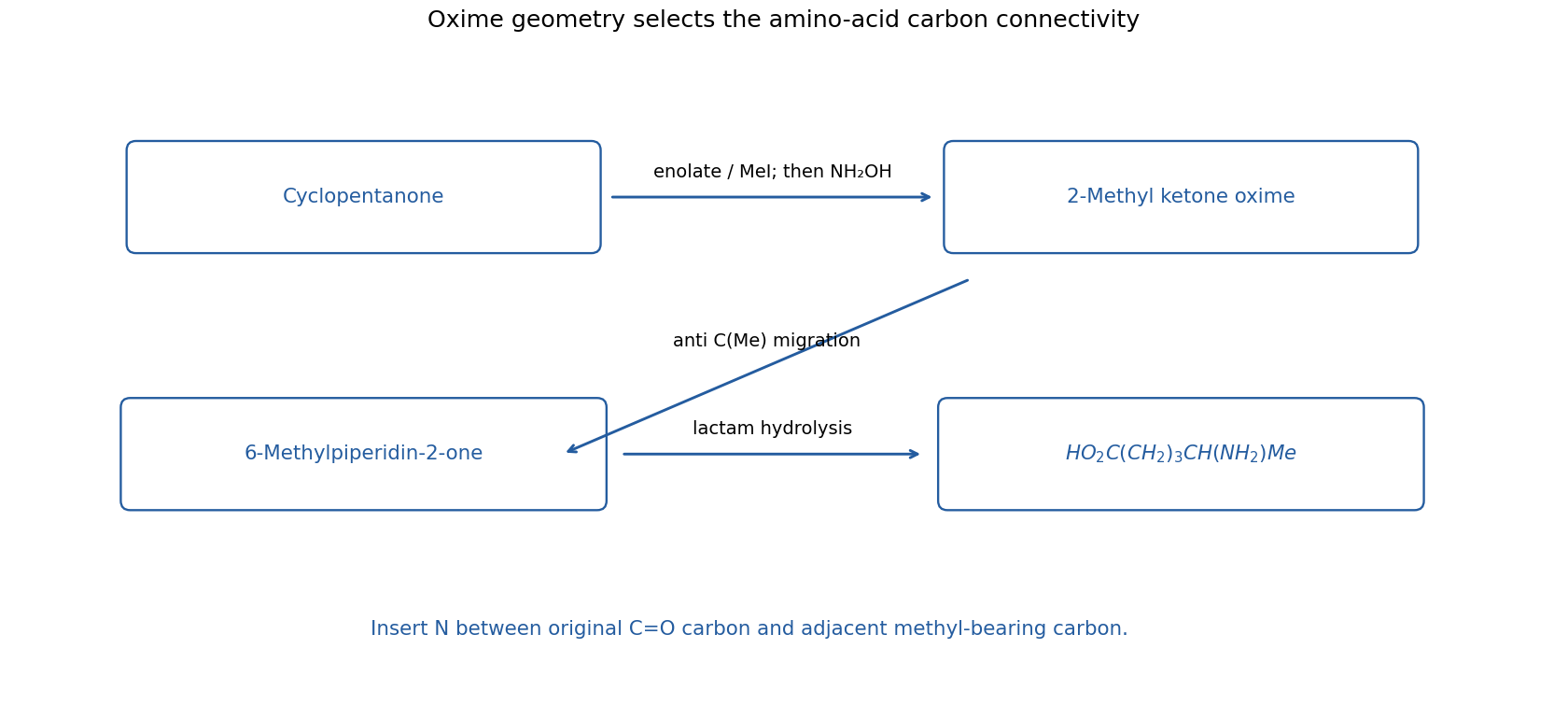
The target is 5-Aminohexanoic acid, . Disconnect its terminal amine/carboxylic-acid relationship through hydrolysis of 6-methylpiperidin-2-one. This six-membered lactam follows from a regioselected Beckmann ring expansion of 2-methylcyclopentanone oxime.
Start with cyclopentanone. Form its enolate with lithium diisopropylamide in dry THF at low temperature, add methyl iodide, then quench to obtain 2-methylcyclopentanone. Control the methyl iodide/base stoichiometry to suppress a second alkylation. React the ketone with hydroxylamine to form its oxime and select the geometrical oxime isomer in which the bond to the methyl-substituted adjacent ring carbon is anti to the departing oxime oxygen group.
Activate the oxime, for example under appropriate acid-promoted Beckmann conditions. The anti methyl-bearing C–C bond migrates onto nitrogen as the N–O-derived leaving group departs, inserting nitrogen between the original carbonyl carbon and the methyl-substituted ring carbon. Hydration/tautomerization gives 6-methylpiperidin-2-one. The opposite oxime geometry would insert nitrogen on the other side and ultimately place methyl at a different position in the amino acid; oxime geometry is therefore an essential part of this proposal.
Hydrolyse the lactam with aqueous acid and heat, then adjust the work-up to the desired acid/ammonium form. Cleavage of its acyl–nitrogen bond opens the ring to after suitable neutralization. All five original cyclopentanone carbons are retained, and the one methyl carbon comes from methyl iodide. A racemic mixture product is appropriate to the stereochemically unspecified target. The reaction sequence is an organic ring-expansion synthesis and requires no biological transformation.
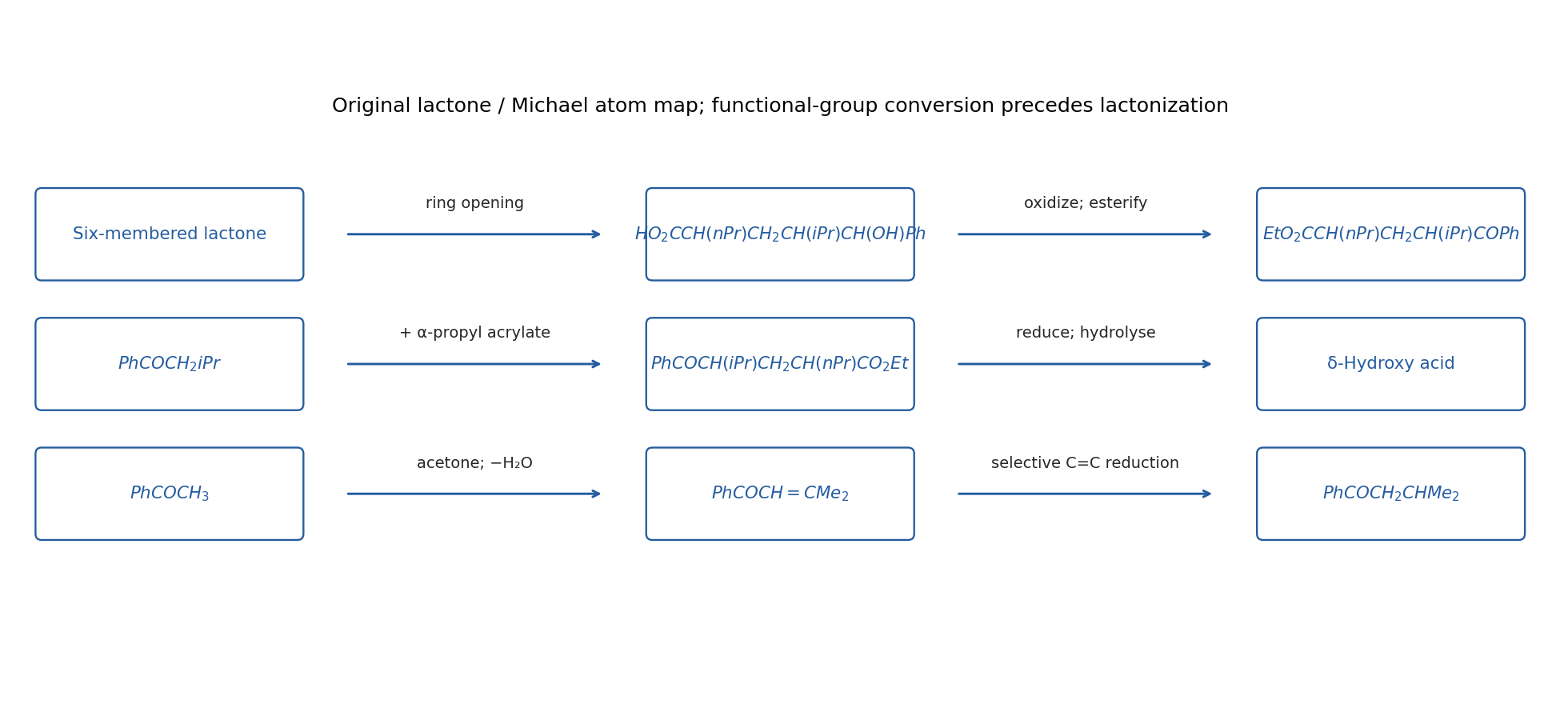
Open the cyclic ester at its acyl–oxygen bond. The resulting delta-hydroxy acid isOxidation-state reversal at the benzylic alcohol gives . This identifies the key Michael disconnection between the central and groups:The nucleophile is the enolate or enamine of the phenyl ketone. The electrophile's propyl substituent must be alpha to its ester carbonyl; using a beta-propyl acrylate would move the substituent to the wrong ring position.
Disconnect further to the indicated acetophenone. Crossed aldol addition to acetone followed by dehydration gives ; selective conjugate reduction or controlled alkene hydrogenation then gives . This avoids requiring an efficient SN2 alkylation with a secondary isopropyl halide. The alpha-propyl acrylate can be obtained by alpha-hydroxymethylation/dehydration of ethyl pentanoate, , using formaldehyde.
In the forward direction, perform the Michael coupling, reduce the phenyl ketone selectively with sodium borohydride while retaining the ordinary ester, hydrolyse the ester, and cyclize the delta-hydroxy acid by controlled acid-catalysed lactonization or an activated-acid coupling. The six-membered ring then has the order carbonyl–––––O. This atom order checks all three substituent positions. No relative configuration is specified, so the scheme does not imply a single diastereomer from the Michael addition or reduction.