For every prime factor of , Fermat's little theorem gives . Since divides the least common multiple , it follows that . The primes are distinct and hence pairwise coprime, so their product divides this integer. ThusFor the specified product, and . Since , raising the preceding modular congruence to the forty-eighth power proves for every coprime to . This is the defining phenomenon of a Carmichael number.
Introduce , , and . Composition of the Möbius transformations represents a finite continued fraction. Their matrices giveIndeed, multiplying the last factor gives the linear recurrences and , which reproduce the continued fraction convergents of the continued fraction. Each factor has determinant . Taking determinants therefore yieldsThis identity also proves that the numerator and denominator in the first column are coprime, so no unnoticed cancellation changes the displayed matrix.
Extend the Möbius transformations to isometries of three-dimensional hyperbolic space. For any interior point , the limit set of a Kleinian group is the set of boundary accumulation points of . Its definition is independent of : two interior orbits stay at a bounded hyperbolic distance, so have the same boundary limits. The Kleinian limit set is closed and -invariant. Iterating a loxodromic Möbius transformation in the positive and negative directions shows that its two fixed points belong to the Kleinian limit set.
The two fixed-point sets in this problem cannot have exactly one common point. Otherwise conjugate that point to infinity and the other fixed point of the first transformation to zero. The transformations then have the forms , with , and , with . But is a sequence of distinct group elements converging in the Möbius group. Taking quotients of consecutive elements gives nonidentity elements converging to the identity, contrary to discrete subgroup. Consequently the Kleinian limit set contains at least three points.
Let be any point of the Kleinian limit set, and choose distinct with . The rank-one convergence of divergent Möbius transformations supplies a subsequence converging to uniformly away from one exceptional boundary point . To see the lemma directly, normalize determinant-one representing matrices by their norms. The norms tend to infinity, and a subsequential limit has rank one: its kernel is and its image is the attracting point. In the positive-Hermitian-matrix model of hyperbolic space, has this same image limit, so the attracting point is indeed .
Choose distinct in the Kleinian limit set other than . Then and both tend to , belong to the Kleinian limit set, and remain distinct because is injective. If were isolated, both would eventually equal , an impossibility. The limit set has no isolated points.
A binary block code is a subset ; its length is the common word length , its size is , and its minimum distance is the least Hamming distance between distinct words. There are words in a radius- Hamming ball, since one chooses the positions to change.
Put . Two radius- Hamming balls about different codewords cannot meet: otherwise the triangle inequality would make their centres at distance at most . Comparing their combined size with gives the Hamming boundFor the other direction, start with one word and repeatedly add any word at distance at least from every word already selected. Finiteness ensures that this process stops. At that point the radius- Hamming balls cover the entire cube; an uncovered word could otherwise be added. These balls may overlap, but their total size is at least . This gives the Gilbert–Varshamov bound
In a generalized linear model, the linear predictor is , a linear combination of the covariates with unknown coefficients. The link function relates this predictor to the mean: . The canonical link function chooses the natural parameter of the exponential family, namely . Differentiating the normalization of the density shows that , so the canonical link function is on the admissible parameter interval.
For a Bernoulli distribution, the probability mass function can be written asThus and . The canonical link is the logit:
The infection term is a mass-action contact rate: each infection removes one susceptible individual and adds one infected individual. Recovery at rate transfers individuals from the infected class to the recovered class. Loss of immunity at rate transfers recovered individuals back to the susceptible class. Thus these equations describe the SIR model with waning immunity, also called the SIRS model. Adding the equations gives , so . The nonnegative population region is invariant because the derivative of any population on its zero boundary is nonnegative.
Since , the infected population satisfies . Integration gives . Hence forces the infected population to decrease exponentially from the outset: there is no epidemic outbreak.
For and , a nonzero infected equilibrium requires . Using and population conservation givesEliminate before assessing stability, since perturbations must preserve the total population. The resulting Jacobian matrix at this endemic equilibrium isIts trace is negative and its determinant positive, so both eigenvalues have negative real part: the endemic equilibrium is locally asymptotically stable on the fixed-population plane. The full three-variable system has a neutral direction corresponding to changing the conserved population.
Writing , as the trace is and the determinant is . Hence the discriminant . As , the trace is and the determinant is again , giving a positive discriminant . Both quantities are in both limits, but the eigenvalues are complex for sufficiently small and real for sufficiently large .
Representative normal forms are for a saddle-node bifurcation, for a transcritical bifurcation, and for a supercritical pitchfork bifurcation. Replacing the last cubic term by gives the subcritical pitchfork bifurcation.
Treat as a variable with . The extended center manifold is tangent to , so write . Its invariance equation is . At quadratic order this readsMatching coefficients gives , , . Substitution into the first equation therefore givesHere denotes total degree at least three in . With , and , this becomes . Thus , , , and the bifurcation is a saddle-node. For negative parameter, the negative- branch is stable and the positive- branch unstable along the center manifold; the transverse eigenvalue is near .
For real , the integrand depends only on , so first take . Integrate over the upper-half-plane semicircle, indenting above both real poles with small clockwise semicircles. The large arc tends to zero by Jordan lemma. Each indentation contributes times its residue, and there are no enclosed poles. Thus the Cauchy principal value on the whole real axis isThe imaginary part is odd and the real part even. Taking the real part and halving givesThe right-hand side is even in , completing the negative- case as well.
The bob has and . Substituting these into the Lagrangian givesThe mixed term is . Removing this total derivative and the time-only term leaves the equivalent Lagrangian . The Euler-Lagrange equation becomesIn free fall, , so : a bob initially at rest relative to the lift remains at its initial angle, and otherwise moves around the pivot with constant angular speed. Every constant angle is then an equilibrium, with no restoring force. For , the equilibria are and modulo .
Near , the linearized equation is . When this is an harmonic oscillator, so the downward configuration is stable. Writing instead gives , with an exponentially growing solution. Downward is stable; upward is unstable.
When , the signs reverse. The downward configuration has an exponentially growing disturbance, whereas near one obtains . Upward is stable; downward is unstable. The effective gravity in the descending lift points upward in this case.
A thin spherical shell has mass and inward gravitational force . The net outward pressure force is . Their balance gives the hydrostatic equilibrium equationSince , multiplying by and differentiating yields .
At the centre, require and finite and . Spherical symmetry gives ; indeed makes the pressure gradient for regular density. At the surface require , usually approximated by zero, because pressure matches the surrounding medium. If the stellar mass is prescribed, also impose . An equation of state is needed to close the system. A vanishing surface density is appropriate for some stellar models but is not a universal boundary condition.
After its giant phases, the Sun ejects much of its envelope and leaves a carbon–oxygen white dwarf. The remnant mass lies below the Chandrasekhar limit. Its support is chiefly electron degeneracy pressure: the Pauli exclusion principle forces electrons into distinct momentum states even at low temperature, giving when they are nonrelativistic. Consequently pressure support need not cease when nuclear burning ends. The white dwarf subsequently cools and fades.
The process called inverse beta decay here is electron capture, , becomes possible for free particles when the electron's total energy exceeds approximately , corresponding to a kinetic energy about . Electron capture on nuclei has thresholds modified by nuclear binding energies. In a solar-mass progenitor's ordinary white dwarf remnant, the Fermi energy is below the relevant capture thresholds, so the electron population providing support is stable. At much higher density, electron capture can reduce the electron density and pressure and promote collapse; this is why stability against electron capture matters in assessing degeneracy support. The Sun ends as a cooling white dwarf, rather than a neutron star.
The Prime number theorem states that , where counts primes not exceeding . Dirichlet theorem on primes in arithmetic progressions states that if , then the progression contains infinitely many primes.
If for an odd prime , the multiplicative order of modulo is four. Lagrange's theorem therefore gives . Conversely, Wilson's theorem gives . Pairing the factors and yieldsFor , the sign is positive, so the factorial supplies a square root of . Thus is a quadratic residue exactly when .
Write . The odd integer is modulo . If all of its prime factors were modulo , their product, with multiplicities, would be modulo , so at least one factor is modulo . Every prime factor of is odd and satisfies ; the criterion just proved gives . Neither integer is divisible by any , since their residues modulo are respectively and . Starting with any finite list thus produces a new prime in each residue class. Both classes contain infinitely many primes, independently of the general Dirichlet theorem on primes in arithmetic progressions.
In the RSA cryptosystem, choose distinct large primes , put , choose coprime to , and choose with . Publish and keep the factorization and private. Encrypt a properly encoded message as and decrypt as . The Chinese remainder theorem proves correctness even for nonunits: modulo either prime, the message is either zero or satisfies Fermat's little theorem.
The public exponent has few nonzero binary digits, so exponentiation needs only sixteen squarings and one extra multiplication. It is an efficient conventional choice, subject to the required coprimality and secure randomized message encoding. The same numerical choice for the private exponent would speed decryption, but for large moduli with balanced prime factors it is disastrously small: the continued-fraction attack on a small RSA private exponent recovers when, for example, and . A small public exponent and a small private exponent have very different security implications.
To factor from , write with odd. Choose random modulo . If is nontrivial, factoring is already done. Otherwise compute and repeatedly square; the final value is one. If a value immediately preceding the first one is neither nor modulo , then andIndeed, the signs of modulo and differ. Restart if the chain begins at one or reaches first. The Chinese remainder theorem makes the two prime components independent for a uniformly chosen unit. Their two-primary orders differ with probability at least one half: if the two exponents of two in are equal, the probability of equal orders is at most one half, and if unequal it is smaller. Since odd preserves these orders, this gives a randomized factoring procedure with bounded expected repetitions.
A bit commitment must be hiding before opening and binding after it. A concrete RSA construction uses a valid public RSA permutation whose inverse is unavailable to the receiver. Choose a random unit and a random bit vector , and set to their binary inner product modulo two. Send , , and . To open, reveal ; the receiver checks and recovers . Injectivity makes the opening bit unique. The hard-core predicate theorem applied to gives computational hiding under the RSA inversion assumption. The setup must ensure a valid modulus and exponent without giving the receiver the private exponent; otherwise hiding fails. Merely encrypting or would not hide a bit, since both ciphertexts could be computed publicly.
A homogeneous equilibrium has . Besides , a nonzero equilibrium satisfies , giving . Concentrations are nonnegative, so only nonnegative roots are physically admissible. At a positive equilibrium, the reaction Jacobian matrix isNegative trace and positive determinant are equivalent toThus a positive homogeneous stable branch exists precisely when and , on the upper root . The lower positive branch has negative determinant and is unstable. At the branches meet and have a zero eigenvalue; at the strict linear stability condition also fails.
The trivial equilibrium has eigenvalues , so it is asymptotically stable for . It exists for all , independently of the nonzero branches. If negative were allowed mathematically, the negative branch for would also be homogeneously stable, but it does not represent a chemical concentration.
A Fourier mode with evolves under . Its trace remains negative for a homogeneously stable positive branch. Its determinant isIf , this is positive for every . Otherwise its minimum is attained at . Stability requires , orIn terms of , the boundary is the positive root of :Within , all modes decay for ; a finite band grows for , giving a Turing instability. Equality is neutral at one nonzero wavenumber.
For , the positive lower branch is unstable for every . The upper branch is homogeneously stable for : it is stable to all modes to the left of and unstable to spatial modes to the right. For it is already homogeneously unstable. The zero branch is stable to every spatial mode when , because its mode eigenvalues are and .
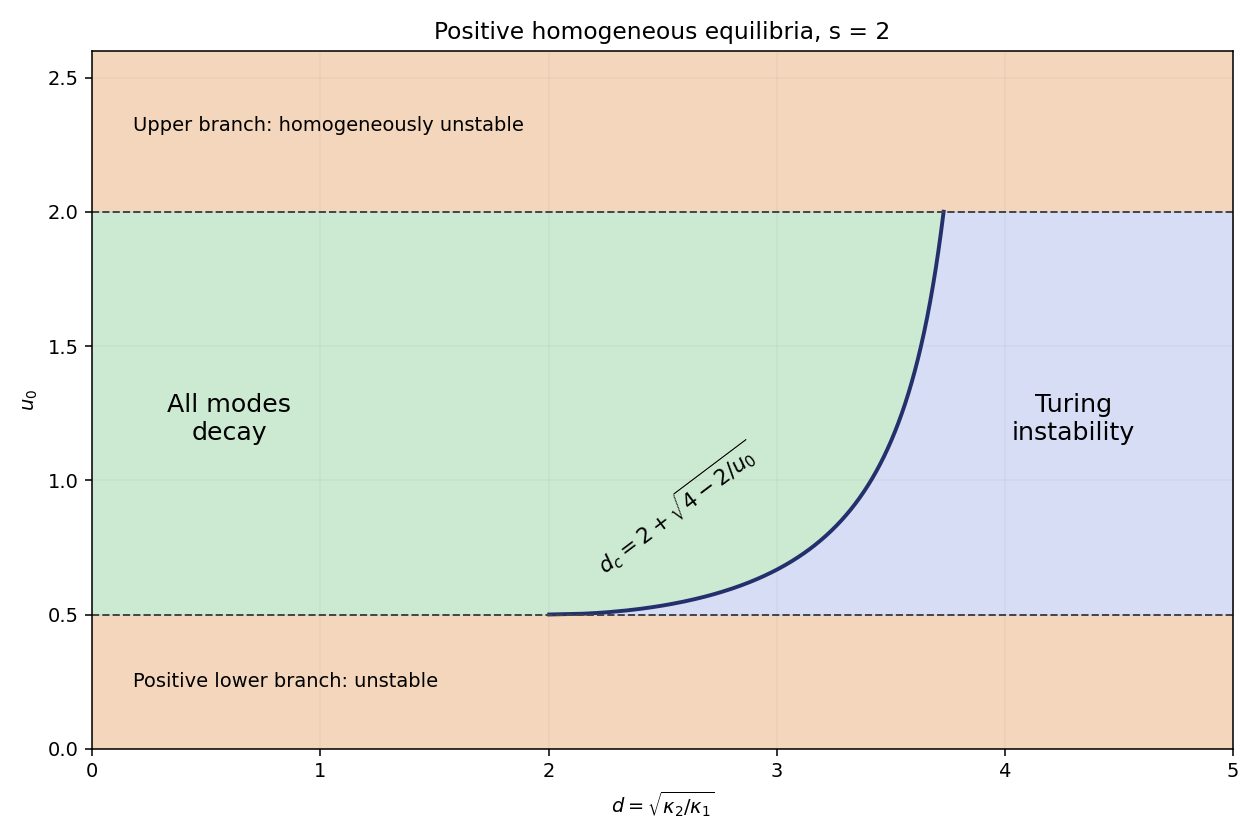

At onset the determinant has a double root, soSquaring the neutral-boundary equation and canceling the positive factors gives . Substitution yieldsFor a positive branch with , the actual neutral curve lies strictly between and . If , then for every such branch: a homogeneously stable state cannot have this Turing instability. If , then for every finite positive , so every homogeneously stable positive state is spatially unstable. The negative value yielded by the displayed formula outside its boundary domain is not a physical critical wavenumber and does not imply renewed stability. One must also keep , which can restrict the attainable neutral curve further.
Write the Papperitz symbol by listing pairs of exponents at . For they are , , and . Under the points in the -plane correspond respectively to in the -plane. Thus the pulled-back exponents are at zero, at one, and at infinity.
Multiplication by shifts the exponents at one by and those at infinity by , yieldingThis is the original Gauss hypergeometric equation. Both functions are analytic and normalized to one at zero, so uniqueness of that normalized local solution proves the Pfaff transformationContinue the identity using the branch . As usual, the parameters must admit the normalized hypergeometric solution; excluded singular parameter values are treated only when their limiting solution exists.
For , the exponents at are , , and . The substitution exchanges zero and infinity, giving at , at one, and at infinity. Multiplication by shifts the zero exponents by and the infinity exponents by . The resulting Papperitz symbol is again , , . Therefore satisfies the same hypergeometric equation, with the stated branch .
First assume and nonsingular parameters, so the two infinity solutions and , obtained by exchanging , are independent. Write . Since the power series at starts at one, and .
In the parameter region , let in the Pfaff transformation. The term vanishes after multiplication by , while and . The supplied value at one of the Gauss hypergeometric function therefore givesAnalytic continuation in the parameters extends this coefficient to the nonresonant parameter domain. Exchange to determine . Hence the hypergeometric connection formula at infinity isThe branch is . The existence of alone does not exclude integer . At such resonant values the two separate displayed terms can be singular; the correct statement takes their combined parameter limit, which can contain logarithms. This qualification is essential, for example when .
The azimuthal coordinate is cyclic, so its canonical momentum is conserved. Time independence of the Lagrangian also conserves the energy. The two constants areFor a horizontal launch from depth , take , so , , and . Thus and . The meridional motion has effective potential .
Grazing the equator makes it a turning point, so at . Conservation of energy gives . ThereforeTo check that no earlier turning point prevents reaching the equator, put . On , is strictly convex. Its two endpoint values are equal for this speed, so its interior values are smaller. The trajectory can therefore move between the launch point and the equator. The equator is genuinely a turning point since there.
For fixed , the Euler-Lagrange equation for the meridional coordinate requires . Combining this with and givesThe resulting motion is a conical pendulum. The positive-depth condition is necessary for a nondegenerate constant-latitude orbit in gravity; the bottom point is the limiting zero-speed equilibrium.
A first-order structure consists of a nonempty domain, an interpretation of each constant as a domain element, each -ary function symbol as a map from the -fold domain product to the domain, and each -ary relation symbol as a subset of that product. Under an assignment of values to variables, terms are evaluated recursively. Atomic formulas assert equality of term values or membership in an interpreted relation. Boolean connectives act on truth values, and quantifiers range over the whole domain. The set consists of assignments to the free variables making the formula true.
For a substructure , constants lie in , functions restrict to , and relations restrict to tuples from . Induction on terms shows that every term with arguments from has the same value in both structures. Atomic formulas consequently have the same truth values, and induction on Boolean connectives givesfor every quantifier-free formula.
For a nonempty chain of -model substructures, form their union . Every finite tuple belongs to one member of the chain, so is closed under all interpreted functions and contains the constants. Consider any inductive axiom . A specified finite tuple lies in one member, which supplies witnesses there. The quantifier-free formula has the same truth value in that member and , so satisfies the axiom. Hence is a -model and the least upper bound of the chain. The poset is complete for nonempty chains. If chain-complete is defined to include the empty chain, a least element must additionally exist, which the stated hypotheses do not ensure.
The reflexivity, antisymmetry, transitivity and totality axioms for a total order are universal with quantifier-free formula matrices, and hence inductive with an empty existential block. Add and , with strict inequalities expressed using and inequality. These exclude least and greatest elements. This theory is inductive.
For each positive integer , the finite ordered interval has a greatest and a least element, and these intervals form a chain of substructures. Their union is , which has neither. An inductive first-order theory must be preserved by such unions, as proved above. The theory with both endpoints cannot be axiomatized inductively, even though it has an ordinary first-order axiomatization with existential–universal endpoint sentences.
Define the asymmetric Ramsey number for a red or a blue . The base cases are finite. If , choose a vertex of . Its red neighbors number at least , or its blue neighbors number at least . Apply the appropriate smaller Ramsey number inside that neighborhood: either the opposite-color clique already exists, or a same-color clique extends by the chosen vertex. Thus , proving finiteness by induction, in particular for .
In a graph of maximum degree , a ball of radius about a vertex has at most vertices. Hence a connected graph of order has a vertex outside this ball, at distance at least . The argument also applies whenever the graph has at least vertices.
Now take a connected graph of order . If some vertex has at least neighbors, apply the two-color Ramsey theorem to their pairs, coloring an edge red and a nonedge blue. A red is an induced complete graph, while a blue is an independent set of neighbors, which with the centre induces . Otherwise the maximum degree satisfies . For , connectedness and the vertex count rule out . The ball bound then provides vertices at distance at least . A shortest path between them has no chord, since a chord would shorten it; its first edges induce . The case is immediate. Therefore
The polynomial is separable, since its derivative has no common root with it when the characteristic does not divide . Its roots form a cyclic multiplicative group of order . For completeness, any finite subgroup of a field's multiplicative group is cyclic: if its exponent is , all its elements are roots of , so its size is at most , while the elementary decomposition of a finite abelian group gives an element of order .
Choose a primitive root . Then , and every field automorphism sends to for a unique unit modulo . Composition multiplies the exponents, and fixing fixes all of . This is the required injective homomorphismFor , the least extension containing a primitive th root is characterized by , since its multiplicative group is cyclic of order . Thus is the multiplicative order of modulo . The successive powers of modulo are , so
For , define . This preserves the space of degree- homogeneous polynomials and satisfies . The diagonal torus of SU(2) acts on the monomials with distinct weights .
If a nonzero subspace is invariant, averaging against each torus character projects onto the individual weight spaces. Therefore contains at least one monomial. Invariance also implies invariance under differentiated Lie-algebra operators and their complex linear combinations. The complexified algebra contains the operators and , up to harmless signs. They carry each monomial to its adjacent monomial with a nonzero coefficient unless already at the appropriate endpoint. Repeated application produces every monomial, so . The representation is irreducible.
Use the Clebsch-Gordan decomposition for SU2, which states that . Here this givesTo determine symmetry, realize the tensor product as polynomials in two pairs of variables. A highest-weight vector in the th summand can be chosen proportional to . Exchanging the two factors multiplies it by , and hence multiplies the entire irreducible summand by that sign. Even belong to the symmetric square, odd to the exterior square. ThusTheir dimensions are respectively and , as required for a four-dimensional space.
The dual representation on is . The bilinear form on is nondegenerate and invariant under SU(2), because every group matrix has determinant one. Thus it gives an equivariant isomorphism . Taking the th symmetric power gives an equivariant isomorphism between its th symmetric power and its dual. Since homogeneous polynomials realize , this proves
The fundamental group of the figure-eight is the free group on its two circle loops . A two-sheeted covering space is specified by their permutations of the two-point fiber. It is connected exactly when this action is transitive, equivalently when at least one permutation exchanges the sheets. Since is abelian, relabeling the two sheets does not identify any further cases. There are therefore three connected double covers, given by , where exchanges the sheets.
In either of the first two covers there are two vertices joined by two parallel edges, with a loop at each vertex. The two covers differ as covers of the fixed base, but their total spaces are homeomorphic by exchanging the base-circle labels. The third cover has two vertices joined by four parallel edges and no loops.
These last two graph types are not homeomorphic. Their two degree-four branch points are intrinsically identifiable topologically. Removing either branch point in the graph with loops leaves two components: the punctured loop at that point, and the remaining connected graph. Removing either branch point in the four-edge graph leaves a connected four-armed graph. Thus the three covers give two homeomorphism types of total space. This is the distinction between equivalence of covers and homeomorphism of covering spaces.
If and , then because is bounded and linear. Therefore , proving weak continuity of .
For a bounded sequence in , extract successive subsequences on which the first, second, and subsequent coordinates converge, then take a diagonal subsequence. Call the coordinate limits . Every finite partial sum satisfies , so and . For any , the pairing on its first coordinates converges, while the pairing on the tail is bounded uniformly by . First choose large, then take the subsequence limit. The Riesz representation theorem identifies these pairings with every continuous linear functional, proving the requested weak convergence.
For , norm convergence implies weak convergence immediately. Conversely, suppose but a subsequence has . Coordinate convergence to zero allows us to select indices and cutoffs such that the mass of before or at is below , and its mass after is below . Its mass on the intervening block is then at least . On that block set when nonzero and zero otherwise. These prescriptions define . The bounded linear functional has real part at least on every selected , contradicting weak convergence. Translating by the limit proves weak and norm convergence of sequences coincide in , the Schur property.
A compact operator sends bounded sets to relatively norm-compact sets. Every bounded sequence in has a weakly convergent subsequence by the argument above, after scaling into the unit ball. Its image under converges weakly and therefore in norm by the Schur property. Sequential compactness in a metric space gives relative compactness of the image of the unit ball. Every bounded linear operator from to is compact.
For a nonconstant holomorphic map between compact Riemann surfaces, choose local coordinates making the map . Its local degree is , and its ramification excess is ; branching order conventions use either of these quantities, so both are specified below. The degree is the number of inverse images of any regular value, or the sum of local degrees in any fiber. The Riemann-Hurwitz formula is .
The projective closure is . Its three partial derivatives cannot vanish simultaneously at any projective point, so it is nonsingular and inherits the complex structure of a smooth projective curve. The affine polynomial is irreducible by Eisenstein applied to at the prime in , so the smooth projective curve is connected. At its points are , where ; these are exactly the points added at infinity.
The extension of the coordinate projection is . There is no point on the curve with , so this gives a holomorphic map everywhere. More explicitly, in the chart put , . Near an infinity point, and . Thus is a local coordinate and has nonzero derivative at zero. Each infinity point is unramified, with local degree one.
For a generic finite , there are distinct solutions of , so . Ramification occurs exactly at , . At each such point, is a local coordinate and , giving local degree and ramification excess . There are no other critical points, since away from the projection is a local coordinate. Therefore
The Gauss map sends each point of an oriented surface to its chosen unit normal . Both and are the plane orthogonal to , so the derivative is an endomorphism of that plane. In local coordinates , differentiating gives . Since , this equals . Bilinearity then gives for all tangent vectors. The derivative of the Gauss map is self-adjoint.
If the Gauss map is a diffeomorphism onto , the surface is compact and is invertible everywhere. Its Gaussian curvature is continuous and nowhere zero, so has constant sign on the connected surface. To determine that sign, maximize a height function . At a maximum, is parallel to the normal and the Hessian of the height function is semidefinite. Thus the second fundamental form is semidefinite, up to a sign. Its determinant is nonnegative and cannot be zero because is invertible. Hence at that point and therefore everywhere.
The converse is false under the stated hypotheses. An open hemisphere of the unit sphere is a connected oriented surface with , but its outward Gauss map has only that hemisphere as its image, and is not a diffeomorphism onto all of . The missing compactness hypothesis matters.
The characteristic function is . It satisfies . Thus a real-valued characteristic function gives , and the uniqueness theorem for characteristic functions implies equality of the two distributions. Conversely, equality in distribution gives equality with the complex conjugate, making the characteristic function real. Reality for all is equivalent to symmetry of the distribution about zero.
Choose a bounded strictly increasing function, for example . Independence and identical distribution imply . If almost surely, the left side is zero. Therefore is almost surely constant; injectivity of makes almost surely constant. Using a bounded function avoids any unassumed second moment of .
Independence gives for . Taking real parts shows . The integrand is nonnegative, so it vanishes almost surely for each such .
Choose a countable sequence of positive in that interval, and intersect the corresponding probability-one events. On their intersection, a nonzero difference would give for large , contradicting . Thus almost surely, and part (a) proves is almost surely constant.
Condition on . The normal characteristic function gives , whose Gaussian integral is . A second Gaussian integral gives , taking the square-root branch continuous from one at . Independence of and therefore gives
Complete the random assignment by assigning passenger to the one vacant seat. This turns the uniformly random seating of the first passengers into a uniformly random permutation of all passengers. Following an occupant to the seat on their ticket traverses precisely the cycle containing ; the process ends at the initially vacant seat.
The cycle length of a tagged element in a uniform permutation is uniform on . Indeed, for length , its count is , out of equally likely permutations. A cycle of length displaces already-seated passengers. The mean number of displacements is therefore . Conditional on the cycle, summing the mean duration of each displacement givesThis counts the delay caused by moving already-seated passengers, as the final wording suggests. If “each move” is intended also to charge the last passenger's own initial seating, even when their seat was vacant, the number of timed moves is instead, and the answer is . These conventions differ by the baseline boarding time ; the distinction is present in the source wording.
In Bayesian inference, a finite parameter space has posterior probabilities , with the product of the prior probability and likelihood and the evidence. Although each weight may be easy to evaluate, summing a large parameter space can be impractical. The Metropolis–Hastings algorithm constructs a Markov chain with posterior stationary distribution, allowing posterior expectations, probabilities and credible regions to be estimated from its trajectory. Its acceptance ratios cancel , so direct enumeration of the normalizing constant is unnecessary. Posterior sampling alone does not automatically provide the evidence for comparing models.
Restrict to the positive-weight support. From a state , propose according to and accept with probabilityOtherwise stay at . For distinct states, the accepted transition kernel satisfiesThus detailed balance holds, and summing over proves stationarity. Irreducibility of the accepted kernel makes this stationary distribution unique. Proposal irreducibility by itself is insufficient if proposed edges have zero reverse probability and are always rejected.
For convergence of the distribution from an arbitrary start, also require aperiodicity, which can always be supplied by making the chain lazy. In a finite irreducible aperiodic chain, some power has all entries positive. Its rows then share a fixed positive probability component, so repeated application contracts total variation distance geometrically. This proves that the chain's distribution approaches .
The stronger fact needed for averages isOne can justify this directly by returns to a chosen state. Successive excursions are independent identically distributed cycles by the Strong Markov property. In a finite irreducible chain, return times have finite mean: from every state there is a path of uniformly bounded length and uniformly positive probability to the chosen state, giving a geometric tail bound. Apply the strong law of large numbers to cycle lengths and accumulated rewards. Their ratio converges; the mean visits per cycle, normalized by the mean cycle length, form a stationary distribution and hence equal . The unfinished final cycle is negligible. This proves the displayed average law, even when the chain is periodic. Under these conditions, Metropolis–Hastings delivers the required posterior expectations.
The proposal must connect the whole positive posterior support by moves with nonzero reverse probability. Use the full Metropolis–Hastings acceptance probability for asymmetric proposals; dropping the reverse proposal factor generally targets the wrong distribution. Compute likelihoods and acceptance ratios on a logarithmic scale to avoid overflow and underflow, and handle zero weights explicitly. A lazy step prevents periodicity when distributional convergence is needed.
Finite-chain convergence does not guarantee a useful run length: separated modes and narrow bottlenecks can make mixing extremely slow. Tune proposals to explore efficiently, inspect several starting points and chains, and assess autocorrelation and Monte Carlo uncertainty rather than treating correlated draws as independent observations. Discarding an initial segment can reduce initialization effects, but diagnostics do not prove that every posterior mode has been visited. Thinning is not required for correctness and often throws away useful information. The model and prior must themselves be specified correctly; an exact sampler from an incorrect posterior cannot repair the model.
Articles were limited to the first 100 out of 137 total.
Articles by others on the same topic
There are currently no matching articles.