Let be the unit group of residue classes modulo , and partition it into the set of bases satisfying the displayed congruence and the set of Euler witnesses that do not. If , multiplication by maps injectively into : indeed, if and also lay in , then the multiplicativity of the Jacobi symbol would giveCancelling the invertible congruence for would say that , a contradiction. Hence , so at least half of the coprime bases are witnesses.
It remains to construct one witness for every odd composite number . If is not squarefree, choose an odd prime number with . The Chinese remainder theorem gives a unit such that for the full power and modulo every other prime-power factor. The binomial theorem givesSince , this is neither nor modulo , whereas the Jacobi symbol is always or . Thus is a witness.
If is squarefree and composite, choose distinct primes . By the Chinese remainder theorem, choose to be a quadratic nonresidue modulo and to satisfy modulo every other prime divisor of . Then , while , so the Euler congruence again fails. This proves the existence of an Euler witness for every odd composite integer.
The polynomial Runge theorem says that if is compact, is connected, and is holomorphic on a neighbourhood of , then for every there is a polynomial such that .
For an explicit approximation on the left semicircle , defineThe two power-series expansionsproduce this formula. The first is a geometric series whose ratio has modulus at most on . The second converges uniformly on the whole unit circle; the elementary bound shows that truncating it at gives a total error tending to zero even after summing over . Consequently uniformly on . This is an explicit polynomial approximation of the reciprocal on the left semicircle.
No such sequence exists on the punctured unit circle . If polynomials converged uniformly there, they would be Uniformly Cauchy. Continuity givesso they would converge uniformly on the entire unit circle. The uniform limit theorem would force the value at the missing point to be , and hence the limit would be on the full circle. But the Cauchy integral theorem gives for every , while uniform convergence and contour integration would implya contradiction. This is the polynomial approximation obstruction on a punctured circle.
Use Shamir's secret sharing over the finite field . The Chair independently chooses from the uniform distribution on a finite set and forms the random polynomialChoose distinct nonzero , with equal to the number of discs to be issued, and inscribe on disc .
Any discs give distinct values of a polynomial of degree at most . Their Vandermonde determinant is nonzero, so polynomial interpolation recovers uniquely and hence recovers the secret as .
Conversely, fix any observed discs and any candidate secret . Interpolating through those points and gives exactly one polynomial of degree at most . Thus every candidate is compatible with the observed discs in exactly the same number of ways. Because the coefficients were chosen uniformly, the conditional distribution of the secret is unchanged after seeing any discs. This proves the Perfect secrecy of Shamir's threshold scheme.
A context-free grammar is a quadruple consisting of a finite set of nonterminal symbols, a disjoint finite alphabet of terminal symbols, a start symbol , and a finite set of productions with and . A sentence is a terminal word over an alphabet with , and the generated formal language is .
The first language is context-free. For example, the productionsgenerate exactly : each recursive production adds two s to the left and two s to the right.
The language is not context-free. Suppose it had pumping length in the pumping lemma for context-free languages, and apply the lemma to . Write with , , and for every .
Let and be the respective numbers of s and s in . If , pumping with or destroys equality of the two block lengths. Hence a valid decomposition would require . Pumping with would then produce , where . Butso is not a square number. This contradiction proves the square-count language is not context-free.
Conditional independence makes the log-likelihoodA maximum-likelihood estimator is any . If the model has fitted real parameters, its Akaike information criterion is
For the normal linear model, the Gaussian likelihood givesMaximization over gives the ordinary least squares estimator , and maximization over the variance givesAt this value the quadratic term in is . There are regression coefficients and one variance parameter, so substitution into the Akaike information criterion yields
The hat matrix is an orthogonal projection of rank , so is an orthogonal projection of rank . Because is a standard multivariate normal distribution vector, Cochran's theorem givesThus . Substituting this into the preceding formula gives the Distribution of the Akaike information criterion in a normal linear model:
Adding the three equations of the SIR model with waning immunity givesHence conservation of population holds: is an integral of motion.
At an endemic equilibrium, , so forcesThe equation gives . The conservation law therefore yieldsA positive endemic state exists exactly when , equivalently when the basic reproduction number exceeds one.
Eliminate to obtain the two-dimensional autonomous differential equationIts Jacobian matrix at the endemic equilibrium isSince ,The trace-determinant stability criterion shows that both eigenvalues have negative real part. The Endemic equilibrium of the SIR model with waning immunity is therefore locally asymptotically stable.
For each nonzero period lattice point , the binomial series givesPairing with cancels every odd power. Hence the Laurent series of the Weierstrass elliptic function iswhich is the stated coefficient formula.
SetThis is an elliptic function. Write and in the expansion from part (i). At a lattice point, the coefficient of in is , and its constant coefficient is ; there are no other singular terms. Every apparent pole is therefore a removable singularity, and extends to an entire elliptic function with value zero at the lattice points.
An entire elliptic function is bounded on a fundamental parallelogram and hence everywhere. By Liouville theorem it is constant, and its value at zero is zero. Thus , proving the Weierstrass elliptic differential equation
The repulsive force is , so the Hamiltonian isThe Hamilton's equations give and . Consequentlyso the angular momentum is conserved. Moreover,It follows that the Laplace-Runge-Lenz vector is conserved. By the Hamiltonian conservation law, these time derivatives are exactly and , so both Poisson brackets vanish.
The integrals of motion are the energy , the components of , and the components of , subject toTaking the dot product of with givesTherefore the polar equation of a repulsive inverse-square orbit iswhere and . For a nonradial physical scattering orbit , the identity above gives , as expected for a hyperbolic Kepler orbit.
For equal internal degeneracy, the number density of an isotropic ultrarelativistic species is proportional toWith , compare the Fermi-Dirac distribution and Bose-Einstein distribution usingFor , a change of variables in the second term gives the fermion-to-boson thermal integral ratioParticle number has , so . The energy density contains one further factor , so it has and
The selective phase rotation multiplies the component parallel to by and fixes its orthogonal complement. Therefore
Conjugating the reflection operator by a unitary operator reflects about the conjugated state:Thus one may take .
For , put . After the first phase rotation the state isSince , the requested state isIt is proportional to exactly when , hence when . The state is then , whose global phase has no physical effect.
Choose to prepare the uniform superposition, so the marked-state probability is . Apply the marked-state phase oracle , followed by the reflection about the prepared state. Part (iii) shows that this single Grover iteration produces . A projective measurement in the four-item basis therefore returns the marked element with probability one. This is exact Grover search on four entries.
For an odd prime number , the Legendre symbol isIf , multiplicativity of the Legendre symbol givesBoth factors belong to , so they are equal. Thus .
To prove it, replace each residue exceeding by its negative, obtaining numbers in . No two of them are equal modulo : such an equality would give , hence in the allowed range. They therefore permute , and multiplication givesCancel the nonzero factorial and apply Euler's criterion to obtain the lemma.
For , all least positive residues exceed . Hence the first supplementary law for quadratic reciprocity is
Write . Choose a quadratic nonresidue . Multiplication by permutes , while multiplicativity of the Legendre symbol gives . Thereforeso the complete Legendre-symbol sum is zero.
Since and , the bijection reduces the next sum to . Count pairs satisfying . On one hand their number isOn the other hand , and every gives exactly one pair by , . There are therefore pairs, proving the quadratic Legendre-symbol correlation
For , the indicator that both and are quadratic residues is . Summing and using the two identities above gives the number of consecutive nonzero quadratic residues modulo an odd prime
A deterministic finite automaton is a tuple with finite state set , finite input alphabet , transition function , initial state , and accepting-state set . It accepts a word when the extended transition function of a deterministic finite automaton carries to a state in . A regular language is a language accepted by some deterministic finite automaton.
The pumping lemma for regular languages says that if a regular language is accepted by an automaton with states, every accepted word of length at least has a decomposition with , , and in the language for every . Indeed, among the states visited before and after the first symbols, two are equal by the pigeonhole principle. The intervening nonempty word labels a loop, which may be traversed any number of times without changing the final accepting state.
In base two, the powers of two have representations , so their language is the regular expression and is regular.
Suppose instead that their base-ten representations formed a regular language. Apply the pumping lemma to a sufficiently long decimal power of two , and put . Pumping gives decimal integers represented by , all powers of two. A direct place-value calculation shows thatfor a constant independent of . The lengths, and hence the exponents in , tend to infinity. Dividing by givesFor large , the right side has absolute value less than one while the left side is an integer, so it must vanish. This would make a power of two equal to , impossible for by unique prime factorization. Thus the decimal powers of two are not a regular language.
Removing the death term with gives the heat equation with initial data . The heat kernel therefore yieldsFor each fixed , the exponential mortality factor and diffusive prefactor show that as . Its spatial integral is , the expected number of surviving larvae.
Because , the egg density is the accumulated depositionIt is convenient to use the Fourier transform. The larval equation givesApplying the stated inverse-transform integral with gives the remnant density from diffusion with mortality and deposition
Each larva undergoes diffusion over its exponentially distributed lifetime of mean and deposits eggs at rate wherever it is found. The characteristic diffusion length before death is , which explains the exponential spatial decay. Integrating the remnant over space givesThis is also immediate physically: each of the larvae lives for mean time and therefore lays an expected eggs. The eggs remain as a stationary record because they neither die nor diffuse.
Expand the density contrast in Fourier modes, . In the static universe each mode satisfiesFor there are sound wavesFor , Jeans instability gives growing and decaying exponentials with rate . At the Jeans wavenumber the two solutions are constant and linear in time.
On long wavelengths the gradient term is negligible. The Friedmann equation impliesDuring matter domination, and , so the linear growth equation becomesThe power-law ansatz gives or . Since , the growing and decaying modes are
Under the stated approximation the perturbation equation isDuring radiation domination, , so andMatter perturbations therefore have only logarithmic growth of matter perturbations during radiation domination.
In a curvature-dominated universe, , so andThe nondecaying mode is constant: curvature domination gives freezing of matter perturbations during curvature domination, rather than continued growth.
The promise is Simon's problem. If , then implies , so is an injective function. If , then each value has exactly the two preimages and ; thus is two-to-one and is constant on the two-element cosets of .
Starting from , the first layer of Hadamard gates givesThe Boolean quantum oracle then givesUsing the Walsh-Hadamard transform identitythe final state is
When , the function is injective, so the states are distinct computational basis states and hence form an orthonormal set. Therefore, for arbitrary signs ,
In the final state, the second-register amplitude vector associated with outcome isFor injective , part (ii) says that its squared norm is . By the Born rule for a product-basis measurement, every is therefore observed with probability : the input register is uniformly distributed.
Now let and choose one representative from each pair . Since andthe unnormalized second-register amplitude for outcome isIf , every paired contribution cancels, so the probability is zero. If , every coefficient has magnitude two. The distinct pair values give orthogonal states, so the squared norm before the overall factor is . The probability is thereforeThus one run samples uniformly from the strings in the orthogonal complement over the binary field , which is the sampling step in Simon's algorithm.
A class in set theory in the model is a collectiondefined by a first-order formula with parameters . A set-theoretic class function is a definable class relation for which every input in its domain has exactly one output. Informally, the Axiom schema of replacement says that the image of any set under any such function class is again a set.
Define the class function by the natural-number recursion theorem,Then , and Replacement applied to the set givesas a set.
Call a set small when it injects into some . Every natural number is finite, and every member of is finite, so each injects into . Hence . The set itself injects into , and its hereditary members are natural numbers, so .
We next prove by mathematical induction. The case was just proved. If and , then , so inclusion injects into and makes small. Every set below in its transitive closure is already below and is small by the induction hypothesis. The set itself injects into . Thus every member of is small.
By Cantor theorem, , so the are distinct and injects into . Thus is small. Every other member of belongs to for some , and is small by the preceding paragraph. Therefore . This proves the finite-power-set hereditary-small construction.
The structure is not a model of ZF because it fails the Axiom of union. If were small, it would inject into some . But , since , so restriction would injectTogether with the singleton injection , the Cantor-Schröder-Bernstein theorem would produce a bijection, contradicting Cantor theorem. Hence is not small and therefore does not belong to . Since has no union inside the class, the Union axiom fails.
Turan theorem states that among all -vertex graphs containing no , the maximum number of edges is attained by the Turan graph , the complete multipartite graph whose part sizes differ by at most one.
Here is the Zykov symmetrization proof. Start with an extremal -free graph. If nonadjacent vertices have different neighbourhoods, replace the lower-degree vertex by a clone of the higher-degree one: delete all its incident edges and join it to precisely the neighbours of the other vertex. This does not decrease the number of edges and cannot create a , because a clique using the clone corresponds to one using the original vertex. Repeating the operation, with the standard tie-breaking that merges equal-neighbourhood classes, produces a complete multipartite extremal graph. It has at most nonempty parts, since choosing one vertex from each part gives a clique.
If two part sizes satisfy , moving one vertex from the larger part to the smaller changes the number of cross-edges byThus an extremal partition has exactly parts whose sizes differ by at most one. This is and proves the theorem. For it is Mantel theorem: a triangle-free graph on vertices has at most edges.
Here and . By Mantel theorem, a triangle-free graph of this order has at mostedges, so contains a triangle in a graph.
If , then has four vertices and five of the six possible edges, so it is with one edge deleted. Exactly the two triangles containing neither both endpoints of the deleted edge remain. Hence contains two triangles.
Let be the number of triangles in a graph. Count incidences in which the edge lies in the triangle . Every edge contributes at least one incidence by hypothesis, while every triangle contributes exactly three. ThereforeThis is the edge-triangle incidence bound.
If the edge lies in no triangle, no vertex can be adjacent to both endpoints; hence the neighbourhoods satisfy .
Suppose . The two disjoint neighbourhoods then partition . If both were independent, every edge would run between these two parts, so would be bipartite andcontrary to . Thus at least one neighbourhood contains an edge, and that edge forms a triangle with or .
We now prove by induction on the Triangle lower bound one edge above the Mantel threshold: every graph on vertices with at least edges has at least triangles. Part (ii) is the base case. For , if every edge lies in a triangle, part (iii) givesOtherwise choose an edge lying in no triangle and put . Deleting removes edges, so the graph hasIf , induction gives at least triangles in , while the nonindependence proved above supplies a further triangle through or .
If , then . Induction first supplies a triangle in . Delete one edge of ; the remaining graph still has at least edges, so induction supplies triangles avoiding that edge. Together with , these give at least distinct triangles in .
Suppose the irreducible quadratic became reducible over . It would then have a root , and would be a quadratic intermediate extension. By the Fundamental theorem of Galois theory, would be a subgroup of index two in and hence a normal subgroup by the index-two subgroup is normal result. But the Simplicity of alternating groups says that is simple, while this subgroup would be proper and nontrivial. This contradiction proves that remains irreducible in .
The eleventh cyclotomic field hasThe cyclic group has exactly one subgroup of each order . The Galois correspondence therefore gives exactly four subfields:The Quadratic Gaussian period in the eleventh cyclotomic field satisfies , while generates the maximal real subfield of the eleventh cyclotomic field. Every subgroup of the abelian Galois group is normal, so all four subfields are Galois over .
Each nontrivial proper subfield has prime degree, two or five. If , then , and the tower law forces . Thus every such element is a primitive element. The displayed and are the requested examples. Finally, itself is a primitive element for .
For subgroups and an -representation , Mackey restriction formula isFrobenius reciprocity statesApplying these with givesThe identity double coset contributes one exactly when is irreducible, and every summand is a nonnegative integer. This proves Mackey irreducibility criterion: the induced representation is irreducible exactly when is irreducible and every nonidentity double-coset summand vanishes.
Now take , , and . Thenthe subgroup fixing both and . Conjugation by fixes every element of this subgroup, so the two representations appearing in the corresponding Mackey summand are both . Their inner product is positive because this restriction is nonzero. Hence the Mackey irreducibility criterion fails whenever is irreducible. If is reducible, induction preserves its direct-sum decomposition, so the induced representation is again reducible. Therefore is never irreducible for .
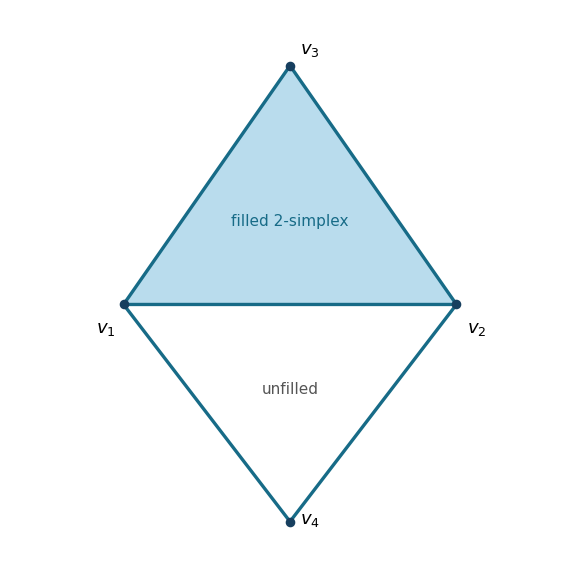
The geometric realization of a simplicial complex consists of the filled triangle together with the two extra edges and . Thus the triangle on has only its boundary:
Articles were limited to the first 100 out of 256 total.
Articles by others on the same topic
There are currently no matching articles.