The direction vectors are and . Their scalar product is . Both are nonzero, so the lines are perpendicular:
Equating Cartesian components gives , , and . Substitution of into the last equation gives , hence . Both parametrizations therefore give the intersection point
For , the components of an eigenvector are equal; for , they are opposite. Dividing each vector by its Euclidean norm givesThey are mutually orthogonal and have unit norm. The labels specify their eigenvalues even when .
Apply the cosine double-angle identity twice:This finite trigonometric sum is already the Fourier series. In increasing harmonic order, including the constant term, the first two nonzero terms are
Each component of the cross product in part (a) is independent of the coordinate with respect to which the divergence differentiates it. Thus
For a particular integral, try . Substitution gives , so . HenceThe forcing frequency differs from the homogeneous frequency, so no resonant factor of is needed.
The specified unit normal vector is , while everywhere. Thus the normal component of the field vanishes pointwise, giving flux
For real coordinates, work on . The chain rule gives and . ThereforeThe derivatives on the right are with respect to . Behaviour at requires separate regularity of the composed function.
The same chain rule gives and . Substituting these and part (a) into the partial differential equation givesThus every twice-differentiable profile gives a solution on .
Let denote singing, and denote male and female. Equal population counts give . The law of total probability therefore yields
By Bayes' theorem, provided ,If , singing has probability zero and the stated observation cannot occur in this model; that conditional probability is undefined.
Expand the vector triple product in Cartesian components. Its first component iswhere adding to both products introduces cancelling terms. Likewise the other two components areTogether these proveNow use the cyclic property of the scalar triple product and the just-proved identity:This proves Lagrange's identity in the requested form,
The sphere of centre and radius has equationLet be the distance between the centres. A nondegenerate circle of intersection of two spheres exists exactly whenThe upper inequality excludes disjoint or externally tangent spheres. The lower excludes strict containment and internal tangency. It also excludes coincident centres, which give either no intersection or an entire common sphere rather than one circle. These inequalities are sufficient because a triangle with side lengths then exists with nonzero area, and rotating its third vertex about the line of centres traces a circle.
For a point on both spheres, expand their equations:Subtracting cancels and gives the planeIts normal is parallel to the line of centres. Under the strict inequalities, the plane cuts either sphere in a genuine circle.
In spherical coordinates, is the polar angle from the positive axis and the azimuthal angle. The Jacobian determinant of the coordinate transformation gives the volume element
Height above the surface is . Integrate the density over all exterior spherical shells:Repeated integration by parts, or the substitution , givesExpand and use these moments to obtain the mass of an exponential spherical atmosphere:For , the leading term is surface area times column mass ; the other terms retain the finite-curvature corrections.
The region lies above the parabola and below the upper semicircle . Their intersections satisfy , hence with . In particular, . The region isIt is symmetric about the axis, with endpoints ; at it extends from to .
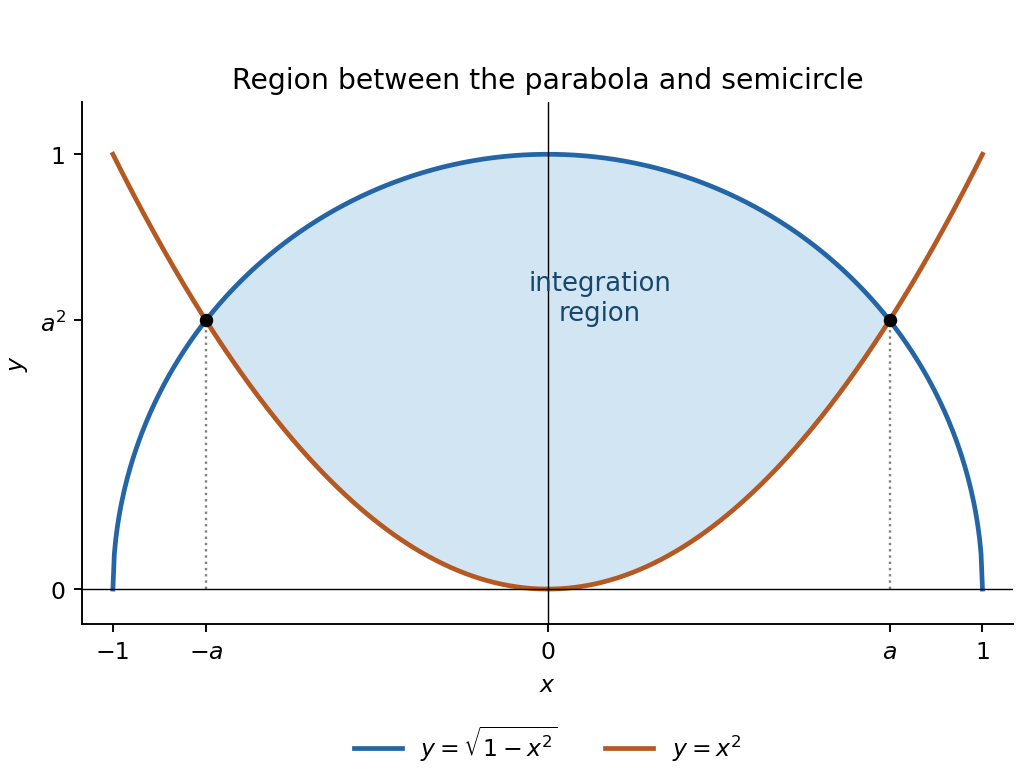

First perform the inner integral, which gives the vertical width of the region:Using givesAt the intersection, , so
Parametrize the path by , from to . For the conservative vector field , the chain rule givesIntegrating proves the fundamental theorem for line integrals:Only the endpoints matter, so the integral is independent of the connecting path.
For a twice continuously differentiable scalar potential, the curl of its gradient isEquality of mixed partial derivatives makes every component zero. ThusThis is the curl of a gradient identity.
Differentiate the components directly:Thus . The field is smooth on all of , a simply connected domain, so the zero-curl condition is sufficient for a conservative vector field. The domain condition matters: zero curl alone need not imply a global potential on a region with holes.
Evaluate the line integral along the three coordinate segments, treating coordinates not changing along a segment as constants. On the first segment, , so and the contribution is zero. On the second segment,On the final segment,The fundamental theorem for line integrals therefore givesTaking its gradient verifies each component of the field. The constant is ; the field specifies only potential differences because the gradient of every constant is zero.
For , the tangent vector is . Substitute into the field:Its scalar product with the tangent is . Hence the explicitly parametrized line integral isAs a check, the potential from part (d) has values at and at , giving the same difference.
Write for , with . Provided the relevant moments exist, the expected value and variance areThe displayed support includes zero, so these are nonnegative integer values.
Normalization of the probability mass function requiresThusThe resulting law is the Poisson distribution with parameter .
For a nonnegative integer , add the probabilities of the disjoint events with goals. The cumulative distribution function is
The zero-goal term contributes nothing to the expected value. Shift the summation index in the remaining terms:The exponential series justifies the convergent reindexing. Thus the parameter is the mean goals per game.
The intended season calculation needs the additional assumption that scores in different games are independent random variables. The printed statement gives their common one-game distribution but does not explicitly state independence; identical marginals alone do not determine season probabilities.
Under independence, each game has probability of at least one goal, soWithout independence this product is not determined by the supplied marginal distribution.
Continue with the independent-games assumption from part (i). Exactly one of the ten games must have one goal, while the other nine have zero. The ten choices of the scoring game are disjoint, so
Under independence, there are two disjoint ways to score two goals in total. One game can contain both, with probabilityAlternatively, two different games can contain one goal each, with probabilityAdding givesThis also follows from the Sum of independent Poisson random variables: the season total is Poisson with parameter , whose probability at two is .
Write the differential form as , with the coefficients as printed. A monomial integrating factor can be found from . The exactness condition givesSolving yields . Thus, on ,After multiplication, the differential form isHence the implicit solutions areThe branch was excluded by the integrating factor but satisfies the original equation and must be restored. On any graph branch with , differentiation of the boxed first integral recovers the original differential equation.
Use , so . Up to an overall minus sign, the differential form becomesSeeking a monomial integrating factor , equality of mixed derivatives givesThese give , so the integrating factor in the original variables isOne may verify exactness directly without relying on invertibility of the cosine substitution:Thus the implicit first integral isThe equivalence with the differential equation holds directly where . The zero solution is included at . At a zero of , the original graph equation requires for any finite differentiable continuation, so no extra finite graph with nonzero is created by multiplying by the vanishing factor. If one allows vertical parametrized integral curves of the differential form, is also such a curve and is already contained in the level set .
Put and differentiate the general form of Clairaut's equation:Cancellation givesFor the equation is defined only when . There are two types of smooth branch.
First, constant gives the straight-line familySecond, gives , so and . Substituting in the original equation gives its two singular envelope branches,Their derivatives are indeed , verifying the required value of . There is no finite-slope continuation of either envelope through , and no real envelope branch for .
For completeness, if “solution” requires only a continuous first derivative, one can join a line from the family to the corresponding envelope at their tangency point . The function and its first derivative match there, so such piecewise branches also solve the original first-order equation. They are not twice continuously differentiable at a nontrivial join. The lines and envelope branches above exhaust the smooth branches; allowing these tangent joins supplies the additional solutions.
Articles were limited to the first 100 out of 142 total.
Articles by others on the same topic
There are currently no matching articles.