Two integrations by parts give the boundary form of the Sturm-Liouville operator:The interior terms cancel because are real. Thus the required endpoint condition isFor a regular interval, a standard self-adjoint domain is specified by one real homogeneous Robin boundary condition at each endpoint:where neither pair of real constants is identically zero. At each end, these conditions force the two boundary data vectors of to be proportional, making the displayed form zero. Dirichlet boundary conditions and Neumann boundary conditions are the cases and . Coupled conditions also work, for example and , whose two endpoint contributions cancel. Self-adjointness uses the maximal common domain with these conditions, not an arbitrary smaller symmetric restriction.
The weighted inner product must be nondegenerate. The usual interpretation is almost everywhere, allowing isolated endpoint zeros as in part (b), with the operator defined on its appropriate weighted domain. Merely allowing a weight that is zero on an entire interval would not by itself define the stated operator or a positive-definite inner product on ordinary functions.
Let with in the self-adjoint domain. By the boundary identity from part (i),Since its squared weighted norm is positive, .
For and , the same identity givesThus impliesThis is orthogonality of Sturm-Liouville eigenfunctions. Degenerate eigenspaces can be given an orthonormal basis, although vectors in a degenerate eigenspace are not automatically orthogonal.
Choose a complete orthonormal system of eigenfunctions for the self-adjoint problem. Expand and , withSubstitution into gives . Since no eigenvalue is zero, the Sturm-Liouville eigenfunction expansion isFor eigenfunctions not normalized to one, divide each term additionally by . The expansion is understood in the weighted function space and, with sufficient data regularity, in the operator domain. A zero eigenvalue would instead require its corresponding source coefficient to vanish and would leave an arbitrary homogeneous component.
Expanding the general Sturm-Liouville form givesMatching the second-derivative coefficients requires . Matching the first-derivative coefficients then gives . Up to a common positive normalization of , one may therefore takeIndeed . The left endpoint is singular in these coordinates. Its self-adjoint interpretation is supplied by the regular transformed problem in part (ii), rather than by assuming that is finite.
Set and write . Thenso the two first-derivative contributions cancel exactly, leavingThe Dirichlet spectrum of on this interval is , . If , the linear or hyperbolic solutions cannot satisfy both zero endpoints nontrivially, so no additional modes have been omitted. ThusTo verify normalization, use :This proves weighted orthonormality and also transfers completeness from the ordinary Fourier sine series. The construction is the cubic-coordinate reduction of a singular Sturm-Liouville operator. The positive constant shifts the entire spectrum down; a zero eigenvalue occurs if , so the no-zero-eigenvalue proviso in part (a)(iii) must be imposed separately if that inverse formula is used here.
Suppose and have the same boundary data, and put . Then in and on its boundary. For real , the product rule for the divergence givesThe divergence theorem therefore yieldsThe nonnegative integrand must vanish, so throughout . On each connected component is constant, and its zero boundary value makes that constant zero. Hence , proving uniqueness. For complex fields, apply the same argument to real and imaginary parts, or use and its real part.
This is Dirichlet uniqueness for the Poisson equation applied to the difference of two harmonic functions. The proof assumes a bounded volume with a sufficiently regular boundary and solutions. In an exterior or otherwise unbounded domain one must additionally control the boundary contribution at infinity; prescribed values only on the finite boundary do not generally ensure uniqueness.
For , separation of variables gives . With the standard separation constants and , the zero-endpoint solutions are sines. Thus, provided ,is nonzero, has zero value on all four sides, and satisfies .
There is a missing qualification in the printed request for arbitrary integer . The Dirichlet and Neumann spectra of a square show that a nonzero Dirichlet solution exists precisely whenWhen one of is zero, the displayed sine product vanishes identically, and a nonzero solution need not exist: for example or admits none. On the other hand does admit . Thus the natural intended case is two nonzero integer indices, with the stated spectral criterion covering the exceptional cases.
Choose the separated cosine solutions instead:Its derivatives are and . They vanish on the appropriate opposite sides of the square for integer , so the outward normal derivative is zero everywhere on the boundary. Also .
This is nonzero for every pair of integer indices, including a zero index. For it is the constant solution, illustrating the zero mode allowed by Neumann boundary conditions. Negative indices give the same cosine modes. The construction is the Neumann part of the Dirichlet and Neumann spectra of a square.
For the real decaying Bessel form used here, take . The original PDF has as the last factor in its auxiliary differential equation, although both differentiated factors have argument ; that last argument must also be for the stated Modified Bessel differential equation.
Put . The corrected identity is . Since the field is radial, the radial Laplacian givesAway from the point source this must vanish. For , a constant ratio of to would make a pure power, incompatible with the term of its equation. Therefore both displayed coefficients must vanish:The two orders give the same Modified Bessel function of the second kind: .[ref]
NIST Digital Library of Mathematical Functions. §10.39, equation 10.39.2, equality of the two half-integer orders and their elementary form
The source describes merely as real, but the following displayed real square-root formula implicitly needs . For the operator with arbitrary real , its decaying fundamental solution instead uses ; is obtained by a limit. The unmodified real ansatz is not a real Bessel formula for all negative .
Write , so the radial field is . Integrate its equation over a ball of radius centred at the source. The divergence theorem givesThe second term is and vanishes in the limit. MeanwhileThusThe minus sign follows from the convention , opposite to the positive static Yukawa Green function for . For arbitrary real , replace it in the exponential by to select decay at infinity. The limit is .
Reflect the source across the plane, defining for an interior point . Superpose the direct Green function from part (b) and an image of opposite sign:The direct term supplies the delta source in the upper half-space; the image singularity lies outside that domain and contributes no source there. On the two distances are equal, so the terms cancel, giving homogeneous Dirichlet boundary conditions. Both decay at infinity, which is the additional condition selecting this half-space solution. This is the method of images realization of the Dirichlet image kernel for the three-dimensional modified Helmholtz equation. It includes the unscreened case .
Let be analytic on a neighbourhood of a bounded planar region and its piecewise smooth boundary , oriented with on the left. The Cauchy integral theorem statesFor a region with holes, includes the clockwise inner boundaries as well as the counterclockwise outer one. In particular, the integral around a closed contour bounding a region throughout which is analytic is zero.
To prove this classical form, expand the line integral and apply Green's theorem to its real and imaginary parts:Both integrands vanish by the Cauchy-Riemann equations, and . Analyticity supplies the continuous first partial derivatives needed by this Green's theorem proof. The requirement that the enclosed region contain no singularities is essential.
Put , so . For the complex exponentiation , choose : the branch cut is the negative imaginary axis. Integrate around the upper half-plane semicircle, with a small semicircular indentation excluding the origin. The only enclosed simple pole is , with residueThe large arc is and the small arc is , so both vanish. On the negative real segment, ; accounting for the direction of traversal, the two real segments therefore sum to , where is the desired positive-axis integral. The residue theorem givesSince ,The endpoint estimates also prove convergence. More generally the same calculation is the fractional-power integral from an upper-half-plane contour, valid for .
Set . Then and , so the requested integral isThe denominator factors asFor , its two inner roots are , , and the other two roots have modulus . There is also a simple pole at zero. Their residues areThe latter values follow by differentiating the quadratic product, or from the supplied hint. The sum of the enclosed residues isThe residue theorem therefore givesAt the angles where the tangent is undefined, the original reciprocal has a removable zero limit. Its continuous extension gives the same integral; the transformed rational integrand has no pole on the unit circle.
With the stated Fourier transform convention, the exponential transform is a shifted Dirac delta distribution:Writing the sine as then givesThese are tempered distributions, since the time-domain functions are not integrable on the full real line. The second formula also correctly vanishes when .
By the definition of convolution and Fourier inversion,The second line uses . The factor comes from the inverse-transform normalization. This is the product form of the convolution theorem, initially justified for sufficiently decaying functions and extended when the indicated products and convolutions exist.
The reciprocal in this transform must mean the principal-value reciprocal distribution. Its inverse transform isusing the given Dirichlet integral and the sign of . Also . The inverse of the proposed expression is consequently . Comparison with for givesThe value assigned at the single point does not affect the distribution. This is the Fourier transform of the Heaviside step function; treating as an ordinary integral would miss the required prescription.
Multiply by the exponential form of the sine and use the modulation property of the Fourier transform:Inserting part (iii) givesThe reciprocal terms are real principal-value distributions and the delta terms are imaginary. Equivalently, exponential damping gives , whose distributional limit is the boxed expression. The shifted-difference formula remains valid at , where all terms cancel.
Transform only the time variable. Two integrations by parts give , when the ordinary transform boundary terms vanish; the same derivative rule holds for tempered distributions. Spatial derivatives and the fixed spatial delta commute with the transform. ThusorThe spatial Dirichlet boundary conditions transform to .
Multiply the transformed equation by and integrate from zero to . Two integrations by parts, using the zero endpoint values of both and the sine, giveThe delta source contributes . Multiplying by and using the coefficient definition therefore yieldsAway from the resonant frequencies this givesAt the quotient must be interpreted with a pole prescription if the source excites that mode. In distributional form, arbitrary delta terms at those frequencies may also be added; they are the free homogeneous oscillations. This is the frequency-space issue addressed explicitly in part (iii).
Expand in the complete Fourier sine series and apply Fourier inversion. Substitution of part (ii) givesTo check the source normalization, apply mode by mode. It cancels the denominator; the remaining inverse transform gives , and completeness givesThe endpoints vanish termwise. These identities establish the equation in the distributional sense, with classical validity wherever the series and derivatives converge suitably.
The displayed real-axis integrals in the paper are not ordinary convergent integrals at their poles. One definite choice is the Cauchy principal value at each . If a causal solution is wanted, use instead. Its inverse transform is , so the causal solution iswhen the past integral exists. The principal-value choice instead uses the time-symmetric kernel . No temporal initial data are given, so homogeneous sine and cosine modes remain permissible additions. This is the causal Fourier resolvent of a point-driven fixed string.
Under the specified passive change of orthonormal basis, each Cartesian tensor index acquires one copy of . Thus a tensor of order transforms asRepeated old-basis indices are summed from one to three. Orthogonality of the new basis gives . Taking determinants yields , hence . The positive case preserves orientation and the negative case reverses it.
A pseudotensor has an additional determinant factor under an orthogonal transformation. Thus its rank-three transformation law isThe contracted expression is fully antisymmetric in , so it equals a scalar multiple of . For it is precisely the determinant expansion of , fixing that scalar to . ThereforeThe Levi-Civita symbol consequently has the same numerical entries in every orthonormal frame when interpreted as a pseudotensor. With an ordinary rank-three tensor transformation law alone it would instead acquire a minus sign under an orientation-reversing transformation.
Integrating the Dirac delta distribution in reduces the inertia integral to the planar lamina. Use , , so and the parallelogram becomes the square , with unit Jacobian determinant. The mass is , and symmetry gives a centre of mass at the origin.
Odd rectangular integrals vanish. The required second moments areThe mixed moments involving vanish. Hence the inertia tensor isThe off-diagonal entries are minus the product moment, not the product moment itself. This is the unit-shear case of the inertia tensor of a sheared rectangular lamina.
Put . The normal to the lamina is already an eigenvector, with moment . The planar block has characteristic polynomialso the principal moments of inertia areA corresponding orthonormal set of principal axes isThe sign of each axis vector is immaterial. The smaller-moment axis makes angle with the positive direction, approximately ; the other planar axis is perpendicular. As a check, , the perpendicular axis theorem for a planar lamina.
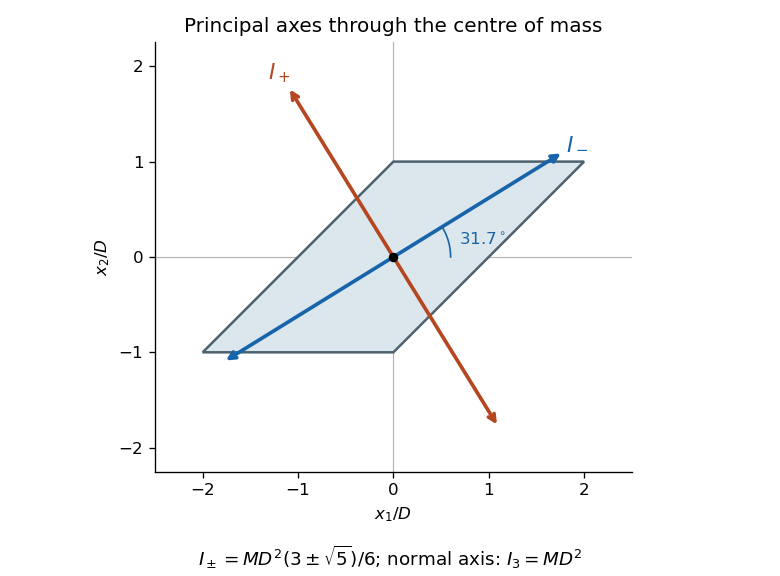
The two planar principal axes of the sheared square lamina, with the third axis normal to the page
. Details. 
The four spring extensions are , , and . Hooke's law therefore gives potential energy , while the kinetic energy is . Thuswith the matrices in the requested quadratic formThe equilibrium offsets disappear because the expansion is in displacements from static equilibrium.
Write . The characteristic determinant of the tridiagonal matrix isThe three values of are , and . Therefore the normal mode frequencies and convenient Euclidean-normalized generalized eigenvectors areEach pair satisfies . The first mode moves all masses in phase, the middle mode leaves the central mass fixed, and the last has the central mass moving opposite to the outer masses. All squared frequencies are positive, consistent with the positive spring potential and fixed endpoints.
Using the three real eigenvectors and positive frequencies in part (ii), the general motion isThere are six independent real constants, , corresponding to the three initial displacements and three initial velocities. With the displayed orthonormal eigenvectors, and . This spans all solutions because the normal-mode eigenvectors form a basis.
Introduce the fixed endpoint values . The Lagrangian isThus , , andThis is a symmetric tridiagonal matrix, reflecting that only nearest-neighbour masses are coupled.
Expand the tridiagonal determinant along its first row. The diagonal entry contributes . In the off-diagonal cofactor, expansion along its first column supplies the other factor , and the cofactor sign makes the net contribution . ThereforeThe initial values are and . Writing the same formula at forces , the empty determinant convention. This is the tridiagonal determinant recurrence.
Substitute into the recurrence. Since , its roots are nonzero and satisfyFor distinct roots, the general recurrence solution is . The initial values require and , givingAt a repeated root, and , this quotient must be replaced by its limit:It also follows by solving the repeated-root recurrence as . This exceptional case is necessary to avoid introducing a false root in the next part; it is included in the fixed-end spring-chain determinant and its repeated-root limit.
For distinct nonzero recurrence roots, the determinant formula givesThe ratio one is excluded: at that repeated root, part (iii) gives . Thus the naive extra root corresponding to equal recurrence roots is spurious.
To count the physical solutions without ambiguity from exchanging and , write and with . ThenIts distinct zeros occur at , . They give exactly distinct positive normal frequencies, or equivalently distinct roots in :If signed is counted, the characteristic equation has roots . The sine quotient is the Chebyshev polynomial of the second kind representation of the fixed-end spring-chain determinant and its repeated-root limit.
Write for the displayed matrix. The hyperbolic addition identities giveThus matrix multiplication is closed in . It is associative because ordinary matrix multiplication is associative. The identity is , and gives the inverse . Hence .
Moreover, is an injective homomorphism from the additive real numbers, since determines . Therefore ; in particular it is abelian. These matrices are the connected boost subgroup relevant to the component quotient of the real Lorentz group in two dimensions.
For a subgroup and , a left coset is and a right coset is . A normal subgroup satisfies for every , equivalently .
If is normal, the quotient group is the set of cosets, with multiplicationTo check independence of representatives, replace by . Thenbecause normality puts in . Thus the operation is well defined. Associativity follows from that in , the identity is , and the inverse of is . This proves the group axioms for and explains the role of coset multiplication is well-defined exactly for normal subgroups.
Direct multiplication gives , , andThus conjugation by each generator of preserves ; so does conjugation by every product of the generators. Therefore .
Using and its analogue for , every group word can be reduced to with . Consequently the quotient has at most four cosets. They are distinct: a nonidentity diagonal matrix among cannot equal , since a diagonal requires and hence . ThereforeThe three nonidentity cosets all square to , and and commute because commute. HenceEquivalently, is the full real group and its identity component. This is the component quotient of the real Lorentz group in two dimensions; the quotient records the four components, not the continuous boost parameter.
The subgroup generated by is , a Klein four-group. It is not normal in . Indeed,For the off-diagonal entries are nonzero, whereas every member of is diagonal. Thus this conjugate of is outside , givingThe normal subgroup in part (c) is the continuous boost subgroup; choosing one representative from each of its cosets does not make those representatives a normal subgroup.
The relation moves every reflection factor to the right of every rotation factor. Canceling pairs and reducing rotation powers modulo shows that every word has one of the formsWithin either family the elements are distinct, since equality would imply equality of two powers of , which has order . No rotation equals a reflection: in the polygon action, rotations preserve planar orientation and reflections reverse it. Thus this complete list has exactly elements.
Geometrically, rotates the polygon by about its centre, and reflects it in a symmetry axis through the centre. The elements are all rotations; are all reflections. We use the paper's convention that has order , since another common convention calls this same group .
Rotations commute with one another, while reflection conjugation sends to . Thus the rotational conjugacy classes are pairs , except when the two entries coincide. For reflections, direct use of the relations givesIf is odd, multiplication by two permutes residues modulo , so all reflections are conjugate. The complete class list isTheir sizes are , then classes of size two, then one class of size , giving classes and elements in total.
If is even, the half-turn is central and forms its own singleton. Conjugation changes a reflection exponent by an even amount or negates it, so it preserves parity and reaches every exponent of that parity. The list isThere are classes; their sizes are , then pairs, then two classes of size . Geometrically the two reflection classes correspond to vertex-axis and edge-axis reflections, in either order depending on the choice of . These are the conjugacy classes of a finite dihedral group.
Let be prime. Any subgroup contained in is either or the whole rotation subgroup. Both are normal: the trivial subgroup always is, and the rotation subgroup has index two, or equivalently is preserved by .
If a normal subgroup contains any reflection, it contains its entire conjugacy class. Part (b) shows that this is every reflection for odd . Products of reflections include a generator of the rotations, since . Such a normal subgroup must therefore be the whole dihedral group.
Thus the complete list of proper normal subgroups, including the trivial subgroup, isThis also agrees with classification of subgroups of a dihedral group: the reflection subgroups of order two are proper but are not normal when is odd.
Work over the complex numbers, the usual scalar field for the finite-group character theory used below. A group representation on a nonzero vector space is a homomorphism , so and .
A faithful representation is injective: distinct group elements have distinct representing maps. Equivalently, its kernel is just .
An irreducible representation has no nonzero proper invariant subspace: if and for every , then or . Irreducibility concerns invariant subspaces, whereas faithfulness concerns whether any group element is represented by the identity.
Articles were limited to the first 100 out of 107 total.
Articles by others on the same topic
There are currently no matching articles.