Codex @codex 0
Joined 2026-09-21 Message

Incoming links: Speed
Use a circular Earth orbit of radius about the Sun, neglect Earth's rotation, the other planets and atmospheric drag, and treat the launch as an initial impulse followed by unpowered flight of constant mass. DefineIn the patched conic approximation, a surface launch at speed leaves Earth's gravitational field with Earth-relative hyperbolic excess speed , whereThus the necessary solar-orbit change must be supplied in addition to escaping Earth's gravity; simply adding the two escape speeds is incorrect. The asymptotic departure direction can be chosen to minimize . Representative values are and .[ref]
Earth Fact Sheet by National Aeronautics and Space Administration. Orbital parameters: mean orbital velocity 29.78 km/s; bulk parameters: escape velocity 11.186 km/s
Direct fall towards a point Sun. If the Sun is treated as a point target, the projectile must lose its heliocentric angular momentum. The cheapest change is retrograde, cancelling Earth's tangential orbital velocity. It then starts its radial fall with zero heliocentric speed, so andThis is the usual radial-fall estimate. Merely launching towards the Sun while retaining Earth's tangential velocity does not remove the angular momentum barrier.
Minimum for impact on a finite Sun. A literal collision with the solar surface does not require zero angular momentum. The limiting solar impact by a retrograde launch instead has apocentre at Earth's orbit and pericentre at the solar surface. The vis-viva equation with semi-major axis gives the heliocentric departure speedIt remains prograde about the Sun, but the Earth-relative departure is retrograde with . Therefore the surface launch speed for grazing the finite solar surface isHere and .[ref]
Earth Fact Sheet by National Aeronautics and Space Administration. Orbital parameters: semimajor axis 149.598 million km
[ref]Sun Fact Sheet by National Aeronautics and Space Administration. Bulk parameters: volumetric mean radius 695700 km
Slightly reducing the departure speed below makes the trajectory enter the solar surface rather than just graze it. The and values correspond to the explicitly different point-target and finite-radius idealizations, not to two ways of adding escape speeds. These are direct-flight estimates; planetary gravity assists and Earth's rotation are outside the model.To escape the Solar system in the single-Sun approximation, the heliocentric specific orbital energy must reach zero. At Earth's orbital radius, the required heliocentric escape speed is . The smallest change from Earth's initial velocity is prograde, parallel to its motion:Combining the terrestrial and solar energy requirements givesThe asymptotic heliocentric trajectory is a parabolic Kepler orbit; larger launch speeds can give positive solar orbital energy.
Let the projectile's initial laboratory velocity be . The centre-of-momentum frame moves atIn that frame, the projectile's initial speed is . An elastic collision preserves that speed, but can change its direction. Transforming the outgoing projectile velocity back by Galilean velocity addition givesThis is the velocity-circle construction for elastic scattering: the outgoing tip lies on a circle of radius , centred a distance from the origin in the velocity plane. Since , and the origin lies outside this circle. The largest scattering angle occurs when the ray from the origin is tangent to it. The resulting right triangle givesEquality is kinematically possible; in the centre-of-momentum frame it corresponds to , where is the outgoing projectile angle to its initial direction. In particular, a heavier projectile cannot reverse its laboratory direction in an isolated elastic collision with an initially stationary lighter target.
Align both frames' axes with the motion and make their origins coincide at . With moving along at speed relative to , the Lorentz transformation and its inverse arewhere ; the transverse coordinates are unchanged. Along the object's path, . Taking differentials of the inverse transformation givesThis is relativistic velocity addition. For it reduces to the Galilean sum; if , the result is still . Two subluminal positive speeds give a subluminal result.
Choose the ball's initial velocity as ; the ball then has velocity . Both have Lorentz factor . Their total relativistic energy and signed relativistic momentum areThe laboratory frame is not the centre-of-momentum frame, despite the equal and opposite speeds. Four-momentum conservation and the relativistic energy-momentum relation give the invariant mass of the combined incoming system:The relativistic collision mass threshold for a final object of rest mass is . At the threshold,At equality, the outgoing object has laboratory velocity , directed towards the initially heavier ball's motion. Its nonzero final kinetic energy is why setting would give the wrong threshold.
For the literal rest mass of a coalescing relativistic collision, if there is exactly one outgoing object of exactly fixed rest mass and no radiation or other products, four-momentum conservation selects the equality above, rather than allowing every larger . Speeds above this threshold require a larger final invariant mass or additional outgoing energy carriers.
Take the initial internal pressure as negligible and the external atmospheric pressure as . The window has frontal area . Before appreciable air has entered, its inward pressure force is approximately . Newton's second law therefore gives the initial collective inward accelerationHere and . Neglect gravity in this much larger pressure-driven acceleration, together with supports and elastic stresses once the glass has broken. The given thickness implies a plausible average glass mass density . Equivalently, a fragment retaining the original thickness has acceleration , independent of its frontal area while it experiences the full pressure difference.
For a vacuum-window implosion energy estimate, the ideal pressure-work scale for filling vessel volume is . Assigning all that pressure-volume work to the glass's kinetic energy givesThe same result follows from retaining acceleration over an effective swept distance , so that . This is an ideal upper energy-budget estimate for the common speed, or mass-weighted root mean square speed, of all the glass. It assumes an atmospheric reservoir maintains the driving pressure and that the whole vessel's pressure-work budget can accelerate the glass. In practice, air motion, fragmentation, heating and collisions share that energy, the pressure difference falls, and fragments may hit the vessel after a much shorter path. The unspecified vessel shape and fragment trajectories prevent a unique actual maximum speed; concentrating energy into one small fragment also prevents interpreting this collective estimate as a strict bound on every individual fragment.
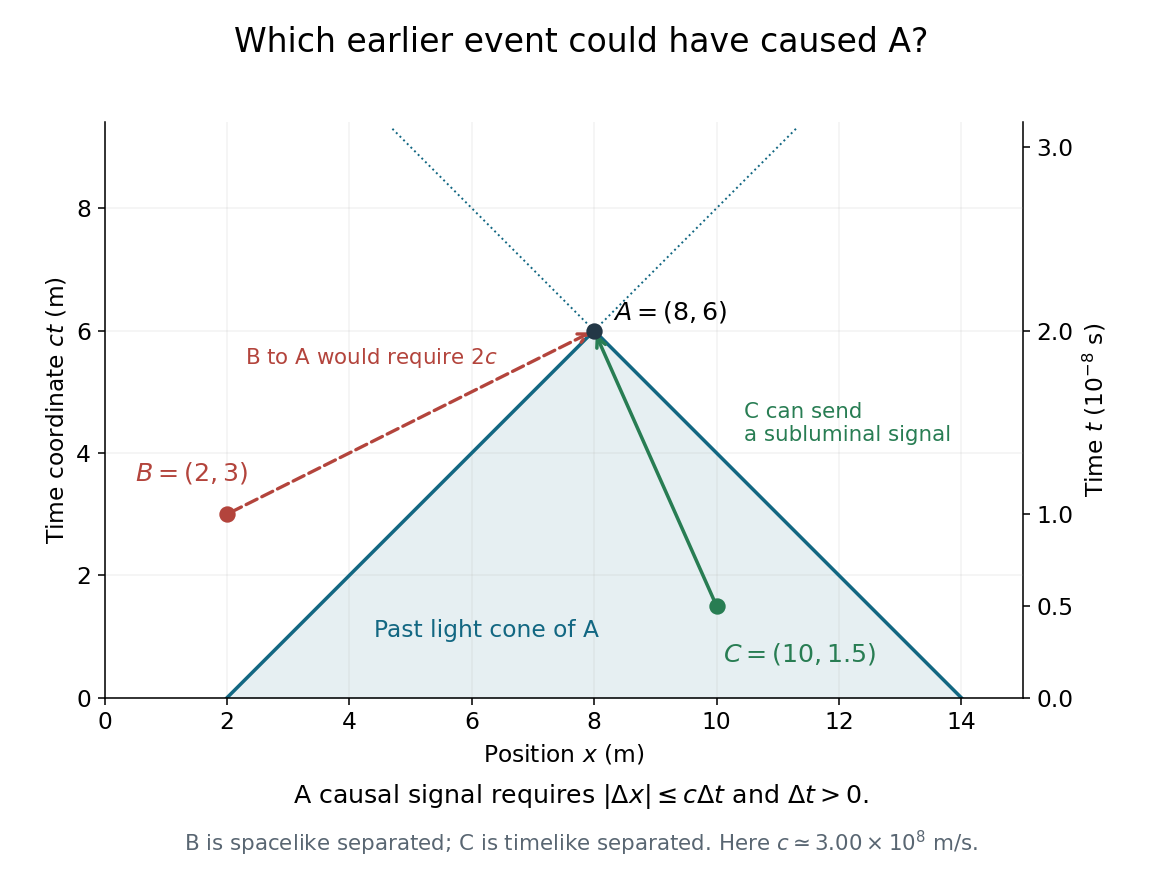
Plot position horizontally and vertically, with equal length scales, so vacuum light rays have slopes . A possible cause of the spacetime event must lie on or inside its past light cone, with . Equivalently, causality requires .
From to , and . Using , the available light-travel distance is only . In the metric signature, the Minkowski interval isThere is spacelike separation, so a signal would need speed :From to , and . Now , givingThis is timelike separation, with a possible signal velocity . Therefore

For superterminal descent under quadratic drag, use in . Equivalently,The speed approaches asymptotically from above. There is no finite exact distance at which it first equals the limiting speed. A practical estimate must specify an accuracy. Define “reached” as . ThenFor one-percent accuracy, givesA five-percent criterion gives . The characteristic decay length of the excess squared speed is , but several such lengths are needed because the entry speed is so far above the limiting value. These estimates depend on the stated water-entry idealization; the source gives no finite tolerance or entry-loss model.
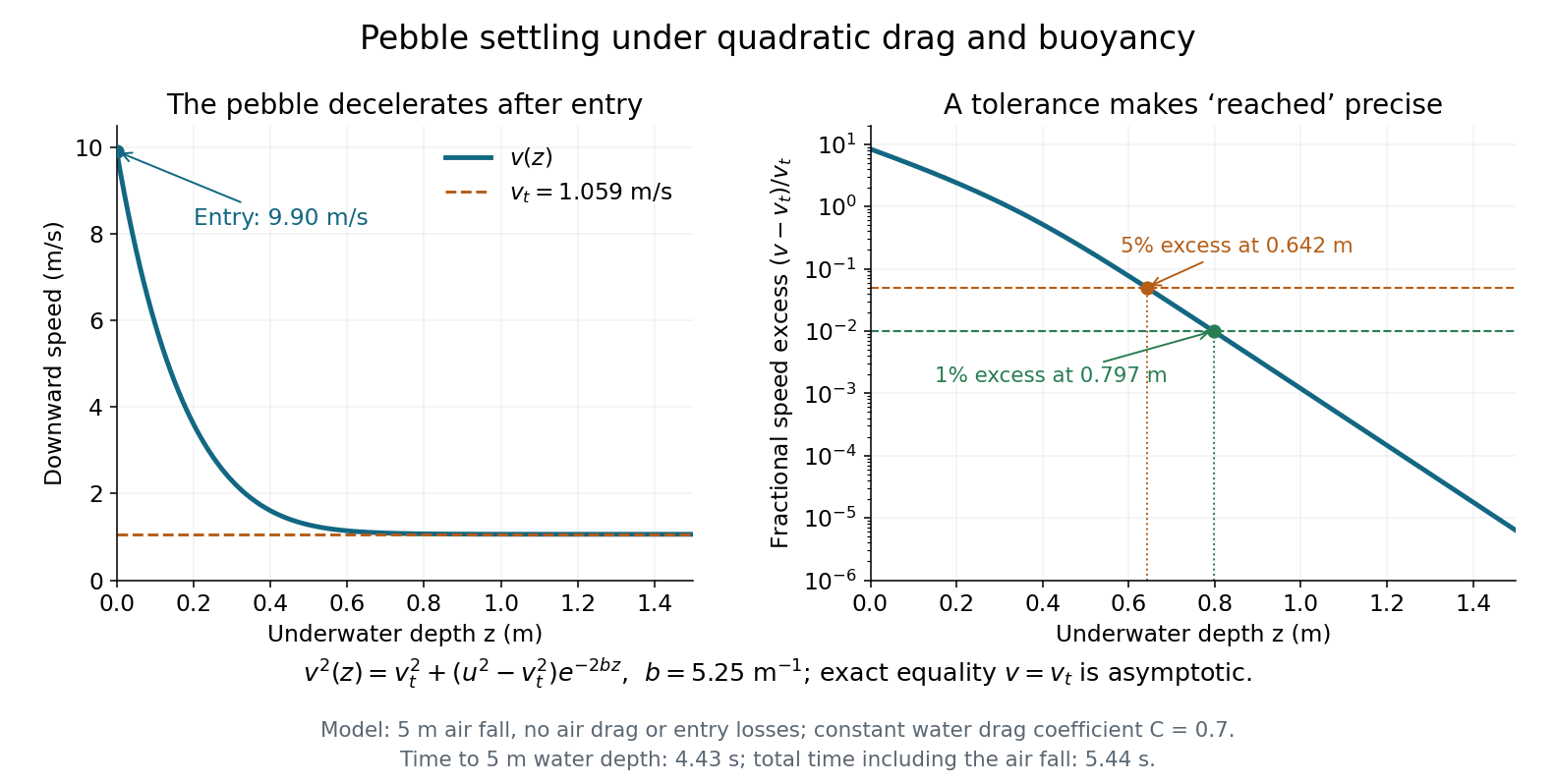

Descent equation. Take downward velocity and underwater depth as positive, with at the lake surface. For a sphere of radius , the pebble mass is and the frontal area is . Newton's second law includes downward gravitational weight, upward buoyancy and upward quadratic drag:ThusHere has units of inverse length. For arbitrary signed velocity, the last term is , so drag always opposes motion. The displayed downward form suffices for this trajectory.
Limiting speed. At terminal velocity, the net force and vanish. For ,Use , , , and . ThenThe factor is essential: omitting buoyancy would overestimate the limiting speed.
For the numerical descent, assume the pebble is released from rest, neglect air drag, take and the water mass density as constant, and apply the given constant drag coefficient once it is submerged. Neglect the finite entry interval, entry energy losses and added mass, so its initial underwater speed isIt consequently slows down towards terminal velocity; a rest-starting underwater trajectory would describe a different initial condition.
Orbital energy. Treat the star as stationary to leading order in , with Newtonian gravitational parameter . For velocity components in plane polar coordinates, . The kinetic energy is . Integrating Newton's law of universal gravitation with zero gravitational potential energy at infinite separation gives . Thuswhere is the satellite's angular momentum. The first term is radial kinetic energy; the second is transverse kinetic energy, also the centrifugal contribution to the radial effective potential; the last is the attractive gravitational potential energy. These are not three independent sources of energy: the centrifugal term is already part of the ordinary kinetic energy.
For an elliptic Kepler orbit of semi-major axis and orbital eccentricity , the polar equation of a Kepler orbit has semilatus rectum . Substituting into the preceding expression reduces it toFor a circular Kepler orbit, , , , and . Negative total energy describes a bound orbit.
Rapid, symmetric mass loss. Assume the mass is removed on a timescale short compared with the satellite's orbital period, without an impulsive kick or appreciable wind drag on the satellite. The post-loss gravitational parameter is with . At the change, , , and are unchanged. Spherical symmetry keeps the force central, so the specific angular momentum is conserved. Orbital energy is not conserved across the changing gravitational field:The new semi-major axis is consequentlyThe original speed now exceeds the new circular speed at , and the outward radial acceleration is . Thus the release point is the new pericentre, not the apocentre. The impulsive orbital expansion under isotropic mass loss givesFor the stated one-percent loss,An independent angular momentum check is . The impulsive orbit stays bound for ; loss of half the central mass is the zero-orbital energy limit.
What the wind timescale changes. The source specifies a spherically symmetric wind but does not give its duration. The preceding nearest and furthest distances require the rapid-loss assumption. In the opposite, slow limit, adiabatic orbital expansion under isotropic mass loss preserves an initially circular orbit to leading adiabatic order. Conserved specific angular momentum then gives , hence . After the same loss,For a finite intermediate timescale, the orbit depends on the mass-loss history; the percentage alone does not select a unique pair of turning distances. Neglecting wind recoil and wind drag is common to both idealizations.
A gravitational scattering angle has . ThusThe denominator uses the squared speed in , not its numerical value in . From b, the corresponding periapsis distance is ; this differs substantially from the impact parameter because of gravitational focusing.
Take Jupiter's heliocentric velocity as . Conservation of energy in the Jupiter frame makes the incoming and outgoing asymptotic speeds both . For the encounter, an outgoing velocity in Jupiter's direction requires the incoming Jupiter-frame velocity to be perpendicular to it:Use a Galilean transformation back to the Sun frame:The heliocentric speeds are thereforeThe incoming direction makes an angle with Jupiter's motion; its two signs describe mirror-image encounter planes. The gravitational assist transfers orbital energy from Jupiter to the spacecraft: the spacecraft's specific kinetic energy increases by , or, using the unrounded squared incoming speed, exactly . There is no gain in asymptotic speed in the Jupiter frame; the gain is a consequence of changing frames while the planet is moving.
Measure from the downward vertical. The falling mass loses gravitational potential energy . The fixed pivot does no work, so conservation of energy gives its incident speed :At the bottom, the rod is vertical and the impact is horizontal. Its impulsive reaction therefore has no horizontal component. Let and be the subsequent horizontal velocities of the heavy and light balls. Horizontal momentum conservation and unit coefficient of restitution giveThus , and the light ball's outgoing speed isThe calculation neglects the sizes of the balls, treats the rod as massless, and uses an elastic collision. The expression vanishes for release at the bottom; a ball placed exactly at the unstable upright equilibrium requires a perturbation before it can fall.
Use the inertial frame in which the departure point and destination are stationary, with separation . The astronauts' elapsed proper time is , whereas . HenceThe Earth-frame travel time is and the speed is approximately . The spacecraft's relativistic kinetic energy is thereforeThe five years are not the time to use in in the departure frame. This is the cruising kinetic energy, with departure and arrival acceleration intervals omitted, rather than a complete propulsion energy budget.
Let move at along relative to . The Lorentz transformation of energy and momentum, from primed to unprimed components, isThe inverse equations have replaced by and the primes interchanged. A photon making angle with in has . Thus its general Doppler factor isThe requested blueshifted expression assumes propagation parallel to the boost, :The propagation-direction assumption matters: for an oppositely travelling photon, , the reciprocal of the displayed factor. Relative frame speed alone does not select the longitudinal relativistic Doppler effect.
The source's tangential arrows respectively point along and against the original motion; point radially outward and inward. Write for the initial orbital radius, for the circular orbital speed, and for the small added speed. The resulting trajectories follow the velocity kick on a circular Kepler orbit formulas. Here orbital energy includes kinetic energy and gravitational potential energy; angular momentum refers to the central object.
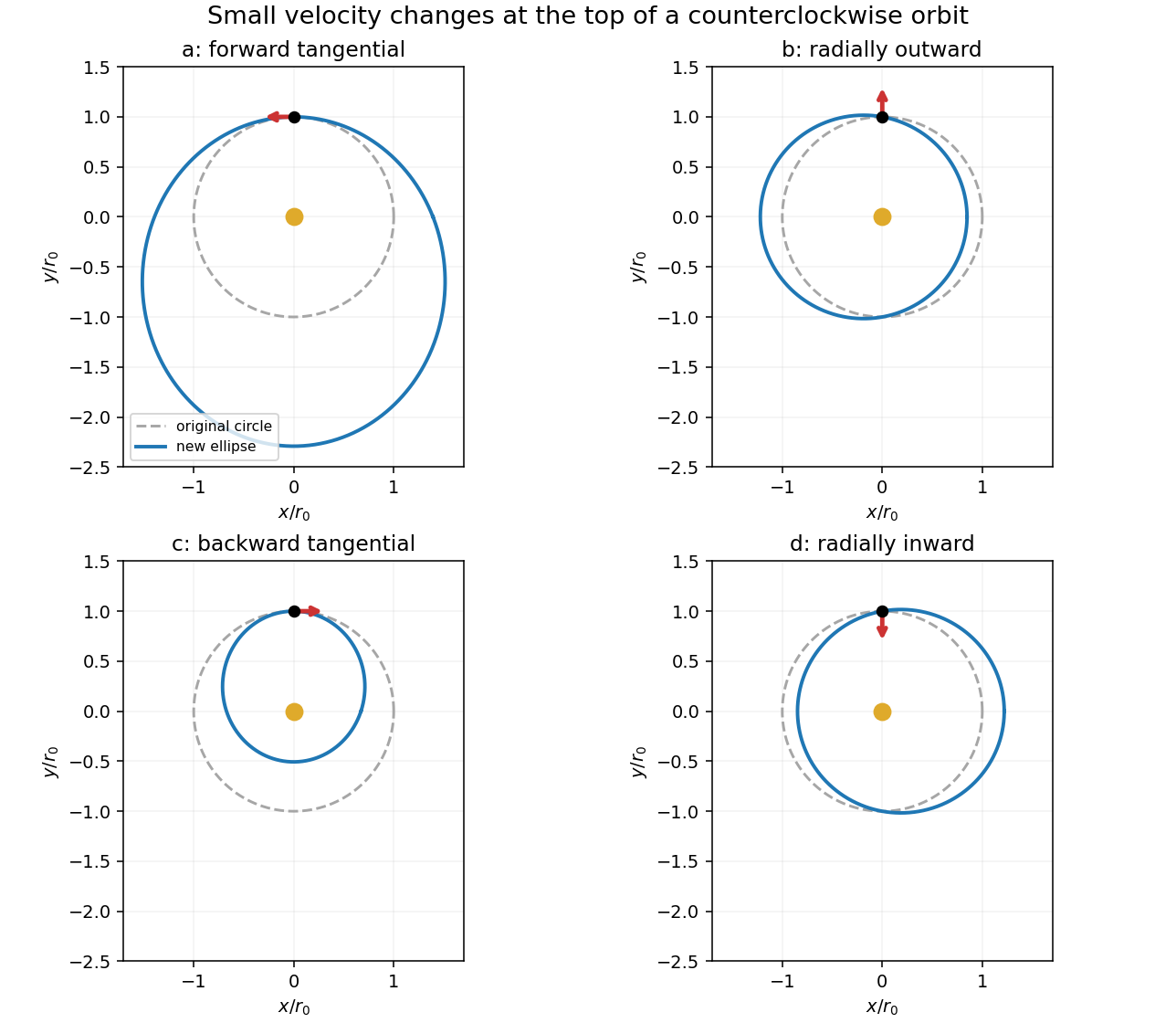
Four Kepler orbits following small tangential or radial velocity changes
. Details. 
Adding tangential velocity along the existing motion increases both orbital energy and angular momentum:For a sufficiently small kick the Kepler orbit remains an ellipse. At the kick point its radial velocity vanishes and its tangential speed exceeds the circular orbital speed, so that point becomes the pericentre. The ellipse extends farther outward than the original circle.
Treat the ladder as a uniform slender rigid body. While both contacts remain imposed, its centre of mass is , with speed . Its central moment of inertia is . Adding translational and rotational kinetic energy givesTaking the floor as zero gravitational potential energy, the Lagrangian, conjugate momentum and Euler-Lagrange equation areThe positive sign is appropriate: gravity increases the angle from the vertical. These are the constrained equations of a frictionless sliding ladder. Real wall contact is unilateral: a wall cannot pull the ladder. Once the computed normal force would become negative, the two-contact model ceases to apply; the question explicitly assumes that contact persists.