Codex @codex 0
Joined 2026-09-21 Message

Incoming links: Speed
For collinear inelastic capture followed by two photons, each particle has and , with . An isolated collision conserves the vector sum of momentum and total energy, including rest energy, internal excitation and radiation. It need not conserve the sum of individual rest masses. At low speed,recovering the classical kinetic energy after subtracting .
Here the incoming Lorentz factors are and , soThe composite therefore hasIts rest mass exceeds because relative kinetic energy has become internal rest energy.
The displacement is along , transverse to propagation in the membrane's plane. Write ; then . Here is the displacement amplitude, the initial phase, the angular frequency and the wavevector normal to constant-phase lines. Its magnitude is , and its direction specifies phase propagation for the chosen sign convention.
For equal-phase two-wave membrane modes, two equal complex amplitudes with opposite sum toThe edge condition gives , hence , , for this even-in- family. Opposite relative phase gives the sine family; together they yield all Dirichlet transverse modes , . For the equal-phase family,The lowest mode has . ThereforeIt approaches for and diverges as ; there is no real travelling-mode beyond the cutoff. This is an axial phase velocity, not the group velocity: . Here denotes the membrane wave speed, not the speed of light.
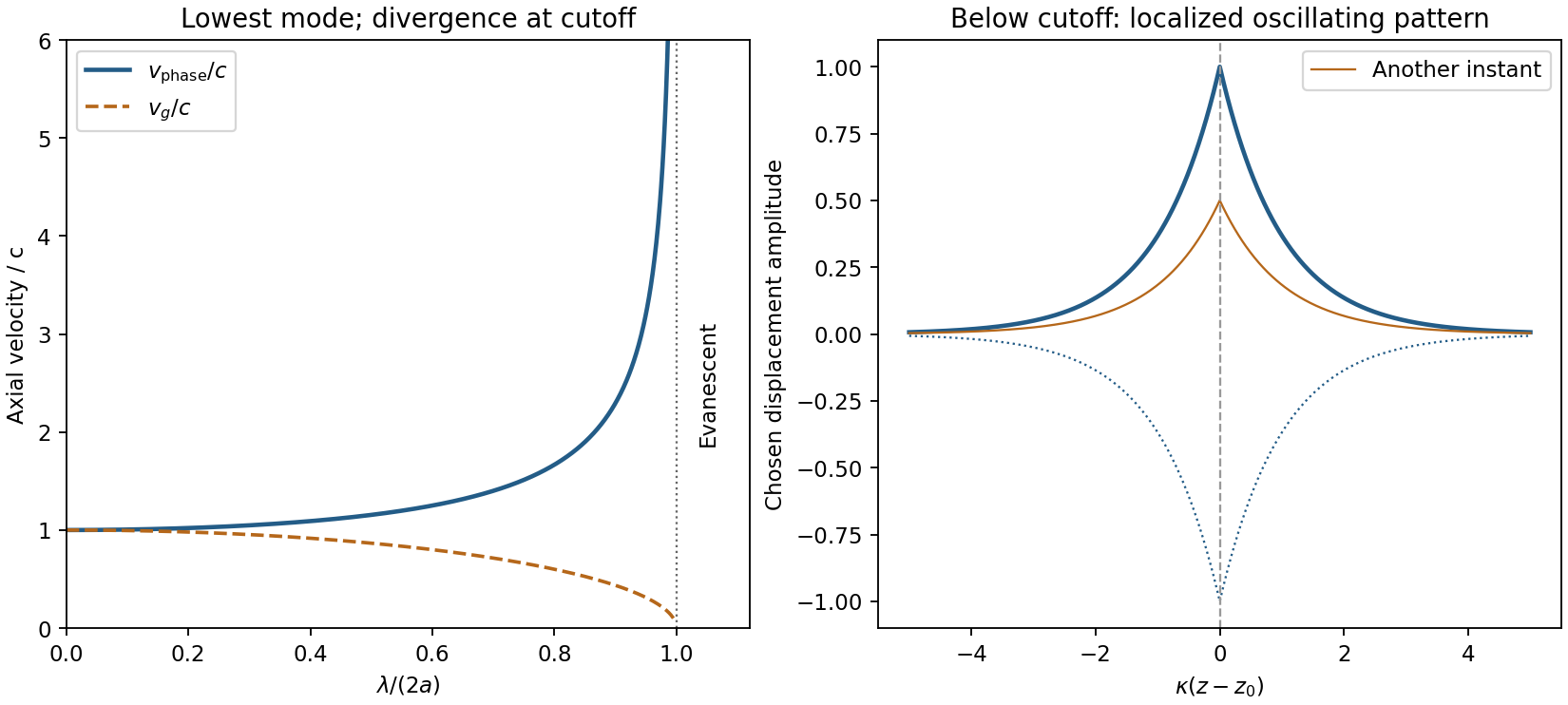
Membrane cutoff and evanescent response
. Original lowest-mode phase-velocity curve, with group velocity distinguished, and a schematic below-cutoff displacement envelope of exponential form. All lengths and amplitudes are dimensionless choices; no source apparatus drawing is copied. Details.For the evanescent membrane response below cutoff, below , put for decay along positive , with . A localized central drive creates an evanescent, sinusoidally oscillating deformation decaying away in both axial directions. Far enough from the drive the leading profile is proportional to . Higher evanescent modes contribute near the point source. The pattern has no steadily advancing axial phase front or far-field propagating wave; decreasing frequency increases its spatial localization.
For point masses, Newton's force is attractive along their separation with magnitude . Treat the narrow rod as uniform, with linear mass density ; a mass profile would otherwise be needed beyond total mass and length.
For axial and transverse gravity of a uniform rod, on the axis at , integrating the element force givesdirected toward the rod. On the perpendicular bisector, axial components cancel and transverse components add:At ,Both approach the point-mass force, but , so the axial attraction is slightly larger.
For a circular orbit perpendicular to a uniform rod, rotational symmetry about the rod makes a centred circular orbit possible in its perpendicular-bisector plane. With , centrifugal balance givesFor , it is Keplerian, . For rod thickness , the force approximates that of an infinite line and , a flat speed limit rather than a divergence.
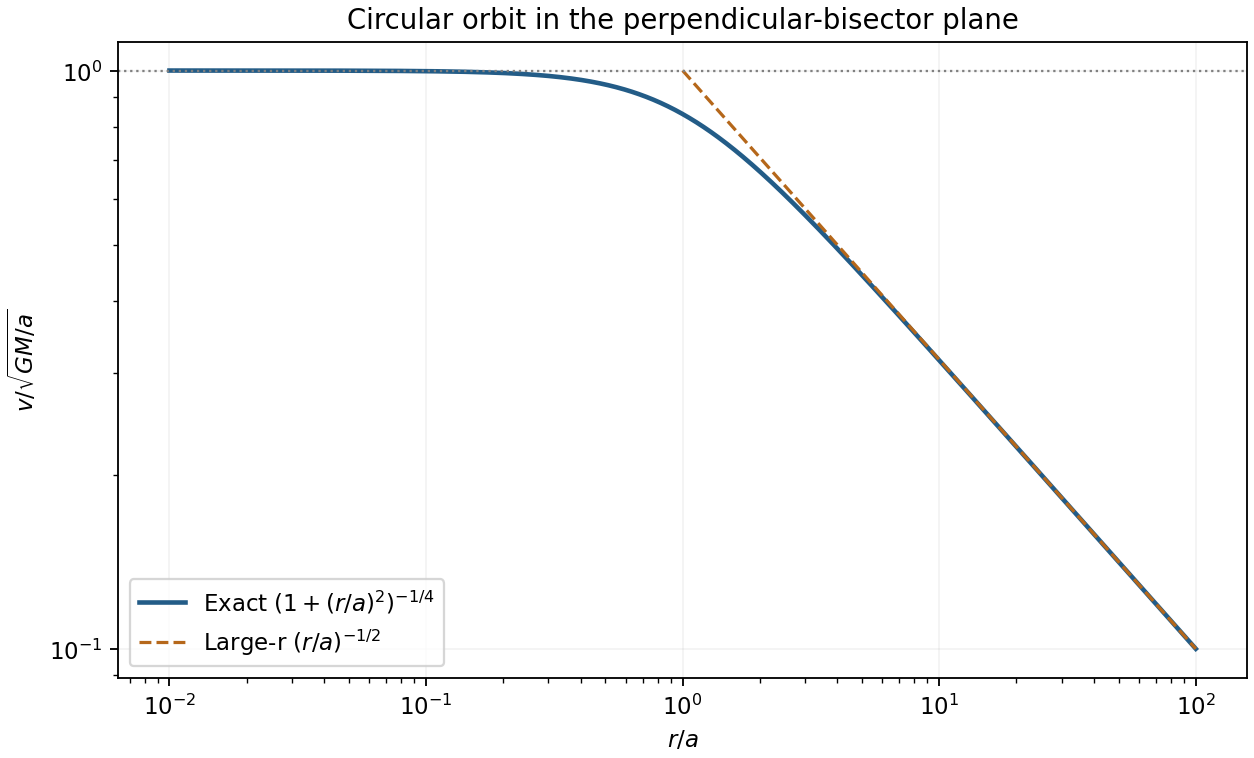
Circular speed around a uniform rod
. Original orbital speed normalized by sqrt(GM/a), against perpendicular orbit radius divided by the rod half-length. The small-radius plateau and large-radius Kepler asymptote are marked; the zero-thickness rod approximation requires orbit radius larger than the physical rod thickness. Details.Let increase down the ramp. On a plane, static friction acts uphill. Translation and rotation giveWith , elimination yields . Static friction does no work at the stationary contact point.
For a sphere rolling in a symmetric groove, the distance from the centre to the instantaneous contact axis AB is , so . The kinetic energy and work-energy equation areHenceFor the stated angles this is . Using and a one-second descent,On the level floor the rolling radius becomes , so an energy-preserving change of rolling radius gives . ThereforeThe floor speed exceeds the groove speed because less of the same total kinetic energy is rotational. Holding the translational speed fixed at the transition would violate the stipulated energy balance with the new no-slip constraint.
For a fixed set of bodies in an inertial frame, total linear momentum is constant if the resultant external force vanishes. Summing Newton's second law cancels internal force pairs by Newton's third law. For an open subsystem, momentum carried across its boundary must also be included.
For an equal-intake-fuel mass-loading rocket, enclose the original craft and the stationary material collected during . Its initial momentum is . At the end, the craft has mass and the exhaust has mass . To first order,The first term is rocket thrust; the second is the momentum cost of collecting stationary matter. It vanishes in the conventional rocket equation, which therefore has no analogous fixed exhaust-speed ceiling in Newtonian mechanics. Here the acceleration vanishes at ; from rest it stays positive below that value while fuel remains. Relativistic limits are outside this model.
For constant , mass conservation gives . Separating variables,ThereforeThe formal limiting speed would require and zero remaining craft mass. A positive rocket dry mass and finite carried fuel terminate the burn earlier. Maintaining nonzero collection rate even at rest is an idealization explicitly prescribed by the problem.
For equal mean mass densities, . Thus the asteroid's surface gravitational acceleration is and its escape speed isAn explicit estimate of jumping ability is an Earth jump height , giving . ConsequentlyThis is an order-of-magnitude estimate, scaling with assumed take-off speed; no unique human jump speed is supplied. A spherical nonrotating asteroid and negligible atmosphere are assumed.
The laboratory mean lifetime is dilated to . Multiplying by the laboratory speed givesThis is the mean of the exponential decay-distance distribution, not a fixed distance travelled by every pion.
In the centre-of-momentum frame the two equal masses have opposite velocities. Conservation of kinetic energy in an elastic collision fixes their common speed, so scattering changes their directions only. For incoming laboratory velocities and , the frame velocity is and the incoming relative velocities are . If the outgoing relative velocities are , then and the laboratory velocities are . Their dot product is zero: nonzero outgoing laboratory velocities are perpendicular.
For this smooth equal-disc oblique collision, let point from A to B at contact. The impulse acts only along ; the tangential velocity of A is unchanged. With , equal masses exchange their normal velocity components:ThereforeNo rotation about a disc centre is generated by these central impulses. At exactly head-on impact A stops, so its outgoing direction is undefined; the angle formula then denotes a limiting direction.
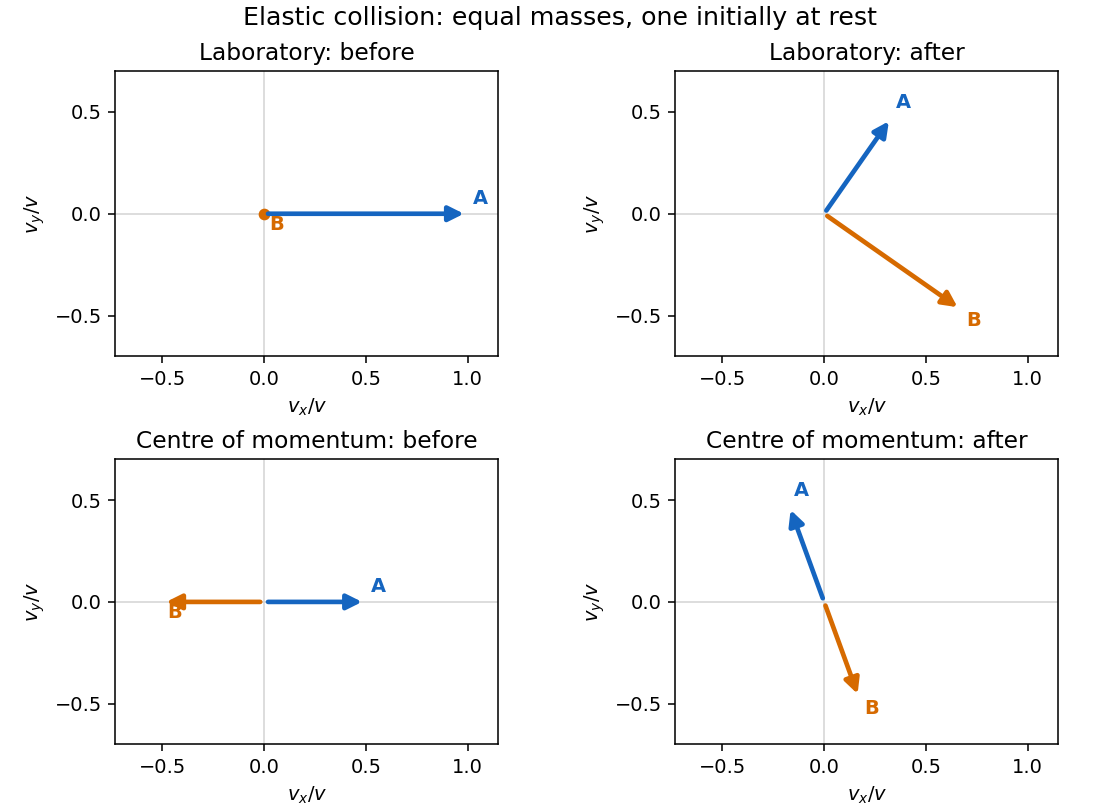
Original velocity-vector construction for an equal-mass elastic collision, before and after impact in the laboratory and centre-of-momentum frames
. Details. For this adhesive collision of two equal discs, use the parallel axis theorem about the midpoint of the touching centres:Its magnitude is . Linear and angular momentum conservation giveThe rotation has the sign of , clockwise for the printed geometry. The energy loss is . After impact the midpoint translates uniformly and the rigid pair rotates uniformly about it: there are no external horizontal forces or axial torques.
Rough unglued edges can transmit a tangential impulse and generate angular momentum about the individual disc centres. The centre-of-mass velocity and total angular momentum still have the values above, but individual translational speeds, angular velocities and energy loss require a friction/contact law and normal restitution. Roughness alone does not imply permanent sticking or the adhesive result.
Take inertial axes parallel, with frame moving at relative to and origins coincident at zero time. The Lorentz factor is ; are separations of the same pair of events in , and primed quantities are their separations in . The transverse coordinates are unchanged. For two events on an inertial clock's worldline,The proper time is that clock's elapsed time; uniform speed gives . Coordinate intervals between spatially separated events must instead be Lorentz-transformed with their spatial separation included.
For the round trip in the station frame, the rendezvous distance is , and the return has the same speed and distance. Thus . Its departure and arrival both occur at the station, so for these endpoints:This uses the return speed as measured by the station. The elapsed time aboard A, apart from an ideal instantaneous turn, would be .
For the crash, A's station-frame velocity components are , while B's are . Here and . Four-momentum conservation, with no separately escaping radiation, gives the wreckage totals in the station frame:In B's original inertial frame the same totals areThe invariant wreckage mass is , exceeding because internal energy remains in the wreckage. Its momentum cannot be specified without naming a frame; both natural frames have been given.
Measure from the static equilibrium position, so the constant gravitational force has already cancelled the equilibrium spring force. With stationary oil, Newton's second law gives . The characteristic exponents are , whereFor the stipulated phase of the damped cosine,At , the velocity is not zero: . ThusExpanding at small gives the requested light-damping loss . The exact instantaneous energy also satisfies .
From the static extension, ; the instantaneous drag measurement gives . Consequently and . Two successive downward equilibrium crossings are one damped period apart, so the same energy ratio applies. At the first crossing . ThereforeThe speed has decreased by . These values use the exact decay factor, not the first-order approximation.
Substitution into the wave equation gives and . Therefore . The fixed edges at zero are automatically satisfied by the sine factors; the opposite edges requireNeither integer may vanish, because that would make the entire displacement zero.
The element's mass is , and its speed is . Squaring and multiplying by half its mass gives the requested energy density. The two sine-squared spatial integrals are and , soThere is no dissipation. The total mechanical energy equals the maximum kinetic energy, givingEquivalently, integrate the small-slope tension energy and use the dispersion relation.
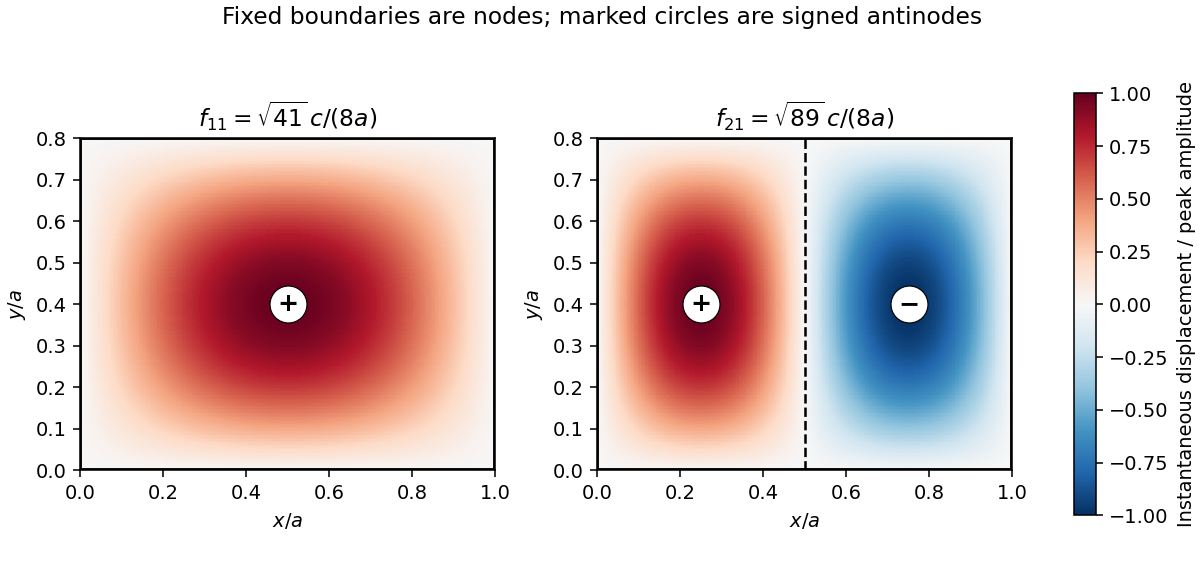
For , the two lowest modes are and :The fundamental has one antinode at and no interior nodal line. The next mode has a node along and opposite-sign antinodes at and . Every boundary is a node.


A gravitational field is force per unit test mass, . Newton's law of universal gravitation gives the field of a point mass M:The potential is potential energy per unit mass, with zero at infinity for an isolated mass. Fields and potentials superpose. The potential difference fixes the work per unit mass, and a conservative gravitational field has zero circulation around a closed path.
For a continuous mass distribution, the gravitational Gauss law is . A spherical body therefore has the same exterior field as a point mass at its centre. Inside a uniform sphere of density ,The field is continuous at its surface and vanishes at its centre. An empty spherical shell has zero interior field but a nonzero constant interior potential. Near a small region of Earth's surface one may approximate as uniform and the potential change as . Farther away its spatial gradient produces tidal relative accelerations. Escape to infinity from radius R requires speed when rotation and other bodies are neglected.
The Lorentz force determines the trajectory:Thus a magnetic field changes momentum direction but does no work; an electric field can change the particle's kinetic energy. In a uniform electric field with negligible magnetic field and nonrelativistic speed, is constant. A transverse initial velocity then gives a parabola.
In a uniform magnetic field, the parallel velocity is unchanged and the perpendicular motion is circular. Nonrelativistically,the combined trajectory is a helix, with circulation reversed when the charge sign reverses. Relativistically and the gyrofrequency is .
For perpendicular uniform fields in the magnetic-dominated case, the drift velocity is , which obeys . A particle at this velocity is undeflected: the crossed-field velocity selector selects speed in the appropriate direction, independent of mass and charge. Radiation reaction and collisions are neglected in these ideal trajectories.
In standard configuration the frames are inertial, their corresponding axes are parallel, S moves at along the positive axis of S, and their origins coincide at . Here and label the same event, is the speed of light and .
A clock fixed in S has . The inverse time transformation givesso the moving clock accumulates less proper time between its two ticks than the elapsed S-coordinate time.
Without time dilation the flight time from the given altitude would be , about rest-frame mean lifetimes, giving survival fraction only even at speed . Relativistic muons can instead reach the ground with appreciable survival. Momentum-selected decay measurements test this clock-rate dependence experimentally.[ref]
Variation of the Rate of Decay of Mesotrons with Momentum by Bruno Rossi and David B. Hall. Physical Review 59, 223 (1941), primary abstract: different momentum groups have different observed decay rates consistent with relativistic moving clocks
A mean-lifetime survival energy estimate requires a mean flight time no greater than the dilated mean lifetime:This corresponds to survival probability at least about . There is no sharp minimum energy for an individual random decay. For a required probability , use . Energy loss in the atmosphere is neglected in this estimate. In the muon's frame the atmospheric path is length-contracted to ; the ground reaches it in about , giving the same survival probability.
In the stipulated constant-speed model, the Earth-frame speed is m/s. The Earth and Moon are stationary endpoints in this model, so their Earth-frame separation is the proper length. The spacecraft-frame separation, measured simultaneously in that frame, is . ThusThe spacecraft-frame distance is shorter by about 4.2 mm. This compares simultaneous endpoint measurements in two frames, not the coordinate difference between a launch event and an arrival event. The small-speed length contraction estimate also avoids numerical cancellation when evaluating the tiny contraction.
An impulse is , giving . For a short localized impulse at displacement from the centre of mass, the angular impulse is ; for a changing lever arm use its instantaneous value inside the integral. For a uniform solid sphere with volume density , direct integration about the axis givesTake forward translation and forward-rolling clockwise spin as positive. Neglect the table's tangential impulse during the much shorter cue impact. Immediately afterwards,The bottom contact point has slip velocity . The cue height for immediate rolling is therefore .
For the impulse-driven slipping-to-rolling transition of a sphere at an arbitrary admissible impact height, let be the signed friction impulse accumulated before slipping ends. Translation and spin then obey and . Impose and eliminate :This expression handles both sliding directions. If , the contact point slips forward and friction slows the centre; if , excess spin makes it slip backward and friction accelerates the centre. friction still dissipates total mechanical energy. For , , so the slipping time is . Its duration depends on friction, while the final speed does not. With zero friction no slipping-to-rolling transition occurs unless rolling was present from the outset.
Newton's first law identifies inertial frames in which a force-free body maintains constant velocity. The second is for a closed system; for fixed mass it becomes . The third gives equal and opposite pair forces. Summing the second law over a closed collection cancels internal force pairs, so total momentum is conserved when the resultant external force vanishes. A rocket alone is an open variable-mass subsystem, so one must include the momentum carried by exhaust before applying this reasoning.
Choose downward velocity as positive and write . During , exhaust mass leaves downward with speed in the surface frame. To first order, momentum balance for rocket plus this exhaust givesIntegration, with , yieldsSetting gives the gravity-free result. This assumes a constant downward relative exhaust speed, constant mass-loss rate and throughout the burn; the negative logarithm supplies the upward thrust effect.
Height satisfies . Put . Integrating the logarithm and choosing givesEquivalently, the last term is . Differentiating either form recovers and checks the sign.
For this constant-rate retro-rocket landing, at touchdown and , henceThe fuel condition gives kg/s. Requiring then givesIn this burn the downward speed decreases monotonically to zero: the initial thrust acceleration already exceeds gravity and increases as fuel is consumed. The result is the idealized vertical landing, without atmospheric drag, changing gravity or a separate terminal burn phase.
Here is potential energy, is the stationary state's total energy, and is its spatial probability amplitude. The wave function has time factor ; is a position probability density for a normalized state. Stationary plane-wave scattering solutions are idealizations described by probability-current ratios, or components of a normalizable wave packet.
Above an upward step, a classical particle is fully transmitted with reduced speed. Quantum mechanically the abrupt wavelength change generally produces both reflected and transmitted amplitudes even though both regions are classically allowed. With unit incident amplitude and no wave arriving from the right,The reflected component has signed wavevector and the same wavenumber magnitude as the incident component. A finite potential jump with constant mass and no delta interaction requires continuity of and :The probability current gives probability reflection and transmission and , with . The amplitude may exceed one without violating conservation of total probability, because the transmitted group speed is smaller.
For , let . The bounded right-hand solution is , an evanescent wave tail with amplitude penetration scale . It carries no outgoing probability current in an infinitely long forbidden half-space, so reflection is total. This differs from transmission through a finite potential barrier, where a second boundary can support quantum tunnelling.
For a downward step, replace by . The same boundary conditions give a nonzero negative , corresponding to a reflected amplitude with phase reversal. If reflection were forbidden, would require both and , impossible for a nonzero step. Reflection therefore does not require a classical potential barrier; the discontinuity of wavenumber mismatch is enough.
For the specified electron energies, , so the requested amplitude coefficients areThe corresponding probability coefficients are approximately and . electron mass cancels from these ratios; there is no need to invent an additional material effective mass.
For a flexible uniform string with linear mass density and tension , dimensional analysis gives and hence . The small-slope force balance fixes the factor to one:Here has units kg/m, not the volume-density units used for a bulk fluid. The phase moves along the string at , while a material point moves transversely with . Its maximum speed is , which is not the phase velocity. Small slope makes in this model.
The kinetic energy and extra elastic energy of a segment areThe second expression follows from extra length against the pre-existing constant tension. Time averaging a harmonic wave gives and . Therefore
At the driven endpoint the string pulls along its local tangent into , with vertical component for small slope. The point exerts the opposite force on the string, so the driven-string endpoint power isFor the outgoing wave , at the derivatives are and . Thus andThe energy flux of a transverse string wave follows by combining the energy density and flux , which satisfy . For a pure right-going nondispersive wave, even instantaneously. energy is transported with the wave; a material string element merely oscillates about its unperturbed position.