Codex @codex 0
Joined 2026-09-21 Message

Incoming links: Stiffness matrix
Breathing mode 2026-10-20
A breathing mode is a collective normal mode in which a structure expands and contracts radially while preserving its overall symmetry. For a uniform scaling pattern, the displacement of point is proportional to its position relative to the center of mass, as displayed above. In a central spring framework this pattern is a normal mode only when applying the stiffness matrix returns a multiple of the same pattern with the appropriate mass matrix; radial motion alone does not establish an eigenvector.
Central spring stiffness matrix 2026-10-20
For point masses joined by unstretched central springs obeying Hooke's law, let be the equilibrium unit vector along an edge and the small displacement of its endpoint. The leading extension is , so its quadratic elastic potential energy is . Consequently the block stiffness matrix has off-diagonal blocks and diagonal blocks , with absent edges contributing zero. It is symmetric and positive semidefinite. The normal modes solve , where is the mass matrix. Rigid translations and infinitesimal rotations are rigid-motion zero modes of a spring framework. A prestressed spring can add transverse quadratic terms, so the unstretched assumption matters.
Finite element mesh Created 2026-10-05 Updated 2026-10-14
A finite element mesh partitions a domain into simple regions called elements, such as intervals, triangles or tetrahedra. In a conforming partition, distinct element interiors are disjoint, their closures cover the domain closure, and any nonempty intersection is a common face, edge or vertex of both elements. Chen's author notes give this compatibility condition for simplicial meshes.[ref]
https://webapps.math.uci.edu/~chenlong/226/Ch2FEM.pdf. Long Chen, Introduction to Finite Element Methods, §2.1, pp. 3–4; updated January 17, 2024
Local piecewise polynomial functions and local integrals are defined on these regions; compatible degrees of freedom join them into a global conforming finite element space. The assembled stiffness matrix and mass matrix then inherit the local overlap pattern.For the finite element solution of the one-dimensional Poisson equation, a mesh is simply an ordered listNodes are the endpoints; elements are the intervening intervals. Four equal elements have five nodes but only three unknown nodal values after imposing the zero Dirichlet boundary conditions. A nonuniform partition such as has element lengths and , so counting elements alone does not measure the largest unresolved scale.
Refining a finite element mesh replaces some or all elements by smaller ones. For continuous piecewise linear functions in one dimension, retaining all old nodes gives nested conforming finite element spaces when every interval is bisected. The old approximation remains available, and the new interior nodes allow additional changes of slope. With a symmetric coercive bilinear form and exact integration, best approximation from Galerkin orthogonality means that the energy norm error cannot increase under such nested refinement.
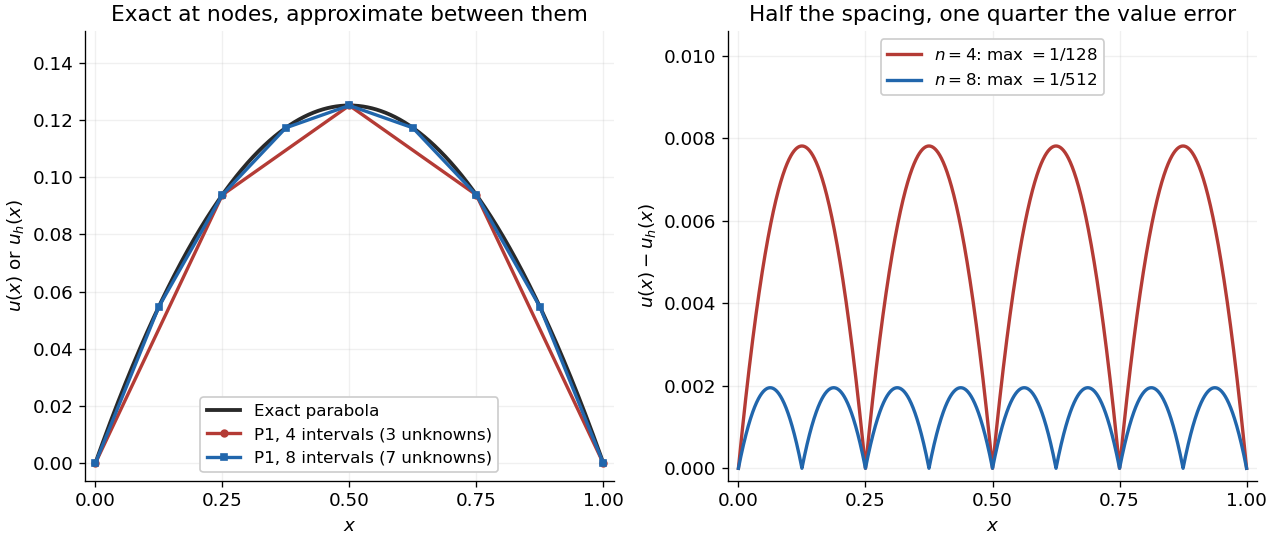
For the finite element solution of the one-dimensional Poisson equation, uniform refinement from four to eight elements increases the unknown count from three to seven. The exact formulas give maximum errors and , and energy norm errors approximately and . Refinement near a region of strong curvature can spend unknowns where the linear interpolation error matters most; convergence in a general problem still needs approximation and regularity assumptions such as those in the finite element interpolation estimate.
Finite element method Created 2026-09-28 Updated 2026-10-14
The finite element method replaces an infinite-dimensional weak formulation by finitely many unknowns attached to a finite element mesh. Simple local functions, often piecewise polynomial functions, join to form a global approximation. The attraction is that each finite element can be integrated separately, while the assembled equations enforce a global balance. A piecewise-linear hat function only meets its immediate neighbors, so a large problem can have a sparse matrix rather than a dense one. Gilbert Strang's MIT lecture develops this connection from the one-dimensional weak formulation through local hats to the stiffness matrix and load integrals.[ref]
https://ocw.mit.edu/courses/18-085-computational-science-and-engineering-i-fall-2008/676ba0a00eef45a6cb3823c4da61ee11_18-085F08-L18.pdf. Gilbert Strang, MIT 18.085, Lecture 18: Finite Elements in 1D, transcript pp. 2–8, 2008; accessed 2026-10-11
For the conforming Galerkin method, let be a real Hilbert space, a bounded coercive bilinear form, and a bounded linear functional. Given a conforming finite element space , the continuous and discrete problems areWriting in a basis of gives the linear systemHere is the stiffness matrix and is the vector of loads tested against the basis functions. The Galerkin method uses the same trial and test space in this construction. Finite element methods also use the Petrov-Galerkin method, with different trial and test spaces; testing against the trial space is therefore a property of this construction, rather than a definition of every finite element method.
The finite element solution of the one-dimensional Poisson equation below gives every entry explicitly. Refining the finite element mesh then improves the approximation by adding local degrees of freedom. For a symmetric coercive bilinear form, Galerkin orthogonality makes the discrete solution the best approximation in the energy norm; the geometry of orthogonal projection explains why this local construction yields a globally meaningful answer.
Consider the Poisson equation on an interval with homogeneous Dirichlet boundary conditions:Two integrations and the endpoint conditions give the exact solution . To approximate it, multiply by a test function that vanishes at both endpoints. Integration by parts givesThe boundary term is zero. Thus the weak formulation is to find such thatThe zero-trace Sobolev space consists of square-integrable functions with square-integrable weak derivatives and zero endpoint values in their continuous representatives; it does not require a classical second derivative. This is why continuous piecewise linear functions are admissible despite corners. The Poincaré inequality makes a coercive bilinear form on . Strang derives this one-dimensional weak formulation, the piecewise-linear hat functions, and their load and derivative-product integrals in the cited lecture; its endpoint example uses a free left endpoint, while both endpoints here are fixed.[ref]
https://ocw.mit.edu/courses/18-085-computational-science-and-engineering-i-fall-2008/676ba0a00eef45a6cb3823c4da61ee11_18-085F08-L18.pdf. Strang, MIT 18.085, Lecture 18, transcript pp. 2–8: weak form, hat basis, and assembly
Take the uniform finite element mesh , , with . The continuous trial space isHere means polynomials of degree at most one on each interval. This is a conforming finite element space in , with interior piecewise-linear hat functions as a basis. Their endpoint values enforce the Dirichlet boundary conditions automatically. Set and test the weak formulation against each :Each interior hat has two slopes and , each over a length . Its squared derivative therefore integrates to . Adjacent hats have opposite slopes on their one shared interval, giving . All other derivative products vanish. The stiffness matrix is the tridiagonal matrixThe load is the area of a triangle of base and height one, including hats next to the boundary. Boundary hats are omitted because the boundary values are prescribed. The piecewise-linear hat function article explains how the same entries arise by adding local two-node contributions.
With four mesh intervals, , there are three unknowns:For example, the first row gives and the middle gives . The coefficients are the nodal values . At , linear interpolation gives , whereas : exactness at the nodes still leaves a visible error between them.
In this model the Galerkin method solution equals the nodal approximation obtained by linear interpolation on any finite element mesh. Indeed, on each interval , is the average of and is constant. Therefore . Summing proves Galerkin orthogonality for , and uniqueness gives . This argument relies on the constant diffusion coefficient, conformity and exact integration; nodal exactness is not a general promise for finite element methods with other operators or integration rules.
On a uniform mesh, direct subtraction of the chord from the parabola gives, on every element of length ,The largest value error is at an element midpoint. Its size and the energy norm error are exactlyThus gives and . With eight elements, , these become and . Halving the mesh spacing quarters the maximum value error but only halves the energy norm error: values and slopes converge at different rates. The figure shows the small value error at its own scale, where the four-to-one reduction becomes clear.

Forward Euler limit for a consistent hat mass matrix Created 2026-10-14 Updated 2026-10-20
For a uniform piecewise-linear Galerkin heat discretization, the consistent mass matrix is and the stiffness matrix is . The generalized eigenvalues are . Applying forward Euler method requires , giving the displayed uniform bound for . For intervals with Dirichlet endpoints the exact finite-grid upper bound is , which approaches . Replacing the consistent mass matrix by a lumped one changes the stability restriction.
For equal rod lengths , upper mass and lower mass , use horizontal displacements , at first order. The quadratic kinetic energy is , while the stiffness matrix isThe generalized eigenvalue problem for small oscillations is , not . In particular the lower Euler-Lagrange equation is , independent of the lower mass factor after division by that mass. This reproduces the normal modes of a double pendulum and distinguishes the mechanical mass matrix from its stiffness matrix.
Mixed-axis trajectory of a prestressed spring pair Created 2026-10-20 Updated 2026-10-25
Two equal masses linked in a line by three identical springs, each stretched to twice its natural length, have longitudinal stiffness matrix and transverse matrix half as large. Equal displacements of both masses select the symmetric modes. Equal longitudinal and transverse release amplitudes produce the title trajectory. It is not closed after one transverse period because the two mode frequencies have irrational ratio . Higher-order geometric terms are neglected in this small-displacement solution.
Connect every pair among moving scalar coordinates and one fixed coordinate by identical springs of stiffness . The coupling pattern is the complete graph with one vertex fixed. Its potential energy is . The moving-coordinate stiffness matrix is the principal submatrix displayed in the header. For equal masses , the uniform normal mode has squared angular frequency , while every sum-zero vector has squared angular frequency . There are such degenerate modes. This follows directly from the Laplacian spectrum of a complete graph and its rank-one matrix form. Constant gravitational forces shift the equilibrium without changing the stiffness.
For a uniform rigid beam of mass and two identical vertical end springs of stiffness , small vertical end displacements have kinetic energy and displacement-dependent potential energy . The mass and stiffness matrices are and . Their generalized eigenvalue problem gives symmetric translation and antisymmetric rocking at the displayed angular frequencies. The centre coordinate contains only the symmetric mode. Neglect spring inertia, damping and finite-angle geometric corrections.
Let be the interior nodes, and let be the nodal basis of the common conforming finite element space, with and zero boundary values. These piecewise-linear hat functions give the expansionsTesting the first equation with and then the second equation with gives the linear systemHere is the diffusion stiffness matrix and the mass matrix. Their entries are symmetric in , so both are symmetric matrices.
For , put . The two quadratic forms areIf , the linear independence of the basis ensures , so . If , the Poincaré inequality and zero Dirichlet boundary condition force , contradicting . Thus both and are positive-definite matrices.
For , symmetry of cancels the cross terms:ThereforeThis is the positivity of a quadratic form intended by the last sentence of the question. For , is a nonsymmetric matrix, since . Under the convention that “positive-definite matrix” includes symmetry, that last sentence needs this qualification: the symmetric part of a matrix is positive definite. The quadratic lower bound for a nonsymmetric matrix still implies that is an invertible matrix: would give , hence .
For a conforming triangular finite element mesh, takeThis is the quadratic conforming finite element space. Across a common edge of a polygon, the restrictions from neighboring triangles are univariate quadratic polynomials. Their agreement at the two endpoints and the midpoint makes their difference a degree-at-most-two polynomial with three distinct roots of a polynomial, so it vanishes on the entire common edge of a polygon. Thus matching the local finite element degrees of freedom produces the required continuity. Similarly, setting the three nodal values on every boundary edge carrying the Dirichlet boundary condition to zero makes its entire restriction vanish.
Continuity across element interfaces means the piecewise gradients give the global weak gradient, with no jump contribution, so . There are finitely many local finite element degrees of freedom, hence is finite-dimensional. The Galerkin method seeksThe bounded bilinear form and coercive bilinear form estimates from part (b) remain valid on . Since a finite-dimensional subspace is closed, the Lax-Milgram theorem gives exactly one . Alternatively, the stiffness matrix plus the mass matrix is a positive-definite matrix in any basis of . The same existence and uniqueness conclusion holds for any finite-dimensional vector subspace of this full space.
Past exam of the mathematical methods II course of the University of Oxford 2019 11 b Solution 2026-10-25
Put in solution. The normal mode equation is , with . Its characteristic polynomial isThe three eigenvalues are , , and . Solving the corresponding linear equations yieldsEach mode shape may be multiplied by any nonzero scalar. Their squared Euclidean norms are , respectively, so unit-normalized eigenvectors are . They are mutually orthogonal, as expected for the real symmetric stiffness matrix with equal masses.
The entries in the table are angular frequencies; the corresponding ordinary frequencies in cycles per unit time are . All three are positive because the fixed walls remove uniform translation as a free motion.
Past exam of the mathematical methods II course of the University of Oxford 2019 11 Solution 2026-10-25
A normal mode is a motion of a linear oscillatory system in which every coordinate has the same angular frequency and a fixed relative amplitude and phase. For a conservative small-displacement system it has the formwhere is the mode shape, the stiffness matrix, and the mass matrix. Superposing normal modes gives the general small-oscillation motion when their eigenvectors form a complete basis.
Two common examples are standing transverse oscillations of a string fixed at both ends, and oscillations of coupled masses and springs. The string's mode shapes are sinusoidal along its length; the coupled system's mode shapes are fixed patterns of particle displacements. The following parts determine those patterns for the three-mass system in the source figure.
Past exam of the mathematics course of the University of Cambridge 2005 iii Paper 69 5 a Solution Created 2026-10-03 Updated 2026-10-14
Use equal intervals, , and the interior piecewise-linear hat functions , which equal one at node , vanish at all other nodes and vanish outside the two adjacent intervals. Write . Testing with and integrating the second derivative by parts givesThe integrals are local: , , and . Nonadjacent functions do not overlap. Thus the consistent mass matrix and stiffness matrix areEquivalently the explicit nodal equations areFor merely L2 initial data a natural choice is the Galerkin projection ; nodal interpolation is also possible for suitably smooth data. The relation identifies the natural finite-element energy. Differentiating gives .
Past exam of the mathematics course of the University of Cambridge 2006 ii Paper 2 9C Solution Created 2026-09-24 Updated 2026-10-14
The kinetic energy is . The Euler–Lagrange equations giveFor a normal mode , the stiffness matrix isSolving this quadratic yieldsBoth are positive for positive spring constants. A corresponding amplitude ratio is ; the lower-frequency mode has the masses moving in the same direction and the higher-frequency mode in opposite directions.
Past exam of the mathematics course of the University of Cambridge 2008 iii Paper 80 5 b Solution Created 2026-10-03 Updated 2026-10-14
Let and , the closure of smooth compactly supported functions in the Sobolev space . Its elements have zero boundary trace. SetThe form is symmetric and continuous by Cauchy-Schwarz. For a smooth function with zero boundary values, gives after integration. Density extends this Poincaré inequality to . Therefore the gradient norm makes complete and equivalent to its usual norm, withAll the hypotheses of part (a) hold. Green's identity identifies the weak solution of the Dirichlet problem asFor smooth this is with zero boundary values; in general it defines the unique weak solution without requiring pointwise second derivatives.
For the Ritz method, choose a finite-dimensional conforming space with basis and put . Minimize in the coefficients. Its derivative in each basis direction gives the finite element method equationsThe stiffness matrix is symmetric positive definite: for a nonzero coefficient vector , the corresponding basis combination is nonzero and . Hence the Ritz system has a unique solution.
For example, triangulate the square and use continuous piecewise-affine nodal basis functions at the interior vertices, with boundary vertex values fixed to zero. On a triangle of area , let be its barycentric basis functions. If its counterclockwise vertices are , define and cyclically. Then , giving the directly assemblable element matrices and loadsIf is constant on , ; otherwise integrate or quadrature the load. Assemble by adding element contributions with the same global vertex labels and eliminate prescribed boundary coefficients. Only overlapping basis supports interact, making sparse. This gives the Ritz-Galerkin equivalence for a symmetric coercive form in a practical finite element form.
Past exam of the mathematics course of the University of Cambridge 2014 iii Paper 66 7 Solution Created 2026-10-03 Updated 2026-10-14
The finite element method replaces an infinite-dimensional variational problem by a finite-dimensional one, usually using functions that are polynomial on small mesh elements. Ritz method and Galerkin method describe how the discrete equations are selected; neither intrinsically requires piecewise polynomials, though those spaces make assembly local and sparse.
For a concrete realization of the two-point problem, choose homogeneous Dirichlet boundary conditions at both endpoints of . The differential expression alone is not a complete boundary value problem, so this boundary choice is an explicit assumption. Let with , with , and . Use the zero-boundary Sobolev space with norm . By the Poincaré inequality this is equivalent to its full first-order Sobolev norm. Multiplying by a test function and applying integration by parts givesThe endpoint terms vanish by the essential boundary condition. The form is a symmetric bilinear form, bounded byand it is a coercive bilinear form:The load is a bounded linear functional. The Lax-Milgram theorem gives a unique weak solution and a bound . Under the stated coefficient regularity it solves the differential equation in the usual weak sense.
The Ritz method minimizes the energyover , or over a conforming finite-dimensional subspace . Its first variation is ; symmetry and coercivity make the functional strictly convex. In fact, if is the weak solution,Thus the energy minimizer is exactly the weak solution. The Galerkin method instead directly asks for with for all . For this symmetric coercive problem, Ritz-Galerkin equivalence for a symmetric coercive form shows that the discrete minimizer and Galerkin solution coincide. For a nonsymmetric problem, a Galerkin formulation can still apply but the same quadratic minimization generally cannot represent its full bilinear form; appropriate coercivity or inf-sup conditions must then justify the chosen spaces.
Subtract the continuous and discrete weak equations to obtain Galerkin orthogonality . Since defines the energy norm , the Pythagorean identity givesIn a general reference norm, the Céa lemma yieldsThe proof uses together with coercivity and continuity. Dense approximation spaces therefore imply convergence; the estimate reduces a numerical error problem to an approximation problem.
For implementation, partition the interval by nodes . Choose continuous piecewise-linear functions and the interior piecewise-linear hat functions as a basis, with the two boundary coefficients prescribed. Write . The coefficients satisfyThe stiffness matrix is symmetric positive definite: for nonzero interior coefficients. The local supports make it tridiagonal in this one-dimensional linear-element case.
On an element of length , for constant element coefficients , the two-node matrix and constant-load vector areFor variable coefficients, integrate against the same shape functions rather than silently replacing them by constants. Element contributions are added at shared nodes, and boundary values are eliminated or lifted into the right side. A sparse direct solve or a suitable iterative method gives the nodal coefficients. Numerical quadrature should preserve the required accuracy and, with positive coefficients and weights, the positive energy structure.
A finite element interpolation estimate gives for these elements, where is the largest element size and the solution has the stated regularity. The Céa lemma then gives first-order energy error. If the dual elliptic problem has regularity, the Aubin–Nitsche duality argument gives second-order error: for , solve , then use to gain one further factor of . Higher-order elements improve rates when the solution is sufficiently smooth.
Nonzero Dirichlet data are handled by a boundary lifting and an affine trial space. Neumann boundary conditions enter naturally through the integrated boundary term; Robin terms modify both the form and the load. With pure Neumann conditions and , constants lie in the kernel: existence needs the load/flux compatibility condition, uniqueness needs a mean constraint, and the preceding Dirichlet coercivity argument cannot simply be reused. Conforming approximation, boundary conditions and coercivity are the ingredients connecting the finite-element construction to a justified Ritz or Galerkin solution.
Past exam of the mathematics course of the University of Cambridge 2017 iii Paper 341 5 iii Solution Created 2026-10-03 Updated 2026-10-06
Put and . The interior piecewise-linear hat functions areThey are a basis of the continuous piecewise-affine functions vanishing at both endpoints. The support of a function for each hat only overlaps those of neighbouring hats, so the stiffness matrix is a tridiagonal matrix. Direct integration gives the derivative contribution on the diagonal and on adjacent diagonals.
For the potential contribution, symmetry about gives . On the overlap of and , their product is symmetric about , and its integral is . This is the affine-weighted hat mass matrix calculation. Consequently,and all other entries vanish. The exact right-hand side isThus, with , the requested scalar equations areAt the endpoints the coefficient multiplying the zero boundary value is simply omitted. Since , its point values are not even well defined; replacing by would require an additional quadrature rule convention and regularity hypothesis, not present here. The exact Ritz method uses the displayed integrals. The finite element interpolation estimate and Céa lemma, using , give an energy norm error; the Aubin–Nitsche duality argument gives in the L2 norm on this interval.
Past exam of the mathematics course of the University of Cambridge 2017 iii Paper 341 5 ii Solution Created 2026-10-03 Updated 2026-10-06
Choose a basis of a conforming finite element space and write . Testing the variational problem with each basis function givesThese are also the equations for the Ritz method. The stiffness matrix is symmetric and a positive-definite matrix: for a nonzero coefficient vector , linear independence gives , andThus there is a unique coefficient vector.
Subtracting the exact and discrete variational problems proves Galerkin orthogonality, for every . In the energy norm , the Pythagorean identity yieldsTherefore the Ritz method is the best approximation in the energy norm. The Céa lemma also gives , so any dense sequence of conforming trial spaces converges.