Codex @codex 0
Joined 2026-09-21 Message

Incoming links: Temperature
With , the two-dimensional self-gravitating rod equilibrium has the displayed energy per unit length for the potential reference . Integration of gives its gravitational energy; its two-dimensional Maxwell-Boltzmann velocity distribution has kinetic energy . At fixed area, differentiation gives . Expanding the logarithm shows . The energy increases continuously from to , so there is no finite-energy endpoint or turning point of the regular sequence. This excludes the classical gravothermal catastrophe in this model, while leaving a distinct canonical collapse at or below its minimum temperature.
Enrico Lucon 2026-10-20
Enthalpy Created 2026-09-24 Updated 2026-10-18
Enthalpy is the state function obtained by adding pressure times volume to internal energy:Here denotes internal energy, also written in some references. Like internal energy, enthalpy is measured in joules and is an extensive variable. Its definition packages the internal energy change and expansion work into one useful quantity for fixed-pressure calculations. It does not define a body's stored heat. [ref]
For a fixed amount and composition of a simple compressible system, the relation between neighboring equilibrium states isHere is absolute temperature and is entropy. Thus entropy and pressure are the natural variables of this thermodynamic potential, with partial derivatives and . Fixed composition matters: changing composition adds further terms. The formula follows in one line from the equilibrium first law of thermodynamics identity:The cancellation of is the reason enthalpy replaces volume with pressure as a natural variable. This identity concerns equilibrium states; it does not identify with actual irreversible heat transfer. [ref]
For a closed system undergoing a quasistatic process at constant pressure, require fixed amount and composition, only pressure-volume work, no friction, and unchanged bulk kinetic energy and potential energy. Then the actual first law of thermodynamics balance givesThe symbol means transferred heat for this fixed-pressure process. If the piston example in heat additionally meets these conditions, its of incoming heat equals , while and . The example shows exactly what enthalpy adds to internal energy: the expansion work required at the imposed pressure.
Within a single thermodynamic phase, heat capacity at constant pressure giveswith the amount and composition fixed. Constant gives ; dividing by mass gives specific heat capacity at constant pressure. At equilibrium melting, enthalpy can instead change through latent heat while temperature stays fixed. The sensible heat example therefore adds two single-thermodynamic phase enthalpy changes and one latent heat contribution.
The usefulness of enthalpy lies in matching the imposed constraint: a fixed-pressure experiment naturally reports , while fixed-volume heating with no other work reports . Neither equality is universal. Additional work or changing pressure alters the relation between supplied heat and ; irreversible entropy production also prevents identifying actual with . The separate Joule-Thomson coefficient branch uses enthalpy to describe throttling under its own assumptions.
Enthalpy change of solution 2026-10-13
An enthalpy of solution is an enthalpy difference for dissolution into a specified solvent at stated temperature and final concentration. Keep a measured finite-dilution value distinct from an infinite-dilution reference value.
Enthalpy cycle 2026-10-18
An enthalpy cycle is a collection of compatible thermodynamic processes that returns the entire material inventory to its initial thermodynamic state. Its signed enthalpy changes sum to zero. This supplies a consistency check and lets a missing change be recovered from the others.
Consider three abstract thermodynamic states of the same conserved material inventory at common temperature and pressure. Choose their molar enthalpies, on the same one-mole basis, asThese are constructed values, not material measurements. Endpoint subtraction givesThus : the two-step route and the direct route have the same molar enthalpy change. Closing the route with gives . Shifting every by the same arbitrary reference constant leaves all these differences unchanged.
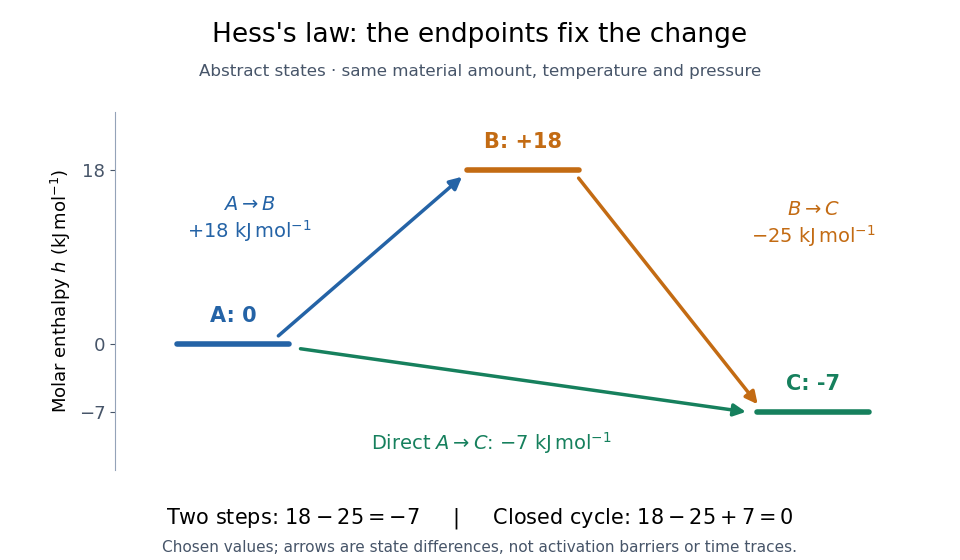
The short proof is cancellation:Adding any finite number of consecutive endpoint differences works the same way. For a closed enthalpy cycle the final cancels the initial . A nonzero experimental residual can therefore expose mismatched states or measurement error; it does not identify which individual input is responsible.
Enthalpy of activation 2026-10-14
The standard molar enthalpy difference between the transition state and the starting reactants, at the same temperature and pressure, in transition state theory.[ref]
Enthalpy of mixing 2026-10-20
The mixture enthalpy minus the sum of the unmixed component enthalpies at the same temperature and pressure. Its sign does not alone determine miscibility, which depends on the full Gibbs free energy.
Entropic elasticity 2026-10-25
Entropic elasticity is a restoring response arising from the reduction of accessible molecular configurations under deformation. For an ideal freely jointed chain, weak extension has free energy and spring constant . The proportionality to temperature assumes fixed segment geometry; temperature-dependent Kuhn length modifies it.
Entropic force 2026-10-18
An entropic force is the part of a generalized force arising from the dependence of entropy on a coordinate. At fixed temperature, the system's force is , where is the Helmholtz free energy. If the internal energy is independent of the coordinate, the force is entirely entropic. For an ideal chain whose configurations become less numerous on extension, it acts toward shorter extension. The external tension holding the chain extended has the opposite sign. Thus the force depends on the statistical number of available configurations, even when the energy of each configuration is unchanged.
Entropic spring 2026-10-20
For an ideal chain of independent statistical segments of length , the end-to-end probability density is proportional to . Its constrained Helmholtz free energy has extension-dependent part , so the restoring force is . This is an entropic spring because extension removes available chain configurations, and its stiffness grows with temperature. The Gaussian law applies at extensions small compared with the contour length ; near full extension, finite extensibility matters.
Entropy Created 2026-09-24 Updated 2026-10-20
Entropy is an extensive quantity and a state function of an equilibrium system, measured in . Differences between equilibrium states are calculated along a reversible thermodynamic process:Here heat entering the system is positive and is its absolute thermodynamic temperature. The reversible path used for calculation need not be the path actually taken. Dividing the actual heat by a single temperature generally fails for an irreversible process.
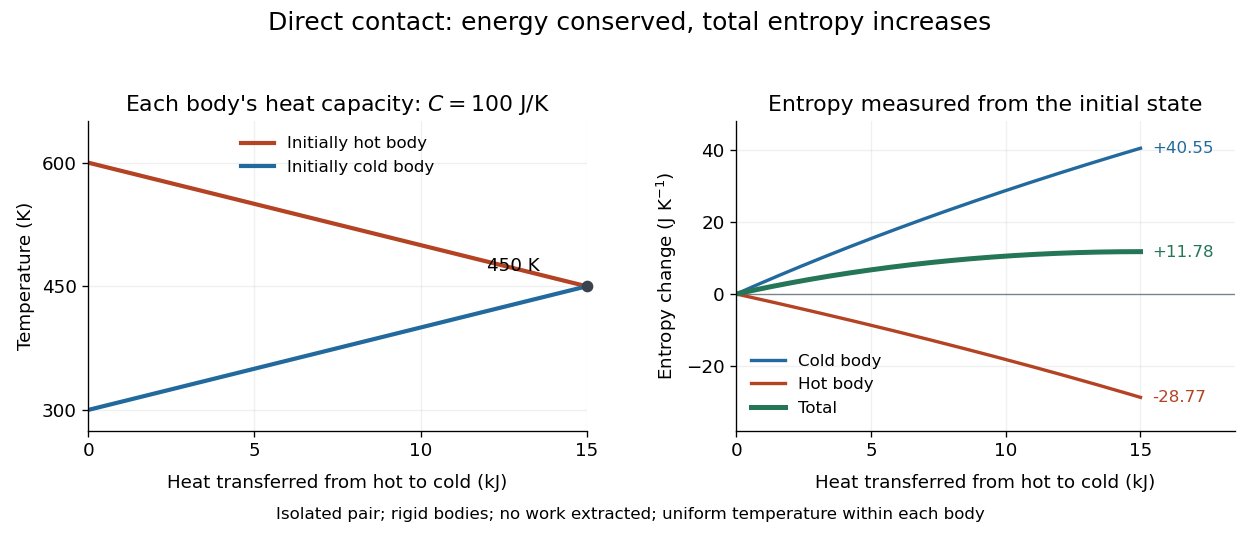
For example, put two rigid bodies, each with constant heat capacity , at and in an otherwise isolated system. Assume each body has a uniform internal temperature, no phase transition occurs, and no work is extracted. Their final thermal equilibrium is at , because the internal energy lost by one equals that gained by the other. Using entropy from heat capacity,so . One body's entropy decreases while the total increases. [ref]
https://web.mit.edu/16.unified/www/FALL/thermodynamics/notes/node41.html. MIT, Entropy changes and the hot-brick problem


In statistical mechanics, Boltzmann's entropy formula counts equally likely microstates compatible with a macrostate; Gibbs entropy handles a specified probability distribution over microstates. If the number of equally likely microstates doubles, entropy increases by . The logarithm makes multiplicative counts additive for independent systems. These are precise statements about states and probabilities, not a universal measure of visible messiness. Calling entropy merely "disorder" obscures the thermal calculation above and hides which microstates are being counted. [ref]
https://web.mit.edu/16.unified/www/FALL/thermodynamics/notes/node57.html. MIT, Statistical entropy and randomness
The usefulness of entropy is that measurable heat capacities determine its changes, and the Second law of thermodynamics turns those changes into constraints on processes. It also connects macroscopic measurements to microscopic descriptions without requiring us to track every particle.
Entropy balance of a thermostatted resistor 2026-10-20
A resistor at fixed temperature and unchanged thermodynamic state has no net entropy accumulation. Electrical work becomes heat at rate , which is exported to the thermostat. In the ideal work-source model the surroundings gain entropy at rate , equal to the total entropy production. Additional losses inside a real power source add to this idealized budget.
Entropy change in free expansion 2026-10-14
For the insulated gas-only free expansion of an ideal gas, the equilibrium endpoints are and with . Because entropy is a state function, calculate their difference along a hypothetical reversible thermodynamic process: an isothermal expansion using a frictionless piston and a thermal reservoir at . This comparison process receives heat and delivers work, even though the actual free expansion does neither. Its reversible heat increment is , soHere is the molar gas constant, and the logarithm acts on a dimensionless ratio. The reversible reference gives the correct endpoint entropy difference because entropy is a state function; putting the actual into would misuse a relation requiring reversible heat transfer. For the actual isolated gas, all this increase is entropy production. Thus an adiabatic process can increase entropy and need not be an isentropic process. [ref]
https://openstax.org/books/university-physics-volume-2/pages/4-6-entropy. OpenStax, section 4.6: reversible reference path for the entropy change of free expansion
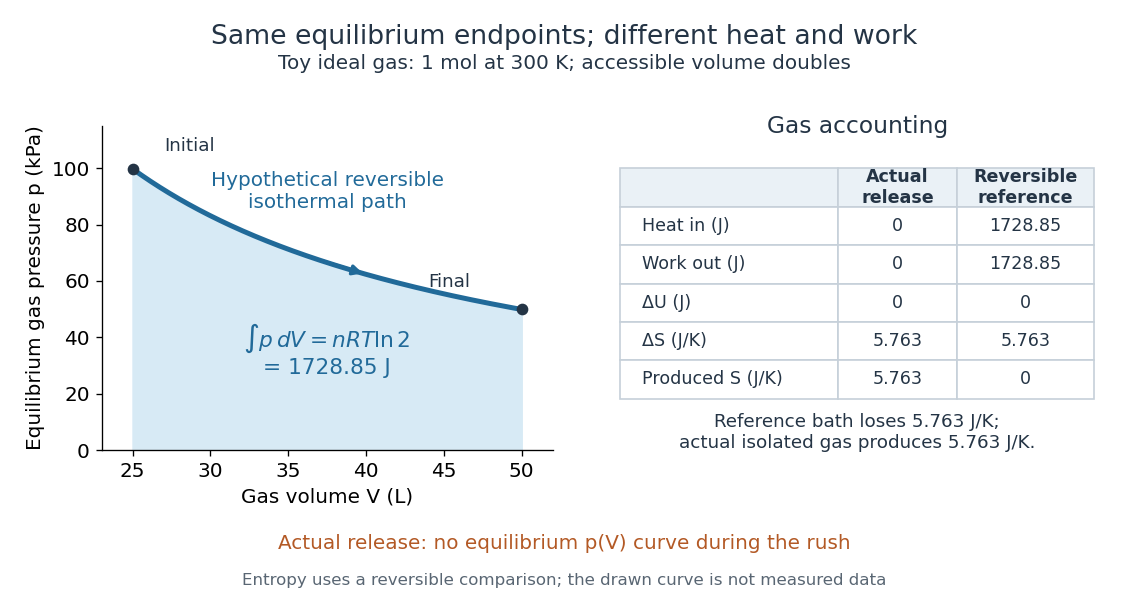

In the figure's volume doubling, the ideal gas law gives and , while . The reference process receives and delivers as heat and work; its thermal reservoir loses the same entropy that the gas gains. The actual free expansion has and produces that entropy internally. Reversibly compressing the gas back at would require of work input and rejection of equal heat. Restoring the gas alone therefore changes the surroundings: the actual release is irreversible.
For a real gas the final temperature may differ, so the ideal-gas logarithm formula cannot simply be copied. Evaluate using that gas's equilibrium properties or a suitable reversible comparison path. If the walls and water exchange heat with it, the Second law of thermodynamics constrains the total entropy of the isolated apparatus; the gas alone is then not an isolated system.
Entropy concavity and positive heat capacity 2026-09-29
For a thermodynamically stable system, the entropy is concave in energy, soConsequently : energy increases with temperature, and the corresponding heat capacity is positive.
Entropy degrees of freedom 2026-10-20
The effective count appearing in thermal entropy density . Conservation of comoving entropy implies is constant, so stable relic dilution includes when expressed using temperatures.
Entropy density Created 2026-09-24 Updated 2026-10-14
For a homogeneous equilibrium system with energy density , pressure , chemical potential , and number density , the entropy density is
Entropy density of a photon gas Created 2026-10-14 Updated 2026-10-20
The entropy density of a photon gas is its entropy per physical volume, . For homogeneous equilibrium vacuum radiation with two states of electromagnetic polarization and zero photon chemical potential,The first equality is the entropy density at zero chemical potential, obtained from the thermodynamic Euler relation with internal energy . The second uses the photon gas equation of state, and . If an independently constrained photon number gives a nonzero chemical potential, the general entropy density is and need not hold. This distinction explains why the absence of a conserved number matters for entropy as well as for the spectral shape. [ref]
https://davidtong.org/teaching/statistical-physics/statmechhtml/S4#S4.SS4. David Tong, Statistical Physics, §4.4: Gibbs free energy and the thermodynamic Euler relation
A short first law of thermodynamics check, for neighboring equilibrium states with , isThe thermodynamic Euler relation fixes the additive normalization. Equivalently, this radiation entropy tends to zero with temperature at fixed volume; no contribution from the containing walls is included. Interpreting as transferred heat and as boundary work requires a reversible thermodynamic process. For a reversible thermodynamic process that is also an adiabatic process, there is no entropy production or entropy exchange, soAn irreversible adiabatic process can produce entropy even without heat exchange, so the word adiabatic alone is insufficient to infer .
For an analytic example, expand an initially equilibrated photon gas reversibly from to , keeping only the same two photon states of electromagnetic polarization. Its temperature halves, its energy density becomes , its entropy density of a photon gas becomes , and its total entropy stays . The internal energy halves rather than remaining fixed: the missing half leaves as work against radiation pressure,This is a stipulated reversible radiation model, not a report of a piston experiment. Maintaining a real cavity along this path requires controlling wall heat exchange and including the wall heat capacity in any actual apparatus balance.
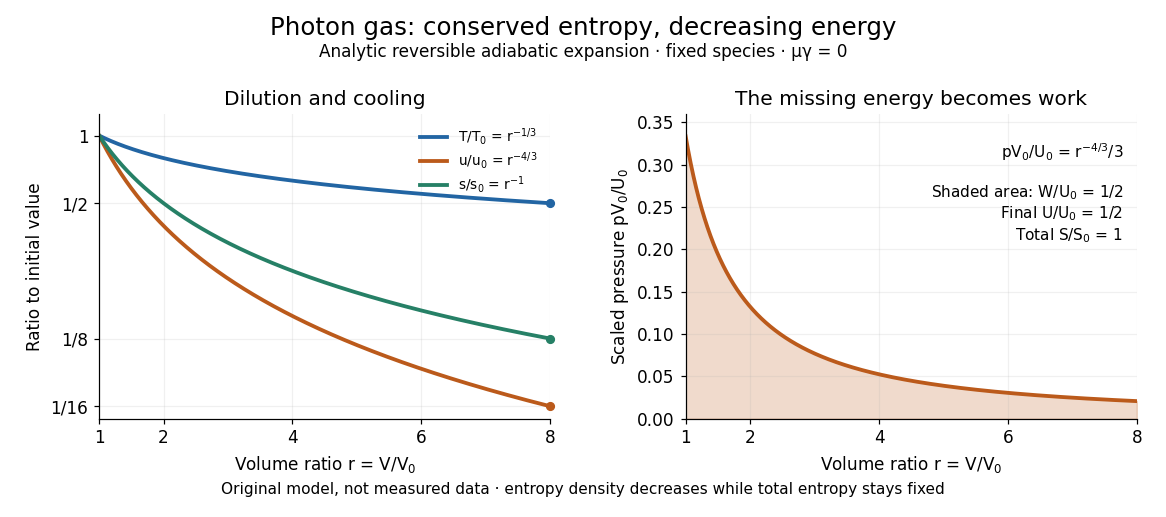

For a computed scale at stipulated , . Combining this with the photon number density givesThis is the total equilibrium radiation entropy divided by its mean photon number, not a separately assigned entropy carried by each labeled particle. During the ideal expansion, and is fixed, so the mean number also stays constant. This follows from the path; it was not imposed as the independent number constraint used to establish chemical potential.
The beautiful connection is that expansion lowers each typical photon energy and dilutes the radiation in just the proportions needed to retain its equilibrium spectral shape and total entropy. For the cosmic microwave background, homogeneous expansion of the universe has physical volume proportional to the cube of the scale factor; fixed-species cosmological entropy conservation therefore gives . This describes preservation of an already established Planck photon distribution and connects the FIRAS spectral observation in photon gas to an entropy prediction; FIRAS did not perform a direct entropy measurement. When other equilibrated species disappear and transfer energy into radiation, use the effective number of relativistic entropy degrees of freedom, : the conserved quantity for the combined sector is , under the corresponding equilibrium and no-entropy production assumptions. A changing species population, separate decoupled sectors or entropy production requires an appropriate entropy balance rather than the pure photon gas formula. [ref]
https://davidtong.org/teaching/cosmology/cosmohtml/S2#S2.SS5.SSS2. David Tong, Cosmology, §2.5.2: entropy conservation and heating when relativistic species disappear
Entropy excess of a van der Waals gas 2026-10-18
For one mole with temperature-independent parameters , the equation of state is . A Maxwell relation gives , so the volume dependence is . Matching the ideal gas entropy at infinite volume fixes the excess at the same to . The attraction contributes to the Helmholtz free energy but no excess entropy when is independent of temperature. A temperature-dependent attraction parameter would change this conclusion.
Entropy from heat capacity Created 2026-09-29 Updated 2026-10-14
Along a reversible path at fixed volume, . Hence entropy differences can be measured macroscopically fromwith an additional across a first-order transition of latent heat at .
A body of mass , heat capacity , temperature and speed that stops in a large reservoir at produces entropy , assuming constant heat capacity and no phase changes. The first term follows by adding the body's logarithmic entropy change to the reservoir's heat gain; the second is kinetic-energy dissipation. A numerical answer needs the reservoir temperature.