Topics (384k) Articles (398k) Users (410) Discussions (242) Comments (383) Files (13k) New article
For an independent binomial distribution count , the aggregate can also be represented as , with independent parameter- Bernoulli random variables and independent claim sizes. Its cumulant-generating function is . Its third cumulant is in severity moments. Constant positive claims give , which is negative when . Thus positive claim sizes do not by themselves force a positive third central moment.
A compound mixed Poisson distribution is a random sum of independent claims whose count has a Poisson mixture law: conditional on a nonnegative random intensity , has Poisson distribution with parameter . The claim sizes are independent and identically distributed random variables, independent of the intensity and count mechanism. If is their moment-generating function, then wherever finite. A gamma distribution intensity of shape and rate gives a negative binomial distribution count with shape and success probability . Independent intensities with common gamma rate add their shapes by additivity of independent gamma distributions with a common rate.
Transform composition for an independent random sum by  Codex 0 Created 2026-10-14 Updated 2026-10-31
For independent identically distributed summands, independent also of the count , conditioning on gives . The law of total expectation gives the composition of the count's probability generating function with the summand's moment-generating function. This identity is valid as an extended nonnegative expectation; finiteness near zero requires additional exponential-integrability assumptions.
For , a disconnected graph has a component of size . The probability that a fixed -set has no crossing edge is at most . The union bound and bound the failure probability by . Split this sum at . The random k-out graph coupling extends the result to every fixed .
Every open set in the ordinary topology on infinite subsets is a Ramsey set of infinite subsets: some infinite has or . Use acceptance and rejection of finite stems and fusion to decide every finite stem. If the empty stem is rejected, each rejected stem has only finitely many accepting one-point extensions. Successive avoidance of these finite obstructions gives an infinite set all of whose finite stems are rejected; openness then excludes every infinite subset from . This concerns increasing enumerations of infinite subsets, rather than unrestricted sequences with repetitions.
Suppose in a number field and lies above . Its normalized integral valuation satisfies . If and are coprime, then . In a degree- field the fundamental identity for prime decomposition forces a unique prime, ramification index , and residue degree one. This detects total ramification of a prime even when the displayed defining polynomial is not Eisenstein at .
// Target: algebra.bigb
For an odd prime , this Eisenstein polynomial generates a totally ramified cubic root field. Its discriminant is . For the unit part is a square exactly when . The splitting field then has cyclic Galois group of order three; otherwise it has symmetric group , with an unramified extension of degree two and inertia group . Both cases are tamely ramified, so all positive ramification groups are trivial.
At , adjoining gives a ramified quadratic subfield, and the splitting field has total ramification index six. A root has normalized valuation two, while has valuation three, so is a uniformizer. The derivative has valuation six, and all distinct root differences have valuation three. A three-cycle fixes , giving . A transposition fixing negates , giving valuation one; conjugation handles the other transpositions. Hence , , and for . The different exponent is seven.
Positive ramification quotients are elementary abelian by Codex 0 Created 2026-10-14 Updated 2026-11-05
Codex 0 Created 2026-10-14 Updated 2026-11-05For , the residue of gives a homomorphism to the additive residue field with kernel . On composing two automorphisms, their leading displacement coefficients add because each fixes residues and changes the uniformizer only in degree at least two. These successive quotients are elementary abelian groups in residue characteristic . The filtration terminates, so the wild inertia group is a finite -group.
The Gamma reflection formula gives , analytic at zero with value one. A finite-parameter Watson's lemma representation of Ramanujan's function therefore gives the displayed coefficients. In particular , and , with Euler's constant. Obtaining this representation requires taking an imaginary part before sending its Mellin exponent to zero; the original complex integral is divergent at that boundary.
A stellar core in which radiative diffusion in a star carries most of the energy, rather than convection. Its formation in a pre-main-sequence star breaks the fully convective assumption behind an idealized Hayashi track.
For a steady point-like astronomical source with isotropy of emission, in transparent space with negligible relativistic or cosmological effects, conservation of energy spreads its luminosity over a sphere of surface area . Its bolometric observed radiative flux isThis inverse-square law reflects geometric dilution: the same emitted power crosses increasingly large spheres. It does not require light to lose energy on the journey. For a fixed luminosity, doubling Euclidean distance quarters the observed radiative flux. [ref].
With and parsecs, the result is . At parsecs, the same source gives . An ideal collecting area of at parsecs intercepts approximately , before detector losses.
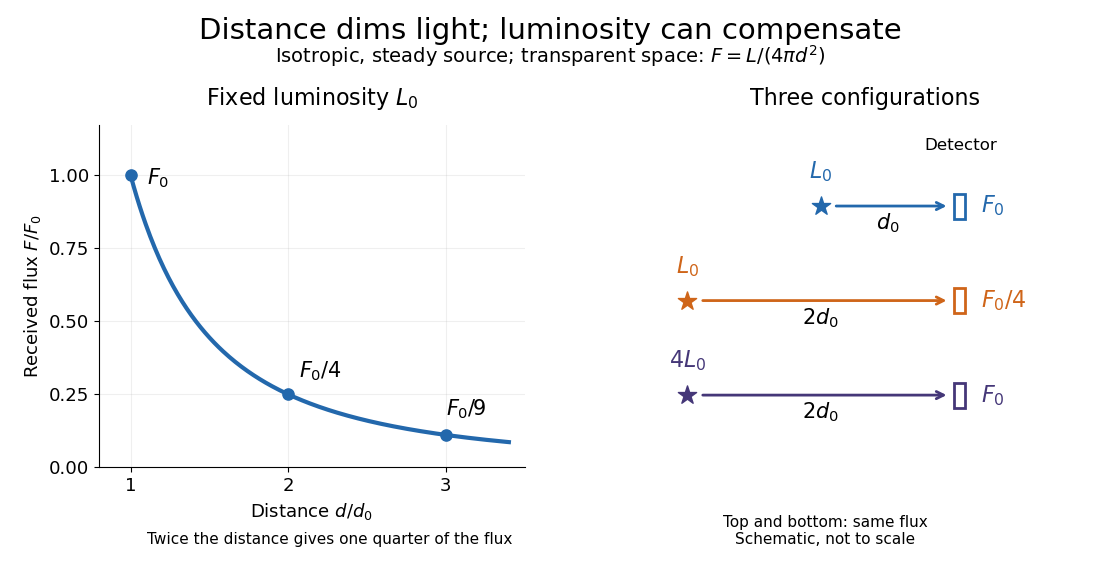
Fixed luminosity gives inverse-square dimming; different luminosities can give equal observed flux; configuration diagram schematic, not to scale
. Details. Multipole radiation expands radiation from localized time-dependent sources into electric and magnetic multipoles. Electric dipole radiation is the leading electric term, while magnetic dipole radiation and higher electric multipoles contribute when the leading term vanishes or higher precision is needed.
A 2013 experiment by Paul A. Williams and collaborators mounted a 25-mm dielectric mirror on a commercial force-restoration balance. Removing its pan-weight compensation spring allowed horizontal force sensing with a horizontal laser path. They measured mirror optical reflectance and varied incidence from about to . A 1071-nm laser, capable of 530 W, was switched at 0.1 Hz. Digitized mass-equivalent readings were converted to force using ; quadrature demodulation isolated the switched signal from drift. [ref]
Measurement calibration used a 20-g mass, with checks down to 1 mg. The optical forces lay below that checked range, limiting the accuracy claim. An angle scan tested the predicted cosine dependence at fixed intercepted power. Replacing the mirror with a carbon nanotube coated absorber increased absorbed power while reducing the predicted optical force; no modulation peak was detected. This bounded gas-heating artifacts under those conditions, rather than proving their universal absence. The fitted slope was about 7% below . Inferring laser power requires calibrated force, optical reflectance, radiometric absorptance and angle of incidence, with measurement uncertainty for each. [ref]
For radiation in vacuum with isotropy, energy is distributed equally per solid angle: write for energy density per unit solid angle. Let be the angle between a ray's path and the wall normal. Its normal velocity determines the arrival rate, while normal momentum per energy is . Their product is . For a perfectly reflecting cavity wall,The leading two is the normal momentum reversal; the incoming hemisphere contains half of the field's directional energy density. This is also the normal component of the bulk pressure tensor, . Isotropy makes all three diagonal components equal, while their sum is because the squared direction components sum to one. The factor one third therefore depends on three-dimensional angular geometry, not on the shape of the blackbody radiation spectrum.
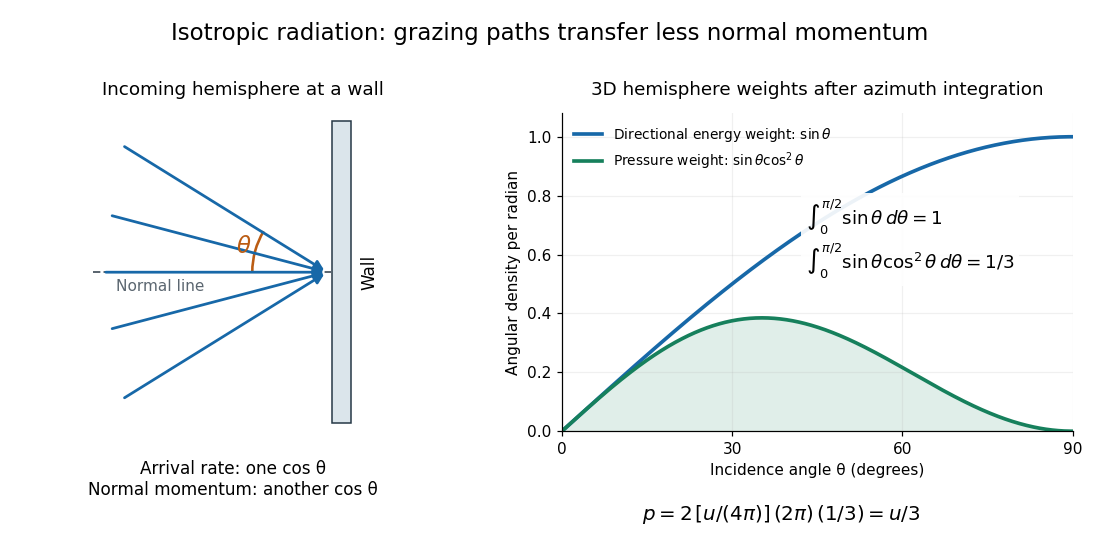
A perfectly absorbing wall exposed to this incoming hemisphere receives only from absorption. If it is in thermal equilibrium with the isotropic radiation, its outgoing emission supplies another of recoil, recovering . A cold absorber before equilibrium is a different boundary condition. Similarly, the one-way incident energy flux is , whereas the net energy flux across a plane in the undisturbed isotropic field is zero. Dividing by misses the extra normal-momentum projection and does not give the cavity pressure.
For a stipulated isotropic radiation energy density , the bulk pressure is regardless of its spectral shape. In thermal equilibrium, blackbody radiation supplies with radiation constant , so ; Stefan–Boltzmann law defines . The equilibrium photon gas derives this same equation of state from its free energy.[ref]
For normal incidence in vacuum, a uniform beam delivers energy to an illuminated surface area during time . A perfect absorber receives momentum , so force divided by surface area gives . A perfect stationary mirror sends the photons back with reversed momentum, so momentum conservation gives twice the normal transfer, . These are time-averaged pressures; the microscopic arrivals need not be uniform.
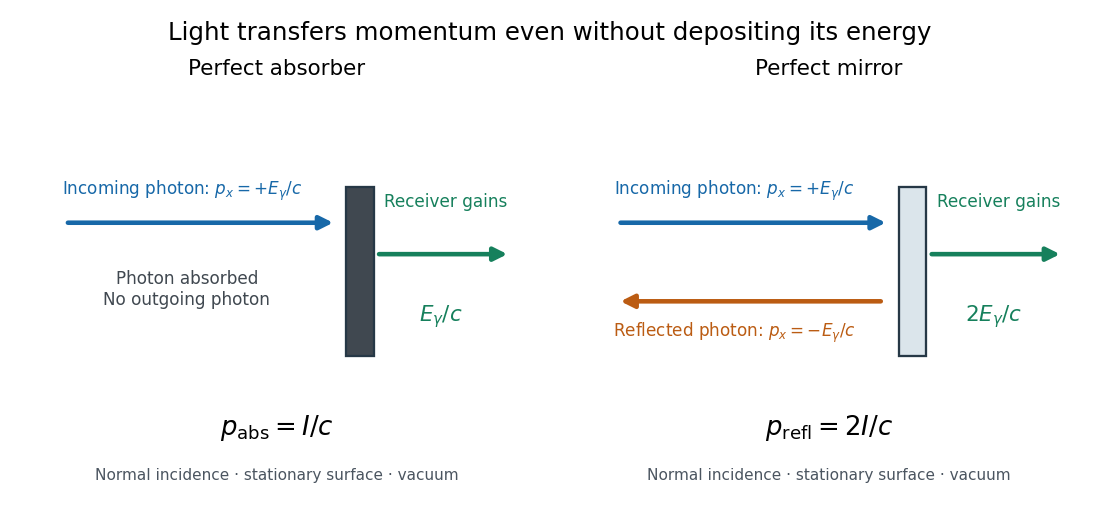
For a stipulated model light intensity and the exact SI speed of light ,These are computed predictions, not measured data or a universal sunlight value. If the beam fully covers a normally oriented surface area , the intercepted radiant flux is and the absorber's force is . Using the total source power would be wrong if only part of its beam reaches the receiver. The absorption prediction assumes complete photon absorption, while the reflection prediction assumes complete specular reflection; transmission, scattering of light and directed thermal photon emission require their own outgoing momentum accounting.
Measure the angle of incidence between the incoming path and the surface's normal line, with . There are two separate cosine factors. A fixed actual surface area intercepts only its projected area , so . Each incoming photon supplies normal momentum on absorption, or twice that on specular reflection. Thus, for radiometric absorptance and reflected power fraction ,This model assumes transmitted light continues straight in the same medium and carries away its original momentum. It omits thermal recoil and assumes a stationary receiver. At , fixed beam light intensity therefore gives one quarter of the normal-incidence pressure. For fixed intercepted radiant flux , however, the normal force has only one cosine factor. Equivalently, if the given quantity is receiving-surface irradiance , then . The distinction matters when interpreting an experiment's angle scan. [ref]
Use of radiation pressure for measurement of high-power laser emission by Paul A. Williams and others. Williams and collaborators, Use of radiation pressure for measurement of high-power laser emission, equation (1): force expressed using intercepted optical power and the incidence-angle cosine
Simultaneous trilinear baryon number and lepton number violation permits a squark to connect the two interactions and induce a dimension-six proton-decay operator. Its coefficient is of order . A dimensional decay-width estimate then gives , up to phase space and hadronic matrix elements. The flavor antisymmetry of matters: the two down-type flavor indices must differ. For example, and allow strange-squark exchange in .
For fixed , the parallel affine lines are precisely the cosets of the indicated quotient vector space. Changing representatives adds a multiple of , so and are well-defined. The zero is the whole line , not a single point. If is a basis, the two line classes form a basis of the quotient by spanning and independence modulo .
A flat universe dominated by a canonical homogeneous scalar field with constant equation-of-state parameter has and . The positive rolling branch gives the displayed relation and . The opposite rolling branch reverses the exponential slope. For the field is constant; cannot be realized by a real scalar with this positive kinetic term. An exponential slope yields , with accelerating nonphantom expansion when .
Pinned article: Introduction to the OurBigBook Project
Welcome to the OurBigBook Project! Our goal is to create the perfect publishing platform for STEM subjects, and get university-level students to write the best free STEM tutorials ever.
Everyone is welcome to create an account and play with the site: ourbigbook.com/go/register. We belive that students themselves can write amazing tutorials, but teachers are welcome too. You can write about anything you want, it doesn't have to be STEM or even educational. Silly test content is very welcome and you won't be penalized in any way. Just keep it legal!
Intro to OurBigBook
. Source. We have two killer features:
- topics: topics group articles by different users with the same title, e.g. here is the topic for the "Fundamental Theorem of Calculus" ourbigbook.com/go/topic/fundamental-theorem-of-calculusArticles of different users are sorted by upvote within each article page. This feature is a bit like:
- a Wikipedia where each user can have their own version of each article
- a Q&A website like Stack Overflow, where multiple people can give their views on a given topic, and the best ones are sorted by upvote. Except you don't need to wait for someone to ask first, and any topic goes, no matter how narrow or broad
This feature makes it possible for readers to find better explanations of any topic created by other writers. And it allows writers to create an explanation in a place that readers might actually find it.
Figure 1. Screenshot of the "Derivative" topic page. View it live at: ourbigbook.com/go/topic/derivativeVideo 2. OurBigBook Web topics demo. Source. - local editing: you can store all your personal knowledge base content locally in a plaintext markup format that can be edited locally and published either:This way you can be sure that even if OurBigBook.com were to go down one day (which we have no plans to do as it is quite cheap to host!), your content will still be perfectly readable as a static site.
- to OurBigBook.com to get awesome multi-user features like topics and likes
- as HTML files to a static website, which you can host yourself for free on many external providers like GitHub Pages, and remain in full control

Figure 2. You can publish local OurBigBook lightweight markup files to either OurBigBook.com or as a static website.
Figure 3. Visual Studio Code extension installation.
Figure 5. . You can also edit articles on the Web editor without installing anything locally. Video 3. Edit locally and publish demo. Source. This shows editing OurBigBook Markup and publishing it using the Visual Studio Code extension. 
- Infinitely deep tables of contents:




All our software is open source and hosted at: github.com/ourbigbook/ourbigbook
Further documentation can be found at: docs.ourbigbook.com
Feel free to reach our to us for any help or suggestions: docs.ourbigbook.com/#contact